wayground logo

Free Printable Worksheets

Font size

S
M
L
XL
Worksheets

Unit 1 Review

Total questions: 40

Worksheet time: 30mins

Name
Class
Date
1.
What kind of properties can only be observed when a substance changes into a different substance?
a)
physical properties
b)
chemical properties
c)
liquid properties
d)
real properties
2.
Which of the following is a chemical property of water?
a)
Reacts with pure sodium.
b)
Boils at 100 oC.
c)
Dissolves sugar easily. 
d)
Has a density of 1 gm/mL
3.
Which of the following matches the correct definition to an example?
a)
Chemical Change: My foot changes color
b)
Physical Change: My microwave exploded
c)
Chemical Change: My dog ate my homework
d)
Physical Change: My homework burned in a fire
4.
Define a Physical Property
a)

A property of matter that describes a substance

b)
A property in which stops a chemical reaction from occuring.
c)
A property or behavior of a substance which undergoes a chemical change or reaction.
d)
A property which makes the object smell or taste different.
5.
Define a Chemical Property
a)
A property of matter not involving in its manifestation a chemical change
b)
A property in which stops a chemical reaction from occuring.
c)
A property or behavior of a substance which undergoes a chemical change or reaction.
d)
A property which makes the object smell or taste different.
6.
Is ripping paper a chemical or physical change?
a)
Chemical
b)
Physical
c)
neither
d)
both
7.
Is cooking an egg a 
a)
chemical change
b)
physical change
c)
neither
d)
both
8.
Is a car getting rusty a 
a)
Chemical Change
b)
Physical Physical
c)
Both
d)
Neither
9.

When gases condense and liquids freeze it is a

a)

physical property

b)

chemical property

c)

physical change

d)

chemical change

10.
Which of the following is NOT an example of a physical change?
a)
crumpled paper
b)
pencil sharpening
c)
shrunken clothing
d)
sour milk
11.
Green bananas turning yellow on their own as they ripen.
a)
Chemical Change
b)
Physical Change
c)
both
d)
neither
12.
Unexpected changing of color is a sign of a _________ change.
a)
Physical
b)
Chemical
c)
both
d)
neither
13.
Two liquids are mixed, as a result, a solid is formed. This is evidence of..
a)
New substances being formed
b)
physical change
c)
chemical property
d)
physical property
14.
Which of the following is an example of a physical change?
a)
Water freezing into ice
b)
A piece of wood burning
c)
A toy car rusting
d)
Zinc producing hydrogen gas when mixed with water
15.
What does it mean when there is a physical change? 
a)
Matter has changed from one substance into another
b)
Matter has changed on the molecular level
c)
A new substance has been formed
d)
Matter has changed size, shape or form
16.
If an atom has an extra neutron, it is a(n)
a)
Positive ion
b)
Negative ion
c)
Isotope
d)
Neutral Atom
17.
Can an atom of Hydrogen have 2 protons?
a)
Yes, because it can be an ion
b)
No, because protons identify the atom
c)
Yes, because it can be an isotope
d)
No, because only neutral atoms exist
18.
Can an atom of Helium have 3 electrons?
a)
Yes, because it can be an ion
b)
No, because protons identify the atom
c)
Yes, because it can be an isotope
d)
No, because only neutral atoms exist
19.
If an atom has more protons than electrons, it is a(n)
a)
Positive ion
b)
Negative ion
c)
Isotope
d)
Neutral atom
20.
If an atom has more electrons than protons, it is a(n)
a)
Positive ion
b)
Negative ion
c)
Isotope
d)
Neutral atom
21.
If an atom has an equal number of protons and electrons it is a...
a)
Positive ion
b)
Negative ion
c)
Isotope
d)
Neutral atom
22.
Which answer choice describes the subatomic particles and their respective charges?
a)
p-    e+    n
b)
p+    e     n-
c)
p+    e-    n
d)
p-     e+    n
23.

The vertical (up and down) columns in the Periodic Table are called

a)

groups

b)

towers

c)

periods

d)

atomic numbers

24.

Which is a halogen?

a)

Helium

b)

Chlorine

c)

Oxygen

d)

Neptune

25.

Which of the following are not physical properties of metal?

a)

Combustibility

b)

Conductivity

c)

Malleability

d)

Ductility

26.

Which of the following could be properties of nonmetals?

a)

Poor electrical conductivity

b)

Poor thermal conductivity

c)

Dullness

d)

Brittleness

27.

I am a nonmetal

I am in period 2

I am in group 16/6A

a)

Ba

b)

Si

c)

O

d)

S

28.

I am a metal

I am in group 2

I am in period 6

I am…

a)

Mo

b)

Re

c)

S

d)

Ba

29.

What has both metal and nonmetal properties?

a)

Electrons

b)

Metalloids

c)

Protons

d)

Metals

30.

If an atom has an atomic mass of 27 and an atomic number of 13, how many neutrons does it have?

a)

13

b)

15

c)

14

d)

12

31.

The majority of elements on the periodic table are

a)

Nonmetals

b)

Metalloids

c)

Metals

32.

what is the big group of metals called found within the metals

a)

transition metals

b)

nonmetals

c)

noble gases

d)

halogens

33.
What is an isotope? 
a)
A charged atom
b)
An atom with different amounts of neutrons
c)
An atom with different amounts of protons
d)
A neutral atom
34.
How many neutrons does a Sodium 24 isotope have?
a)
12
b)
13
c)
14
d)
15
35.

If a proton is added or removed from an atom, what happens?

a)

It becomes a different element.

b)

It becomes a different isotope.

c)

Nothing happens.

36.

What is the difference between Neon-20 and Neon-22?

a)

They have different numbers of electrons.

b)

They have different numbers of neutrons.

c)

Only 1 is radioactive.

d)

No difference.

37.

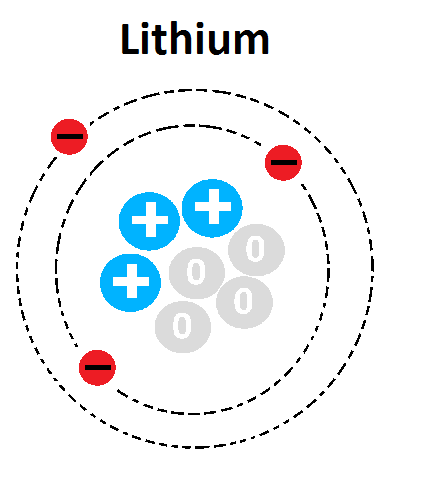
What is the mass number of this atom?

a)

1

b)

3

c)

4

d)

7

38.
A neutral atom of the isotope 2612Mg would consist of
a)
12 protons, 26 neutrons, 26 electrons
b)
26 protons, 12 neutrons, 26 electrons
c)
26 protons, 14 neutrons, 14 electrons
d)
12 protons, 14 neutrons, 12 electrons
39.
A carbon isotope consists of 6 protons, 6 electrons and 8 neutrons.  What is the mass number for this isotope?
a)
12
b)
14
c)
6
d)
8
40.
What do carbon-12 and carbon-14 have in common?
a)
they have same number of protons
b)
they have the same number of neutrons
c)
they have the same atomic mass
d)
they have the same atomic weight