
 Worksheets
6th Grade SS Review for Midterm 2020
Total questions: 104
Worksheet time: 3hrs 57mins
Name
Class
Date
1.

What is this landform?
a)
lake
b)
peninsula
c)
hills
d)
mountain
2.

What is this landform?
a)
valley
b)
hills
c)
river
d)
lake
3.
The Declaration of Independence
a)
Secondary Source
b)
Primary Source
4.
A dictionary, an almanac, and an encyclopedia are all examples of
a)
Primary Sources
b)
Secondary Sources
5.
Diaries are examples of a
a)
Primary Source
b)
Secondary Source
6.
A biography about Abraham Lincoln
a)
Primary Source
b)
Secondary Source
7.
What river goes with Egypt?
a)
Nile
b)
Euphrates
c)
Egypt
d)
Indus
8.
What was the first river valley to appear?
a)
China
b)
Egypt
c)
Indus
d)
Mesopotamia
9.
Land that is completely surrounded by water.
a)
Island
b)
Plain
c)
River
d)
Valley
10.
Land that is surrounded by water on three sides.
a)
Peninsula
b)
Ocean
c)
Mountain
d)
Valley
11.
What was the writing system used in Mesopotamia?
a)
Hieroglyphics
b)
Sanskrit
c)
Alphabet
d)
Cuneiform
12.
Which direction does the Nile flow?
a)
South
b)
east
c)
North
d)
west
13.
Which of the following came first?
a)
989 BCE
b)
746 CE
c)
873 BCE
d)
1903 CE
14.
Who was found at the top of all social classes in ancient Egypt?
a)
nobles and priests
b)
farmers
c)
artisans
d)
pharaoh
15.
What was the purpose of irrigation?
a)
keep crops dry
b)
to provide water to crops
c)
provide indoor plumbing
d)
give people drinking water
16.
Who was on top of the Mesopotamian social hierarchy?
a)
Priests
b)
Slaves
c)
Kings
d)
Crafters
17.
What is the acronym to remember the Five Themes of Geography?
a)
MAD
b)
MRHELP
c)
PIG
d)
COW
18.

beliefs, customs, practices, & behavior of a group of people
a)
technology
b)
culture
c)
domesticate
d)
migration
19.

movement of people from one place to another
a)
domesticate
b)
Neolithic
c)
migration
d)
surplus
20.

person who moves from place to place without a permanent home
a)
culture
b)
nomad
c)
settler
d)
irrigate
21.

extra; more than is needed
a)
Neolithic
b)
surplus
c)
technology
d)
animism
22.
About 10,000 years ago, human civilization changed in a major way. What was this change?
a)
Humans began to make tools.
b)
Humans began to use spoken language.
c)
Humans increasingly became literate.
d)
Humans began to farm & domesticate animals.
23.
How did the start of farming change early human tribes?
a)
It forced them to stay in one place and build villages and cities.
b)
It caused them to continue to hunt animals and gather plants.
c)
It ended fighting between the tribes for land.
d)
It stopped them from building temples for their gods.
24.
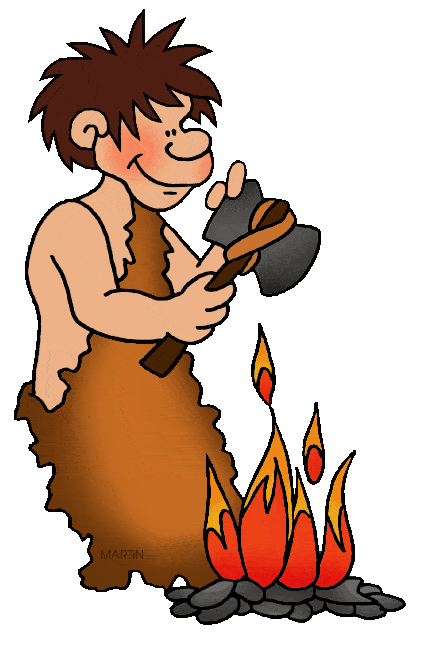
Which statement best describes hunters and gatherers?
a)
They were experts at using their environment to meet their basis needs.
b)
The tools they made from metal helped them to survive.
c)
They domesticated animals to help with daily activities.
d)
They developed ways to bring water to their crops.
25.
What is the greatest change between the Paleolithic and Neolithic cultures?
a)
the shelters people used
b)
the way people got food for themselves
c)
the tools people used
d)
the clothes people wore
26.
Which statement best describes the Neolithic people?
a)
They lived in caves or built simple shelters.
b)
They migrated from place to place to hunt animals for food.
c)
They could settle in one place because they had a reliable food supply.
d)
They used simple tools made from stone.
27.

Which of the following describes how the earliest humans (paleolithic) lived?
a)
by hunting and gathering food
b)
by herding sheep and other live stock
c)
alone or in pairs
d)
in farming villages along streams and rivers
28.
Which field of social studies looks at past events?
a)
Geography
b)
History
c)
Economics
d)
Political Science
29.
The equator divides what two hemispheres?
a)
East and West
b)
North and South
30.
The United States of America is in which two hemispheres?
a)
North and West
b)
South and East
c)
North and South
d)
East and South
31.
An imaginary line that divides the northern and southern hemispheres is the.....
a)
Prime Meridian
b)
longitude
c)
equator
d)
latitude
32.
On which two hemispheres are Mesopotamia and Egypt located on?
a)
Northern and Eastern
b)
Eastern and Southern
c)
Western and Southern
d)
Northern and Western
33.
Cuneiform symbols were made with wedge shaped marks on clay tablets
a)
True
b)
False
34.
The Code of Laws' punishment was too easy on people.
a)
True
b)
False
35.
What were the effects of the Neolithic Revolution?
a)
Surplus Food Supply
b)
Specialization of Jobs
c)
Permanent Settlements
d)
All of the above
36.

Name the civilization:
- Tigris and Euphrates
- Cuneiform
- City-States
- Tigris and Euphrates
- Cuneiform
- City-States
a)
Egypt
b)
Mesopotamia/
Sumer
Sumer
c)
India
d)
China
37.
Cuneiform was?
a)
A special agreement
b)
writing system
c)
a temple
38.
What is a Scribe?
a)
they were priests
b)
they were teachers
c)
they were writers
39.

Given that the Nile generally flows in a northward direction, which statement is MOST accurate?
a)
It flows into the Red Sea.
b)
It flows into Lake Victoria.
c)
It flows into the Suez Canal.
d)
It flows into the Mediterranean Sea.
40.
the next life, in which the dead are believed to live again
a)
mummy
b)
afterlife
c)
dynasty
41.
a dead body preserved in lifelike condition
a)
afterlife
b)
artisan
c)
mummy
42.
What material did the Ancient Egyptians write on?
a)
Paper
b)
Clay tablets
c)
Planbooks
d)
Papyrus
43.
embalm
a)
preserve a dead body
b)
a supernatural being worshipped as controlling the world
c)
a sequence of powerful leaders in the same family
d)
a body that is embalmed, dried, and wrapped for burial
44.
Belief in one god.
a)
theocracy
b)
monotheism
c)
regent
d)
delta
45.

Egypt was near the river
a)
Euprates
b)
Nile
c)
Mississippi
d)
Tigris
46.

Identify #2.
a)
Persian Gulf
b)
Black Sea
c)
Red Sea
d)
Caspian Sea
47.

#6?
a)
Mediterranean Sea
b)
Tigris River
c)
Euphrates River
d)
Taurus Mountains
48.

#7?
a)
Euphrates River
b)
Tigris River
c)
Mediterranean Sea
d)
Persian Gulf
49.

#9?
a)
Black Sea
b)
Mediterranean Sea
c)
Caspian Sea
d)
Persian Gulf
50.
Why did the ancient Egyptians place the favorite belongings of the pharaoh in his tomb?
a)
So no other human would ever use them
b)
To keep thieves from stealing them
c)
To prevent his servants from stealing them
d)
So they could be used by the pharaoh in the next life
51.
The goal of mummification was to
a)
Make sure the body decayed
b)
Preserve the body and achieve immortality
c)
Become one with the universe
d)
None of the above
52.
How many days did it take to mummify a body in ancient Egypt?
a)
5
b)
10
c)
50
d)
70
53.
What was the special salt used to dry the body during mummification
a)
Sea
b)
Morton
c)
Natron
d)
Iodized
54.
This book has over 200 spells that help the deceased to reach the afterlife is known as the
a)
Book of Resurrection
b)
Book of the Dead
c)
Book of Amon Re
d)
Mummification for Dummies
55.
The only organ left in the body was the ______ it was believed to be the center of intelligence
a)
Brain
b)
Heart
c)
Liver
d)
Stomach
56.
This organ was considered useless so it was removed and thrown away
a)
Brain
b)
Heart
c)
Liver
d)
Stomach
57.
BC
a)
Before Christ
b)
Before Christmas
c)
Before church
d)
Before bed
58.
CE
a)
Common Era
b)
Christmas Eve
c)
Cheers Everyone!
59.
ancient Egyptian picture writing,using symbols for syllables
a)
hieroglyphs
b)
braille
c)
sign language
60.
Civilization in Mesopotamia developed between which two rivers?
a)
the Persian Gulf and the Mediterranean
b)
the Tigris and the Persian Gulf
c)
the Persian Gulf and the Euphrates
d)
the Euphrates and the Tigris
61.
There are ___ continents and ___ major oceans.
a)
5; 7
b)
7; 5
c)
4; 5
d)
5; 4
62.
Which type of map uses a variety of colors?
a)
political
b)
physical
63.
Which type of map that usually includes brown or green for land, and blue for water?
a)
political
b)
physical
c)
blank
64.
north, south, east, west
a)
cardinal directions
b)
map
c)
global positioning system
d)
atlas
65.
imaginary line that circles the middle of the earth
a)
equator
b)
latitude
c)
longitude
d)
map belt
66.

Which continent is circled?
a)
South America
b)
North America
c)
Australia
d)
Europe
67.

Which continent is circled?
a)
Africa
b)
Asia
c)
Australia
d)
AshyAshe
68.

Which continent is circled?
a)
Australia
b)
Russia
c)
South America
d)
Asia
69.

Which ocean is #1?
a)
Atlantic
b)
Pacific
c)
Indian
d)
Arctic
70.

Which ocean is #2?
a)
Southern
b)
Atlantic
c)
Indian
d)
Pacific
71.

Which ocean is #3 ?
a)
Mediterranean
b)
Pacific
c)
Southern
d)
Indian
72.

Which ocean is #4?
a)
Indian
b)
Southern
c)
Atlantic
d)
Mississippi
73.
Type of map that shows names of boundaries of countries and locations
a)
political
b)
physical
c)
topographic
74.
How did the rivers impact the villages surrounding Mesopotamia?
a)
the rivers were polluted with chemicals
b)
the rivers fertilized the rich soil necessary for farming
c)
the rivers overflowed and killed many people
d)
the rivers dried up every month
75.

Which letter on the map indicates the location of Mesopotamia?
a)
A
b)
B
c)
C
d)
D
76.
Mesopotamia is called this because the earliest people and cultures were located here
a)
River Rats
b)
city states
c)
Cradle of Civiliztion
77.

What is Hammurabi main quote?
a)
A tooth for a tooth
b)
A foot for a hand
c)
An eye an eye for an eye
78.

What body of water is the arrow pointing to?
a)
Mediterranean Sea
b)
Red Sea
c)
Western Desert
d)
Nile River
79.

What river is the arrow pointing to?
a)
Tigris
b)
Euphrates
c)
Western Desert
d)
Nile River
80.

What river is the arrow pointing to?
a)
Tigris
b)
Euphrates
c)
Western Desert
d)
Nile River
81.

What river is the arrow pointing to?
a)
Tigris
b)
Euphrates
c)
Western Desert
d)
Nile River
82.

What is the name of this rich farmland called?
a)
Nile Delta
b)
Nile River
c)
Egypt
d)
Mesopotamia
83.

What body of water is the arrow pointing to?
a)
Mediterranean Sea
b)
Black Sea
c)
Western Desert
d)
Nile River
84.
What would attract settlers to the Fertile Crescent?
a)
cool temperatures
b)
fertile soil
c)
calm rivers
d)
religious temples
85.
what is the belief in many gods?
a)
polytheism
b)
monotheism
c)
ziggurat
d)
priest
86.
what is the name for a Sumerian government official who could write cuneiform?
a)
scribe
b)
priest
c)
king
d)
farmer
87.
The Babylonian king Hammurabi created the first set of public laws. What do we call this?
a)
Hammurabi's Code
b)
The Rule of Law
c)
The Twelve Tables
d)
The Hanging Gardens of Babylon
88.
Why did civilizations develop in river valleys?
a)
good soil for farming
b)
great beaches for swimming
c)
property values are high you live on the water
d)
They river gods told them to
89.
which of the following is a word that describes bringing water from its source to a crop using canals and dams?
a)
irrigation
b)
caravan
c)
trade
d)
cuneiform
90.
"The Land Between the Rivers" is
a)
The Fertile Crescent
b)
Sumer
c)
Mesopotamia
d)
Babylon
91.
What two rivers surround Mesopotamia?
a)
Tigris and Euphrates
b)
Nile and Euphrates
c)
Tigris and Nile
d)
Tigris and Econlockhatchee
92.
The area is called the "Fertile Crescent" because
a)
It has good soil for growing crops
b)
it is shaped like a semicircle
c)
it is near 2 rivers and crescent shaped
d)
it's land is good for farming and is semi circle shaped
93.
On which continent was Mesopotamia located?
a)
Africa
b)
Europe
c)
Asia
d)
Australia
94.
Canopic jars were important because they stored
a)
jewelry
b)
organs
c)
the heart
d)
old bones
95.
A large stone coffin is a
a)
sarcophagus
b)
sausage
c)
pyramid
d)
chamber
96.
Pyramids are
a)
warehouses to store food surplus
b)
temples where people are allowed to come and pray
c)
tombs with 2 rectangle-shaped sides
d)
tombs with 4 triangle-shaped sides that meet in a point at the top
97.
Who mummified their dead?
a)
Mesopotamia
b)
Egypt
c)
Stone age civilization
d)
Neolithic civilization
98.
What was Hammurabi's Code?
a)
system of laws and punishments for Mesopotamia
b)
system of laws and punishments for Egypt
c)
code for a computer game
d)
system of laws and punishments for the Yuan Dyansty
99.
What is inundation?
a)
The time where planting season began.
b)
The time when the Nile River flooded.
c)
The time when less people built pyramids.
d)
The time when the pharaoh died.
100.
What does an archaeologist do?
a)
Write books
b)
Keep track of everything
c)
Study graves and building of people who lived in the past
d)
Perform religious rituals
101.
What is Howard Carter well known for?
a)
Discovering the Great Pyramid.
b)
Finding out how the pyramids were built.
c)
Discovering King Tut's tomb.
d)
Performing the first CT scan on a mummy.
102.
How was the brain removed during mummification?
a)
The skull was crushed.
b)
The left side of the head was cut open.
c)
A long hook was cut through the nose.
d)
A long knife was put through the mouth.
103.
The process of preparing a body for the afterlife was called
a)
surgery
b)
bandaging
c)
embalming
d)
wrapping
104.
How was the flooding of the Nile River different from the Tigris & Euphrates River?
a)
The Nile River had a predictable flood pattern.
b)
The Nile River had an unpredictable flood pattern.
c)
The Nile River never flooded
100 %

