wayground logo

Free Printable Worksheets

Font size

S
M
L
XL
Worksheets

TNReady Review

Total questions: 100

Worksheet time: 1hrs 9mins

Name
Class
Date
1.
Who were hunter-gathers?
a)
Human beings who hunted wild animals.
b)
Early Humans who hunted animals and gathered wild plants to survive.
c)
Hominids
d)
Homo erectus
2.
What was the role of the man and the woman in the clan?
a)
The men cared for the children and made clothing/gathered nuts. The woman made the decisions and hunted.
b)
The woman cared for the children and made clothing/gathered nuts/berries. The men made decisions and hunted.
c)
The woman were head of the clan.  The men picked berries.
d)
The men took care of the children and the woman were the head of the household.
3.
What changes occurred during the Neolithic Era?
a)
People became nomads and they had to travel from place to place.
b)
People became hunter-gatherers.
c)
People settled in permanent locations.
d)
People hunted animals.
4.
True or False?  People of the Neolithic Era grew crops such as corn, wheat, beans, etc.  They also domesticated animals.
a)
True
b)
False
5.
This picture shows an area known as the..
a)
Farming Curve
b)
Fertile Crescent
c)
Green C
d)
Fertile Curve
6.
Civilization in Mesopotamia developed between which two rivers?
a)
the Persian Gulf and the Mediterranean
b)
the Tigris and the Persian Gulf
c)
the Persian Gulf and the Euphrates
d)
the Euphrates and the Tigris
7.
Who wrote a legal code that covered most areas of daily life?
a)
Gilgamesh
b)
Hammarabui
c)
Nineveh
d)
Sargon
8.
The Sumerian writing system was called
a)
Cuneiform
b)
Hieroglyphs
c)
English
d)
Sargon
9.
Which of these are Sumerian inventions?
a)
Plow
b)
Wheel
c)
Sailboat
d)
All of them
10.
A Sumerian temple to honor their chief god was called a
a)
scribe.
b)
cradle.
c)
Gilgamesh.
d)
ziggurat.
11.
The few Sumerians who learned how to write often held high positions in society as what?
a)
artisans
b)
scribes
c)
heads of households
d)
merchants
12.
What was the main religion of the Sumerians?
a)
Monotheism
b)
Christianity
c)
Polytheism
d)
Judaism
13.

Where did the first civilizations arise because of farming conditions?

a)

in the mountains

b)

near the sea

c)

in river valleys

d)

in the desert

14.
Building dams, channels, canals, and ditches to bring water to crops 
a)
irrigation
b)
nomads
c)
ziggurat
d)
scribes
15.
The word "Mesopotamia" means
a)
middle of the fertile crescent
b)
land in the middle of the desert 
c)
land between the rivers
d)
land north of the sea
16.
The Nile River flows through two important regions in Egypt called
a)
Mesopotamia
b)
Upper and Lower Egypt
c)
Eastern and Western Egypt
d)
Nubia and Cairo
17.
What is a dynasty?
a)
a collection of queens
b)
a collection of kingdoms
c)
series of rulers from different families
d)
series of rulers from the same family
18.
Which of the following beliefs was  central to Egyptian religion?
a)
the afterlife
b)
the pyramids
c)
the pharaohs
d)
the heavens
19.
Describe the burial practices of Egyptians?
a)
They used a funeral pyre for the dead.
b)
They carried the dead to a nearby country.
c)
They preserved bodies as mummies.
d)
They were buried in the river.
20.
Why were tombs filled with art, jewelry, etc.....?
a)
Tombs were museums.
b)
Tombs were private storage for the pharaoh.
c)
Tombs were the safest place in the kingdom.
d)
They believed the dead enjoyed their materials in the afterlife.
21.
Pyramids are 
a)
warehouses to store food surplus
b)
temples where people are allowed to come and pray
c)
tombs with 2 rectangle-shaped sides
d)
tombs with 4 triangle-shaped sides that meet in a point at the top
22.
Egyptian writing system
a)
papyrus
b)
alaphabet
c)
cuneiform
d)
heiroglyphics
23.
Where is the most fertile soil in Egypt?
a)
Nile Delta
b)
desert
c)
far south
d)
cataracts
24.
What is papyrus?
a)
mud used in building
b)
plant from which paper is made
c)
rock used to make tools
d)
animal skin
25.

Why was the Rosetta Stone so important?

a)

It helped archaeologists decipher Egyptian writing.

b)

It gave clues about building.

c)

It was a book of the dead.

d)

It told how pharaoh's rules.

26.
This device helped lift water from the river
a)
ladle
b)
scoop
c)
shaduf
d)
jar
27.
What is the Diaspora?
a)
Jews coming into Israel.
b)
Dispersal of Jews outside of Israel.
c)
Jews being taken to jail.
d)
Invaders attacking the Jews.
28.
What event allowed the Israelite kingdoms to be conquered?
a)
They grew too large
b)
They were very wealthy
c)
They were not skilled fighters
d)
They split into two smaller kingdoms
29.
True or False: The Persians conquered the Chaldeans and allowed the Israelites to return to Judah.
a)
True
b)
False
30.
The Chaldean king who captured Jerusalem and punished the Jews severely
a)
Nebuchadnezzar
b)
David
c)
Solomon
d)
Johanan ben Zakkai
31.
David set up the Israelite capitol at
a)
Jericho
b)
Jerusalem
c)
Canaan
d)
Judah
32.
The first Temple of Jerusalem was built by 
a)
David
b)
Solomon
c)
Abraham
d)
Moses
33.
Who was the founder of Judaism and the descendents of the Israelites?
a)
Joshua
b)
Moses
c)
Jesus
d)
Abraham 
34.
The laws given to Moses by God were the...?
a)
Hammurabi's Code
b)
Mosaic Laws
c)
Ten Commandments 
d)
Ten Plagues 
35.
What does monotheism mean?
a)
Honoring the Sabbath
b)
Believing in only one God
c)
Following the Mosaic Laws
d)
Receiving the messages of God
36.
The first five books of the Hebrew bible is called the...?
a)
Torah
b)
Red Sea Diary 
c)
Talmud
d)
Dead Sea Scrolls 
37.
A Jewish house of worship is called a 
a)
church
b)
Sabbath
c)
synagogue
d)
Torah
38.
Who led the Israelites out of Egypt and into the Sinai Desert?
a)
Jacob
b)
Moses
c)
Pharaoh
d)
Abraham
39.

Which word best describes a large land mass that is smaller than a continent?

a)

country

b)

subcontinent

c)

state

d)

region

40.
What physical feature gave the Indus valley natural protection?
a)
Red Sea
b)
Mediterranean Sea
c)
Fertile Crescent
d)
Himalayan Mountains
41.
What is the name of the writing system of ancient India?
a)
cuneiform
b)
hieroglyphics
c)
sanskrit
d)
calligraphy
42.
Where did all of these civilizations develop?
● Mesopotamia
● Egypt
● China
● India
a)
in river valleys
b)
in the mountian range
c)
in the coastal region 
d)
in the rain forest region
43.
All of the following were Indian achievements EXCEPT ?
a)
Concept of zero
b)
Algebra
c)
Wood Block Printing
d)
Arabic Numbers
44.
Two large cities formed along this?
a)
Ganges River
b)
Indian Ocean
c)
Indus River
d)
India River
45.
Reincarnation
a)
The process of recycling
b)
The process of rebirth
c)
The process of decomposition
d)
The process of farming
46.
Divided India's society into groups?
a)
Social Hierarchy
b)
Caste System
c)
Social Classes
d)
Hinduism
47.
The very numbers we use today?
a)
Roman Numerals
b)
Arabic Numerals
c)
Hindu-Arabic Numerals
d)
Latin-Hindu Numbers
48.
This caste was the highest of the Indian caste system. They were priests
a)
Brahmin
b)
Kshatriyas
c)
Vaishyas
d)
Sudras
49.
The law of _____________________ determines how a person will be reincarnated
a)
ahimsa
b)
dharma
c)
moksha
d)
karma
50.
Fulfilling one’s duty or responsibility based upon age, caste, or position in life is one’s
a)
ahimsa
b)
dharma
c)
moksha
d)
karma
51.
Hindu god known as the creator of the world, supreme ruler, and the source of all knowledge
a)
Brahma
b)
Ganesha
c)
Shiva
d)
Vishnu
52.
The oldest of India's religious texts, they contain hymns and rituals to please the gods
a)
Varna
b)
Vedas
c)
Ramayana
d)
Reincarnation
53.
The original name of the founder of Buddhism was
a)
Asoka
b)
Kalinga
c)
Siddhartha Gautama
d)
Vishnu
54.
Buddhists believe that by following this path they will achieve enlightenment
a)
The Royal Road
b)
The Yellow Brick Road
c)
The Eight Fold Path
d)
The path least taken
55.

The Gupta Empire is known for all of the following EXCEPT

a)

the writing of many dramas

b)

extensive trade with the Middle East & Asia

c)

a limited understanding of gravity

d)

increased rights for women

56.
Along what river did China's earliest civilizations develop?
a)
Huang He (Yellow)
b)
Indus
c)
Yangtze
d)
Nile
57.
The right of a Chinese Dynasty to rule with the blessings of the Gods is called...?
a)
The Mandate of Heaven
b)
The Dynastic Cycle
c)
The Heavenly Commandments
d)
The Oracle Bones
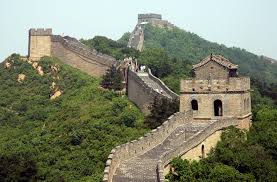
58.
What is the purpose of the structure pictured here?
a)
It is a temple
b)
To protect China's northern border
c)
To protect China's Southern border
d)
To protect China from India 
59.
Trade route that stretched from western China to southern Asia
a)
filial piety
b)
Silk Road
c)
Great Wall
d)
Anyang
60.
Line of rulers from the same family
a)
Legalism
b)
long Chinese line
c)
filial piety
d)
dynasty
61.
How did geography affect the development of Chinese culture?
a)
Long coastlines made access to trade possible.
b)
Flat land made travel easy.
c)
Great Wall of China made travel along the top easier for traders.
d)
Tall mountains and deserts isolated China from other nations.
62.
What was the natural border of China that was a mountain range?
a)
Rocky Mountains
b)
Himalayan Mountains
c)
Appalachian Mountains
d)
Sierra-Nevada Mountains
63.
What was the natural border of China that was a desert?
a)
Sahara
b)
Gobi
c)
Death Valley
d)
Antarctica
64.

Confucius was very famous ____________ in Ancient China.

a)

emperor

b)

philosopher

c)

army leader

d)

god

65.
What did Daoism teach?
a)
Belief in one god
b)
To live a long life, go with the flow
c)
Obey out of fear
d)
Belief in many gods
66.
What is Legalism?
a)
A government
b)
Making all things of a certain type alike
c)
The strict following of laws to rule
d)
A belief
67.
Name the two beliefs of Confucianism
a)
meditation and right thought
b)
respect for elders and proper behavior
c)
no rulers and love of nature
d)
education and karma
68.
The Ancient Chinese have a written language that is _____________________. 
a)
pictures
b)
words and pictures
c)
characters and symbols
d)
drawings and words
69.

The symbol is known as "Yin and Yang." It is an important symbol in

a)

Confucianism

b)

Taoism

c)

Buddhism

d)

Hinduism

70.
I'm a scholar who is very knowledgeable in government.  Which philosophy would support me working in government?
a)
Legalism
b)
Confucianism
c)
Buddhism
d)
Daoism
71.
According to the ancient Greeks, the gods and goddesses lived...
a)
in Athens.
b)
on Mount Olympus.
c)
in Sparta.
d)
in Turkey.
72.
Why was communication difficult between communities in Ancient Greece?
a)
They did not have telephones
b)
Mountains and Water
c)
communication was easy
d)
most people had horses
73.
The ancient Greeks were  
a)
Monotheistic  
b)
Polytheistic
c)
Atheist
d)
Scientologist
74.
How is the influence of ancient Greece seen in today's world?
a)
the clothes that they wore
b)
buildings and architecture
c)
everybody walks everywhere
d)
communities are isolated
75.
What does the word "Democracy" mean?
a)
"rule by the government"
b)
"rule by the many"
c)
"rule by the wealthy"
d)
"rule by the people"
76.
The games held every four years at a festival to honor Zeus were called
a)
Goodwill Games
b)
Marathons
c)
Olympics
d)
Triathlons 
77.
A militaristic city-state where boys were trained from an early age to fight.
a)
Athens
b)
Delphi
c)
Corinth
d)
Sparta
78.
A city-state which favored democracy and a well-rounded education. 
(Also, the largest city-state by a wide margin)
a)
Sparta
b)
Athens
c)
Delphi
d)
Corinth
79.
A system that of writing that uses symbols to stand for individual sounds is called an 
a)
alphabet
b)
character
c)
codex
d)
hieroglyph
80.
Why did the Greeks think that myths, epics, and fables were important?
a)
They often provided money for the rich.
b)
They had nothing else to do.
c)
They often taught lessons and values.
d)
They often taught people how to read.
81.
What does the term “Hellenistic” mean?
a)
It means the spreading of Greek animals following the death of Alexander the Great.
b)
It means the spreading of Greek culture following the death of Alexander the Great.
c)
It means the spreading of Greek culture following the death of Pericles.
82.
Which of these was a result of the geographic conditions of Greece in their early civilization?
a)
unified political organization
b)
withdrawal from international contact
c)
a society centered around plantations
d)
a reliance of sea-based commerce
83.
Which government has one person in charge who rules by force and with total authority?
a)
monarchy
b)
oligarchy
c)
tyranny
d)
democracy
84.
Which government has its power passed down through a royal family line?
a)
monarchy
b)
oligarchy
c)
tyranny
d)
democracy
85.
What kind of democracy did ancient Athens have?
a)
Direct 
b)
Representative
86.
What kind of government did Ancient Sparta have?
a)
monarchy
b)
oligarchy
c)
tyranny
d)
democracy
87.
What was a unified formation of Greek soldiers called?
a)
Phalanx
b)
Phylange
c)
Assembly
d)
Ephor
88.
An empire started by Cyrus the Great
a)
Greece
b)
Rome
c)
Persia
d)
Egypt
89.
300 Spartan soldiers held the Persian army to a stalemate for three days before the Persians eventually defeated them in what famous battle?
a)
Battle of the Greeks
b)
Battle of Thermopylae
c)
Battle of Little Big Horn
d)
Battle of Pericles
90.
After the Persian War, Athens and Sparta came into conflict with one another.  Eventually, war broke out between the two city-states.  
What was this war called?
a)
Persian War II
b)
Greek War
c)
Peloponnesian War
d)
War Between the City-States
91.
What were the rights and responsibilities of Roman citizens? 
a)
Vote
b)
Pay taxes
c)
Serve in the army
d)
All of the above
92.

Why was Rome's geographic setting important?

a)

Strong winds brought heavy spring rains to the land.

b)

Its position was central to Italy and the known Western world.

c)

It was surrounded by deserts which kept is safe from invasion.

d)

Farmers depended on yearly flooding to plant crops.

93.
Which area was NOT a part of the Roman Empire?
a)
North Africa
b)
Russia
c)
Britain
d)
Gaul
94.

Which of the following is NOT a reason that led to the fall of the Roman Empire?

a)

Empire was hard to defend because of size.

b)

The economy was failing.

c)

Invasions from barbarian tribes.

d)

Science convinced people the earth was flat and they fell off the edge.

95.
The Romans spoke this language.
a)
Japanese
b)
English
c)
Spanish
d)
Latin
96.
Why was communication and transporting of good so much easier in Rome?
a)
good network of roads
b)
banned slavery
c)
all the hills
d)
irrigation system
97.

The government of the Roman Republic was characterized by all of the following.

Select three correct answers.

a)

Checks and balances

b)

The idea of civic duties & responsibilities

c)

Separation of powers/3 branches of government

d)

Voting rights for women

e)

Voting in a direct democracy

98.

What are some of the Roman Empire’s lasting contributions & achievements?

Select three correct answers.

a)

Republic form of government

b)

Cement/Concrete

c)

Buddhist meditation

d)

Aqueducts

e)

Direct Democracy

99.

Which statement most likely reflects the views of a plebeian living in the Roman Republic?

a)

“I am a strong warrior and I will defend the Republic until the day that I die.”

b)

“Although my people make up the majority of the population in Rome, it is sad that we are not treated equally and cannot become Senators in the Republic.”

c)

“I have so much wealth and power in the Republic. I love being able to vote and I hope to earn a position as Roman Consul one day.”

d)

“I spend most of my time cleaning up after banquets, picking up after the children, and helping wealthy women get dressed for the day.”

100.

Which statement most likely reflects the views of a patrician living in the Roman Republic?

a)

“I am a strong warrior and I will defend the Republic until the day that I die.”

b)

“Although my people make up the majority of the population in Rome, it is sad that we are not treated equally and cannot become Senators in the Republic.”

c)

“I have so much wealth and power in the Republic. I love being able to vote and I hope to earn a position as Roman Consul one day.”

d)

“I spend most of my time cleaning up after banquets, picking up after the children, and helping wealthy women get dressed for the day.”