
 Worksheets
Capacitors circuits
Total questions: 20
Worksheet time: 15mins
Name
Class
Date
1.

Two resistors have the same resistivity and cross-sectional area. One is twice as long as the other. What is the voltage on the longer resistor?
a)
12 V
b)
8 V
c)
6 V
d)
4 V
2.
A parallel plate capacitor is connected to a cell of constant emf. The plates are moved further apart without disconnecting the cell. What happens to the capacitance and voltage across the plates?
a)
capacitance increases; voltage remains constant
b)
capacitance remains constant; voltage decreases
c)
capacitance decreases; voltage increases
d)
capcitance decreases; voltage remains constant
3.

Which graph shows how the current through an ideal ohmic resistor changes with voltage?
a)
A
b)
B
c)
C
d)
none of the above
4.
Capacitors C1 and C2 are connected in parallel and a potential difference is applied to the combination. If the capacitor that is equivalent to the combination has the same potential difference, then the charge on the equivalent capacitor is the same as:
a)
the charge on C1
b)
the sum of the charges on C1 and C2
c)
the difference of the charges on C1 and C2
d)
the product of the charges on C1 and C2
5.
Two identical capacitors are connected in series and two, each identical to the first, are connected in parallel. The equivalent capacitance of the series connection is ________ the equivalent capacitance of parallel connection.
a)
twice
b)
four times
c)
half
d)
one fourth
6.
Capacitors C1 and C2 are connected in series. The equivalent capacitance is given by:
a)
C1C2/(C1 + C2)
b)
(C1 + C2)/C1C2
c)
1/(C1 + C2)
d)
C1 + C2
7.
Capacitor C1 and C2 are connected in parallel. The equivalent capacitance is given by:
a)
C1 + C2
b)
1/(C1 + C2)
c)
C1C2/(C1 + C2)
d)
(C1 + C2)/C1C2
8.

Each of the four capacitors shown is 500 microF. The voltmeter reads 1000V. The magnitude of the charge on each capacitor plate is:
a)
0.2 C
b)
0.5 C
c)
20 C
d)
50 C
9.
A parallel-plate capacitor has a plate area of 0.2 m2 and a plate separation of 0.1 mm. To obtain an electric field of 2.0 ´ 106 V/m between the plates, the magnitude of the charge on each plate should be:
a)
3.5 ´ 10-6 C
b)
7.1 ´ 10-6 C
c)
1.4 ´ 10-5 C
d)
1.8 ´ 10-5 C
10.
If both the plate area and the plate separation of a parallel-plate capacitor are doubled, the capacitance is:
a)
doubled
b)
halved
c)
unchanged
d)
one-fourth the original
11.
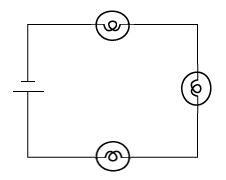
The picture shows an electrical circuit. This circuit is a series circuit because:
a)
It has 3 light bulbs.
b)
The same current flows through all three light bulbs.
c)
It uses a single battery.
d)
The electrical current has more than one path to flow through
12.
In a Series circuit the more lightbulbs you add the brighter they get
a)
False
b)
True
13.
What is a Parallel circuit?
a)
Has only one path
b)
Has more than one path
c)
Allows energy to travel through easily
d)
Has only one light bulb
14.
Which best describes a simple series circuit?
a)
Electricity flows along one pathway.
b)
The flow of electricity comes from the switch.
c)
Electricity flows along many pathways.
d)
The flow of electricity comes from the light bulb.
15.
The loads in a series circuit do not share the available voltage.
a)
True
b)
False
16.
Across all the paths in a parallel circuit the voltage is the same,
a)
True
b)
False
17.

If a p.d of 5V is across the combination, what is the total energy stored by the combination?
a)
68.8J
b)
1.71x10⁻³J
c)
8.59x10⁻⁴J
d)
4.00x10⁻³J
18.

An uncharged capacitor is connected to a battery.
a)
A
b)
B
c)
C
d)
D
19.

An uncharged capacitor is connected to a battery.
a)
A
b)
B
c)
C
d)
D
20.
A capacitor of capacitance C has a potential difference V across it and stores energy Z joules. A second capacitor has a capacitance of C/2 and a potential difference of 2V across it. What is the energy stored on the second capacitor?
a)
Z
b)
2Z
c)
4Z
d)
8Z
100 %

