
 Worksheets
Monroe-2nd Q Review: Revolutionary War, AOC, Constitution
Total questions: 123
Worksheet time: 19mins
Name
Class
Date
1.
Anti-federalists wanted a Bill of Rights added to the constitution to help protect...
a)
Individual Rights
b)
State Rights
c)
Slavery
d)
The Articles of Confederation
2.
The Federalists papers were written to persuade people to support the new constitution.
a)
True
b)
False
3.
Which one of the following is not a guaranteed freedom found in the First Amendment?
a)
Right to own a gun
b)
Right to freedom of Speech
c)
Right to petition the government
d)
Right to assemble peacefully
4.
______ is the belief that the government gets its power from the people.
a)
Rule of Law
b)
Popular Sovereignity
c)
Checks and balances
d)
Federalism
5.
The first ten Amendment to the Constitution are called the _______.
a)
Bill of Rights
b)
Preamble
c)
Articles
d)
Naturalization
6.
What article of the Constitution created the Executive Branch of government?
a)
ArcticleI
b)
Article II
c)
Article III
d)
Article IV
7.
The Constitution replaced the ______ as the governing document of the country.
a)
Declaration of Independence
b)
Bill of Rights
c)
Emancipation Proclamation
d)
Articles of Confederation
8.
The _______ is the opening paragraph of the Constitution.
a)
Article 1
b)
Preamble
c)
Bill of Rights
d)
Prelude
9.
Which branch executes the laws?
a)
Executive
b)
Judicial
c)
Appellate
d)
Legislative
10.
Which branch interprets the laws?
a)
Executive
b)
Judicial
c)
Appellate
d)
Legislative
11.
Which branch makes the laws?
a)
Executive
b)
Judicial
c)
Appellate
d)
Legislative
12.
What is the name for a change or addition to the Constitution?
a)
Federalism
b)
Amendment
c)
Ratification
d)
Veto
13.
citizens elect representatives to carry out their will
a)
popular sovereignty
b)
federalism
c)
individual rights
d)
republicanism
14.
The Great Compromise solved the problem of both big and small states wanting representation.
a)
True
b)
False
15.
The Three-Fifths Compromise help settle the debate over whether to count slaves in the population or not.
a)
True
b)
False
16.
Anti-federalists SUPPORTED making a new constitution.
a)
True
b)
False
17.
Which compromise is made up of ideas from the Virginia Plan and the New Jersey plan?
a)
The Great Compromise
b)
The three-fifths compromise
c)
The constitutional compromise
d)
The big compromise
18.
What is the name of the first Constitution?
a)
Articles of Confederation
b)
Articles of Incorporation
c)
The Federalist Papers
d)
The Great Constitution
19.
Which group of people wanted the Constitution to include a Bill of Rights?
a)
Federalists
b)
Anti-federalists
c)
Democrats
d)
Northerners
20.
Which term means 'system where the national government shares power with state governments'?
a)
propose
b)
republican
c)
federalism
d)
execute
21.
Which term means 'approve or pass an amendment'?
a)
republican
b)
federalism
c)
execute
d)
ratify
22.
Which branch of government writes the bills that become laws?
a)
judicial
b)
legislative
c)
executive
23.
How many members are there in the U.S. Senate?
a)
50
b)
100
c)
435
24.
Congress is made up of which two parts?
a)
Cabinet and Senate
b)
Senate and the House of Representatives
c)
Supreme Court and House of Representatives
d)
Senate and Supreme Court
25.
Which branch of government does the President belong to?
a)
judicial
b)
legislative
c)
executive
26.
Which branch of government guarantees trial by jury?
a)
judicial
b)
legislative
c)
executive
27.
How many members are in the House of Representatives?
a)
50
b)
100
c)
435
28.
How many years is one term for a representative?
a)
1 year
b)
2 years
c)
4 years
d)
6 years
29.
How many years is one term for a Senator?
a)
2 years
b)
4 years
c)
6 years
d)
8 years
30.
Which two groups must approve a bill, in order for it to go to the President to become a law?
a)
Supreme Court and the President
b)
House of Representatives and Senate
c)
Judicial Branch and Executive Branch
31.
Which of the following has the power to declare war on another country?
a)
President
b)
Congress
c)
Supreme Court
32.
Which group remains in power until they retire, die, or are removed for bad behavior?
a)
House of Representatives
b)
Supreme Court
c)
Senate
33.
Which branch of the government maintains a cabinet of advisors, who run the 15 executive departments?
a)
Executive
b)
Legislative
c)
Judicial
34.
What is the purpose of the Bill of Rights?
a)
they define the rights of U.S. Citizens
b)
they explain the introduction to the Constitution
c)
they gave women the right to vote
35.
What is the first step to make a law?
a)
Get the president to approve the bill
b)
Get the majority vote of Congress.
c)
Go to a committee.
d)
Write a bill
36.
What is the second step in creating a law?
a)
Go to a committee
b)
Get the majority vote of Congress
c)
Get the president to approve the bill
d)
Write a bill
37.
What is the third step to make a law?
a)
Write a bill
b)
Get the president to approve the bill.
c)
Go to a Committee
d)
Get the majority vote of Congress
38.
What is the final step in making a law?
a)
Get the president to approve the bill
b)
Write a bill
c)
Get the majority vote of Congress
d)
Go to a Committee.
39.
Which article of the Constitution describes the executive branch?
a)
Article I
b)
Article II
c)
Article III
40.
How is the president of the United States elected?
a)
The House of Representatives votes
b)
Popular Vote
c)
Electoral College Vote
d)
They flip a coin.
41.
What is the Constitution?
a)
The preamble of the U.S.A.
b)
The highest law in the U.S.A.
c)
It tells the history of the U.S.A.
d)
A group of men called the Framers.
42.
Which branch has the courts and judges and interprets the law?
a)
Executive Branch
b)
Legislative Branch
c)
Judicial Branch
d)
None
43.
The three branches of government have a system of checks and balances. What does this mean?
a)
Changes can be made to the constitution.
b)
Each has a limit, or check, on the other one that keeps one branch from taking over the other two
c)
Basic rights and freedoms of citzens in Georgia.
d)
None
44.
Is a veto an example of checks and balances or separation of powers?
a)
Checks and balances
b)
separation of powers
c)
None
d)
None
45.
Giving each branch of government a specific job is called _________________.
a)
checks and balances
b)
Bill of Rights
c)
separation of powers
d)
Amendments
46.
What was the effect of Shay's Rebellion?
a)
A general agreement that a stronger government was needed
b)
The northwest territory was split into smaller sections
c)
The Articles of Confederation were ratified
d)
The King of England regained control of the colonies
47.
A gathering to strengthen the government of the new nation by revising the Articles of Confederation or writing a new constitution.
a)
Constitutional Convention
b)
Shay's Rebellion
c)
The Northwest Ordinance
d)
Articles of Confederation
48.
States with larger populations should have more representation in congress than smaller less populated states.
a)
Virginia Plan
b)
New Jersey Plan
49.
Each state, large or small, should have the same number of representatives in congress.
a)
Virginia Plan
b)
New Jersey Plan
50.
Who was the leader of the Constitutional Convention?
a)
Alexander Hamilton
b)
George Washington
c)
James Madison
d)
John Oglethorpe
51.
Each side gives up something to reach an agreement.
a)
Compromise
b)
Ratify
c)
Veto
d)
Ordinance
52.
Under the Articles of Confederation, which of the following could congress NOT do.
a)
Raise an Army
b)
Created Laws
c)
Collect Taxes
d)
Print Money
53.
An official order
a)
Ratify
b)
Congress
c)
Confederation
d)
Ordinance
54.
Why did the Anti-federalist eventually agree to ratify the Constitution?
a)
colonial grievances were added
b)
the Bill of Rights protecting individual rights would be added
c)
the Great Compromise set up the Legislative Branch
d)
Term limits were established by the Congress for the Executive
55.
The Preamble of the Constitution begins, "We the People." Which Constitutional principle is represented in the phrase?
a)
federalism
b)
checks and balances
c)
individual rights
d)
popular sovereignty
56.
Why did the Anti-federalism opppose the Constitution?
a)
they believe it infringed on states' rights
b)
really loved the Articles of Confederation
c)
believed that the US should rejoin Great Britain
d)
Wanted to create an American monarchy
57.
The existence of 3 separated, but co equal branches of government represent which Constitutional principle?
a)
federallism
b)
individual rights
c)
separation of powers
d)
checks and balances
58.
House of Representatives representation is based on ....
a)
equal representation
b)
how many Supreme Court justices there are
c)
population of the the state
d)
physical size of the state
59.
The Senate's representation is...
a)
equal for every state
b)
varied based on population
c)
based on the Supreme Court
d)
based on the physical size of the state
60.
What rebellion led to the Constitutional Convention?
a)
The Whiskey Rebellion
b)
The French Rebellion
c)
Bacon's Rebellion
d)
Shay's Rebellion
61.
What year was the Declaration of Independence written? Where?
a)
1787; Philadelphia
b)
1776; Philadelphia
c)
1782; Virginia
d)
1803; Boston
62.
What are the Federalist Papers?
a)
a colonial newspaper
b)
a series of essays written after the Constitution attempting to convince colonists to support the Constitution
c)
a colonial social media page
d)
series of essays written to encourage independence from Great Britain
63.
When we say "Congress" we mean:
a)
All branches of the government
b)
President and Vice President
c)
House of Representatives and Senate
d)
Legislative Branch and Executive Branch
64.
If the President vetoes the bill that has been passed by the House and Senate, how can the Legislative Branch override the veto?
a)
Both the House of Representatives and the Senate have to override it with 2/3 vote
b)
Both the House and the Senate have to override it with 3/4 vote
c)
Only the Senate has to override the veto with 2/3 vote
d)
Only the House has to override the veto with 2/3 vote
65.
Which is correct about the Amendment process.
a)
1/2 vote of Congress and ratification by 1/2 of the states
b)
2/5 vote of Congress and ratification by 1/2 of the states
c)
2/3 vote of Congress and ratification by 2/3 of the states
d)
2/3 vote of Congress and ratification by 3/4 of the states
66.
Why did many Congressional representatives call for replacing the Articles of Confederation?
a)
created a chief executive with the power to veto state laws
b)
created a permanent oversight commitee
c)
established a powerful army that threatened the nation
d)
it created a government too weak to manage the states
67.
One strength of the Articles of Confederation that carried over to the Constitution was the establishment of—
a)
a national mail system
b)
a national road system.
c)
a national bank system.
d)
a national taxation system.
68.
What is the name of the first written plan of government in America?
a)
Constitution
b)
Treaty of Paris
c)
Declaration of Independence
d)
Articles of Confederation
69.
Americans were afraid that a __?__ would lead to tyranny, or oppressive rule.
a)
strong state government
b)
weak government
c)
strong central government
d)
legslature
70.

Under the Articles of Confederation, most of the power was where?
a)
Legislative branch
b)
the president
c)
the states
d)
national government
71.

Under the Articles of Confederation, how many votes did each state get when voting on a new law?
a)
Zero
b)
One
c)
Two
d)
Three
72.

How many branches of government were there under the Articles of Confederation?
a)
One
b)
Zero
c)
Two
d)
Three
73.

Which of the following was NOT a power of Congress under the Articles of Confederation?
a)
Create a plan for the Northwest Territory
b)
Negotiate treaties
c)
Levy taxes
d)
Declare war and peace
74.
What was the position of the group known as the Federalists?
a)
they supported a new Constitution
b)
they questioned the justice of slavery
c)
the feared the power of the national government
d)
the believed that states should have equal representation
75.
Under the Articles of Confederation, Congress could regulate trade between the states.
a)
true
b)
false
76.
Under the Articles of Confederation, America used a national currency (money)
a)
True
b)
False
77.
In order to change (amend) the Articles of Confederation, __________ out of 13 states had to agree.
a)
9
b)
10
c)
13
d)
15
78.
Under the Articles of Confederation Congress could only pass a law if ____________ out 13 states agreed.
a)
13
b)
8
c)
9
d)
10
79.
One weakness of the Articles Of Confederation was that it lacked which 2 branches of government?
a)
Legislative & Executive
b)
Executive & Judicial
c)
Judicial & Legislative
d)
Executive & Oak
80.
Which strong feature of the Articles of Confederation created a method for territories to become states?
a)
The ability to sign peace treaties
b)
Shays' Rebellion
c)
Northwest Ordinance
d)
60,000 Ordinance
81.
What did the Continental Congress want to protect Individual Rights from?
a)
Another rebellion like Shays'
b)
Taxation
c)
Another revolution
d)
Another tyrannical government
82.
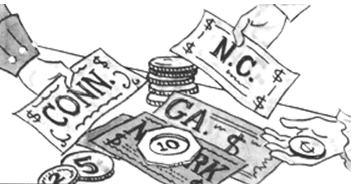
Which of the following weaknesses in the Articles of Confederation does this picture represent?
a)
no common currency (money)
b)
no executive branch
c)
no power to tax
d)
one vote for each state
83.
What is the meaning of taxation without representation?
a)
When people are taxed, but they have no say in the government
b)
When people are taxed twice on the same item
c)
When some people get taxed and others don't
d)
When people in the Colonies are taxed, but no one in England is
84.
Who were the colonial leaders making decisions during the Revolutionary War?
a)
George Washington, Thomas Jefferson, John Adams, Ben Franklin
b)
Thomas Edison, John Deere, Abe Lincoln, George Washington
c)
Daniel Boone, Barach Obama, Abe Lincoln, Thomas Jefferson
d)
George Washington, Abe Lincoln, Eleanor Roosevelt, Betsy Ross
85.
What was the most significant result for our country's history because the Colonies won the Revolutionary War?
a)
It resulted in our freedom and ability to govern ourselves
b)
We won a war
c)
Other counties were impressed by our winning a war
d)
George Washington would always be our President
86.
The American colonists felt that the English government made them...
a)
work too hard
b)
follow unfair laws
c)
buy too much teach
d)
buy too many clothes
87.
What law that forced colonists to provide places to live for all the Redcoats in America?
a)
Townshend Acts
b)
Quartering Act
c)
Sugar Act
d)
Navigation Act
88.
After the battle at Bunker Hill, the Patriots learned...
a)
They had no chance at winning
b)
They were going to beat the British easily
c)
They may lose some battles, but could win the war
d)
They needed to surrender
89.
How would you describe the winter at Valle Forge?
a)
Cold and challenging
b)
Hot and tropical
c)
Great food
90.
The Declaration of Independence was written to formally declare to the people and to the King of England that the colonies were separating from England and they wanted to explain why.
a)
True
b)
False
91.
The Constitution of the United States was written to govern all the people equally and limits any one group or person from having all the power.
a)
True
b)
False
92.
There were no women or African Americans who helped in the Revolutionary War.
a)
True
b)
False
93.
Who was the Commander of the Continental Army?
a)
Lord Cornwallis
b)
King George III
c)
George Washington
d)
Paul Revere
94.
Who was the patriot who warned colonists in Lexington, MA that "the British are coming"?
a)
Paul Revere
b)
George Washington
c)
John Hancock
d)
Sam Adams
95.
Who helps America fight the British; a major factor in America winning the war?
a)
France
b)
China
c)
Italy
d)
Canada
96.
The Declaration of Independence was written by
a)
Sam Adams.
b)
George Washington.
c)
Thomas Paine.
d)
Thomas Jefferson.
97.

The first President of the United States was ______.
a)
Abraham Lincoln
b)
John Adams
c)
Barack Obama
d)
George Washington
98.
What was the purpose of The Declaration of Independence?
a)
To say the colonies were independent from Great Britain
b)
To declare war
c)
To ask for help paying taxes on tea
99.
The Battle of Yorktown was the
a)
longest battle.
b)
shortest battle.
c)
last battle.
d)
first battle.
100.
He wrote "Common Sense" urging the colonies to declare independence.
a)
Thomas Paine
b)
Thomas Jefferson
c)
Patrick Henry
d)
Alexander Hamilton
101.
The Declaration of Independence was signed on
a)
December 25th, 1776
b)
July 4th, 1770
c)
July 4th, 1776
d)
September 17th, 1777
102.
The leader of the British Army that surrendered to the Americans at Yorktown.
a)
Cornwallis
b)
Lord North
c)
Burgoyne
103.
This officially ended the Revolutionary War.
a)
Battle of Valcour Island
b)
Treaty of Ghent
c)
Treaty of Paris (1783)
d)
Surrender at Ft. Ticonderoga
104.
A colonist who is against the King.
a)
Patriot
b)
Loyalist
c)
British Soldier
d)
Children
105.
A person who supports the King.
a)
Minuteman
b)
Loyalist
c)
Patriot
d)
George Washington
106.
A colonists that was ready to fight at any moment.
a)
Redcoat
b)
Minuteman
c)
British Soldier
d)
Soldier
107.
A nickname for a British Soldier.
a)
redcoat
b)
soldier
c)
greencoat
d)
yellowcoat
108.
What happened because of all of the debt Britain gained during the French and Indian War?
a)
The colonists taxed the British to pay back the debt.
b)
The British taxed the colonists to pay back the debt.
c)
The Sons of Liberty went to Great Britain
d)
Colonists threw a party.
109.
Which battle was known for "the shot heard around the world?"
a)
Battles of Lexington (and Concord)
b)
Battle of Saratoga
c)
French and Indian War
d)
Boston Massacre
110.
Why did African Americans join the Continental army?
a)
They had excellent military skills.
b)
They were generously paid to join the army.
c)
They blamed Great Britain for their enslavement.
d)
They hoped independence would lead to an end of slavery.
111.
Which of these was a weakness of the Continental army at the start of the war?
a)
supply shortages
b)
weak commanders
c)
unfamiliar territory
d)
long travel distances
112.
In the _______, rebel guerillas such as Francis Marion led attacks against the British and cut supply lines.
a)
North
b)
South
c)
East
d)
West
113.
The last major battle of the war ended when Cornwallis surrendered his force of about 8,000 at _______________.
a)
Boston
b)
Chicago
c)
New York
d)
Yorktown
114.
The Americans helped expand the war to the seas by encouraging _________________ to attack British merchant ships.
a)
British
b)
Burgoyne
c)
Washington
d)
privateers
115.
Which of the following WAS a strength for the Patriots heading into the Revolutionary War?
a)
Strong Economy
b)
Reason for fighting-Independence
c)
Strongest Navy in the world
d)
Lack of supplies
116.
Why did Thomas Paine write Common Sense?
a)
To convince Patriots to fight for independence
b)
To convince Loyalists to fight
c)
To Convince France to help the Patriots
d)
To Convince England to help the Patriots
117.
How did the Northwest Ordinance show that it was the first attempt at ending slavery?
a)
It said their needed to be 60,000 people
b)
It said that slavery would be limited
c)
It said that slavery would not be allowed in any state
d)
It said that slavery would not be allowed in any new state
118.
Inflation means
a)
to increase prices
b)
to decrease prices
119.
Depreciate means
a)
to gain value
b)
to lose value
120.
Hypocrite means
a)
to do like you ask others to do
b)
to do the opposite of what you ask others to do
121.
A tactic used during Revolutionary War that gave them an edge over the British?
a)
Repeal
b)
Effigy
c)
Violate
d)
Guerilla Warfare
122.
To repeal a law is to?
a)
adding it
b)
taking away
123.
George Washington set many precedents when he was President. Identify one
a)
establishing courts and neutrality
b)
Using the term 'Mr. President' and neutrality
c)
3 branches of government
d)
going to war
100 %

