wayground logo

Free Printable Worksheets

Font size

S
M
L
XL
Worksheets

Modern America

Total questions: 120

Worksheet time: 1hrs 24mins

Name
Class
Date
1.
This economic system America uses today.
a)
Socialism
b)
Communism
c)
Capitalism
2.
The dividing line between the communist countries and the free countries was called the _____.
a)
Berlin Wall
b)
Iron Curtain
c)
Front Line
d)
Mason-Dixon
3.

Which nation on the Korean peninsula has a Communist government?

a)

Japan

b)

South Korea

c)

China

d)

North Korea

4.
The Korean peninsula is divided into two nations at...
a)
Seoul 
b)
Inchon
c)
the DMZ
d)
the 38th parallel 
5.
Classless society: all members of society are considered to be equal
a)
Communism
b)
Capitalism
6.
What two nations were in competition with each other during the Cold War?
a)
Spain and Portugal
b)
England and France
c)
Germany and Italy
d)
United States and Soviet Union
7.

What was the term 'iron curtain' used to describe the division of?

a)

North and South Vietnam

b)

East and West Asia

c)

North and South Korea

d)

East and West Europe

8.
President Truman adopted a new foreign policy during the Cold War know as the Truman Doctrine. What was the main goal of the Truman Doctrine?
a)
To expand trade with Europe
b)
To limit the build up of nuclear weapons
c)
To stop the spread of communism
d)
to send financial aid to Europe
9.
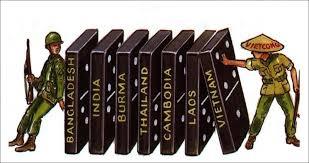
The United States got involved in conflicts like Korea and Vietnam because they were afraid of the domino theory. What is the domino theory?
a)
If one country fell to democracy, others would follow
b)
If one country fell to communism, others would follow
10.
How did the Marshall plan try to stop the spread of communism in Western Europe after WWII?
a)
by providing government housing for refugees
b)
by providing military assistance to Vietnam
c)
by providing money to stop poverty
11.
Why did the United States become involved in the Korean War?
a)
to contain communism
b)
to colonize Korea
c)
to spread communism
d)
to Christianize Koreans
12.
In the 1950s, the United States became involved in the Vietnam War. Why did the United States become involved in this war?
a)
to prevent the collapse of the government of North Vietnam
b)
to stop Vietnam from taking over Hong Kong
c)
to stop the spread of communism to South Vietnam
d)
to prevent attacks against United States shipping
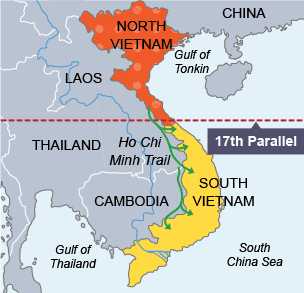
13.

Where was Vietnam divided?

a)

19th Parallel

b)

20thParellel

c)

38th Parellel

d)

34th Parallel

14.
How did the US respond to finding out that the Soviets had missiles in Cuba?
a)
They sent the Air Force to bomb Cuba
b)
They began placing missiles in the Soviet Union.
c)
They placed a naval blockade around Cuba.
d)
They invaded Cuba and the Soviet Union.
15.

Who were the two participants in the Space Race?

a)

The US and Cuba

b)

China and US

c)

The Soviet Union and US

d)

US and North Vietnam

16.
What was the name of the first satellite in space launched by the Soviet Union?
a)
Gagarin
b)
Apollo 11
c)
Sputnik
d)
Apollo 13
17.
A form of economy that promotes free trade, reduced government intervention and entrepreneurism is ________
a)
Capitalism
b)
Communism
c)
Socialism
d)
Marxism
18.
A form of government that allows no personal freedom and citizens have little choice in leaders of their government or policy is called ______
a)
Capitalism
b)
Communism
c)
Marxism
d)
Socialism
19.
What was the Iron Curtain?
a)
an imaginary line dividing communist and non-communist countries 
b)
an imaginary line connecting the major cities of Europe
c)
the border between France and Germany
d)
the border between the United States and Europe.
20.
Who was the US Senator that led investigations to expose communism in the US?
a)
Harry Truman
b)
Joseph McCarthy
c)
Nikita Khrushchev
d)
Douglas MacArthur
21.
The Korean War started because...
a)
Communist North Korea attacked South Korea
b)
the United Nations sent troops
c)
China invaded North Korea
d)
the Soviet Union attacked.
22.
What role did the United States play in the Korean War?
a)
The United States and its allies did not join the Korean War.
b)
The US and its allies fought to defend North Korea.
c)
The US joined its allies in the fight against North Korea to keep communism from spreading.
d)
The United States and its allies only sent supplies and weapons to Korea.
23.
Why was the Cuban Missile Crisis one of the MOST important events of JFK's presidency?
a)
The Soviet Union broke apart into nation states.
b)
The Soviet Union tried to prevent the US from creating more nuclear weapons.
c)
The US and Soviet Union signed a treaty of peace.
d)
The United States and Soviet Union almost started a nuclear war.
24.
What major historical event is represented in this map?
a)
Attack on Pearl Harbor
b)
The Cuban Missile Crisis
c)
The Wright Brother's first flight
d)
The building of the Panama Canel
25.
What does the ‘Iron Curtain’ symbolize? 
a)
The division between East Germany and West Germany
b)
The division between East Berlin and West Berlin
c)
The division between communist Europe and noncommunist Europe 
d)
The division between North Korea and South Korea
26.

During the Cold War, what bill did the U.S. Congress pass to provide financial assistance to western European countries?

a)

Truman Doctrine

b)

Open Door Policy

c)

Marshall Plan

d)

Domino Theory

27.

What country is highlighted on the map of Latin America?

a)

Mexico

b)

Cuba

c)

Colombia

d)

Brazil

28.

The goal of the Bay of Pigs invasion was to get rid of which communist leader in Cuba?

a)

Guevara

b)

Batista

c)

Chavez

d)

Castro

29.

Which country became a close friend of the Cuban government after the Bay of Pigs?

a)

Germany

b)

United States

c)

Soviet Union

d)

Canada

30.

What did the US government create to allow the military to moved more efficiently within the US?

a)

GI Bill of Rights

b)

National Interstate and Defense Highways Act

c)

Autobahn

d)

Truman Doctrine

31.

What was done because racial tension in the military needed to be reduced and Korean War needed for more troops

a)

Truman signed GI Bill of Rights

b)

Truman signed executive order integrating military

c)

Eisenhower ordered National Interstate and Defense Act

d)

McCarthy enacted the Marshall Plan

32.

The creation of a national space program (NASA) was a main effect of

a)

McCarthyism

b)

the Korean War

c)

the launch of Sputnik

d)

The Marshall Plan

33.
What previous Supreme Court decision did Brown v. Board overturn?
a)
Worcester v. Georgia
b)
Plessy v. Ferguson
c)
Roe v. Wade
d)
Marbury v. Madison
34.

A US army soldier returning home after WWII to find that he could get a loan and buy an affordable new home and receive free tuition to college would most likely owe a debt of gratitude to:

a)

HUAC and Joseph McCarthy

b)

"Reaganomics"

c)

The New Deal

d)

The GI Bill

35.

Congress passed this, which authorized the construction of a national network of highways to connect every major city in America. The new system replaced the railroad network as the principal way of transporting goods and boosted economic development.

a)

G.I. Bill

b)

Truman Doctrine

c)

National Interstate and Defense Highway Act

d)

Marshall Plan

36.

Sputnik concerned leaders in the United States because:

a)

It was an agreement between the USSR and Cuba that placed nuclear missiles within 90 miles of the U.S.

b)

It was a Soviet satellite that signaled that the US was far behind the Soviets in education.

c)

It was a submarine that U.S. ships were defenseless against.

d)

It was a bomb ten times more powerful than the atomic bomb dropped on Japan.

37.

Congress granted LBJ power to go to war with North Vietnam by passing the ______ thus changing US soldiers from advisers to fighters was.

a)

Great Society

b)

War Powers Act

c)

26th Amendment

d)

Gulf of Tonkin Resolution

38.

What was the goal of "Vietnamization"?

a)

Hand South Vietnam over to the communists

b)

Keep peace with the Soviet Union

c)

Retake territory lost during the Tet Offensive

d)

Force South Vietnam to take over more of the fighting

39.

The Gulf of Tonkin Resolution led to...

a)

American withdrawal from Vietnam

b)

Public disapproval of the war

c)

Escalation of the war

40.
Who was the communist leader of North Vietnam?
a)
Ho Chi Minh
b)
Mao Zedong
c)
Ngo Dien Diem
d)
Hideki Tojo
41.

Who were the communists in South Vietnam who used guerrilla style tactics were called?

a)

Vietminh

b)

Vietcong

c)

Ho Chi Minhions

42.
What resolution passed that gave Lyndon Johnson broad powers to defend South Vietnam from communism?
a)
Gulf of Tonkin Resolution
b)
Gulf of Maddox Resolution
c)
USS Tonkin Resolution
d)
Gulf of Vietnam Resolution
43.
Which university saw four students die during violent protests against the Vietnam War?
a)
Kent State
b)
Ohio State
c)
Miami of Ohio
d)
Dayton
44.
Plan to replace US troops with Vietnamese troops to end US involvement in Vietnam
a)
Vietnamization
b)
Gulf of Tonkin Resolution
c)
Maddox Resolution
d)
Agent Orange
45.
U.S. soldiers murdered civilians in this Vietnamese village.
a)
Ho Chi Minh
b)
Tonkin
c)
Diem
d)
My Lai
46.
Vietnamization was the plan to...
a)
promote Vietnamese culture in the United States
b)
Slowly withdraw from Vietnam 
c)
Let the Vietnamese citizens in the United States have a tax break  
47.
What is the idea that if Vietnam fell to communism, the rest of SE Asia would follow?
a)
Domino theory
b)
MAD theory
c)
Containment theory
d)
China Syndrome
48.
What event prompted the US Congress to give Lyndon Johnson the power to wage war in Vietnam?
a)
The assassination of John F. Kennedy.
b)
The assassination of Ngo Dinh Diem, leader of South Vietnam.
c)
The "attacks" on U.S. ships in the Gulf of Tonkin.
d)
Soviet and Chinese support of Ho Chi Minh in North Vietnam.
49.
The idea that if South Vietnam fell to communism, other nations would soon follow...
a)
Vietnamization 
b)
Communism
c)
Domino Theory
d)
Imperialism
50.
Allowed the public to be negatively influenced concerning the  Vietnam war?
a)
Television and media bias
b)
Radio 
c)
Telegraph
d)
Internet
51.
In Vietnam the fighters used an irregular warfare tactic that made it difficult for our soldiers to be successful...it was called?
a)
Vietnamese Warfare tactics
b)
Cheetah Warfare
c)
Hidden Warfare
d)
Guerrilla warfare
52.

What major North Vietnam & Vietcong offensive in South Vietnam surprised Americans beginning on 1/30/68?

a)

New Year's Offensive

b)

Ho Chi Minh Offensive

c)

Tet Offensive

d)

Saigon Offensive

53.
What was the result of the Brown versus Board of Education court case in 1954?
a)
Segregation of public schools became illegal
b)
African Americans began to play professional sports
c)
Martin Luther King led the March on Washington
d)
Rosa Parks refused to give up her seat on a bus
54.
What was the purpose of the Voting Rights Act of 1965?
a)
It gave black women the right to vote
b)
It made literacy tests in order to vote illegal
c)
It made Jim Crow Laws illegal
d)
It gave all blacks the right to vote
55.
What was the purpose of the Civil Rights Act of 1964?
a)
It made Jim Crow Laws illegal
b)
It allowed blacks to run for public office
c)
It ended segregation in schools
d)
It made poll taxes illegal
56.
The March on Washington was most famous because . . .
a)
it caused race riots in the nation's Capital
b)
200,000 people worked together to help blacks get the right to vote
c)
the KKK became an illegal organization because of the march
d)
Martin Luther King, Jr. gave his "I have a Dream: speech, which inspired hundreds of thousands to help the Civil Rights Movement
57.
Why was President JFK very popular with African Americans?
a)
He helped organize the March on Washington
b)
He made poll taxes and literacy tests illegal
c)
He wasn't popular with African Americans
d)
He was very involved in Civil Rights and introduced the Civil Rights Bill
58.
This act abolished racial, religious, and sex discrimination by employers; unlawful for an employer to “fail or refuse to hire or to discharge any individual, or otherwise to discriminate against any individual with respect to his compensation, terms, conditions, or privileges or employment, because of such individual’s race, color, religion, sex, or national origin.” (signed into law by President Lyndon Johnson) (USH.9F)
a)
Civil Rights Act 1964
b)
Executive Order 1948
c)
Civil Rights Act 1957
d)
Voting Rights Act 1965
59.

What kind of marches did Martin Luther King Jr. lead?

a)

large

b)

mad

c)

nonviolent

d)

violent

60.
 An African American women who was asked to give up her seat on the bus to a white man in Montgomery, Alabama was
a)
Harriet B. Stowe
b)
Rosa Parks
c)
Michelle Obama
d)
Coretta King
61.
Brown vs. Board of Education was a famous case heard by the United States Supreme Court in 1954. The court ruled that it is illegal to:
a)
Allow children to work long hours in factories
b)
Segregate schools based on people’s skin color
c)
Pay black people less than white people for similar work
d)
Return an escaped slave to his/her master  
62.
 Martin Luther King Jr believed in
a)
Violent protests
b)
Really loud protests
c)
Non-violent protests
d)
Violence  when needed protests
63.
This U.S. president was president during the Cuban Missile Crisis and supported the Civil Rights Movement. He was also assassinated for his support. 
a)
John F. Kennedy
b)
Robert F. Kennedy
c)
MLK
d)
FDR
64.

These were any type of law that discriminated against people based on race.

a)

14th Amendment

b)

state laws

c)

federal laws

d)

Jim Crow laws

65.
What was the result of the case?
a)
The Supreme Court ruled in favor of Plessy saying segregation was illegal.
b)
The Supreme Court never made a ruling.
c)
The Supreme Court ruled that segregation was legal.
d)
Plessy never took the case to the Supreme Court.
66.
What court case ruled for "separate but equal"?
a)
Plessy v. Ferguson
b)
Brown v. Board the Education
c)
Scott v. Sanford
d)
Marbury v. Madison
67.

The Civil Rights Movement sought to integrate society. What does this mean?

a)

Repeal laws that forced African Americans to remain separate from whites.

b)

Overthrow the government.

c)

Built new houses and schools for African Americans.

d)

Make sure African Americans received more privileges than whites.

68.

What was the elimination of segregation called?

a)

Civil Disobedience

b)

Desegregation

c)

Stereotype

d)

Racism

69.

What counterargument does Dr. King present to the advice to wait?

a)

Democratically elected officials would not require African Americans to wait.

b)

Socrates would not have waited under the same circumstances.

c)

African Americans already have waited for more than 340 years.

d)

The 1954 Supreme Court decision has made it impossible to wait.

70.

Why was Martin Luther King arrested and put in jail in many southern cities?

a)

He refused to pay income taxes.

b)

The U.S. President felt threatened by his actions.

c)

He participated in illegal fundraising.

d)

He instructed people to disobey unjust laws.

71.
To whom is the Letter from Birmingham Jail addressed?
a)
ministers who criticized King's efforts
b)
whites who arrested King for no reason
c)
his coworkers in the Southern Christian Leadership Conference
d)
his wife and his lawyer
72.

Why did Cesar Chavez start a union?

a)

to help migrant farm workers

b)

to finish school

c)

to learn how to farm

73.
What is a migrant worker?
a)
A person who eats only corn and grapes.
b)
A person who lives near water.
c)
A person who travels to harvest seasonal fruits and vegetables.
d)
A person who grew up in Alaska.
74.
What is a boycott?
a)
Buying three items and getting one free.
b)
Taking time to eat at a new restaurant.
c)
A group of people who have derby races.
d)
Withdraw from something, like a store, in protest or punishment.
75.
Why is Cesar Chavez considered an American Hero?
a)
He rode in the back of the bus.
b)
He helped free many slaves.
c)
He fought for better working conditions for migrant workers.
d)
He wrote stories to help children sleep.
76.

What two countries were involved in the Iranian Hostage Crisis ?

a)

North & South Africa

b)

Iran & United States

c)

Iran & Iraq

d)

China & Japan

77.

What president came into office when the hostages were released ?

a)

Obama

b)

Carter

c)

Trump

d)

Bush

78.

Who was the former Iranian leader or king that U.S. protected?

a)

Mufit

b)

Imam

c)

Shah

d)

Caliph

79.

When did the Iranian Hostage Crisis end ?

a)

April 5 , 2010

b)

August 21 , 1972

c)

January 20 , 1981

80.
How was the Iran Hostage Crisis resolved?
a)
the hostages were all killed
b)
the hostages were released as part of the agreement ending the Vietnam War
c)
the hostages were freed upon Reagan's inauguration
d)
the Camp David Accords led Israel to release the hostages
81.

Khomeini established a theocratic type of government.

a)

True

b)

False

82.

The Shah wanted to westernize Iran.

a)

True

b)

False

83.

A major cause of the Islamic Revolution in Iran in 1979 was the concern by Islamic leaders that

a)

Women were being denied political rights

b)

Traditional values were being undermined by Western ideas

c)

Israel had lost its influence in the Middle East

d)

Religious leaders were becoming too powerful

84.

In the 1970s, when Iran was ruled by the Shah, Khomeini's major criticism was of the...

a)

Shah's friendship with the Soviet Union

b)

Return to traditional Islamic Law

c)

Lack of political and social rights for women

d)

Non-Islamic influences on the culture and economy

85.

In Iran, both the Revolution of 1979 and the rise of Islamic fundamentalism have caused...

a)

An increase in women's rights

b)

Tension between traditionalism and modernization to continue

c)

Foreign control of natural resources to expand

d)

The introduction of a communist form of government

86.

This leader took over Iran after the Shah was removed in 1979

a)

Ayatollah Khomeini

b)

Shah Pahlevi

c)

Mohammed Mossadeq

d)

Jimmy Fallon

87.

The Shah( Pahlavi) wanted to modernize Iran.

a)

True👍

b)

False👎

88.
Strict, literal interpretation of Islam and moral codes
a)
Islamic fundamentalism
b)
theocracy
c)
Sharia law
d)
Islamic Revolution
89.

This is a name given to a day where two high-ranking Justice Dept. officials resigned and the Watergate Special Counsel was fired

a)

Black Tuesday

b)

Monday Night Football

c)

Saturday Night Fever

d)

Saturday Night Massacre

e)

Sunday Morning Showdown

90.

What building is being portrayed as a giant tape recorder here?

a)

Capitol Records Tower

b)

Mar-a-Lago

c)

Supreme Court

d)

Watergate Hotel

e)

White House

91.

To accuse a government official and/or charge with a crime is known as

a)

perjury

b)

political espionage

c)

impeachment

d)

subpoena

92.

Who were the "plumbers" in the Watergate scandal?

a)

special investigation team created to stop news leaks about Vietnam War

b)

people that were investigating Nixon's recordings

c)

committee assigned to work on getting Nixon re-elected

d)

people that were fired for investigating the Watergate scandal

93.

How did the Watergate scandal get its name?

a)

Watergates opening was a metaphor used for the flood of information and the president's inability to stop it

b)

People broke into Richard Nixon's office at the Watergate aprtment complex to get information about the election

c)

Bill Watergate was the director of the FBI in charge of investigating Nixon but he was corrupt

d)

there was a break-in at the Watergate apartments and office complex in D.C.

94.

Five men were arrested when they were caught putting up surveillance equipment in this location:

a)

D.C. National Convention office building

b)

Democratic National Committee headquarters

c)

Republican Committee headquarters

d)

The Washington Post's office building located at the Watergate complex

95.

To what does the "Saturday Night Massacre" refer?

a)

Nixon was impeached on a Saturday; unusual that it wasn't on a week day...

b)

After many refusals to fire people involved with the investigation of the scandal, Nixon started firing many people himself.

c)

Nixon ordered his attorney general to fire a special prosecutor and attorney general refused to do it; he resigned

d)

Nixon ordered people to be killed to keep quiet about his illegal activities in office

96.

What did a U.S. District Court judge subpoena, but Nixon claimed executive privilege and refused to turn over?

a)

surveillance of the break-in at the Watergate building

b)

transcripts of conversations between Nixon and the directors of the FBI and CIA

c)

recorded conversations from inside the White House

97.
Who became the first president in U.S. history to resign?
a)
Jimmy Carter
b)
Richard Nixon
c)
Bill Clinton
d)
Gerald Ford
98.
What kind of evidence proved that Nixon was involved in a scandal?
a)
audio tapes
b)
photographs
c)
video tapes
d)
emails 
99.
Who were the famous journalists determined to learn and publish the truth behind the Watergate scandal?
a)
Woodward and Berstein
b)
Sirica and Butterfield 
c)
Mitchell and Dean
d)
Haldeman and Ehrlichman
100.
Which word means, "easing/lessening of tension?"
a)
Inflation
b)
Detente
c)
Stagflation
d)
Constipation 
101.
Which statement most accurately depicts why president Nixon had to resign from office in 1974?
a)
He had an affair with an intern
b)
He pulled troops out of Vietnam in 1973
c)
He opened relations with China and the Soviet Union
d)
He led a criminal conspiracy from the White House, which mislead the nation
102.
Post-Vietnam War President Nixon called for this policy as a way to relax or ease tensions between the United States and Soviet Union.
a)
Brinkmanship
b)
Containment
c)
Detente
d)
Big Stick Policy
103.
Was appointed as Vice President following the resignation of Spiro Agnew. Became the US President following the resignation of President Richard Nixon after the Watergate scandal. Infamously, pardoned Nixon for his role in the Watergate scandal.
a)
Gerald Ford
b)
Jimmy Carter
c)
Ronald Reagan
d)
Lyndon B. Johnson
104.

President Nixon’s policy of reducing the number of American troops in Vietnam allowing South Vietnam to assume more the fighting was known as…

a)

Vietnamization

b)

Detente

c)

Watergate

d)

Brinkmanship

105.

The War Powers Act of 1973 was intended to affect the balance of power between the President and Congress by

a)

allowing troops to be sent overseas without the president’s consent

b)

requiring the president to remove all United States troops from Southeast Asia

c)

permitting the president to enter treaties without Senate approval

d)

placing limitations on the president’s ability to keep troops in hostile situations

106.

The secret documents detailing the history of American involvement in Vietnam, which were obtained by Daniel Ellsberg and later printed by the new York Times, were known as the

a)

Watergate tapes

b)

Nixon memoranda

c)

Pentagon Papers

d)

Warren Report

107.

The American Hostage Crisis in Iran was caused in part by

a)

the American government allowing the deposed Shah of Iran to come to the US for cancer treatment

b)

Carter's involvement in arranging the Camp David accords between the Egyptians and the Israelis

c)

American air strikes against Iran's ally, Libya

d)

American attempts to overthrow the newly emplaced government of Ayatollah Khomeini

108.

President Gerald Ford lost the most support from the American public for

a)

allowing the fall of South Vietnam to the Communists

b)

his ineffective WIN campaign against inflation

c)

becoming the first unelected president of the United States

d)

his pardon of Richard Nixon

109.

What is the main idea of this cartoon from the Watergate era?

a)

The Supreme Court presides over a presidential impeachment trial.

b)

Congress has to obey the Constitution.

c)

The president has the final word involving constitutional issues.

d)

No person or group is above the law.

110.

What was a result of Nixon’s resignation?

a)

Spiro Agnew became president of the United States.

b)

Nixon was put on trial for his crimes at the United Nations.

c)

Americans questioned the system of checks and balances.

d)

Many Americans lost trust in government officials.

111.
How long were the hostages held in Iran?
a)
44 Days
b)
344 Days
c)
444Days
d)
644 Days
112.
EPA stands for ____ Protection Agency.
a)
Ethical 
b)
Education
c)
Environmental 
d)
Entertainment
113.
Which communist country was the first one to be visited by a sitting US President?
a)
China
b)
Cuba
c)
East Germany
d)
USSR
114.
What was the United States' policy towards communism during the early Cold War?
a)
Containment
b)
Extermination
c)
Nuclear War
d)
Appeasement
115.
This foreign policy involved threatening to use nuclear weapons and a willingness to go to the brink of war
a)
Brinkmanship
b)
Appeasement
c)
Red Scare
d)
Square Deal
116.
This organization investigated suspected communists in the entertainment and other industries.
a)
House Un-American Activities Committee
b)
Loyalty Analysis Organization
c)
Red Scare
d)
Department on Communist Analysis
117.
This Senator is known for his anti-communist "witch hunts" during the Red Scare
a)
Joseph McCarthy
b)
Harry Truman
c)
Dwight Eisenhower
d)
William Lafollette
118.
Eisenhower created this to help provide military assistance and quick evacuations from major cities.
a)
Interstate Highways
b)
Airports
c)
Subways
d)
Starbucks
119.
The Soviets launched this satellite to begin the space race
a)
Sputnik
b)
NASA
c)
HUAC
120.
Pushing dangerous situations to the edge of disaster rather than conceding
a)
Brinkmanship
b)
Confute
c)
Botch
d)
Purport