
 Worksheets
h1-h14
Total questions: 116
Worksheet time: 1hrs 23mins
What was the Geography like for the New England Colonies?
Harbors/ Mountainous/Very Cold
Flat
Island
Desert

slave
slave
Which of the following is the correct grouping of the Southern Colonies?
Virginia, Massachusetts, North Carolina, South Carolina, Georgia
Connecticut, Pennsylvania, Rhode Island, Carolina, Georgia
New York, New Jersey, Georgia, South Carolina, North Carolina
Maryland, South Carolina, New England, Virginia, Georgia
Georgia, South Carolina, North Carolina, Virginia, Maryland
SSUSH1a
The Triangular Trade connected all the continents EXCEPT
Asia
Africa
Europe
The Americas

A series of four acts that required all goods being shipped to and from the colonies to be shipped in English/British vessels. Another way Britain tried to control the colonies.
Navigation Acts
British Maritime Laws
Anti-Smuggling Acts
Blue Laws
The Virginia House of Burgesses was significant because it
negotiated the treaty of the French-Indian War.
attempted to subvert English rule before the Revolution.
acted as the first legislative(government) body in the Americas.
granted early equal rights to non-white American settlers.
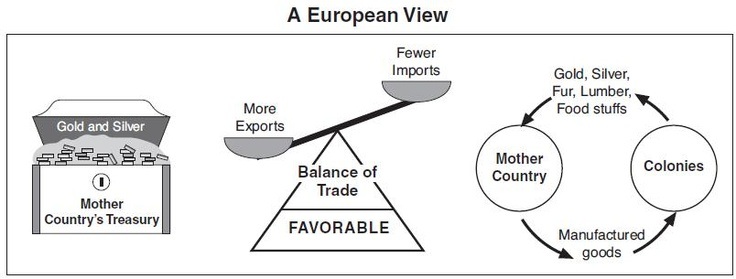
What is mercantilism?
A system where a mother countries gains money and power from natural resources that come from its colonies.
where colonies trade gold and silver with each other.
Wars that start over money.
Plantation colonies trading slaves for money.
Which food did African Americans NOT bring to America?
Corn
Okra
Watermelon
Yams
What percentage of slaves died along the middle passage
10%
20%
30%
40%
What was the significance of Thomas Paine’s pamphlet Common Sense?
It presented a convincing case for independence, using plain language.
It counteracted the Great Awakening by arguing against religion.
It clearly described how increased trade could benefit the colonies.
It considered early arguments against using slave labor in America.

This cartoon was published by Benjamin Franklin in 1754. The cartoon encouraged
States to ratify the new Constitution.
Confederate states to organize a government.
American colonies to unite in their efforts.
Britain to establish more American Colonies.
The 1763 Treaty of Paris concluded a conflict between which two colonial powers?
England and Spain
France and England
Spain and Portugal
Portugal and France
Stated that no colonists could settle in lands to the west of the Appalachian mountains-- made the colonists very upset.
Proclamation of 1763
Stamp Act
Townshend Act
Quartering Act
A group of colonists who formed a secret society to oppose British policies at the time of the American Revolution
Sons of Liberty
Daughters of Liberty
Stamp Act Congress
Committees of Correspondence
During the Battle of _________________, Americans surprised Hessian troops guarding Trenton and took most of them prisoner.
Bunker's Hill
Trenton
Saratoga
Yorktown
Ended the French and Indian War and effectively kicked the French out of North America.
Treaty of Paris (1763)
Treaty of Paris (1783)
Declaration of Independence
U.S. Constitution
(1754-1763) War fought in the colonies between the English and the French for possession of the Ohio Valley area. The English won.
French and Indian War
King Philip's War
American Revolution
French Revolution
1765; law that taxed printed goods, including: playing cards, documents, newspapers, etc.
Townshend Act
Sugar Act
Stamp Act
Tea Act
American colonists who were determined to fight the British until American independence was won
Patriots
Loyalists
Colonists
Settlers
A pamphlet written by Thomas Paine that claimed the colonies had a right to be an independent nation
Common Sense
Declaration of Independence
Olive Branch Petition
Bill of Rights
1781 American victory in Virginia that forced the British to surrender
Battle of Charleston
Battle of Cowpens
Battle of Yorktown
Battle of Saratoga
The Articles of Confederation represented the Americans' distrust of
the British
states rights
any governing authority
a strong central government
Which three rights are guaranteed by the Bill of Rights?
freedom of speech, right to work, right to petition the government.
right to bear arms, right to a speedy trial, right to an education
freedom of speech, right to bear arms, right to a speedy trial
right to vote, right to work, right to a speedy trial
This group opposed a strong central government and would not sign the Constitution until certain rights were guaranteed to individuals and states.
Native Americans
Anti-Federalists
Industrialists
The British
A group of individuals with broad common interests who organize to nominate candidates for office, win elections, conduct government, and determine public policy.
Political Party
Federalists
Democratic-Republicans
Virginia and Kentucky Resolutions
The national anthem of the United States written by Francis Scott Key, inspired by the battle of Fort McHenry.
The Star Spangled Banner
Pledge of Allegiance
Monroe Doctrine
Jay's Treaty
Group of officials who head government departments and advise the President.
Cabinet
Advisors
Departments
Branches
"Father of the Constitution," Federalist leader, and fourth President of the United States.
George Washington
Thomas Jefferson
James Madison
James Monroe
In the first half of the 20th century (early 1900s), literacy tests, poll taxes, and grandfather clauses were passed by the southern states in order to
deny the right to vote to women
end the Reconstruction Era
deny the right to vote to African Americans
help pay for the growing New Deal programs
The US Supreme Court case Plessy v. Ferguson, determined that segregation was acceptable under the condition that...
all children receive permission to attend the same school
whites receive higher quality facilities and services than blacks
the segregation laws did not spread outside of the Southern states
the separate facilities or services for both races be of equal quality

I was jailed for sitting in the "whites only" section of a rail car; I sued claiming my 14th & 15th Amendment rights had been violated.
Homer Plessy
Alonzo Herndon
W.E.B. DuBois
Booker T. Washington
Which of the these was a precedent set by the first President of the United States, George Washington?
the popular election of the President
the tradition of only serving two terms
naming nine Justices to the Supreme Court
addressing the Chief Executive as "Your Highness"
As the first president, George Washington's decisions regarding selecting a Cabinet and serving two terms are all examples of
following Constitutional laws
precedents he made that future presidents followed.
early mistakes that were changed by later presidents.
extending presidential powers not explicitly given to the President
Who was Alexander Hamilton's primary political rival while serving in Washington's cabinet? He later became the founder of the Democratic-Republican Party and our nation's third president.
Henry Knox
Abraham Lincoln
George W. Clinton
Thomas Jefferson
Which of these BEST describes the purpose of the Alien and Sedition Acts?
They prevented people from becoming citizens of the United States.
They provided a means to safely protect the country from French invasion.
They were meant to punish the Federalists who supported the National Bank.
They were aimed at people who were criticizing President Adams and the Federalists.
The Louisiana Purchase of 1803
was a major cause of the Spanish-American War.
pushed the Spanish below the Rio Grande in North America.
resulted in increased conflict between the U.S. and France.
almost doubled the area of the U.S. and gave it control of the Mississippi River.

Which area on the map was purchased from France in 1803?
1
2
3
4
In the War of 1812, the United States:
fought Mexico for territory in the Southwest.
gained the Florida territory from the Spanish.
fought France for control of the Louisiana Territory.
responded to England’s attempts to restrict US trade in Europe.

The main purpose of the route seen here was to
make new roads in a new land.
help Indians relocate to western lands.
explore the newly-acquired U.S territory.
make routes to newly discovered gold in California.
After his first term, John Adams was defeated in the election of 1800 by
James Madison
Thomas Jefferson
George Washington
Alexander Hamilton

Who was the president of the Confederate States of America?
Abraham Lincoln
Ulysses S. Grant
Jefferson Davis
Robert E. Lee

Control of this waterway was an important part of the North's strategy to win the war
Ohio River
Tennessee River
Missouri River
Mississippi River
What battle was the single bloodiest battle in US history?
Antietam
Shiloh
Gettysburg
Vicksburg
The name given to the South
Confederacy
Rebels
Union
Revolutionaries
The Missouri Compromise
created rules for all new territories regarding slavery
allowed slave states to come in without a free state to balance them out
maintained the balance of slave and free states
established rules for statehood in the Mexican Cession

According to the Kansas-Nebraska Act, what would decide whether the territories became a free or a slave state?
popular sovereignty
the 36'30" parallel
one would be a slave state, the other a free state
Rock, Paper, Scissors
what did General Sherman do?
start a war
destroy most of Georgia
killed people
taught math
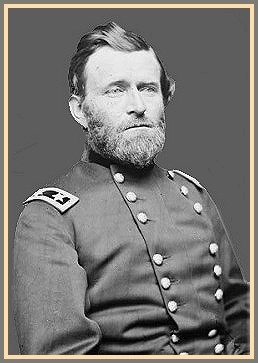


What industry contributed to rapid growth in the steel and oil industries?
Automobile
Electrical Power
Coal
Railroad
This man controlled the steel industry during the Gilded Age
Andrew Carnegie
John D Rockefeller
JP Morgan
Cornelius Vanderbilt
This is a term for when one company controls the majority of an industry
Monopoly
Merger
Corporation
Company
This man owned Standard Oil and controlled 90% of the oil industry during the Gilded Age
Andrew Carnegie
Cornelius Vanderbilt
John D Rockefeller
JP Morgan
This invention made it possible to send coded messages from one place to another in seconds.
telegraph
internet
electricity
Morse code
This inventor had the first two way telephone conversation in 1876, changing communications forever
Alexander Graham Bell
J. P. Morgan
Thomas Edison
Nicola Tesla
Asian immigrant were most likely to be processed here
Angel Island
The Statue of Liberty
New York City
Ellis Island
In the late 1800's, the second wave of immigrants mostly came from this region
Northern and Western Europe
Southern and eastern Europe
Asia
Africa
Many immigrants that moved to the US in the late 1800's found employment in
farms
factories
agriculture
the military
He founded one of the most successful labor unions in the United States
Samuel Gompers
John McCormick
Cornelius Vanderbilt
President Teddy Roosevelt


Book written by Upton Sinclar
The Jungle
The Octopus
History of Standard Oil
How the Other Half Lives
Subject of The Jungle
Problems such as poverty faced by people in the cities
Abuses of the railroad company on farmers
Horrible practices in Chicago Meat packing plants, such as rats on meat
Political corruption in major cities
Book written by Jacob Riis
How the Other Half Lives
The Jungle
History of Standard Oil
McClure's Magazine
Book written by Ida Tarbell
History of the Standard Oil Company
How the Other Half Lives
The Octopus
The Jungle
Legislation enacted as a result of the "The Jungle"
Pure Food & Drug Act
Tenement Housing Act
17th Amendment
21st Amendment


Booker T Washington and WEB DuBois both agreed
white people are superior
the telephone is the best invention
Education for African-Americans is important
Equal rights for all
In 1909, who helped found the NAACP?
Booker T Washington
Alexander Graham Bell
WEB DuBois
Thomas Edison

