
 Worksheets
Soils and weathering
Total questions: 22
Worksheet time: 21mins
Name
Class
Date
1.
What climate conditions would favor frost action the most?
a)
Extreme cold for long periods of time
b)
Extreme heat for long periods of time
c)
Many temperature changes above and below freezing
d)
Many temperature changes above and below 100 dgrees
2.
How does freezing water cause the weathering of rocks? The freezing water—
a)
keeps the rocks in place
b)
makes the rocks last longer
c)
expands cracks and breaks rocks
d)
causes rocks to fall in landslides
3.
All of the following are causes of physical weathering except...
a)
plant growth
b)
wind
c)
acid rain
d)
running water
4.
A marble statue is left exposed to the weather. Within a few years, the details on the statue have begun to weather away. This weathering probably is caused by...
a)
oxygen in the air
b)
carbonic acid in rainwater
c)
lichens
d)
abrasion
5.
Which type of climate will have faster chemical weathering?
a)
Hot and Wet
b)
Cold and Dry
c)
Hot and Cold
d)
Cold and Wet
6.

How do plants weather rocks?
a)
during photosynthesis
b)
when roots grow into cracks of rocks and expand the rock
c)
when the plant moves water from the roots to the leaves
7.
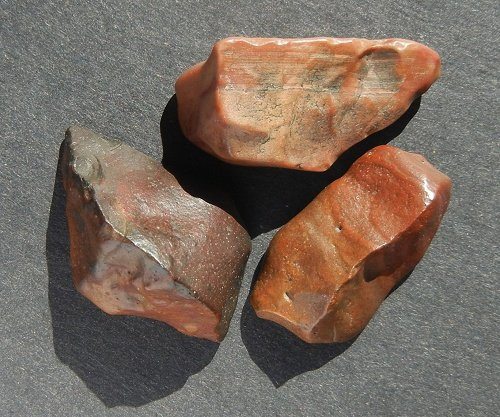
These rocks were made smooth by wind blowing smaller rock particles across their surface. This is an example of:
a)
ice wedging
b)
chemical weathering
c)
acid rain
d)
abrasion
8.

This rock may chemically weather easily because is has many spaces or holes in it that allow water to seep through it called
a)
porosity
b)
abrasive
c)
erosion
d)
unchangable
9.
A metal statue slowly turning green after years of being outside is an example of:
a)
mechanical weathering
b)
chemical weathering
10.

What is HUMUS made from?
a)
Chick-Peas
b)
The remains of decayed plants and animals
c)
Beans
d)
Cheese
11.

Soil is made of
a)
weathered rocks and minerals
b)
dead plants and animals
c)
air and water
d)
all of the above
12.
Identify the soil horizon:
Consists of topsoil rich in humus and has depleted levels of iron, aluminum and clay.
Consists of topsoil rich in humus and has depleted levels of iron, aluminum and clay.
a)
O horizon
b)
A horizon
c)
B horizon
d)
C horizon
13.

What is the layer of soil just below the topsoil? (Found in the B horizon)
a)
soil
b)
subsoil
c)
topsoil
d)
terrace farming
14.

What is the layer of soil that contains humus, leaf litter, and other organic matter? It is the last to form and is most shallow.
a)
O - Organic
b)
A - Topsoil
c)
B - Subsoil
d)
R - Bedrock
15.

Humus is.....
a)
the dead parts of plants and animals in soil.
b)
A food we eat with pretzels.
c)
The tiny particles inside of soil
d)
The roots that come off of a plant and live in soil.
16.
Which soil horizon contains large rock fragments?
a)
Horizon A - Topsoil
b)
Horizon B - Subsoil
c)
Horizon C - Weathered parent material
d)
Bedrock
17.
When there are not enough plants to hold topsoil in place, water and _______ carry the topsoil away, leaving the subsoil exposed
a)
sunlight
b)
birds
c)
magnetic fields
d)
wind
18.
Which of these would weather fastest when exposed to CARBONIC ACID
a)
Quartz
b)
Feldspar
c)
Obsidian
d)
Slate
19.
Which will weather into sediments the fastest?
a)
large rock with no cracks
b)
large rock with cracks
c)
small rock with no cracks
d)
small rock with cracks
20.
Which of these climate conditions will NOT speed up the rate of weathering?
a)
High speed winds
b)
Acidic conditions
c)
large temperature changes
d)
lake that is nearly filled
21.
Which soil is found over the original bedrock from which it formed?
a)
common soil
b)
stable soil
c)
transported soil
d)
residual soil
22.
Which soil is the most common type?
a)
common soil
b)
stable soil
c)
transported soil
d)
residual soil
100 %

