
NEW
Font size
S
M
L
XL
 Worksheets
AP CSP Midterm Review
Total questions: 29
Worksheet time: 16mins
Name
Class
Date
1.
This block takes two inputs: a function (with a blank input slot) and a list, and it reports a new list, in which each item is the result of running an item of the input list through the function.
a)
KEEP
b)
MAP
c)
COMBINE
2.
This block takes a predicate (with a blank input slot) and a list as input and creates a new list keeping only those items from the input list that match some criterion, such as "begins with a vowel," "is less than five characters long," "is even," or "is a vegetable."
a)
KEEP
b)
MAP
c)
COMBINE
3.
This block takes an operation (with two blank input slots) and a a list as input and reports a single result: the combination for all of the elements of the list when using the given operation.
a)
KEEP
b)
MAP
c)
COMBINE
4.
This block runs its script input repeatedly, just like repeat, but before each repetition it sets the variable i to a number starting with its first numeric input, adding 1 for each repetition, until it reaches the second numeric input.
a)
FOR
b)
FOR EACH
5.
This block runs its script repeatedly, just like repeat, but before each repetition it sets the variable “item” to the first item in the list and then runs again with the second item in the list and so on until the end of the list. Essentially the loop will be repeated as many times as the length of the list.
a)
FOR
b)
FOR EACH
6.
extremely large data sets that may be analyzed computationally to reveal patterns, trends, and associations, especially relating to human behavior and interactions.
a)
"Digital Divide"
b)
Algorithm
c)
GeoCaching
d)
"Big Data"
7.
an economic and social inequality with regard to access to, use of, or impact of information and communication technologies.
a)
"Digital Divide"
b)
Algorithm
c)
GeoCaching
d)
"Big Data"
8.
a self-contained step-by-step set of operations to be performed.
a)
"Digital Divide"
b)
Algorithm
c)
GeoCaching
d)
"Big Data"
9.
an outdoor recreational activity, in which participants use a GPS receiver or mobile device and other navigational techniques to hide and seek containers, called "geocaches" or "caches", at specific locations marked by coordinates all over the world.
a)
"Digital Divide"
b)
GeoTag
c)
GeoCaching
d)
"Big Data"
10.
an electronic tag that assigns a geographical location to a photograph or video, a posting on a social media website, etc. For example, when a facebook post includes the location of where the post was made.
a)
"Digital Divide"
b)
GeoTag
c)
GeoCaching
d)
"Big Data"
11.
the process of getting work or funding, usually online, from a group of people.
a)
Crowdsourcing
b)
Venture capitalist
c)
Capital
d)
Protocol
12.
an investor who either provides money to startup ventures or supports small companies that wish to expand but do not have access to equities markets.
a)
Capital
b)
Venture capitalist
c)
Algorithm
d)
Protocol
13.
Money
a)
Capital
b)
Venture capitalist
c)
Algorithm
d)
Protocol
14.
an agreed-upon format for transmitting data between two devices. It determines type of error checking and data compression used.
a)
Algorithm
b)
Pair Programming
c)
Protocol
d)
Script
15.
when two students use one computer to write a program together.
a)
Algorithm
b)
Pair Programming
c)
Variable
d)
Block
16.
something happening now or something that is being broadcast over the exact number of minutes, seconds or hours the event is taking.
a)
GeoTag
b)
GeoCaching
c)
Script
d)
"Real Time"
17.
the process of taking away or removing characteristics from something in order to reduce it to a set of essential characteristics.
a)
Abstraction
b)
GeoCaching
c)
Script
d)
"Real Time"
18.
Finding and fixing errors in programs
a)
Tech support
b)
Decompose
c)
Debugging
d)
Fixing
19.
An error in a program that prevents the program from running as expected.
a)
Error report
b)
Bug
c)
Mistake
d)
Algorithm
20.
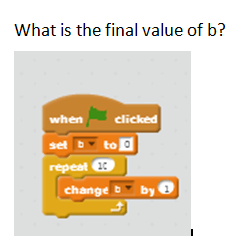
a)
0
b)
9
c)
10
d)
11
21.
What is the purpose of DNS?
a)
It assigns a unique address to every device on the Internet.
b)
It returns the IP address given the name of a website.
c)
It forwards a message from one machine to another.
d)
It has more bits so you can make a longer, unique address.
22.
What is the purpose of a router?
a)
It assigns a unique address to every device on the Internet.
b)
It returns the IP address given the name of a website.
c)
It forwards a message from one machine to another.
d)
It has more bits so you can make a longer, unique address.
23.
Why is IP v4 going to be replaced by IP v6?
a)
IP v6 is easier to use.
b)
IP v4 does not work on old hardware.
c)
IP v4 was not encrypted.
d)
We are running out of IP v4 addresses.
24.
A new or improved idea, device, product, etc, or the development thereof
a)
Innovation
b)
Protocol
c)
Latency
d)
Bandwidth
25.
Which of the following is an example of a binary question?
a)
Do you like the color red or purple?
b)
Why do you want to go to the football game tomorrow night?
c)
How do you cook a turkey?
d)
What are the steps involved in building an app?
26.
The single unit of information in a computer, typically represented as a 0 or 1.
a)
bit
b)
binary
c)
latency
d)
bandwidth
27.
Transmission capacity measure by bit rate is the _____________.
a)
bandwidth
b)
latency
c)
binary message
d)
protocol
28.
The number of bits that are conveyed or processed per unit of time. (For example, 8 bits/sec.)
a)
bit rate
b)
bit
c)
binary rate
d)
bit protocol
29.
A response that can only be 1 of 2 possible values is a ____________.
a)
binary question
b)
binary image
c)
binary message
d)
binary response
Reset

