
NEW
Font size
S
M
L
XL
 Worksheets
Domain One Economics
Total questions: 64
Worksheet time: 1hrs 23mins
Name
Class
Date
1.
Economics is the study of how people seek to satisfy their needs and wants by making choices.
a)
True
b)
False
2.
Human made objects used to create other goods and services
a)
Physical Capital
b)
Human Capital
3.
Knowledge and skills a worker gains through education and experience
a)
Physical Capital
b)
Human Capital
4.
____________ are all the alternatives we give up whenever we choose one course of action over another.
a)
Opportunity Costs
b)
Trade Offs
5.
The next best alternative that you could have chosen is referred to as _____________.
a)
Choice
b)
Opportunity Cost
6.
Which of the following will shift the PPF to the right
a)
Reading more books
b)
More people have moved to the country
c)
A storm destroys the land.
d)
A computers stop working and all robots no longer work.
7.
Which is NOT a Factor of Production?
a)
Land
b)
Capital
c)
Money
d)
Labor
8.

What are three types of economic systems?
a)
Free Enterprise, Communist and Socialist
b)
Theocratic, Democracy and Dictatorship
c)
Monarchy, Democracy and Republic
d)
Urban, Rural and Industrial
9.
Which is NOT a characteristic of a Market Economy?
a)
Property Rights
b)
Freedom of Enterprise
c)
Competition
d)
Freedom of the Press
10.
Burger King and McDonalds keep their prices low because of
a)
Competition
b)
Property Rights
c)
Limited Role of Government
d)
Freedom of Enterprise
11.

How does a free market economy view property rights?
a)
There are many limitations to owning private property
b)
No citizen has the right to own private property
c)
All property is public
d)
Private property is respected and kept secure
12.

How would a free market economy be described?
a)
An economy in which decisions are made by the government.
b)
The international exchange of goods.
c)
An economy based on supply and demand with little or no government control
d)
An economy that is communist
13.

Which is NOT a role of the government?
a)
The government provides public goods
b)
The government prevents any unfair advantages of businesses
c)
All economic activity is controlled by the government
d)
The government protects consumers
14.

Which is NOT a freedom of a free market economy?
a)
No taxes on goods
b)
Freedom to produce and sell anything
c)
Freedom of prices on goods (to an extent)
d)
Little government involvement
15.

In this type of economy, the individual decides who to sell their products to.
a)
Traditional
b)
Mixed
c)
Market
d)
Command
16.

The government has little to no role in the production of goods in this type of economy.
a)
Traditional
b)
Mixed
c)
Command
d)
Market
17.
What type of economic system allows government and private businesses to make economic decisions?
a)
Market
b)
Mixed
c)
Traditional
d)
command
18.
What type of economic system allows the government to decide what to produce, how to produce and for whom to produce?
a)
Market
b)
Mixed
c)
Command
d)
Traditional
19.
What type of economic system is based on customs and beliefs?
a)
Market
b)
Mixed
c)
Traditional
d)
command
20.
Communist countries have what type of economic system?
a)
Market
b)
Mixed
c)
Command
d)
Traditional
21.
People that buy a product
a)
Consumers
b)
producers
c)
goods
d)
services
22.
People that make a product
a)
consumers
b)
producers
c)
goods
d)
services
23.
A system that uses bartering or trading.
a)
Mixed
b)
Market
c)
Traditional
d)
command
24.
What term describes the tools and technology used to make a product?
a)
capital goods
b)
human capital
c)
exports
d)
imports
25.
A person that takes a risk by starting a new business.
a)
human capital
b)
capital goods
c)
entreprenuer
d)
tariff
26.
In a command economic system, who makes decisions on cost and ownership?
a)
the government
b)
the community
c)
buyers and sellers
d)
none of the above
27.
Which of these is the main principle behind a market economy?
a)
supply and demand
b)
barter and trade
c)
governmental control
d)
none of the above
28.
In which type of society would we most likely find a traditional economic system?
a)
a major city
b)
an established country
c)
rural and under-developed territory
d)
all of the above
29.
What type of economic system allows private businesses to decide what to produce, how to produce and for whom to produce?
a)
Market
b)
Mixed
c)
Command
d)
Traditional
30.
What are two advantages that a market economy has over a mixed economy?
a)
more limits on profits
b)
more control over prices and wages
c)
more security and equity for producers and consumers
d)
more freedom and efficiency for producers and consumers
31.
In a market economy, what does a producer mean when it asks, "Is there a market for my products?"
a)
"Is there a place where we can sell our products?"
b)
"Is our product being made more cheaply overseas?"
c)
"Will consumers need and want to buy our products?"
d)
"Will the government support demand for our products?"
32.
A government institutes a rule that schools are allowed to sell whatever foods it chooses, provided that those foods are not high in sugar. Such a ruling is aligned with which economic system?
a)
command
b)
market
c)
mixed
d)
traditional
33.
PPC stands for...
a)
Production Possibilities Curve
b)
Production Possibilities Cat
34.
What is the production possibilities curve?
a)
a graph that shows how much an economy can produce between 2 goods
b)
how much money something is
c)
the opportunity one has to give up in order to gain something else
d)
land, labor, capital, entrepreneurs
35.
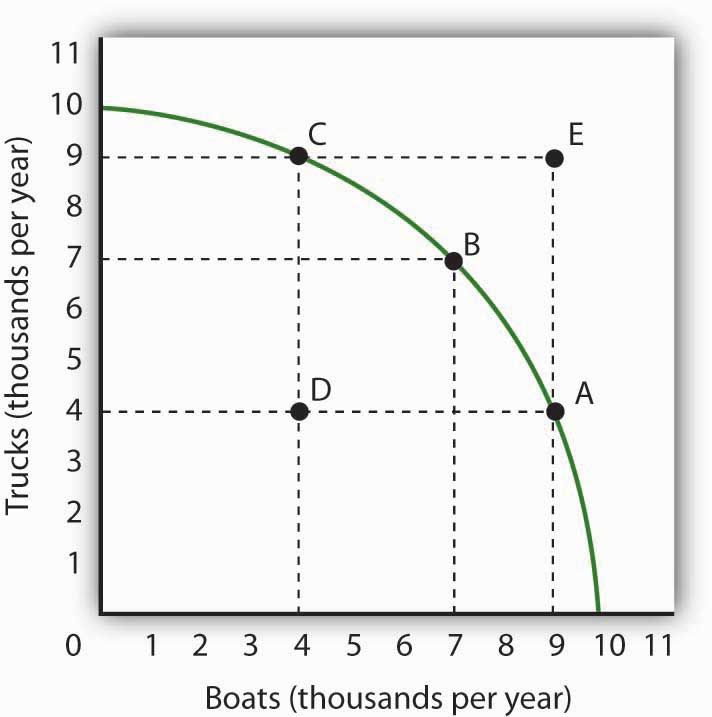
The opportunity cost of increasing production from 7 to 9 trucks is
a)
Scarcity
b)
2 boats
c)
2 trucks
d)
3 boats
36.

The opportunity cost of increasing production from 4 to 7 boats is
a)
1 boat
b)
2 boats
c)
2 trucks
d)
3 trucks
37.
Which of the following would consumers MOST OFTEN need to consider when trying to make a rational economic decision?
a)
The impact of government subsidies
b)
Potential opportunity costs
c)
Externalities
d)
Net Exports
38.
If a natural disaster strikes, the production possibilities curve can shift
a)
No shift
b)
To the left
c)
To the right
d)
Outward on one axis only
39.
If a mass immigration occurs, the production possibilities curve can shift
a)
No shift
b)
To the left
c)
To the right
d)
Outward on one axis only
40.
What can cause a production possibilities curve to move to the right?
a)
thousands of people move out of the country
b)
an epidemic kills thousands of young men and women
c)
a new technology that makes the business runs better
d)
the population is growing increasingly old
41.
Tradeoffs, Opportunity costs, marginal costs, marginal benefits, and personal priorities are all important to consider when
a)
Dealing with fiscal policy
b)
Using credit
c)
making a rational economic choice
d)
responding to monetary policy
42.
David decides to start his own business. He opens a shop that manufactures sports equipment. He pays Frank an hourly wage to make baseball bats, and Gene a salary to manage his finances. Three days after his grand opening, he is ecstatic because Mike, who runs the town's parks and recreation department, calls him and orders equipment for six Little League baseball teams. Which of the following statements is TRUE?
a)
Davis is a producer, Frank is labor, Gene is the entrepreneur of the business, and Mike has just ordered capital goods.
b)
David is producer, Frank and Gene are consumers, and Mike has just made an investment.
c)
David is a the entrepreneur, Frank and Gene are both labor, and Mike is a consumer.
d)
Frank and Gene are both entrepreneurs, David is the owner, and Mike has just made a capital investment
43.

What does point B represent?
a)
Production at greater than the country's minimum potential
b)
Production is less than the country's minimum potential
c)
Production is greater than the country's maximum potential
d)
Production at the country's maximum potential
44.
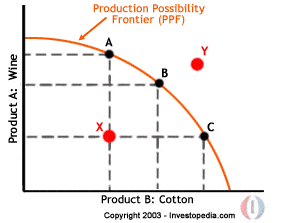
What does point Y represent on the PPC?
a)
Efficiency
b)
Unattainable / impossible
c)
Inefficency
d)
Nothing
45.
A point inside the PPC indicates
a)
Full and efficient utilization of resources
b)
inefficient utilization of resources
c)
Full Employment
d)
Both B & C
46.
What influences productivity, economic growth, and future standards of living?
a)
Government Regulations
b)
Public goods and services
c)
Factories, machinery, technology, and education
d)
Income, full employment, and market failures
47.
What is opportunity cost?
a)
a graph that shows how much an economy can produce between 2 goods
b)
how much money something is
c)
the opportunity one has to give up in order to gain something else
d)
land, labor, capital, entrepreneurs
48.
On your graph paper, compare the following two goods: iPhones and iPods. Mark the point 20 iPods and 0 iPhones. Mark the point 0 iPods and 10 iPhones. Draw a line between the two. If you produce 18 iPods, how many iPhones can you produce?
a)
0
b)
1
c)
10
d)
20
49.
Which of the following is a service?
a)
car
b)
shoes
c)
teacher
d)
computer
50.
Which of the following is a service?
a)
car
b)
shoes
c)
teacher
d)
computer
51.
A buy one get one free sale at a shoe store is an example of what economic concept?
a)
incentive
b)
profit
c)
choice
d)
opportunity cost
52.
The act of assuming the risk of organizing productive resources to produce goods and services.
a)
business
b)
critical thinking
c)
entrepreneurship
d)
risk management
53.
Who created Facebook?
a)
Mark Zuckerberg
b)
Elon Musk
c)
JK Rowling
d)
Walt Disney
54.
Which one of these is NOT a characteristic of an entrepreneur?
a)
risk taker
b)
idea person
c)
generalist
d)
specialist
55.
Any reward or benefit that motivates people to do something.
a)
incentive
b)
money
c)
bonus
d)
financial gain
56.
Exclusive rights given to the inventor of a product, for a specific period of time, to protect them from others copying their product.
a)
copyright
b)
trademark
c)
patent
d)
exclusivity rights
57.
Exclusive rights to symbols or designs.
a)
trademark
b)
patent
c)
copyright
d)
exclusivity rights
58.
Successful entrepreneurs enjoy their work and often start their businesses so that they can share their interests and enthusiasm with others. In other words, successful entrepreneurs have __________ what they do.
a)
reservations about
b)
concerns about
c)
apathy for
d)
passion for
59.
Even when times are tough for Caitlin's business venture, she tends to remain positive—she looks at the glass as half full rather than half empty. What characteristic of entrepreneurship is Caitlin exhibiting?
a)
Organization
b)
Optimism
c)
Innovation
d)
Determination
60.
Jack, a manager, said to his staff, "I know that many of you think that this is a risky course of action. But, I've decided that we should proceed. If this is successful, it could greatly benefit the company. If it fails, I'll accept the consequences and work to find a new solution." What is Jack doing?
a)
Requesting that his staff support his decision
b)
Indicating that he doesn't think he's made a good decision
c)
Asking his staff to share the blame, if the action fails
d)
Accepting responsibility for his decision
61.
Producers are
a)
People that make products/services
b)
Entrepreneuers
c)
Consumers
d)
Tired people
62.
As a new business owner, Thomas is willing to work long hours, watch his spending, and sacrifice his social life to focus on building his clientele. What entrepreneurial trait is Thomas exhibiting
a)
Objectivity
b)
Humility
c)
Organization
d)
Determination
63.
BONUS Question!
What is Mrs. Cromers son's middle name?
What is Mrs. Cromers son's middle name?
a)
Chainsaw
b)
Stihl
c)
Steele
d)
Steel
64.
Which country does Dr. hail?
a)
Kenya
b)
Africa
c)
Lagos
d)
Alabama
Reset

