wayground logo

Free Printable Worksheets

Font size

S
M
L
XL
Worksheets

Unit 4: Surface Processes Review

Total questions: 39

Worksheet time: 46mins

Name
Class
Date
1.
The process by which water, ice, wind or gravity moves weathered rock and soil from one place to another.
a)
weathering
b)
erosion
c)
deposition
d)
dumptruck
2.
This type of weathering occurs when rock is physically broken down into smaller pieces of rock.
a)
mechanical weathering
b)
chemical weathering
c)
erosion weathering
d)
deposition
3.

This type of weathering occurs when sediments are changed into a new substance through chemical processes.

a)

mechanical weathering

b)

chemical weathering

c)

erosion weathering

d)

deposition

4.

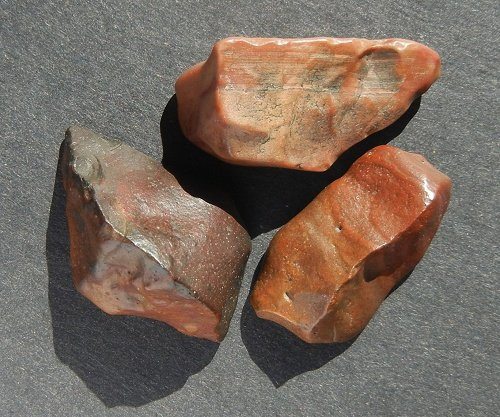
These rocks are smooth because of wind blowing smaller particles across their surfaces. This is an example of:

a)

ice wedging

b)

chemical weathering

c)

acid rain

d)

wind abrasion

5.

These rocks were broken apart from the continuous freeze/thaw of water in the cracks of the rocks. This is an example of:

a)

frost action

b)

acid rain

c)

permeability

d)

abrasion

6.
How is mechanical weathering different from chemical weathering?
a)
Chemical weathering happens over much shorter time frame than mechanical weathering.
b)
Chemical weathering changes the chemical composition of rocks; mechanical weathering does not.
c)
Chemical weathering occurs only in tropical climates; mechanical weathering occurs only in cool climates.
d)
Chemical weathering occurs only in the mountains; mechanical weathering occurs only on flat land.
7.
Potholes forming in the road after a cold winter is an example of:
a)
mechanical weathering
b)
chemical weathering
8.
A metal statue slowly turning green after years of being outside is an example of:
a)
mechanical weathering
b)
chemical weathering
9.
Deposition changes the Earth’s surface because eroded materials _____.
a)
stop the river's flow
b)
make rich farmlands
c)
are dropped in new places
d)
move very slowly
10.

A cliff formed near the ocean. Which statement best describes how this cliff formed?

a)

Warm air melted the rock.

b)

Sun rays evaporated the rock.

c)

Ocean waves eroded the rock.

d)

Plant roots pushed away the rock.

11.
What has the greatest erosion effect on our beaches?
a)
waves
b)
gravity
c)
glaciers
d)
wind
12.
The process of carrying away weathered bits of rocks is called
a)
weathering
b)
erosion
c)
deposition
13.

A mudslide flowing down a steep hill is called?

a)

Weathering

b)

Abrasion

c)

Deposition

d)

Mass movement

14.
Deltas forming at the mouths of rivers is called?
a)
Weathering
b)
Erosion
c)
Deposition
15.

This depositional feature forms at the mouth of rivers where sediment is horizontally deposited into a triangular, branch-like shape.

a)

landform

b)

delta

c)

canyon

16.
What is groundwater?
a)
any form of liquid water
b)
water that is not moving
c)
water on Earth's surface
d)
water below Earth's surface
17.

Curves in a stream are known as:

a)

till

b)

meanders

c)

eskers

d)

deltas

18.
What is an enormous mass of ice moving over land?
a)
glacier
b)
iceberg
c)
ice wedging
d)
dune
19.

Unsorted sediment deposited by a glacier is known as a:

a)

Accumulation

b)

Ablation

c)

Moraine

d)

Glacier

20.
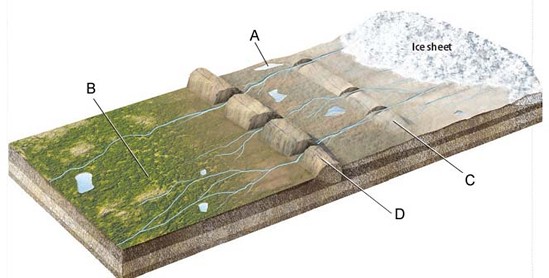
What glacial features are indicated by the labels C and D on the figure?
a)
moraines
b)
outwash plains
c)
kettle lakes
d)
ice sheets
21.

The type of valley formed by a glacier is known as a:

a)

U-Shaped Valley

b)

V-Shaped Valley

22.

These are formed when chunks of ice are broken off a glacier, sink the land surface, and melt.

a)

Moraine

b)

Prairie pothole

c)

Kettle Lake

d)

Fjord

23.

When a horseshoe shaped lake is cut off from a river by deposition, this is known as an

a)

Oxbow Lake

b)

Kettle Lake

c)

Terminal Moraine

d)

Esker

24.

In a meander, where does the most erosion take place?

a)

Inside the curve

b)

Outside the curve

25.

In a meander, where does the most deposition take place?

a)

Inside the curve

b)

Outside the curve

26.
The area that contains a river system is called a _________.
a)
Drain Bassoon
b)
Drainage Basinet
c)
Drainage Basin
d)
Drain Basalt
27.
As the current in a stream becomes stronger, what will happen to its erosional power?
a)
it will increase
b)
it will decrease
c)
it will stay the same
d)
it will increase then decrease
28.
Valleys created by down-cutting streams are ___- shaped
a)
W
b)
U
c)
V
d)
Y
29.
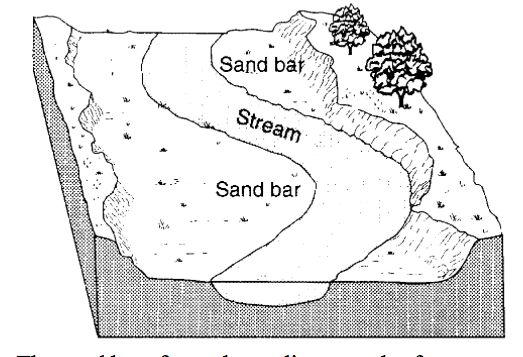
The diagram below shows a portion of a stream. The sand bar formed as a direct result of 
a)
erosion due to a decrease in stream velocity 
b)
erosion due to an increase in stream velocity
c)
deposition due to a decrease in stream velocity
d)
deposition due to an increase in stream velocity 
30.
Sediments are deposited in a river delta because the 
a)
velocity of the river decreased
b)
force of gravity decreased
c)
volume of the river increases
d)
gradient of the river increases
31.
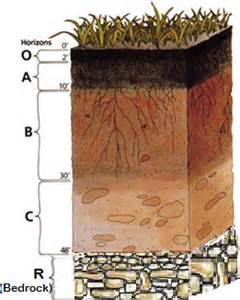
What is the name of Horizon 1?
a)
Subsoil 
b)
Topsoil
c)
Bedrock 
d)
Parent Rock
32.
What is the name of Horizon 4?
a)
Subsoil 
b)
Topsoil
c)
Bedrock 
d)
Parent Rock
33.

Which horizon contains most of the humus (organic matter)?

a)

Horizon A

b)

Horizon B

c)

Horizon C

d)

Horizon D or R

34.
Mass movement is MOSTLY caused by:
a)
water
b)
wind
c)
gravity
d)
weather
35.
A stream’s velocity decreases from 100 cm/s to 5cm/s. Which size sediment particles will still be transported by the stream?
a)
pebbles, sand, silt and clay
b)
sand, silt and clay only
c)
silt and clay only
d)
clay only
36.
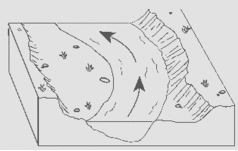
The diagram below shows a section of a meander in a stream. The arrow shows the direction of stream flow. The stream bank on the outside of this meander is steeper than than the stream bank on the inside of this meander because the water on the outside of the meander is moving
a)
Slower, causing deposition
b)
Faster, causing deposition
c)
Slower, causing erosion
d)
Faster, causing erosion
37.

In a meander, the inside curve has a

a)

steeper slope

b)

gentle slope

38.

In a meander, the outside curve has a

a)

steeper slope

b)

gentle slope

39.

A stream’s velocity decreases from 100 cm/s to 5 cm/s. Which sediment will be deposited ?

a)

pebbles

b)

sand

c)

silt

d)

clay