
 Worksheets
Science Review
Total questions: 63
Worksheet time: 2hrs 3mins
Name
Class
Date
1.

The sand castle will most likely be destroyed by the water from -
a)
Wind
b)
Low Tide
c)
High Tide
d)
Air Pressure
2.

The Moon's orbit causes which of the following changes on Earth?
a)
Night and Day
b)
Tides
c)
Eclipses and Erosion
d)
Seasons
3.

At which position is the Earth experiencing summer?
a)
A
b)
B
c)
C
d)
D
4.

At which position is the Earth experiencing winter?
a)
A
b)
B
c)
C
d)
D
5.

At which position is the experiencing fall?
a)
A
b)
B
c)
C
d)
D
6.

At which point is the Earth experiencing spring?
a)
A
b)
B
c)
C
d)
D
7.

What is the cause of the seasons?
a)
Tilt of the Earth's axis
b)
Distance of the Earth from the Sun
c)
Changing weathering patterns
d)
Changes in the Sun's temperature
8.

At what time of day does the Washington Monument cast its longest shadow in the reflecting pool?
a)
11:00 am
b)
1:00 pm
c)
3:00 pm
d)
5:00 pm
9.

In which direction does the Sun appear to move across the sky?
a)
West to East
b)
North to South
c)
East to West
d)
South to North
10.

Based on a normal compass, what time of day could it be?
a)
Sunrise
b)
Sunset
c)
Midnight
d)
Noon
11.

Based on a normal compass, what time of day could it be?
a)
Sunrise
b)
Sunset
c)
Midnight
d)
Noon
12.

Based on a normal compass, what time of day could it be?
a)
5:00 am
b)
10:45 am
c)
12:00 pm
d)
3:00 pm
13.

Why does the Sun appear to rise and set each day?
a)
The Earth rotates once on its axis each day.
b)
The Earth revolves around the Sun once each day.
c)
The Sun revolves around the Earth each day.
d)
The Sun rotates on its axis once each day.
14.

Which of the following happens once every 24 hours?
a)
Earth makes one complete rotation around the Sun.
b)
The Earth makes one complete rotation on its axis.
c)
The Moon makes one complete orbit around the Earth.
d)
The Moon makes one complete rotation around the Sun.
15.

What is a common characteristic of the inner planets?
a)
Large
b)
Gaseous
c)
Rings
d)
Rocky Surface
16.

The order of the planets is:
a)
Mars,Venus,Earth,
Mercury,Saturn
Jupiter, Uranus, Neptune
Mercury,Saturn
Jupiter, Uranus, Neptune
b)
Earth,Venus,Mars
Jupiter, Neptune,
Mercury,Saturn,
Uranus
Jupiter, Neptune,
Mercury,Saturn,
Uranus
c)
Mercury,Venus,Earth
Mars,Jupiter,
Saturn,Uranus
Neptune
Mars,Jupiter,
Saturn,Uranus
Neptune
17.

Which planet is covered in water?
a)
Mercury
b)
Venus
c)
Earth
d)
Mars
18.

What force keeps the planets orbiting the sun?
a)
Gravity
b)
Magnetism
c)
Electricity
d)
Friction
19.

A student observes ice forming on the edge of a school building. At what temperature did the water outside the school building most likely begin to change to ice?
a)
100 C.
b)
32 C.
c)
25 C.
d)
0 C.
20.

Which of these organisms is best suited for the terrarium?
a)
Blue jay
b)
Lobster
c)
Snail
d)
Water lily
21.
Each school year for 30 years, the amount of rain that fell at a school was measure and recorded. Tracking rainfall over a long period provides the most information about which characteristic of an area?
a)
Climate
b)
Temperature of the day
c)
Weather
d)
Type of soil
22.

Most cars have lights, power locks, radios, and other equipment that use electricity. Electric circuits power this equipment. Each circuit has a fuse that completes it. Which of these describes one thing that could happen if the wire in a car fuse burns out?
a)
The car’s lights will burn brighter.
b)
The car’s radio will not work.
c)
The car’s turn signal will blink too slowly.
d)
The car’s power windows will open faster.
23.

The diagram above shows the process of evaporation over the ocean. What is the most likely effect of this process on the land areas nearby?
a)
Increased drought conditions
b)
Decreased erosion of the shoreline
c)
Increased precipitation
d)
Decreased solar energy
24.

A group of students built the circuit shown below. The light bulb does not glow. Which statement explains this observation?
a)
The bell uses most of the energy from the battery.
b)
The light bulb is not part of a complete circuit.
c)
The battery is not charged.
d)
The circuit does not have a switch.
25.

A student looks into a mirror and sees an image of an object. Which diagram shows an X where the object is most likely located?
a)
F
b)
G
c)
G
d)
J
26.

If students could rotate the globe quickly or slowly and the globe could rotate only at the rate that Earth actually rotates, about how long would each complete rotation take?
a)
30 Days
b)
60 Minutes
c)
24 Hours
d)
365 Days
27.

Which property of light makes it possible to produce hand shadows?
a)
Light travels in straight lines.
b)
Light is a form of energy.
c)
Light can be refracted.
d)
Light can be separated into different colors.
28.

a)
Close Switches 1 and 2 and leave Switch 3 open
b)
Close Switch 3 and leave Switches 1 and 2 open
c)
Close Switches 2 and 3 and leave Switch 1 open
d)
Close Switch 2 and leave Switches 1 and 3 open
29.

What is the volume of the rock? The water level is displaced from 20 mL to 23 mL with the rock.
a)
3 mL
b)
23 mL
c)
20 mL
d)
43 mL
30.

Which liquid has the greatest density?
a)
lamp oil
b)
karo syrup
c)
water
d)
honey
31.

Lemonade is an example of a...
a)
Mixture
b)
Solution
32.

Lucky Charms and milk is an example of a...
a)
Mixture
b)
Solution
33.
It takes Earth _________ to make one complete rotation on its axis.
a)
24 hours
b)
365 days
c)
28 days
d)
24 days
34.
The rotation of Earth on its axis causes the pattern of _____.
a)
night and day
b)
constellations
c)
Earth's seasons
d)
the phases of the moon
35.
The imaginary line running through the center of Earth.
a)
axis
b)
moon
c)
constellation
d)
orbit
36.

The Moon and Earth are represented in the picture. Which object represents the moon?
a)
The basketball
b)
The tennis ball
c)
Neither object
37.
The moon is mostly made of
a)
water
b)
rock
c)
cells
d)
tropical rain forest
38.
One thing the Earth and moon have in common is
a)
both have the same atmosphere
b)
both are home to living things
c)
neither has a supply of water
d)
both have rocks
39.
The Earth is a
a)
living organism
b)
planet
c)
comet
d)
star
40.

If it is day on one side of Earth, then what is happening on the other side of Earth?
a)
It is day there, too!
b)
It is raining.
c)
It is very hot.
d)
It is night.
41.

Which of these best shows that the Earth revolves around the sun as the moon revolves around the Earth?
a)
Picture A
b)
Picture B
c)
Picture C
d)
Picture D
42.
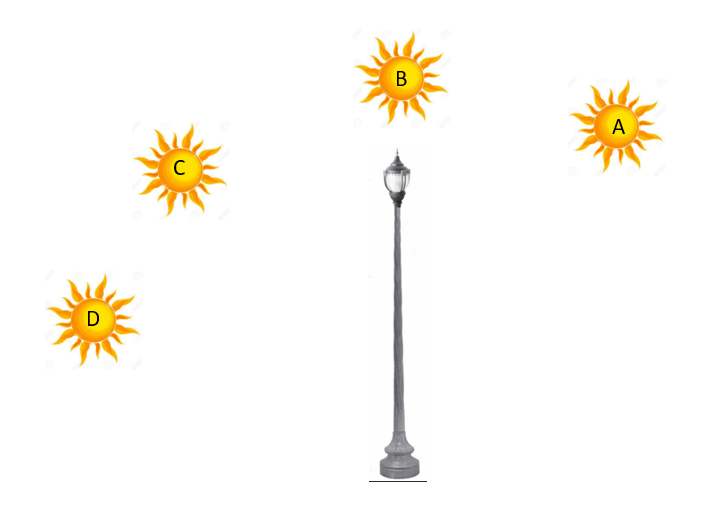
At which location of the sun would the shadow of the lamp post be the shortest?
a)
A
b)
B
c)
C
d)
D
43.
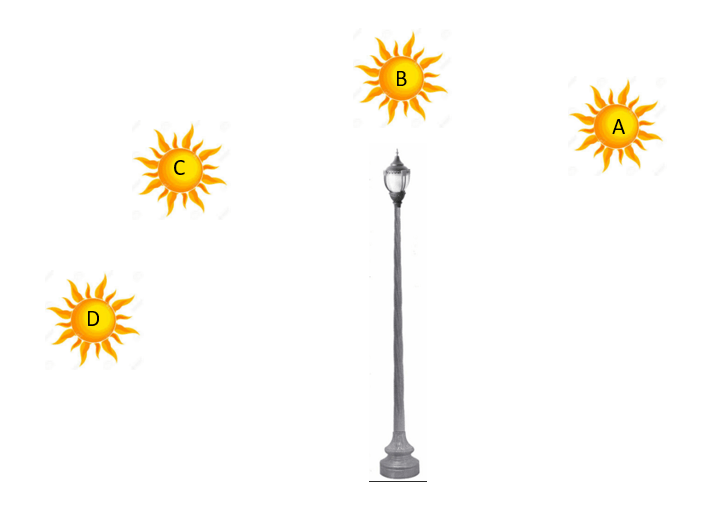
At which location of the sun would the shadow of the light pole be the longest?
a)
A at 11 a.m
b)
B at noon
c)
C at 2 p.m.
d)
D at 6 p.m.
44.

What are the outer planets made up of?
a)
Gas
b)
Rings
c)
Rocks
d)
Moons
45.
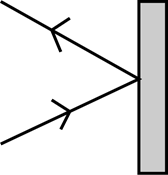
The illustration shows a light ray striking an object.
In the illustration, the light ray striking the object is-
In the illustration, the light ray striking the object is-
a)
absorbed
b)
stopped
c)
reflected
d)
refracted
46.

The pictures shows what a student observed when he looked through a hand lens at a penny.
What happens to light passing through a hand lens that makes the image of the penny appear larger? The light is-
What happens to light passing through a hand lens that makes the image of the penny appear larger? The light is-
a)
absorbed
b)
reflected
c)
refracted
d)
stopped
47.

A student placed a pencil in a cup of water. The pencil appears broken because light-
a)
always travels in a straight line
b)
bends when it passes through water
c)
makes the water in the glass evaporate
d)
reflects the pencil on the water's surface
48.

According to the Law of reflection, a light ray striking a mirror
a)
continues moving through the mirror in the same direction
b)
moves into the mirror at a slightly different angle
c)
bounces off the mirror toward the direction it came from
d)
bounces off the mirror at the same angle it hits.
49.

What is this image an example of?
a)
Reflection
b)
Diffusion
c)
Refraction
50.

a)
Reflection
b)
Refraction
51.
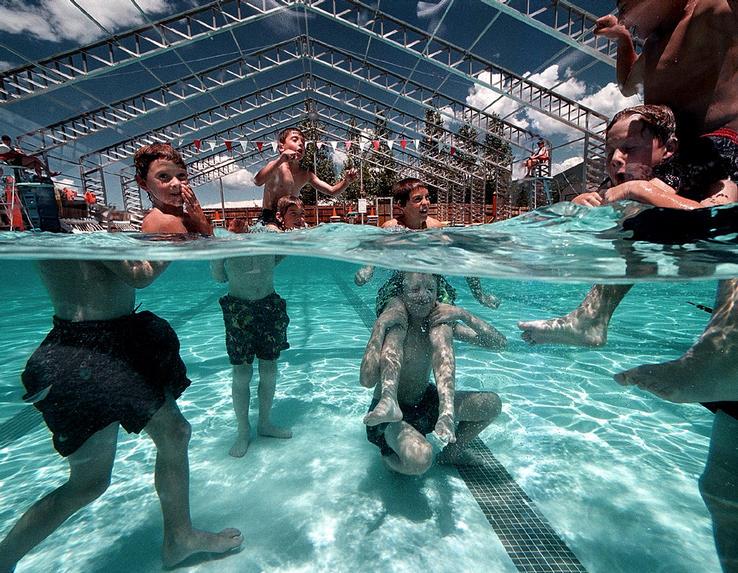
Why does the lower part of the child appear so much different in size from the upper part?
a)
The light rays that travel through water and then into air are refracted.
b)
The light rays that travel through water and then into air are enlarged.
c)
The light rays that travel through air and then into water are reflected.
d)
The light rays that travel through air and then into water are reduced.
52.

a)
Reflection
b)
Refraction
53.

a)
Refraction
b)
Reflection
54.

a)
Reflection
b)
Refraction
55.

a)
Reflection
b)
Refraction
56.

a)
Refraction
b)
Reflection
57.

a)
Reflection
b)
Refraction
58.

a)
Reflection
b)
Refraction
59.

a)
Reflection
b)
Refraction
60.

a)
Reflection
b)
Refraction
61.

a)
Reflection
b)
Refraction
62.

a)
Reflection
b)
Refraction
63.

a)
Reflection
b)
Refraction
100 %

