
 Worksheets
6.1-6.2 Solar System
Total questions: 58
Worksheet time: 2hrs 58mins
Name
Class
Date
1.
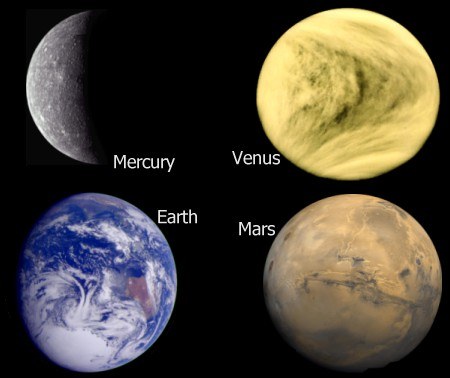
Earth and the other planets closest to the Sun are made mostly of _______
a)
gas
b)
metal
c)
water
d)
rock
2.

The moon is a natural ______ of Earth.
a)
comet
b)
axis
c)
satellite
d)
space probe
3.

The __________ has one star planets, moons, comets, and asteroids.
a)
solar system
b)
universe
c)
galaxy
d)
Earth
4.
One of the main differences between the outer and inner planets is __________.
a)
The inner planets all have water
b)
the inner planets are much bigger than the outer planets
c)
the outer planets are gas planets
d)
the inner planets have rings, and the outer planets don't
5.
Where is the main asteroid belt found?
a)
between earth and mars
b)
Beyond Neptune
c)
Between Mercury and Venus
d)
Between Mars and Jupiter
6.
Select the order from smallest to largest.
a)
Sun, Milky Way, solar system, universe
b)
Sun, Milky Way, universe, solar system
c)
Sun, solar system, Milky Way, universe
d)
Sun, solar system, universe, Milky Way
7.
Which planet in our solar system is closest to the Sun?
a)
Earth
b)
Jupiter
c)
Mercury
d)
Saturn
8.
A ball of ice and dust with a tail of gas and dust pointing away from the sun.
a)
Asteroid
b)
Comet
c)
Meteoroid
d)
Meteor
9.
A small object that appears as a streak of light as it enters earth's atmosphere.
a)
Asteroid
b)
Comet
c)
Meteorite
d)
Meteor
10.
A dust size to 1000+ km rocky object orbiting the sun.
a)
Asteroid
b)
Comet
c)
Moon
d)
Meteor
11.
A natural satellite of a planet.
a)
Asteroid
b)
Comet
c)
Moon
d)
Meteor
12.

What are comets mostly made of?
a)
Rusty metal
b)
Hot, liquid rock
c)
Poisonous liquid
d)
Dirty ice and dust
13.
The _____ is found right after Neptune's orbit.
a)
Meteroid belt
b)
Kuiper Belt
c)
Oort Cloud
d)
Asteroid Belt
14.

______ are meteoroids that entered our atmosphere and hit Earth without completely burning up.
a)
Meteors
b)
Comets
c)
Meteorites
d)
Asteroid
15.
The four terrestrial planets all have
a)
Rocky surfaces
b)
Hot temperatures
c)
Deep atmospheres
d)
Large size
16.
What is the order of the planets?
a)
Mercury, Venus, Earth, Mars, Jupiter, Saturn, Uranus, Neptune
b)
Neptune, Saturn, Jupiter, Uranus, Saturn, Mars, Mercury, Earth
c)
Earth, Neptune, Saturn, Jupiter, Uranus, Mercury, Mars, Venus
d)
Jupiter, Saturn, Mercury, Earth, Mars, Uranus, Neptune,Mercury
17.
The GAS GIANTS or Outer planets are:
a)
Mercury, Earth, Jupiter, Saturn
b)
Saturn, Neptune, Pluto, Mars
c)
Saturn, Jupiter, Uranus, Neptune
d)
Earth, Mars, Saturn, Neptune
18.
The inner planets are:
a)
Jupiter, Earth, Mars, Mercury
b)
Saturn, Uranus, Mars, Earth
c)
Earth, Pluto, Neptune, Mars
d)
Mercury, Venus, Earth, Mars
19.
Why was Pluto demoted to a dwarf planet?
a)
It does not have enough gravity to be spherical
b)
It does not orbit the sun
c)
It has other objects in its area of orbit
d)
It is smaller than Eris
20.
How does the sun produce energy?
a)
Attracting it with gravity
b)
Nuclear Fusion
c)
It doesn't produce energy
d)
Nuclear Fission
21.
Chunks of rock or dust smaller than 10 meters across are known as
a)
Dwarf Planets
b)
Comets
c)
Meteoroids
d)
Asteroids
22.
What most people call a shooting star is really a(n)
a)
Star
b)
Comet
c)
Meteor
d)
Asteroid
23.
Which type of planet is mostly composed of rock and metal?
a)
Inner Planet
b)
Outer Planet
c)
Gas giants
d)
Dwarf Planet
24.
Which type of planet is further from the sun?
a)
Inner Planet
b)
Outer Planet
c)
Terrestrial Planets
d)
Rocky Planets
25.
Which type of planet is typically warmer?
a)
Inner Planet
b)
Outer Planet
c)
Dwarf Planets
d)
Gas Giants
26.
What object in the solar system is considered a dwarf planet?
a)
Mercury
b)
Mars
c)
Pluto
d)
Neptune
27.
What are left over pieces of our Solar Systems early formation called?
a)
Asteroids
b)
Planets
c)
Comets
d)
Stars
28.
The sun is a
a)
planet
b)
star
c)
asteroid
d)
solar system
29.

What is NOT a common characteristic of the outer planets?
a)
Gaseous
b)
Giant
c)
Rings
d)
Smaller than Earth
30.

An ice ball that has a very long elliptical orbit is called a _________.
a)
meteoroide
b)
asteroid
c)
Dwarf planet
d)
comet
31.
A giant sphere of glowing gases is a ___________
a)
Galaxy
b)
Light-year
c)
Star
d)
planet
32.
The unit of measurement for distances OUTSIDE the solar system is a ______________
a)
Astronomical Unit
b)
Light-year
c)
kilometer
d)
Apparent Magnitude
33.
The largest of celestial bodies that revolve around the sun are ________
a)
Planets
b)
Comets
c)
Solar Systems
d)
Asteroids
34.
Which one is not an outer planet?
a)
Jupiter
b)
Neptune
c)
Mars
d)
Uranus
35.
Which planet is not an inner planet?
a)
Earth
b)
Mars
c)
Venus
d)
Saturn
36.
Which of the following is NOT a characteristic of the Sun?
a)
It gives off heat and light.
b)
It is a ball of hot, glowing gas.
c)
It has rings and craters.
d)
It is a bright star.
37.
A girl tells her friend that the Sun is not a star. The girl says that the Sun is much bigger and brighter than the stars at night.What should the girl say to her friend to explain why the Sun does not look the same as other stars?
a)
The Sun is not a star. It's the closest planet.
b)
The Sun is a star but it's only a medium-sized star. It only looks largest because it's the closest star to Earth.
c)
The Sun is a star. It's the largest star in the galaxy.
d)
The Sun is not a star. It's a giant-sized rock.
38.
Which list of planets shows the inner planets in correct order from the Sun?
a)
Mars, Venus, Earth, Mercury
b)
Venus, Mercury, Mars, Earth
c)
Earth, Mars, Venus, Mercury
d)
Mercury, Venus, Earth, Mars
39.

Comets, Asteroids, and Meteoroids all orbit around...
a)
They don't orbit anything
b)
The Earth
c)
The Sun
d)
Each other
40.

A small space rock that makes it into Earth’s surface without burning up is called a ...
a)
Meteor
b)
Meteoroid
c)
Asteroid
d)
Meteorite
41.
A giant, close star (Star #1) will look brighter than a giant star that is far away (Star #2).
a)
True, because Star #2 is smaller.
b)
False
c)
True because Star #1 is closer.
42.
Earth is part of the _____.
a)
Oort Cloud
b)
Milky Way
c)
Kuiper Belt
d)
Asteroid Belt
43.
One astronomical unit equals _____.
a)
the average distance from Earth to the Sun.
b)
the amount of time it takes Earth to orbit the Sun.
c)
the distance to the nearest star.
d)
the amount of time it takes light to travel from the Sun to Earth.
44.
The Sun is the center of the _____.
a)
solar system
b)
Milky Way
c)
constellation Ursa Major
d)
universe
45.
Scientists use _____ to classify how bright a star appears from Earth.
a)
apparent magnitude
b)
light-years
c)
apparent motion
d)
absolute magnitude
46.

Milky Way is a
a)
solar system
b)
universe
c)
galaxy
d)
planet
47.
Where is the asteroid belt?
a)
Between the inner and outer planets
b)
Past Pluto
c)
All over our solar system
d)
Between Earth and Venus
48.

Where is a meteor located?
a)
In the atmosphere
b)
In outer space
c)
On the ground
49.

Where is a meteorite located?
a)
In the atmosphere
b)
In outer space
c)
On the ground
50.

Where is a meteoroid located?
a)
In the atmosphere
b)
In outer space
c)
On the ground
51.
What do we call a "dirty snowball" made of ice, rock, and dust?
a)
Asteroid
b)
Meteor
c)
Comet
d)
Meteorite
52.
What do we call Jupiter, Saturn, Uranus and Neptune?
a)
Gas Giants
b)
Terrestrial Planets
c)
Inner Planets
d)
Oort Cloud
53.
What do we call the distance from the Earth to the Sun?
a)
A light year
b)
An Astronomical Unit
c)
A light minute
d)
A light second
54.
Which unit of measure is best for measuring distances within our solar system?
a)
Light years
b)
Astronomical Units (AU)
c)
Miles
d)
Kilometers
55.
All of the following are found in our solar system except.
a)
the sun.
b)
Jupiter.
c)
the Milky Way.
d)
comets and asteroids.
56.
Are the planets in our solar system all equidistant from each other?
*equidistant means it is the same distance from one planet to the next across the solar system.
*equidistant means it is the same distance from one planet to the next across the solar system.
a)
Yes, they are perfectly set so that if they were lined up there would be exactly the same distance between each planet.
b)
No, the outer planets are all closer to each other than the inner planets
c)
Yes, except for Mars and Jupiter because the asteroid belt is between them.
d)
No, the inner planets are much closer together than the outer planets.
57.
What two forms of energy does the sun give off?
a)
heat and electrical
b)
heat and light
c)
potential and chemical
d)
chemical and light
58.
Distances within our solar system are measured in _______ ________, while distances outside our solar system are measured in __________ ________.
a)
astronomical units (AU); light years
b)
astronomical units (AU); kilometers (km)
c)
light years; astronomical units (AU)
d)
centimeters; meters
100 %

