wayground logo

Free Printable Worksheets

Font size

S
M
L
XL
Worksheets

Earth Systems 7th Grade

Total questions: 53

Worksheet time: 33mins

Name
Class
Date
1.
Which layer has convection currents?
a)
Inner Core
b)
Outer Core
c)
Mantle
d)
Crust
2.
Earthquakes and volcanoes are most likely found in which locations?
a)
At plate boundaries
b)
in oceans
c)
in the middle of continents
d)
in the middle of plates
3.
When one plate sides under neath another, it _________ and the magma _________.
a)
hardens, sinks
b)
melts, sinks
c)
hardens, rises
d)
melts, rises
4.

The Himalayas in Asia are an example of what type of plate boundary?

a)

divergent

b)

convergent building

c)

convergent subducting

d)

transform

5.
Transform boundaries are most likely to produce what phenomenon?
a)
volcanoes
b)
deep sea trenches
c)
underwater mountain ranges
d)
earthquakes
6.

When a plate subducts, what are two formations that can be created?

a)

ridges, and earthquakes

b)

trenches, and volcanoes

c)

mountains and trenches

7.
What is this image...
a)
Revolving boundary
b)
San Andreas (Transform)
c)
Convergent
8.
A mid-ocean ridge occurs at a ________ plate boundary.
a)
transform
b)
convergent
c)
divergent
9.
What type of boundary is the SAN ANDREAS FAULT on?
a)
Covergent
b)
Transformers
c)
Divergent
d)
Transform
10.

What is the name of the plate boundary that slides past each other?

a)

Divergent

b)

Convergent

c)

Transform

d)

Subducting

11.

Which of these events can ONLY happen on a DIVERGENT BOUNDARY?

a)

Ridges

b)

Mountain

c)

A peninsula

d)

An Insanely complex, long answer that you will click out of instinct.

12.
Mountains form from ...
a)
plates sliding past one another
b)
collision of plates
c)
plates moving away from each other
13.

The area around the Pacific Plate where boundaries form is called...

a)

death ring

b)

fire zone

c)

ring of fire

d)

zone of fire

14.
Which of the following is where one plate slides under another plate?
a)
submarine zone
b)
divergence zone
c)
subduction zone
d)
lower zone
15.

Which of the following does not support the theory of plate tectonics?

a)

different fossils on the same continent

b)

identical fossils on continents

c)

mountain ranges

d)

coastlines fit like a puzzle

16.
Crack that forms when large blocks of rock break and move past each other
a)
fault
b)
fissure
c)
hanging wall
d)
footwall
17.
The Great Rift Valley in Africa and the Mid-Atlantic Ridge were all created by this boundary
a)
Divergent
b)
Convergent
c)
Reform
d)
Transform
18.
When soil saturated with water loses its durability when pressure or stress is applied.
a)
Liquification
b)
Liquefaction
c)
Tsunami
d)
Flooding
19.
Which of the following is evidence for plate tectonics? 
a)
Matching coal deposits across continents.
b)
Matching goal deposits across continents.
c)
Matching financial deposits across continents.
d)
Matching building deposits across continents.
20.
What is the name of the supercontinent in Earth's early history?
a)
Pancake
b)
Eurasia
c)
Pangaea
d)
Panamerica
21.
One piece of evidence we have for the Theory of Plate Tectonics is _______.
a)
Fossils don't match up
b)
Seafloor spreading causes trenches
c)
Ms. Cotich loves puzzles
d)
The plates fit together like puzzle pieces
22.

When a oceanic plate subducts under a continental plate, it will form

a)

ridges

b)

volcanoes or trenches

c)

mountains

d)

cooling

23.

Which type of plate boundary would cause mountains to form

a)

Transform

b)

Convergent (building)

c)

Divergent

d)

Convergent (subducting)

24.

Who is your most favorite science teacher?

a)

Ms. Cotich

b)

Ms. Gee

c)

Ms. Malone

25.
Pangaea was an ancient supercontinent made up of...
a)
America, Greenland, and Europe.
b)
Antarctica, India, and America.
c)
all of Earth’s continents.
d)
South Africa, India, Australia, and South America.
26.
One of the fossils Wegener used to support his hypothesis of continental drift was
a)
Glossopteris
b)
Trilobite
c)
insects in tree amber
d)
ammonite molds
27.
Where are most divergent boundaries located?
a)
Along the middle of most ocean floors
b)
Along the margins of most continents
c)
Across the middle of many continents
d)
All the above options are correct
28.
The type of plate boundary where two plates come together is a .....
a)
Convergent Boundary
b)
Divergent Boundary
c)
Transform Boundary
d)
Plate Boundary
29.
Which of the following causes Earth's tectonic plates to move?
a)
Energy from the Sun
b)
Magnetic Pole Reversal
c)
Convection currents in the mantle
d)
Faults in Mountain Ranges
30.

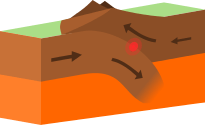
What type of plate boundary is this?

a)

Convergent building

b)

Divergent

c)

Convergent subducting

d)

Transform

31.
What type of event will occur at this boundary?
a)
Earthquake
b)
Volcano Eruption
c)
Tornado
d)
Mountain Building
32.
A divergent boundary occurs when plates ....
a)
Pull apart
b)
Come together
c)
Slide past each other
d)
subducting
33.

Oceanic ridges are formed by _______ plate boundaries

a)

Convergent

b)

Transform

c)

Plate

d)

Divergent

34.
A fault is formed by the movement of a __________ plate boundary
a)
Transform
b)
Convergent
c)
Divergent
35.
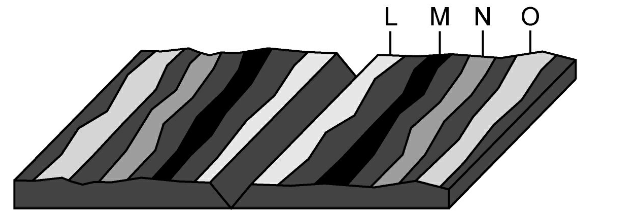
Where would the oldest rock be found?
a)
L
b)
M
c)
N
d)
O
36.
How is it possible for new crust to be formed without increasing the surface area of the Earth?
a)
Crust is destroyed at the same time it is created
b)
New crust is underwater where it sinks
c)
New crust breaks more easily than old crust
37.
Mountains are created when....
a)
Two continental plates collide
b)
Two oceanic plates pull apart
c)
An Oceanic plate subducts under a Continental Plate
d)
Two continental plates pull apart
38.
A subduction zone is formed...
a)
when one tectonic plate sinks below another
b)
at every type of convergent plate boundary
c)
at every type of divergent plate boundary
d)
at transform boundaries
39.
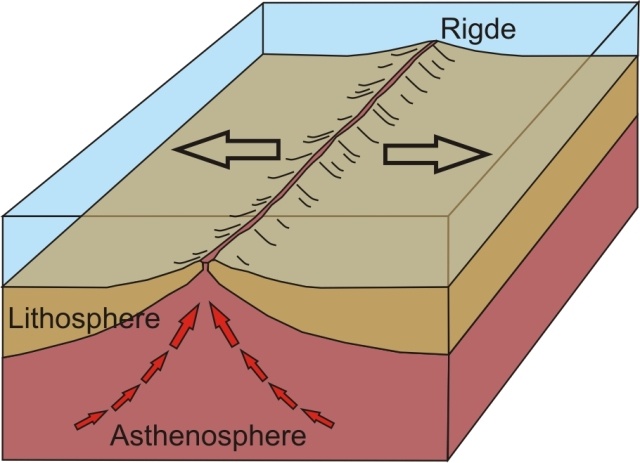
What kind of plate boundary is shown here?
a)
divergent
b)
convergent
c)
transform
d)
subducting
40.

What kind of plate boundary is shown here?

a)

divergent

b)

convergent subducting

c)

transform

d)

convergent building

41.

What is the spatial (size) and time (scale) for a LANDSLIDE or DEBRIS FLOW?

a)

small, fast

b)

small, slow

c)

large, fast

d)

large, slow

42.

What is the spatial (size) and time (scale) for a VOLCANIC ERUPTION?

a)

medium, fast

b)

slow, gradual with catastrophic event

c)

medium, gradual with catastrophic event

d)

slow, fast

43.

What is the spatial (size) and time (scale) for a METEOR STRIKE?

a)

medium, fast

b)

slow, gradual with catastrophic event

c)

slow, fast

d)

medium, gradual with catastrophic event

44.

What is the spatial (size) and time (scale) for PLATE MOVEMENT?

a)

medium, fast

b)

large, fast

c)

medium, slow

d)

large, slow

45.

What is the spatial (size) and time (scale) for SEAFLOOR SPREADING?

a)

medium, fast

b)

large, slow

c)

medium, slow

d)

large, fast

46.

What is the spatial (size) and time (scale) for FOSSIL FUEL FORMATION AND EXTRACTION

a)

medium, formation slow, extraction fast

b)

large, formation slow, extraction fast

c)

medium, formation slow, extraction slow

d)

large, formation fast, extraction fast

47.

What do plates move on?

a)

putty

b)

magma

c)

hot water

d)

they don't float

48.

Volcanoes exist, for example, Mt. Ranier. This supports the claim that plates move because...

a)

volcanoes form when magma blasts through the crust.

b)

volcanoes form when one plate subducts under another.

c)

volcanoes were always on Earth.

d)

volcanoes form in the middle of plates.

49.

Rock types match across continents. This supports the claim that plate move location...

a)

the rocks were taken by people to other continents.

b)

the rocks were transported by ocean currents.

c)

the continents must have once been together and have since moved apart.

d)

the rocks formed after the plates moved.

50.

If there is a divergent boundary on one edge of a plate

a)

there is a convergent subduction boundary on the other.

b)

the plate grows bigger.

c)

there is a transform boundary on the other.

d)

there is a divergent boundary on the other too.

51.

Divergent boundaries form

a)

ridges

b)

trenches

c)

mountains

d)

black holes

52.

Convergent subducting boundaries form

a)

ridges

b)

trenches

c)

volcanoes

d)

mountains

53.

Earthquakes occur at

a)

divergent boundaries

b)

convergent boundaries

c)

transform boundaries

d)

all plate boundaries