
 Worksheets
Unit 5 Test Review 2.0
Total questions: 50
Worksheet time: 44mins
Name
Class
Date
1.
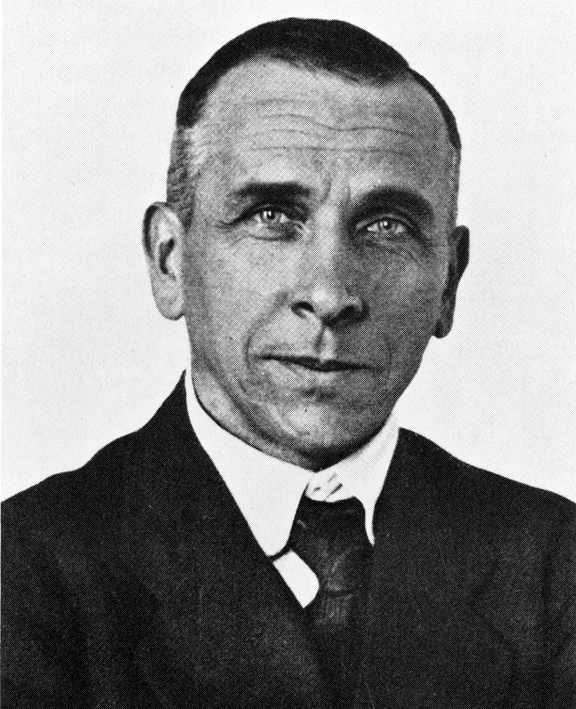
Who is the person credited with developing the theory of continental drift?
a)
Harry Hess
b)
Galileo
c)
Alfred Wegener
d)
Newton
2.
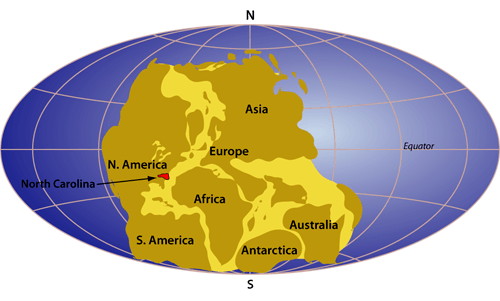
What is this a picture of?
a)
plate tectonics
b)
continental drift
c)
pangea
d)
glacier scaring
3.
What does the theory of continental drift state?
a)
The continents were once joined in a super-continent and have moved over time
b)
Continents are stationary and do not move
c)
The Earth is broken into lithospheric plates that move due to convection currents
d)
none of the above
4.
What evidence did Wegener use in his theory?
a)
Continents and fossils fitting together/matching-up like puzzle pieces
b)
glacier scars and evidence from temperature
c)
mountain ranges and coal deposits line up across continents
d)
all of the above
5.
Why did no one believe Wegener's thoery?
a)
He could not explain HOW the continents moved
b)
He didn't have evidence
c)
His data was wrong
d)
He didn't use the right technology to gather data
6.
What two specific continents fit together most noticeably?
a)
Africa and North America
b)
South America and Europe
c)
South America and Africa
d)
Antartica and Africa
7.
How long ago is Pangea believed to have existed?
a)
200-300 million years ago
b)
1000-2000 years ago
c)
10,000-20,000 years ago
d)
20-30 billion years ago
8.

the breakdown of rock into smaller pieces of the same rock without any change in its composition
a)
mechanical weathering
b)
chemical weathering
c)
erosion
d)
deposition
9.

the breakdown or decomposition of rock that takes place when minerals change through chemical processes
a)
chemical weathering
b)
mechanical weathering
c)
erosion
d)
deposition
10.
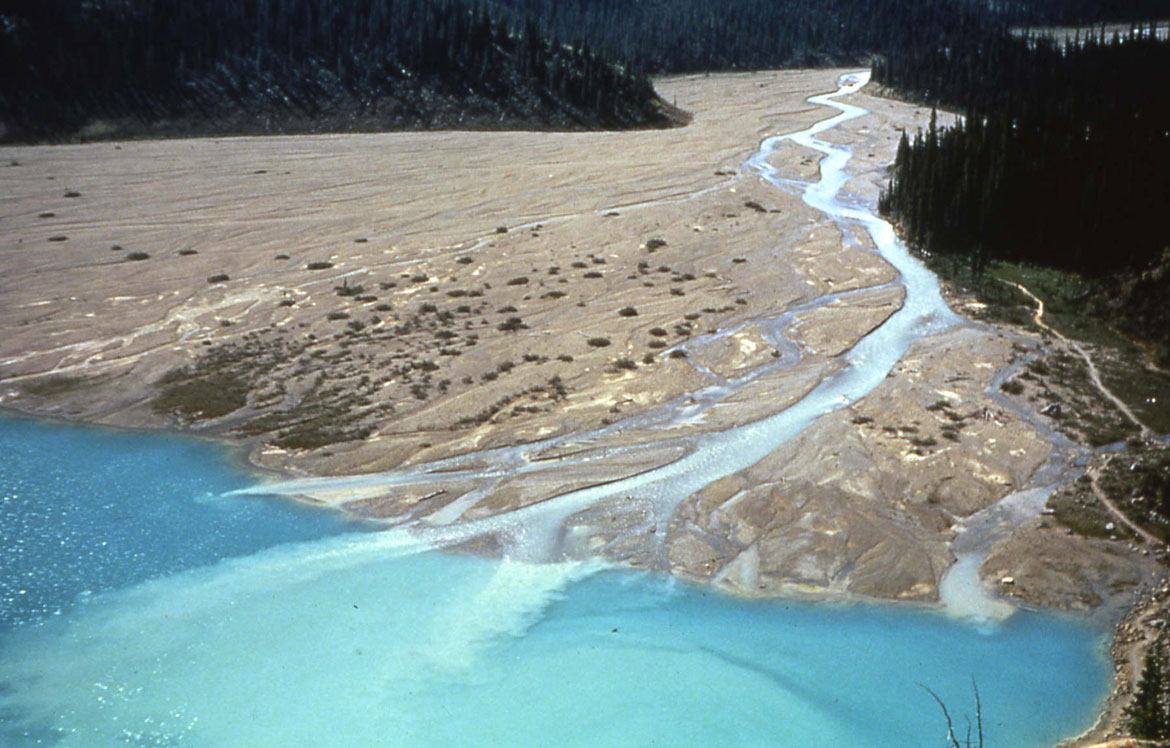
The dropping off of sediments in a new place is called __________.
a)
departing
b)
deposition
c)
erosion
d)
weathering
11.
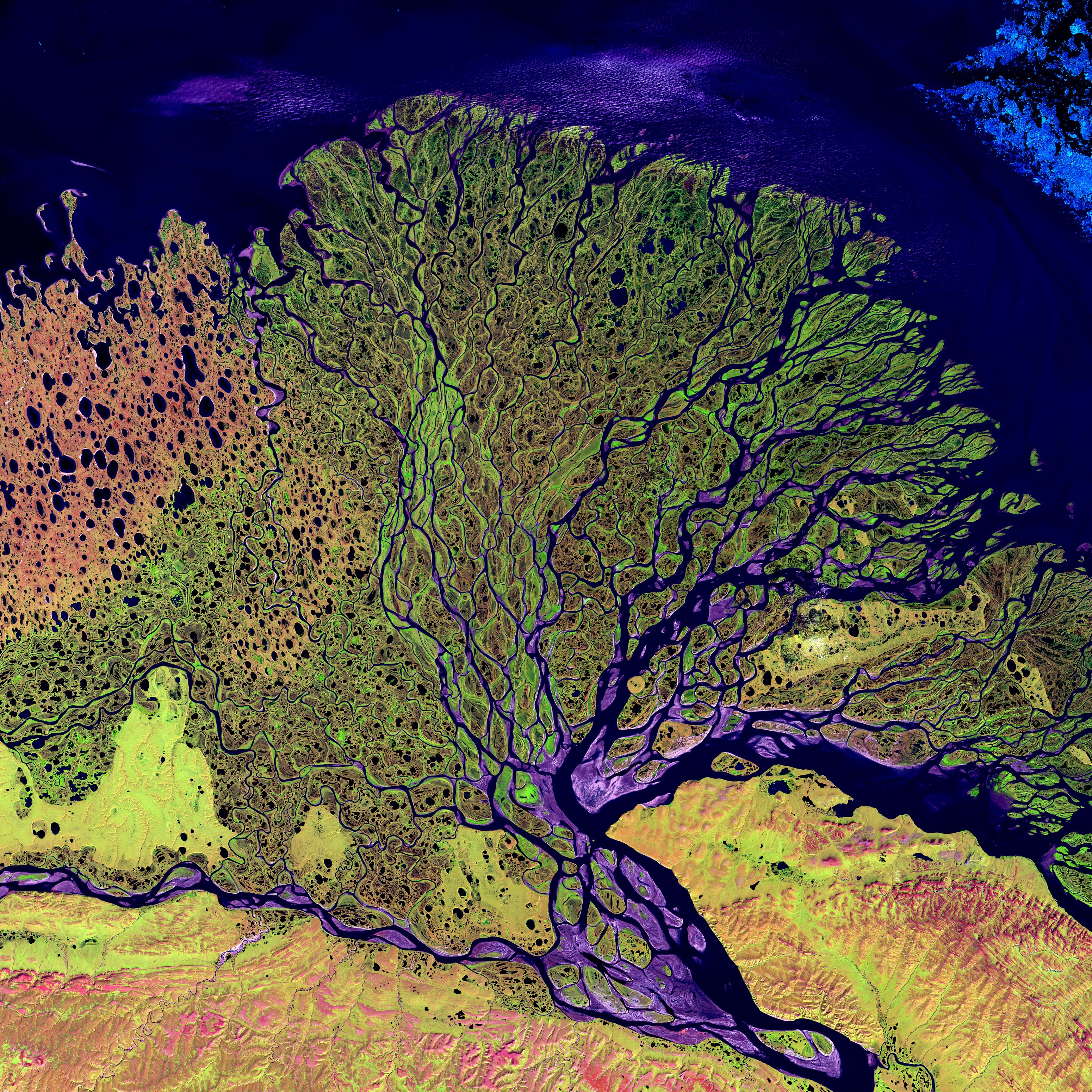
Deltas are built up by -
a)
deposition
b)
leaching
c)
abrasion
d)
erosion
12.
The type of plate boundary where two plates come together is a .....
a)
Convergent Boundary
b)
Divergent Boundary
c)
Transform Boundary
d)
Plate Boundary
13.
Which of the following causes Earth's tectonic plates to move?
a)
Energy from the Sun
b)
Magnetic Pole Reversal
c)
Convection currents in the mantle
d)
Faults in Mountain Ranges
14.
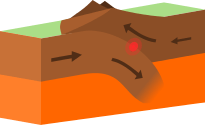
What type of plate boundary is this?
a)
Plate
b)
Divergent
c)
Convergent
d)
Transform
15.

What type of event will occur at this boundary?
a)
Earthquake
b)
Volcano Eruption
c)
Tornado
d)
Mountain Building
16.
A divergent boundary occurs when plates ....
a)
Pull apart
b)
Come together
c)
Slide past each other
d)
subducting
17.
Which of the following is NOT evidence to support the theory of plate tectonics?
a)
Fossils
b)
Mountains
c)
Glaciers
d)
Sand Erosion
18.
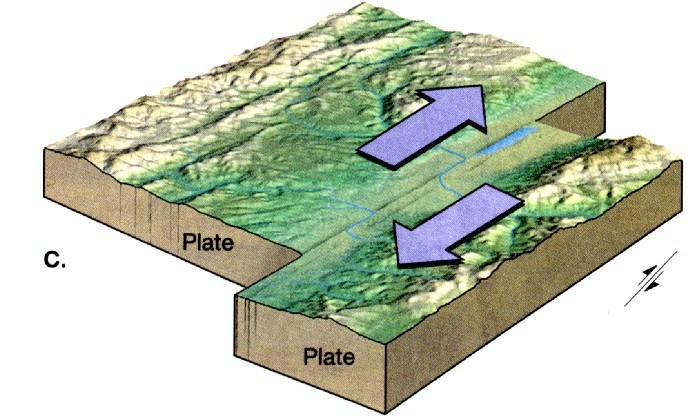
What type of plate boundary is this?
a)
Transform
b)
Convergent
c)
Divergent
d)
Plate
19.
A fault is formed by the movement of a __________ plate boundary
a)
Transform
b)
Convergent
c)
Divergent
20.

What is the highest elevation this hill could possibly have? (might not be labeled)
a)
1040
b)
1060
c)
1079
d)
1009
21.
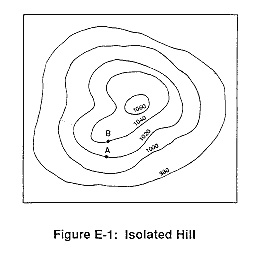
What is the contour interval on this map?
a)
100
b)
10
c)
15
d)
20
22.
It is steep on a topographic map where __________.
a)
lines are closest together
b)
a river flows into a lake
c)
contours bend
d)
contours are far apart
23.
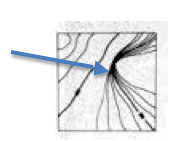
What feature is at the arrow?
a)
volcano
b)
mountain
c)
cliff
d)
river
24.

What are the darker lines called?
a)
roads
b)
index contour
c)
contour interval
d)
waves
25.

What is the difference in elevation between Point X and Point Y?
a)
120 m
b)
240 m
c)
360 m
d)
340 m
26.

What height must a hiker climb to reach the peak of the mountain?
a)
303m
b)
253m
c)
300m
d)
200m
27.

Which of the following pairs is correctly matched?
a)
6 and F
b)
1 and A
c)
1 and B
d)
2 and C
28.
The density of an object is
a)
The mass divided by the volume D = m/v
b)
The volume divided by the mass D = v/m
c)
The same as its weight
d)
The same as the size of the object
29.
An irregularly shaped stone was lowered into a graduated cylinder holding a volume of water equal to 2 ml. The height of the water rose to 7 ml. If the mass of the stone was 25 g, what was its density?
a)
5 ml
b)
16 g
c)
.20 g/ml3
d)
5 g/cm3
30.
Jack has a rock. The rock has a mass of 14g and a volume of 2cm3. What is the density of the rock?
a)
7 mL
b)
7 g/cm3
c)
28 g/cm3
d)
1/7 g/cm3
31.
Frank has an eraser. It has a mass of 4g, and a volume of 2cm3. What is its density?
a)
8 g/cm3
b)
2 g/cm3
c)
1/2 g/cm3
d)
24 g/cm3
32.

What phase of the moon is depicted below?
a)
New moon
b)
waxing Crescent
c)
Full Moon
d)
Waxing Gibbus
33.

What moon comes after the Third Quarter Moon?
a)
Waining Crescent
b)
New moon
c)
Waxing Crescent
d)
Waining Gibbous
34.
How many Major Name Phases of the Moon are there?
a)
10
b)
4
c)
6
d)
8
35.

What Phase of the Moon is depicted below?
a)
New moon
b)
First Quarter
c)
Full Moon
d)
waxing Crescent
36.
As the moon's shape appears to get smaller, we say that the moon is _.
a)
swelling
b)
waxing
c)
waning
d)
disappearing
37.
About how long does it take the moon to make one complete cycle around the earth?
a)
65 days
b)
8 days
c)
365 days
d)
28 days
38.
Phases of the moon in which the moon appears to be getting larger are referred to as _.
a)
waxing
b)
waning
c)
new
d)
eclipse
39.
Which of the following words describe the phases of the moon?
a)
none, quarter, half, three quarters, full
b)
new, crescent, quarter, gibbous, full
c)
dark, light, half, quarter, blue
d)
first quarter, second quarter, third quarter, fourth quarter
40.

Name the phase of the moon that comes AFTER this moon phase.
a)
waxing gibbous
b)
full moon
c)
1st quarter
d)
3rd quarter/last quarter
41.

Name the phase of the moon that comes AFTER this moon phase.
a)
full moon
b)
3rd/last quarter
c)
waxing crescent
d)
new moon
42.

If the Northern Hemisphere is experiencing Summer, What season is the Southern Hemisphere experiencing?
a)
Summer
b)
Winter
c)
Spring
d)
Fall
43.

What position is the Earth in when the Northern Hemisphere is In the middle of Winter?
a)
Leaving Summer and heading towards Winter
b)
Leaving Winter and Heading towards Summer
c)
Leaning Towards the Sun
d)
Leaning away from the Sun
44.

When the Northern Hemisphere of Earth is Leaning away from the Sun, What season is the Southern Hemisphere experiencing?
a)
Summer
b)
Winter
c)
Spring
d)
Fall
45.
If the Southern Hemisphere is experiencing Fall, What season is the Northern half in?
a)
Fall
b)
Spring
c)
Summer
d)
Winter
46.

What season is the Southern hemisphere in when the North Pole is leaning into the Sun?
a)
Summer
b)
Fall
c)
Winter
d)
Spring
47.

As a whole, Giants are considered hotter than White Dwarfs.
a)
True
b)
False
48.
Which category is our Sun located in?
a)
White Dwarfs
b)
Supergiants
c)
Main Sequence
d)
Giants
49.

Which of the following is the brightest?
a)
red supergiants
b)
blue main sequence
c)
red dwarfs
d)
white dwarfs
50.

The surface temperature of a particular brown dwarf is 1000K. Where would it fit on an HR Diagram?
a)
top-left
b)
top-right
c)
bottom-left
d)
bottom-right
100 %

