wayground logo

Free Printable Worksheets

NEW

Font size

S
M
L
XL
Worksheets

Middle School Earth Science

Total questions: 50

Worksheet time: 30mins

Name
Class
Date
1.
Mountains form from ...
a)
plates sliding past one another
b)
collision of plates
c)
plates moving away from each other
2.
Associated with transform boundaries.
a)
Volcanoes
b)
mountains
c)
trenches
d)
earthquakes
3.
The area around the pacific plate where boundaries form is called...
a)
death ring
b)
fire zone
c)
ring of fire
d)
zone of fire
4.

Which is true about hotter material in the mantle (convection currents)?

a)

more dense, sinks

b)

less dense, sinks

c)

less dense, rises

d)

more dense, rises

5.
This land formation occurs at a divergent continental/ continental boundary.
a)
mid ocean ridge
b)
deep ocean trench
c)
pacific hot spot
d)
rift valley
6.
Which ocean is expanding due to a mid-ocean ridge?
a)
Indian
b)
Dead Sea
c)
Atlantic
d)
Artic
7.
What are the 3 basic layers?
a)
core, mantle, lithosphere
b)
asthenosphere, lithosphere, crust
c)
core, mantle, crust
d)
crust, mantle, inner core
8.
The outer core is liquid metal while the inner core is solid due to 
a)
water vapor
b)
great pressure
c)
a decrease in pressure
d)
being solid metal
9.
What do fossils tell us?
a)
Organisms and environments that once existed
b)
organisms that are alive today
10.
The oceanic crust _________ when it reaches the continental crust.
a)
sinks
b)
rises
c)
expands
11.
Which process or processes change the size and shape of the oceans?
a)
subduction only
b)
sea-floor spreading only
c)
both subduction and sea-floor spreading
d)
both  drilling for samples and subduction
12.
What evidence did Wegener use in his theory?
a)
Continents and fossils fitting together/matching-up like puzzle pieces 
b)
glacier scars and evidence from temperature
c)
mountain ranges and coal deposits line up across continents
d)
all of the above
13.
What two specific continents fit together most noticeably?
a)
Africa and North America
b)
South America and Europe
c)
South America and Africa
d)
Antartica and Africa
14.
Most geologists rejected Alfred Wegener's idea of continental drift because...
a)
it did not agree with their current theory
b)
Wegener was interested in what Earth was like millions of years ago
c)
Wegener used several different types of evidence to support his hypothesis
d)
Wegener could not identify the force that moved the continents
15.
True or False : Sea-floor Spreading adds new material to the ocean floor?
a)
True
b)
False
16.
What is a scientific model?
a)
A representation of an object but smaller
b)
An exact representation made of similar material
c)
A representation of an object or system
d)
A familiar copy of an object
17.
In science, what is a scientific theory?                               
a)
the first idea to explain an observation 
b)
the best idea to explain a hypothesis 
c)
an explanation for many hypotheses and observations
d)
an explanation for many questions and answers 
18.
What is a scientific law?
a)
an explanation of hypotheses, results, and observations
b)
the final answer to a scientific question 
c)
a scientific statement 
d)
an explanation of many experimental results and observations
19.
Which type of rock results from melting and cooling of magma?
a)
Igneous
b)
Metamorphic
c)
Sedimentary
d)
Extrusive
20.
Which type of rock forms from extreme heat and pressure?
a)
Igneous
b)
Sedimentary
c)
Organic
d)
Metamorphic
21.
A metamorphic rock changes into an igneous rock by what two processes?
a)
Melting and cooling
b)
Extreme heat and pressure
c)
Compaction and cementation
d)
Weathering and erosion
22.
Wind, water, and ice breaking down rock is called
a)
Erosion
b)
Deposition
c)
Compaction
d)
Weathering
23.
What is the MAIN way rocks are classified?
a)
Their color and shapes
b)
How they form
c)
Mineral bands
d)
Where they form
24.
The process in which dissolved minerals crystallize and glue sediment together.
a)
compaction
b)
deposition
c)
organic rock
d)
cementation
25.
When sediments are pressed together tightly, this is called ____________.
a)
Compaction
b)
Cementation
c)
Weathering
d)
Erosion
26.
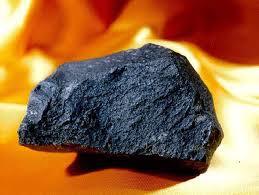
This rock was found near the mouth of a volcano. What type of rock is this?
a)
Sedimentary
b)
Igneous
c)
Metamorphic
27.
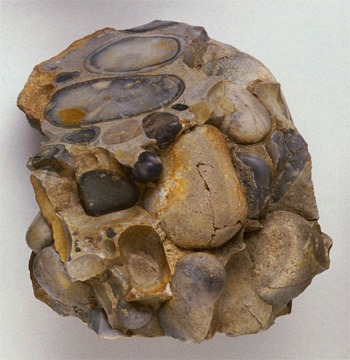
This rock was formed by smaller pieces of rock that settled at the bottom of a lake millions of years ago. What type of rock is this?
a)
Sedimentary
b)
Igneous
c)
Metamorphic
28.
This rock started as lava that cooled and then was heated and put under pressure over time. What type of rock is this?
a)
Sedimentar
b)
Igneous
c)
Metamorphic
29.
Each rock type can follow only one pathway of the rock cycle.
a)
True
b)
False
30.
Fossils are often found in ____________ because it is formed from the remains of once living things.
a)
metamorphic
b)
magma
c)
igneous
d)
sedimentary
31.
The length of time required for half of the radioactive atoms in a sample to decay is its...
a)
era
b)
age
c)
half-life
d)
eon
32.
According to the law of superposition, the oldest fossils are found 
a)
At the top of the rock layers
b)
Near the bottom of the rock layers
c)
In the middle of the rock layers
d)
Somewhat near the surface
33.
Which rock layer in the diagram seems to be the oldest?
a)
F
b)
E
c)
B
d)
A
34.
According to the law of superposition, which layer is the youngest?
a)
A
b)
B
c)
C
35.
Which type of dating method can be used on rock layers by applying the Law of Superposition?
a)
relative dating
b)
absolute dating
c)
radioactive dating
d)
radiometric dating
36.
Which of the following is the oldest?
a)
Layer L
b)
Intrusion D
c)
Intrusion H
d)
Layer E
37.
What element is usually used to date fossils?
a)
uranium-235
b)
carbon-14
c)
mercury-203
d)
thorium-234
38.
Letter "F" is a....
a)
inclusion
b)
intrusion
c)
fault
d)
unconformity 
39.
Which of the following correctly lists the layers in order from oldest to youngest?
a)
A, B, C, D, E
b)
E, B, C, D, A
c)
E, D, C, B, A
d)
C, B, A, D, E
40.
What type of rock disturbance is this? 
a)
Fault 
b)
Titling 
c)
Folding
d)
Intrusion
41.
What type of rock disturbance is this? 
a)
Fault 
b)
Titling 
c)
Folding
d)
Intrusion
42.
A well-substantiated explanation of some aspect of the natural world that can incorporate facts, laws, inferences, and tested hypotheses.
a)
Fact
b)
Theory
c)
Law
d)
Conclusion
43.
Scientific theories are based on
a)
general assumptions of how systems work.
b)
mathematical principles that can be proven true.
c)
large amounts of data collected over time.
d)
observations from within only one scientific discipline.
44.
Laws are usually mathematically defined.
a)
True
b)
False
45.
A scientific ____________ is a statement that describes what always happens under certain conditions in nature.
a)
law
b)
theory
c)
method
d)
variable
46.

Students want to test if changing the wing shape of a paper airplane will affect the distance it will fly. What is the independent variable?


(TEST VARIABLE/WHAT WE CAN CHANGE)

a)

the wing shape

b)

the distance the airplane will fly

dependent

c)

the temperature in the classroom

d)

the type of paper used to construct the plane

47.

Students want to test if changing the wing shape of a paper airplane will affect the distance it will fly. What is the dependent variable? (OUTCOME/WHAT WE CAN MEASURE)

a)

the wing shape

b)

the distance it will fly

c)

the temperature in the room

d)

the type of paper used to construct the airplane

48.
Students want to test if changing the wing shape of a paper airplane  will affect  the distance it  will fly. Which of the following is a good hypothesis for this experiment? 
a)
If the airplane fly for three minutes, then that will be the best design 
b)
If the wing shape is round, then the airplane will fly for more time 
c)
If the wing shape is wider, then the airplane will covered more distance 
d)
If the airplane is made of construction paper, then it will fly farther 
49.

Susie wants to know if an increase in temperature is accelerating the decaying process of apples. What is the dependent variable (outcome variable) in this experiment?


OBSERVED TRAIT

a)

the temperature

b)

the appearance of the apples

dependent

c)

the acceleration

d)

None of the above

50.

Susie wants to know if an increase in temperature is accelerating the decaying process of apples. What is the independent variable (TEST variable) in this experiment?


What we "CHANGE"

a)

the temperature

b)

the appearance of the apple

c)

the acceleration

d)

None of the above