
 Worksheets
Ancient History Review
Total questions: 50
Worksheet time: 34mins
Name
Class
Date
1.
How did the start of farming change early human tribes?
a)
It forced them to stay in one place and build villages and cities.
b)
It caused them to continue to hunt animals and gather plants.
c)
It ended fighting between the tribes for land.
d)
It stopped them from building temples for their gods.
2.
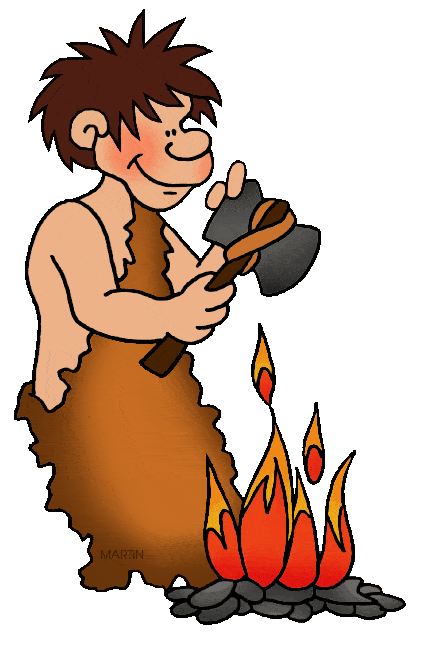
Which statement best describes hunters and gatherers?
a)
They were experts at using their environment to meet their basis needs.
b)
The tools they made from metal helped them to survive.
c)
They domesticated animals to help with daily activities.
d)
They developed ways to bring water to their crops.
3.
What did the hunters and gatherers have to develop before they could effectively work together?
a)
tools
b)
language
c)
fire
d)
domestication of animals
4.
What is the greatest change between the Paleolithic and Neolithic cultures?
a)
the shelters people used
b)
the way people got food for themselves
c)
the tools people used
d)
the clothes people wore
5.
the time period before writing was invented
a)
Pre-history
b)
Paleolithic Age
c)
Neolithic Age
d)
Chronological
6.

What group of people created cave art?
a)
prehistoric
b)
geography
c)
landform
d)
surplus
7.

Domestication of plants and animals, permanent villages, and job specialization are all characteristics of ____________.
a)
the Paleolithic Era
b)
the Mesolithic Era
c)
the Neolithic Era
d)
Age of Dinosaurs
8.

The taming of animals for personal use.
a)
domestication
b)
domination
c)
animalization
d)
petting zoo
9.

The objects identified in the picture would most likely come from which period of time?
a)
Iron Age
b)
Neolithic
c)
Bronze Age
d)
Paleolithic period
10.
What does B.C.E mean?
a)
Before Common Era
b)
Before Cro-Magnon Era
c)
The years before the birth of Christ
d)
The years after the Christian Era began
11.
Civilization in Mesopotamia developed between which two rivers?
a)
the Persian Gulf and the Mediterranean
b)
the Tigris and the Persian Gulf
c)
the Persian Gulf and the Euphrates
d)
the Euphrates and the Tigris
12.
Who wrote a legal code that covered most areas of daily life?
a)
Gilgamesh
b)
Hammarabui
c)
Nineveh
d)
Sargon
13.
The Sumerian writing system was called
a)
Cuneiform
b)
Hieroglyphs
c)
English
d)
Sargon
14.
A Sumerian temple to honor their chief god was called a
a)
scribe.
b)
cradle.
c)
Gilgamesh.
d)
ziggurat.
15.
A city with political and economic control over the surrounding countryside
a)
City-State
b)
Country
c)
Villiage
d)
Culture
16.
Ancient Egyptians had
a)
1 god
b)
many gods
17.
What is commonly found in the pyramids?
a)
tombs
b)
books
c)
ghosts
d)
bugs
18.
Egyptian Civilization grew up
a)
in the middle of the Sahara
b)
along the Nile River
c)
in the land of Sumer
d)
north of the Mediterranean Sea
19.

Where did Buddhism originate?
a)
India
b)
China
c)
Korea
d)
Rome
20.
What did Siddhartha believe was the only way to find the truth about the world?
a)
Be a friend.
b)
Give up all desires.
c)
Ask as many people as you can.
d)
Be nice.
21.
If a person gave up all desires he or she would reach?
a)
Reincarnation
b)
Karma
c)
Dharma
d)
Nirvana
22.
The heart of Buddha's teachings is contained in what?
a)
The Four Noble Truths
b)
Nirvana
c)
Dharma
d)
Illusions
23.
What is The Buddha's Eightfold Path?
a)
eight steps to become a god.
b)
eight steps to eliminate suffering.
c)
eight steps to be reincarnated.
d)
eight steps to become one with the world.
24.
The caste system was first put in place in India thousands of years ago. Which of the following describes the caste system?
a)
It is a system that treats certain people inferior to others
b)
You cannot be removed from your caste, no matter what you do
c)
Your children will be in the same caste that you are
d)
All of the above are true
25.
What is reincarnation?
a)
The belief that one's soul is reborn into the next life based on the actions of your present life
b)
Your soul is gone forever
c)
The reward for your life force
d)
The belief that if you do something bad, you'll be rewarded
26.
Buddhism and Hinduism both believe in reincarnation
a)
true
b)
false
27.
According to belief in the Mandate of Heaven, earthquakes and floods might be signs that
a)
the king did not govern well
b)
the end of the world is near
c)
the people did not obey the laws
d)
the natural world ignored humans
28.

What is the central idea of Daoism
a)
Duty to community
b)
Living in harmony with nature
c)
Enforcing laws with harsh punishments
d)
Humans are naturally evil
29.
The belief that the Chinese king’s right to rule came from the gods
a)
Confucianism
b)
Mandate of Heaven
c)
dynasty
d)
Daoism
30.

Confucius' ideas were put into a book called....
a)
The Analects
b)
The Quran
c)
The Bible
d)
The Buddha
31.
What Chinese school of thought teaches respect to elders and the law as the best way to maintain a peaceful society?
a)
Taoism
b)
Christianity
c)
Confucianism
d)
Buddhism
32.
What religion/philosophy teaches the Four Noble Truths and the Eightfold Path?
a)
Hinduism
b)
Buddhism
c)
Confucianism
d)
Legalism
33.
If the Nile River flows north, which body of water does it flow into?
a)
Mediterranean Sea
b)
Suez Canal
c)
Lake Victoria
d)
Red Sea
34.

What were oracle bones used for?
a)
Cooking
b)
Telling stories
c)
Building the Great Wall of China
d)
Asking for advice from the gods
35.

Using the map, what river valley is shaded in pink?
a)
Egypt
b)
Mesopotamia/
Sumer
Sumer
c)
India
d)
China
36.

Name the civilization:
- Huang He (Yellow) River
- Calligraphy writing
- Paper and Silk
- Huang He (Yellow) River
- Calligraphy writing
- Paper and Silk
a)
Egypt
b)
Mesopotamia/
Sumer
Sumer
c)
India
d)
China
37.

Using the map, what river valley is shaded in yellow?
a)
Egypt
b)
Mesopotamia/
Sumer
Sumer
c)
India
d)
China
38.

Which two cities were discovered in the Indus River Valley?
a)
Tigris and Euphrates
b)
Sumer and Babylonia
c)
Harappa and Mohenjo-Daro
d)
Cairo and Bahgdad
39.
What two rivers are associated with the Indus River Valley?
a)
Ganges and Indus
b)
Tigris and Euphrates
c)
Tigris and Ganges
d)
Nile and Indus
40.

Which of the following means one god?
a)
Monotheism
b)
Polytheism
41.

What river valley would have been here?
a)
China
b)
Mesopotamia
c)
Indus
d)
Egypt
42.
The Chinese were isolated from other parts of the world because
a)
Of the stars
b)
of mountains
c)
of mountains and deserts
d)
of bad leaders
43.
The First Emperor of China
a)
Liu Bang
b)
Shi Huangdi
c)
Wu Wang
d)
Confucius
44.
Which Dynasty came directly before the Qin Dynasty?
a)
Shang
b)
Xia
c)
Zhou
d)
Han
45.
largest public works project put in place by Shi Huangdi
a)
Great Pyramid
b)
Shaolin Temple
c)
Taj Mahal
d)
Great Wall
46.
Which of these did Qin Shi Huangdi NOT accomplish?
a)
common currency
b)
single written language
c)
code of laws
d)
divided China into 36 provinces
47.
Qin Shi Huangdi buried 460 scholars alive for disobeying his rules.
a)
true
b)
false
48.
What did Qin Shi Huangdi have created for him so he could rule in his afterlife?
a)
terra cotta army
b)
Great Wall
c)
Shaolin Temple
d)
pyramid
49.
What was learned through studying King Tut's tomb?
a)
He was a king.
b)
The burial practices of Egyptians.
c)
He was wealthy.
d)
He had many wives.
50.
Egyptian writing system
a)
papyrus
b)
alaphabet
c)
cuneiform
d)
heiroglyphics
100 %

