
 Worksheets
The Sun, Earth's Energy Budget and Heat Transfer
Total questions: 32
Worksheet time: 26mins
Name
Class
Date
1.
What is the definition of CONDUCTION?
a)
When heat is transferred from objects like rays of light or electromagnetically.
b)
a hot liquid or air that expands, becomes less dense, and rises or becomes more dense, and sinks.
c)
When heat transfers from objects that are touching.
d)
When heat transfers through the heater or AC in your house.
2.
What is the definition of CONVECTION
a)
When heat transfers through waves.
b)
When heat transfers from objects that are touching.
c)
a hot liquid or air that expands, becomes less dense, and rises or becomes more dense, and sinks.
d)
Heat traveling from the sun
3.
What is the definition of CONVECTION
a)
When heat transfers through waves.
b)
When heat transfers from objects that are touching.
c)
a hot liquid or air that expands, becomes less dense, and rises or becomes more dense, and sinks.
d)
Heat traveling from the sun
4.

What kind of heat transfer happens when the sun is heating your body?
a)
Conduction
b)
Radiation
c)
Convection
d)
Density
5.
Which of the following is an example of convection?
a)
A hair dryer is drying up your hair.
b)
When the AC or heater changes the temperature.
c)
When a car engine turns hot after being turned on.
d)
The energy from the earth's interior (molten rock circulating)
6.
What heat transfer happens when you burn your hand by touching a fire?
a)
Radiation
b)
Conduction
c)
Convection
d)
infrared
7.
Which of the following is needed for convection to happen?
a)
A fluid (like air or water)
b)
Light in the form of rays
c)
Electromagnetic waves
d)
Fire
8.
When a pot is touching a stove that is on, what heat transfer is happening?
a)
Radiation
b)
Conduction
c)
Convection
9.
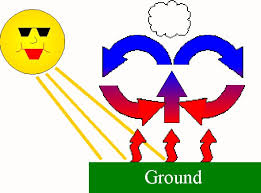
Warm air rises and the cool air sinks demonstrates this type of heat transfer.
a)
conduction
b)
convection
c)
radiation
d)
Insolation
10.
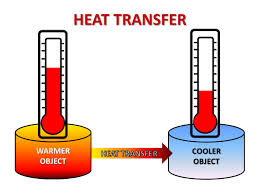
Heat transfers from an area of ____temperature to an area of ___ temperature.
a)
high to low
b)
low to high
c)
high to high
d)
It can travel high to low and low to high.
11.
How does the air move in a land breeze?
a)
From east to west
b)
From west to east
c)
From the land to the ocean
d)
From the ocean to the land
12.
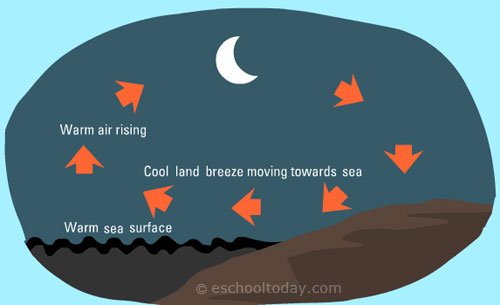
Is this a land or a sea breeze?
a)
land breeze
b)
sea breeze
13.
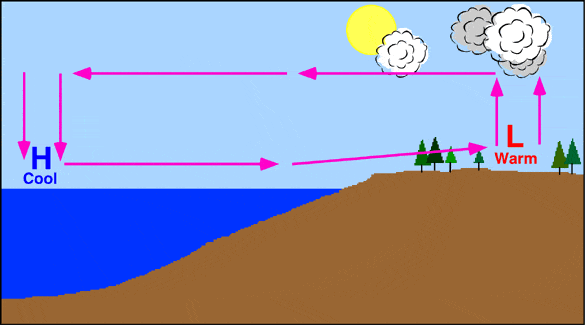
Is this a land or a sea breeze?
a)
land breeze
b)
sea breeze
14.

Which factor is most responsible for the movement of the air shown?
a)
uneven heating of the air
b)
imbalance in organisms breathing the air
c)
sunlight getting blocked by the land
d)
different levels of liquid in the air
15.
About 30% of the solar energy that reaches the atmosphere is reflected back into space. About 20% is absorbed by the air. What percentage reaches earth's surface?
a)
50%
b)
30%
c)
100%
d)
55%
16.

Which set of labels correctly completes this diagram?
a)
Oil is less dense and floats on water/ water is more dense and sinks in oil
b)
liquid water evaporates / condensed water precipitates
c)
animals take in oxygen for respiration / plants take in carbon dioxide for photosynthesis
d)
warm air molecules move faster and rise / cool air molecules move slower and sink
17.

What happens to the air at the beach at night?
a)
The air is still
b)
The air moves along the coast
c)
The air flows from the ocean to the land
d)
The air flows from the land to the ocean
18.
What is the primary source of energy for the Earth?
a)
Coal
b)
Wind power
c)
Natural gas
d)
The sun
19.
About 30% of the sun's incoming energy never reaches Earth because it is....
a)
absorbed by the ocean
b)
trapped by the gravitational pull between the moon and the Earth
c)
reflected back into space
d)
destroyed by the ozone layer
20.
Land heats up and cools down faster than water.
a)
True
b)
False
21.
dark colored surfaces _________ radiation
a)
reflect
b)
absorb
22.
light colored surfaces ____________ radiation
a)
absorb
b)
reflect
23.

Some of the sun's energy is absorbed by Earth's surface and released back into the atmosphere as
a)
infrared radiation
b)
greenhouse gases
c)
ultraviolet light
d)
visible light
24.
How would Earth be different without greenhouse gases in its atmosphere?
a)
More heat from solar radiation would escape into space
b)
More solar radiation would be reflected back into space
c)
More solar radiation would penetrate Earth's crust and mantle
d)
More heat from solar radiation would be stored in Earth's core
25.

High altitude cirrus clouds are primarily formed from which substance?
a)
carbon dioxide gas
b)
solid ice crystals
c)
nitrogen compounds
d)
ozone molecules
26.
How does the transfer of energy from the sun to Earth compare with the way energy is distributed in the ocean water?
a)
energy from the sun is transferred through convection, while energy in the ocean water is distributed by conduction
b)
energy from the sun is transferred through radiation, while energy in ocean water is distributed by convection
c)
energy from the sun is transferred through conduction while energy in the ocean water is distributed by radiation
d)
energy from the sun is transferred through radiation while energy in ocean water is distributed by conduction
27.

which gas when condensed into its liquid state in the atmosphere forms clouds?
a)
methane
b)
nitrogen
c)
water vapor
d)
carbon dioxide
28.

Some of the sun's energy is absorbed by Earth's surface and released back into the atmosphere as
a)
infrared radiation
b)
greenhouse gases
c)
ultraviolet light
d)
visible light
29.

Clouds form whenever
a)
sunlight warms ocean water
b)
air is cooled to its dew point
c)
air is warmed more than 10 degrees Celsius
d)
air pressure drops
30.

Which of the following describes the global convection currents that drive global winds?
a)
warm air sinks at the equator and cold air rises at the poles
b)
warm air rises at the equator and cold air sinks at the poles
c)
cold air rises at the equator and warm air sinks at the poles
d)
warm air moves from the oceans toward the continents.
31.
Which property of water vapor allows it to function as a greenhouse gas?
a)
water vapor expands when exposed to sunlight
b)
water vapor absorbs and reemits heat radiated from Earth
c)
water vapor changes ultraviolet radiation into carbon dioxide
d)
water vapor transmits heat as solar radiation
32.
Michelle performed an investigation on how much sunlight is absorbed by various surfaces, but the results did not match her hypothesis. What should Michelle do now?
a)
perform the investigation in a different way
b)
change the hypothesis to match the results
c)
choose a different investigation
d)
repeat the investigation
100 %

