

wayground logo

Free Printable Worksheets

Font size

S
M
L
XL
Worksheets

Mid Year Review

Total questions: 34

Worksheet time: 6hrs 55mins

Name
Class
Date
1.
A disadavantage of wind energy...
a)
Protects wildlife
b)
Produces CO2 emissions
c)
Only efficient in certain areas
2.

Law of _________________: in a sequence of undisturbed sedimentary rocks, the oldest are on the bottom and the youngest are on the top

a)

Superposition

b)

Original Horizontality

c)

Faunal Succesion

d)

Crosscutting

3.
Which layer is the oldest?
a)
D
b)
C
c)
B
d)
A
4.
According to the law of superposition, which layer is the youngest?
a)
A
b)
B
c)
C
5.

What 2 characteristics make a good index fossil?

a)

Good looks and a great smile

b)

widespread and on Earth of a short time

c)

widespread and on Earth for a long time

d)

only found in Clinton Twp and in every rock layer

6.

Which pathogen is considered to be nonliving?
a)
Virus
b)
Bacteria
c)
Protist
d)
Fungi
7.
Which pathogen can be cured by antibiotics?
a)
Virus
b)
Bacteria
c)
Protist
d)
Fungi
8.
Examples of diseases caused by this pathogen are Malaria, Hiking Sickness, and Sleeping Sickness. 
a)
Virus
b)
Bacteria
c)
Protist
d)
Fungi
9.
What do viruses need to reproduce?
a)
they need genetic material
b)
They need a host cell
c)
They need  bacteria
d)
They need insulin
10.
Practical only in locations near hot spots and the volcanic activity. This is a disadvantage of ____.
a)
Solar
b)
Wind
c)
Geothermal
d)
Hydroelectric
11.
Dams disrupt a river’s ecosystem and are only available in areas that have large, fast-flowing rivers.  This is a disadvantage of ___. 
a)
Geothermal
b)
Fossil Fuels
c)
Nuclear
d)
Hydroelectric
12.
Fossil fuels are classified as nonrenewable because they.......
a)
require expensive equipment
b)
take millions of years to replace
c)
can be found all over 
d)
provide all the energy we use
13.
What is a change in an organism that allows for it to survive in its environment?
a)
homologous
b)
vestigial
c)
variation
d)
adaptation
14.
Which term refers to the process by which individuals that are better suited to the environment survive and reproduce therefore passing down their genes to their offspring? 
a)
Evolution 
b)
Variation 
c)
Adaptation
d)
Natural Selection 
15.
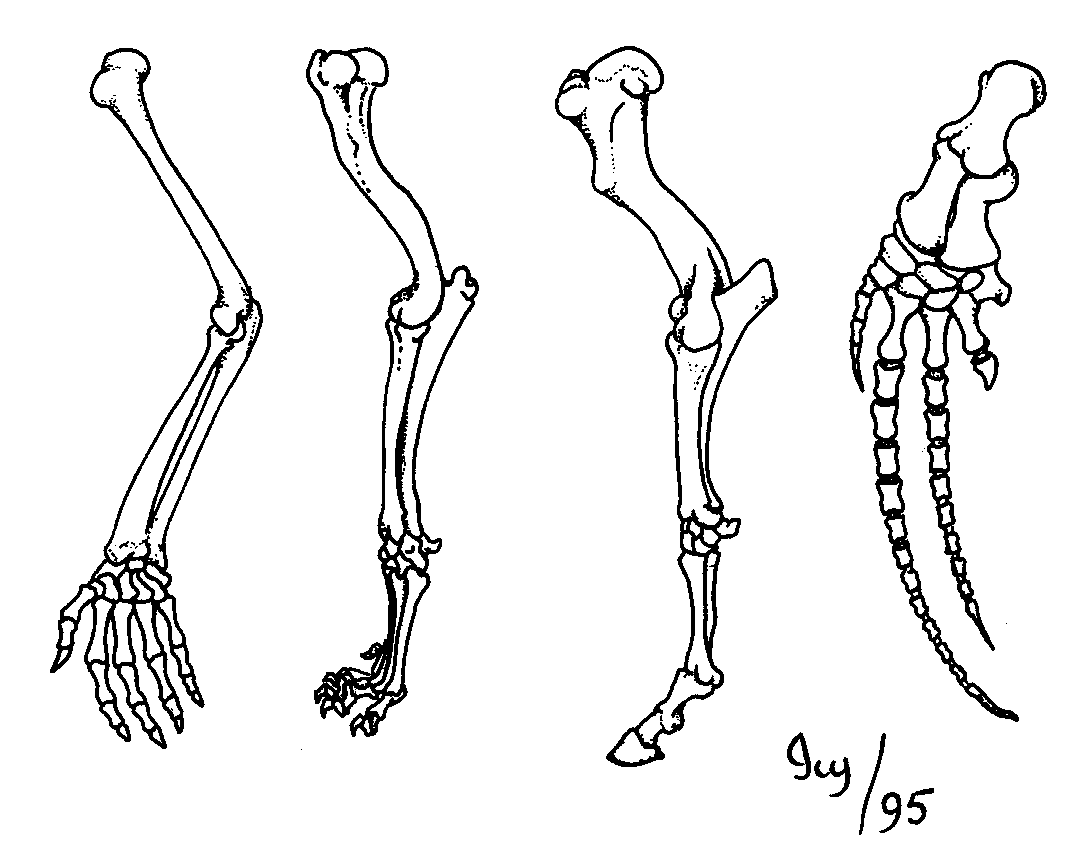
Structures with the same parts have different functions; suggests that organisms share a common ancestry
a)
vestigial structures
b)
homologous structures
c)
adaptive radiation
d)
fossil
16.

Which of the following energy sources are fossil fuels? (Check all that apply)

a)

Biomass

b)

Coal

c)

Natural Gas

d)

Oil

17.
Which of these is NOT a disadvantage of a nuclear power plant?
a)
It's waste can destroy habitats and ecosystems.
b)
It costs a lot of money to build.
c)
It produces radioactive waste.
d)
It produces large amounts of energy.
18.
Which best describes the role of mutations in natural selection?
a)
Mutations help an organism to better survive in their environment
b)
An organism may acquire a helpful mutation by interacting with the environment
c)
A mutation may result in an adaptive trait that makes an organism more likely to survive and reproduce
d)
Organisms with certain traits are more likely to win competitions for mutations
19.
If the environment suddenly changed, how could a species go extinct?
a)
The environmental change means fewer predators are around
b)
There are more homes available in the newly changed environment
c)
New resources are available with less competition
d)
There aren't enough members of the species with a trait necessary to survive in the new environment
20.

Scientists can explore whether two different animal species have evolved from a common ancestor, using evidence from all of the sources below except

a)

analysis of strands of DNA

b)

comparing the anatomical structure of each organism

c)

comparing the diets of each organism

d)

studying the embryos during development

21.

Sort each of the choices into the correct category:

Categorize the following

Gold

Pt

Baking Soda

CaO

Element
Compound
22.

Which is the source of all energy?

23.

Identify the level that receives the least amount of energy.

24.

Select the letter that represents the valence electron.

25.

Select the letter that represents the subatomic particle that gives the element its identity.

26.

Select the element that is a metal.

27.

Organize each energy source to the correct category.

Categorize the following

Solar

Geothermal

Biomass

Hydro

Wind

Nuclear

Coal

Oil

Natural Gas

Renewable
Nonrenewable
28.

Susie is not feeling well. She goes to the doctor and the doctor prescribes her an antibiotic. Susie most likely has ​ (a)   .

Choose from the below words
strep throat
Influenza
ringworm
malaria
29.
Identify the feature that represents a cross-cutting relationship.
30.

When electricity passes through water, hydrogen and oxygen are produced. Which table correctly labels the compounds and elements involved in the process?

a)

Water-->Compound

Hydrogen-->Compound

Oxygen--->Element

b)

Water-->Compound

Hydrogen--->Element

Oxygen--->Compound

c)

Water--->Compound

Hydrogen--->Element

Oxygen--->Element

31.

When the elements copper (Cu) and oxygen (O) chemically combine, they form...

a)

an ion

b)

a gas

c)

a compound

d)

a mixture

32.
All of the following would classify an element as a metal except?
a)
Dull
b)
Luster
c)
Malleable
d)
Hard
33.
A student is given a sample of an unknown substance. He is asked to determine if it is classified as a metal, a metalloid, or a nonmetal. He discovered that the unknown element conducted some heat and electricity, had a shiny luster, and broke easily. This element is most likely a 
a)
metal
b)
nonmetal
c)
metalloid
d)
cannot be determined
34.
Which table below correctly lists the properties of metals and nonmetals? *
a)
A
b)
B
c)
C
d)
D
