
 Worksheets
Graphing Quadratics Homework
Total questions: 75
Worksheet time: 3hrs 58mins
Name
Class
Date
1.
What is the vertex of the quadratic function: y=1/2(x-3)2+8?
a)
(3,8)
b)
(-3,-8)
c)
(-3,8)
d)
(3,-8)
2.
What is the axis of symmetry?
a)
the slope of the graph
b)
the dividing line for a parabola
c)
a way to spin my pencil
d)
the x-axis
3.
If the graph of a quadratic does not intercept the x-axis at any point, then it has:
a)
1 Real Solution
b)
2 Real Solutions
c)
Half a Solution
d)
No Real Solution
4.

.How many zeros does this parabola have?
a)
3
b)
2
c)
0
d)
1
5.
If given the equation
y = 3(x + 5)2 - 4, what is the vertex of the parabola?
y = 3(x + 5)2 - 4, what is the vertex of the parabola?
a)
(5, -4)
b)
(-5, -4)
c)
(-15, -4)
d)
(15, -4)
6.
A parabola has a vertex at (-3,2). Where is the axis of symmetry?
a)
y = -2
b)
x = 3
c)
x = -3
d)
y = 2
7.
What is the equation for the axis of symmetry of
f(x)= (x +1)2 + 5
f(x)= (x +1)2 + 5
a)
x = 1
b)
x = -1
c)
x = -5
d)
x = 5
8.

Is this a max or min?
a)
max
b)
min
c)
cannot be determined
9.
What is another word for zeros?
a)
y-intercepts
b)
roots
c)
vertex
d)
axis of symmetry
10.

Does this graph have a maximum or minimum value?
a)
maximum
b)
minimum
c)
neither
d)
both
11.
What form is the equation in?
y = 2x2-8x+7
y = 2x2-8x+7
a)
Standard
b)
Vertex
c)
Factored
d)
None of These
12.

Use the graph to determine the solutions.
a)
-1 and -3
b)
1 and -3
c)
1 and 3
d)
-1 and 3
13.
Quadratic equations take the shape of a _______ when graphed.
a)
U
b)
straight line
c)
wavey line/snaked
d)
circle/elliptical
14.
The following is an example of which form?
y= 1/3(x+3)2
y= 1/3(x+3)2
a)
Factored Form
b)
Standard Form
c)
Intercept Form
d)
Vertex Form
15.

What is the vertex?
a)
(0, - 1)
b)
(0, 0.5)
c)
(-1, 0)
d)
(0.5, 0)
16.

Does the quadratic have a max/min vertex, and does the parabola open up/down?
a)
max/ opens down
b)
min/ opens up
c)
max/ opens up
d)
min/ opens down
17.
The lowest point of a parabola is _______?
a)
Maximum value
b)
Minimum value
c)
A root
d)
An x-intercept
18.
If "a" is negative, does the parabola open up or down? Does it have a maximum or minimum?
a)
Down, Max
b)
Down, Min
c)
Up, Max
d)
Up, Min
19.
Which word does not mean x-intercept?
a)
Roots
b)
Parabolas
c)
Zeros
d)
Solutions
20.

Choose the correct translated function.
a)
f(x)= (x+5)2-3
b)
f(x)= (x-5)2-3
c)
f(x)= -(x+5)2-3
d)
f(x)= (x+3)2-5
21.

Match the equation to its description.
a)
Right 2 and up 2
b)
Left 2 and up 2
c)
Right 2 and down 2
d)
Left 2 and down 2
22.

If the blue is f(x)=x2, then the red must be
a)
g(x)=x2-5
b)
g(x)=x2+5
c)
g(x)=(x-5)2
d)
g(x)=(x+5)2
23.

a)
y = (x - 1)2 - 2
b)
y = (x + 1)2 - 2
c)
y = (x - 2)2 + 1
d)
y = (x + 2)2 - 1
24.
Which transformation transforms the graph of
f(x) = x2 to the graph of
g(x) = (x + 4)2?
f(x) = x2 to the graph of
g(x) = (x + 4)2?
a)
a vertical translation 4 units up
b)
a vertical translation 4 units down
c)
a horizontal translation 4 units to the left
d)
a horizontal translation 4 units to the right
25.

Match the description to its equation.
Moves right 7
Moves right 7
a)
A
b)
B
c)
C
d)
D
26.

Match the description to its equation:
moves down 3
moves down 3
a)
A
b)
B
c)
C
d)
D
27.
What is the vertical shift of this equation?
f(x) = -(x + 3)2 - 5
f(x) = -(x + 3)2 - 5
a)
left 5
b)
right 5
c)
up 5
d)
down 5
28.
What is the horizontal shift of this equation?
f(x) = 3/4 (x - 5)2 + 12
f(x) = 3/4 (x - 5)2 + 12
a)
up 5
b)
down 5
c)
left 5
d)
right 5
29.
What is the vertical shift of this equation?
g(x) = 3/4 (x - 5)2 + 12
g(x) = 3/4 (x - 5)2 + 12
a)
up 12
b)
down 12
c)
left 12
d)
right 12
30.
Does the graph of this equation open up or down?
f(x) = -(x + 3)2 - 5
f(x) = -(x + 3)2 - 5
a)
up
b)
down
31.

Which quadratic function is represented by the graph?
a)
y = 2(x - 4)2 + 5
b)
y = 2(x + 4)2 + 5
c)
y = -2(x - 4)2 + 5
d)
y = -2(x + 4)2 + 5
32.
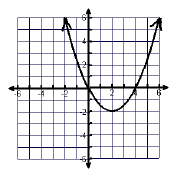
What are the zeros?
a)
x= 0 and x= -4
b)
x= 0 and x= 4
c)
y= 0
d)
x= 2
33.
True or false:
The solutions, roots, x-intercepts, and zeros of a quadratic equation are all the same thing.
The solutions, roots, x-intercepts, and zeros of a quadratic equation are all the same thing.
a)
True
b)
False, because the solution and root are the same but the x-intercept and zero are different
c)
False, because the x-intercept and root are the same but the zero and solution are different
d)
False, they are all different
34.

What is the range for the function below?
a)
y ≤ 4
b)
y ≥ 4
c)
All real numbers
d)
-3 ≤ y ≤ 1
35.

What are the root(s)?
a)
{-4 , 2}
b)
{2}
c)
No Solution
d)
{2 , -4}
36.
What are the roots of the function
f(x)= (x - 2)(x + 3)?
f(x)= (x - 2)(x + 3)?
a)
x = - 2 or x = 3
b)
x = 2 or x = -3
c)
The are no real roots
d)
x = 2 or x = 3
37.
What piece of information does c identify in the following equation?
y=ax2+bx+c
y=ax2+bx+c
a)
Zeroes
b)
Axis of Symmetry
c)
Direction
d)
y-intercept
38.
Determine the values of
a, b, and c for
the quadratic equation:
4x2 – 8x = 3
a, b, and c for
the quadratic equation:
4x2 – 8x = 3
a)
a = 4, b = -8, c = 3
b)
a = 4, b =-8, c =-3
c)
a = 4, b = 8, c = 3
d)
a = 4, b = 8, c = -3
39.

The solutions of a quadratic equation are known as the _____.
a)
Vertices
b)
Roots
c)
Squares
d)
Formulas
40.

What are the x- intercepts?
a)
x= 0 and x= -4
b)
x= 0 and x= 4
c)
y= 0
d)
x= 2
41.

What is the domain of the function?
a)
D:{ x > 3}
b)
D:{x < 3}
c)
D:{all real numbers}
d)
D:{ -1 < x < 5}
42.
Which equation below is a quadratic?
a)
y=9x+5
b)
y=3x2-6
c)
y=5x3+6
d)
x=3x
43.
Does the equation open or or down?
Y = -3x2 +7x - 2
Y = -3x2 +7x - 2
a)
up
b)
down
44.
What's the axis of symmetry of y=3x2-6x+4
a)
x=1
b)
x=-6
c)
x=2
d)
x=-1
45.
What is the vertex of the function
f(x) = -x2+8x-10?
f(x) = -x2+8x-10?
a)
(4,6)
b)
(4,38)
c)
(-4, -10)
d)
(8, -10)
46.
Find the vertex of
f(x) = -x2 - 4x + 12
f(x) = -x2 - 4x + 12
a)
(-2, 16)
b)
(2, 0)
c)
(2, 4)
d)
(-2, 4)
47.
Use the graph to determine the solutions.
a)
-1 and -3
b)
1 and -3
c)
1 and 3
d)
-1 and 3
48.
Does
y = -4x2
have a maximum or minimum value?
y = -4x2
have a maximum or minimum value?
a)
maximum
b)
minimum
49.

The point in which a graph hits the x-axis is know as the _____
a)
Solution
b)
x-intercept
c)
Root
d)
All answers are correct
50.
What are the x-intercepts of
f(x)=(x - 10)(x + 10)
f(x)=(x - 10)(x + 10)
a)
10
b)
(10 , 0) and (-10 , 0)
c)
(0, -10) and (0, 10)
d)
0
51.

What is the minimum value?
a)
-1
b)
-3
c)
0
d)
-1/2
52.

What are the zeroes?
a)
(-4, 0) and (-2, 0)
b)
(0, -4) and (0, -2)
c)
(-3, -1)
d)
(0, 8)
53.
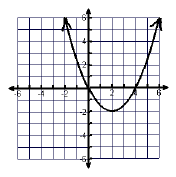
What is the range of this function?
a)
All real numbers.
b)
All real numbers greater than or equal to 0.
c)
All real numbers greater than or equal to -2.
d)
All real numbers greater than or equal to 2.
54.

What is the range of this quadratic function?
a)
All real numbers.
b)
All real numbers greater than or equal to 2.
c)
All real numbers greater than or equal to 4.
d)
All real numbers less than or equal to 4.
55.
What are the zeros of the function
f(x)= -4(x - 3)(x+5)?
*Hint: Type the function into y=
f(x)= -4(x - 3)(x+5)?
*Hint: Type the function into y=
a)
-12 and 20
b)
-5 and 3
c)
-4 and -5
d)
-3 and 5
56.
What is the axis of symmetry?
a)
the slope of the graph
b)
the dividing line for a parabola
c)
a way to spin my pencil
d)
the x-axis
57.
What is the y intercept for the equation:
y = -8x2 + 3x - 7
y = -8x2 + 3x - 7
a)
(0, -8)
b)
(0, 3)
c)
(-8, -7)
d)
(0, -7)
58.
A parabola has a vertex at (-3,2). Where is the axis of symmetry?
a)
y = -2
b)
x = 3
c)
x = -3
d)
y = 2
59.
What form is the following equation written in?
y = 2(x - 2)2 + 4
y = 2(x - 2)2 + 4
a)
Standard
b)
Vertex
c)
Factored
d)
Hege
60.
What form is the quadratic equation written in?
y = 2x2 + 5x + 5
y = 2x2 + 5x + 5
a)
Hege
b)
Vertex
c)
Standard
d)
Factored
61.
What form is the quadratic equation written in?
y = (x - 2)(x + 4)
y = (x - 2)(x + 4)
a)
Factored
b)
Standard
c)
Vertex
d)
Hege
62.
Factor x2-x+56
a)
(x+7)(x-8)
b)
(x-7)(x-8)
c)
(x+7)(x+8)
d)
(x-7)2
63.

What are the green dots called?
a)
axis of symmetry
b)
vertex
c)
parabola
d)
roots or x-intercepts
64.
Find the vertex y = (x - 5)(x - 1)
a)
(5, 1)
b)
(-5, - 1)
c)
(3, -4)
d)
(-3, 32)
65.
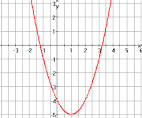
What is the equation of this graph?
a)
f(x) = (x -5)2 + 1
b)
f(x) = (x - 1)2 - 5
c)
f(x) = (x + 1)2 - 5
d)
f(x) = (x + 5)2 +1
66.
Which of the following equations matches standard form of a quadratic?
a)
ax + by = c
b)
y = a(x - h)2 + k
c)
y = ax2 + bx + c
d)
y = mx + b
67.
Which of the following equations shows the vertex form of a quadratic?
a)
y = mx + b
b)
y = a(x - p)(x - q)
c)
y = ax2 + bx + c
d)
y = a(x - h)2 + k
68.
Multiply: (x - 7)(x + 7)
a)
x2 + 7x - 49
b)
x2 - 7x + 49
c)
x2 - 49
d)
x2 + 49
69.
Which is equivalent to (x+4)2
a)
x2+16
b)
x2-16
c)
x2+8x+16
d)
x2+8x-16
70.
Factor:
x2 + 10x + 24
x2 + 10x + 24
a)
(x + 8)(x + 3)
b)
(x + 6)(x + 4)
c)
(x + 12)(x - 2)
d)
(x + 12)(x + 2)
71.
Factor
k2+7x+10
k2+7x+10
a)
(k+2)(k+5)
b)
(k-2)(k-5)
c)
(k+10)(k+4)
d)
(k+2)(k-5)
72.
Factor
n2 + 16n + 63
n2 + 16n + 63
a)
(n-7)(n+4)
b)
(n+7)(n-9)
c)
(n-3)(n-10)
d)
(n+7)(n+9)
73.
Factor
2x2 - 13x - 70
2x2 - 13x - 70
a)
(2x-7)(x+10)
b)
(7x+5)(x+2)
c)
(2x+7)(x-10)
d)
2(x+7)(x+10)
74.
Which of the following expressions is equivalent to
x2 - 225?
x2 - 225?
a)
(15 - x)(15 + x)
b)
(x - 15)2
c)
(x - 15)(x + 15)
d)
(x + 15)(x + 15)
75.
Which of the following expressions is equivalent to:
x2 - 4?
x2 - 4?
a)
(x + 2)(x - 2)
b)
(2 + x)(2 - x)
c)
(x + 2)2
d)
(x - 2)(x - 2)
100 %

