wayground logo

Free Printable Worksheets

NEW

Font size

S
M
L
XL
Worksheets

The 1920s, The Great Depression, and The New Deal

Total questions: 30

Worksheet time: 22mins

Name
Class
Date
1.
REVIEW
Which of the following did Jim Crow laws promote?
a)
racial integration
b)
racial harmony
c)
racial segregation
d)
racial equality
2.
Why did many Americans invest their money in the stock market?
a)
They wanted to be able to loan businesses money. 
b)
They thought they could sell their stock at a low price and make a profit. 
c)
They thought they could sell their stock at a high price and make a profit. 
d)
They wanted to finance a new war. 
3.
What was an effect of the Stock Market Crash in 1929?
a)
People felt less confident in the economy.
b)
Store owners ordered fewer goods from factories. 
c)
Factories had to fire workers due to fewer orders.
d)
All of the above. 
4.
What is unemployment?
a)
The number of people who are fired. 
b)
The number of people with jobs. 
c)
The number of people who are looking for a job but can't find one. 
d)
The number of people who applied for a job during the Great Depression. 
5.
What happened after the stock market crash?
a)
People borrowed money to buy more stocks.
b)
There was a boom in the economy. 
c)
The economy grew strong.  
d)
The economy grew weak. 
6.
REVIEW:
Henry Ford's factories used assembly lines and division of labor 
a)
to build homes
b)
to produce appliances like washing machines
c)
to build cars
d)
to produce more stocks for investors
7.
Which of the following statements best describes what happened on Black Tuesday?
a)
Stock prices fell and the stock market crashed.
b)
Bank runs forced many banks to close their doors.
c)
Federal troops attacked the Bonus Army marchers.
d)
The Supreme Court ruled that the NRA was unconstitutional.
8.
Who was president at the time of the Stock Market Crash?
a)
Abraham Lincoln
b)
Franklin D. Roosevelt
c)
Theodore Roosevelt
d)
Herbert Hoover
9.
On October 29, 1929 share prices on the New York Stock Exchange completely collapsed and partially caused the Great Depression.
a)
Black Thursday
b)
Black Tuesday
c)
Black Friday
d)
Black Sunday
10.
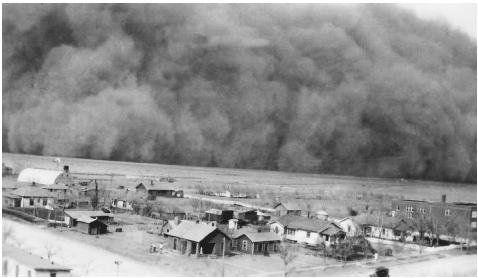
When did "Black Sunday" in the Dust Bowl take place?
a)
1920's
b)
1930's
c)
1940's
d)
1950's
11.
One of the most famous photographs in American history was taken during the dust bowl. The picture's title is:
a)
Migrant Mother
b)
Mama Worry
c)
Maiden Mother
d)
Mistaken Mother
12.
The effect of the Dust Bowl on farmers was made even worse by...
a)
The Great Depression
b)
The Jazz Age
c)
The First Amendment
d)
FDR's New Deal
13.
Why is President Franklin D. Roosevelt often given credit for helping Americans survive the Great Depression?
a)
He came from a wealthy family. 
b)
He helped create the New Deal
c)
He created Hoovervilles for people to live in. 
d)
He told people they should stand in soup lines for food. 
14.
What are the main goals for the New Deal?
a)
Relief for needy
b)
Economic Recovery
c)
Financial Refrom
d)
All were goals of the New Deal
15.

What problem were both the Civilian Conservation Corps and the Works Progress Administration developed to address?

a)

Excessive stock market speculation

b)

High unemployment

c)

Increased use of credit

d)

Overproduction of goods

16.
One difference between the administrations of President Roosevelt and President Hoover was that Roosevelt was-
a)
more willing to use government intervention to solve economic problems
b)
unwilling to allow government agencies to establish jobs
c)
able to ignore economic issues for most of his first term in office
d)
opposed to any type of government regulation of financial institutions
17.

During the Depression, many people lost their home and were forced to live in shantytowns. Some people referred to these shantytowns as Hoovervilles because

a)

President Hoover had failed to act to fight the Great Depression

b)

President Hoover had built the shantytowns

c)

President Hoover was a very popular president

d)

President Hoover had died in office

18.

The ________ ________ is the time when African American artists, writers, and musicians revealed the variety of their cultural contributions to the rest of society

a)

World War I

b)

Great Depression

c)

Medieval Times

d)

Harlem Renaissance

19.

This African-American athlete won 4 gold medals at the 1936 Olympics.

a)

Duke Ellington

b)

Langston Hughes

c)

Jesse Owens

d)

Usain Bolt

20.

Automobiles were being mass produced, which made them a lot cheaper for people to buy, thanks to this man...

a)

Louis Armstrong

b)

Charles Lindbergh

c)

Babe Ruth

d)

Henry Ford

21.

This American aviator inspired the nation by taking the first solo nonstop flight across the Atlantic Ocean.

a)

Louis Armstrong

b)

Henry Ford

c)

Charles Lindbergh

d)

Langston Hughes

22.

This African American POET was one of the most important figures of the Harlem Renaissance.

a)

Langston Hughes

b)

Babe Ruth

c)

Henry Ford

d)

Louis Armstrong

23.

He provided entertainment while playing for the Boston Red Sox and the New York Yankees. He set a record by hitting his 60th home run in a single season in 1927.

a)

Louis Armstrong

b)

Charles Lindbergh

c)

Babe Ruth

d)

Henry Ford

24.

Why did Americans elect Roosevelt?

a)

His wife promsed to help workers and women.

b)

He promised that the federal government would NOT interfere with the economy.

c)

He promised that he would build more shantytowns and soup kitchens.

d)

He promised that he would give the American people a "new deal" by creating programs to help them.

25.
New Deal program tasked with providing electricity to the people through dams and other means.
a)
Works Progress Administration
b)
Tennessee Valley Authority
c)
Tennessee Valley Electrical Organization
d)
Civilian Conservation Corps
26.

In this New Deal program, workers constructed things like roads, bridges, public buildings and parks but it also employed artists and performers...

a)

Tennesee Valley Authority

b)

FDIC

c)

FERA

d)

Works Progress Administration

27.
What are the 3 R's of the New Deal?
a)
Relief, Rebuild, and Reform
b)
Recover, Rebuild, and Reform
c)
Relief, Recovery, and Reform
d)
Recover, Revive, and Reform
28.
Due to the disabled, unemployed, and the elderly over 65 years of age
a)
FERA
b)
TVA
c)
Social Security Act
d)
FDIC
29.

She wrote Gone With the Wind, which became a hugely successful novel, and later on an even bigger movie.

a)

Amelia Earhart

b)

Margaret Mitchell

c)

Eleanor Roosevelt

d)

Shirley Temple

30.
What effect did the Dust Bowl storms have on the Great Depression?
a)
Many farmers were forced to leave the Great Plains.
b)
Unemployment decreased gradually.
c)
Many homes long the Mississippi River were flooded.
d)
Hoover was re-elected as president.