wayground logo

Free Printable Worksheets

NEW

Font size

S
M
L
XL
Worksheets

Physics Review

Total questions: 71

Worksheet time: 2hrs 36mins

Name
Class
Date
1.
What is a force?
a)
a push
b)
a pull
c)
both a push and pull
d)
neither
2.
What tool/equipment is used to measure force?
a)
Triple Beam Balance
b)
Spring Scale
c)
meter stick
3.
What unit of measurement is used to measure force?
a)
seconds
b)
Newtons
c)
meters
d)
grams
4.
A book sitting on a table is an example of what type of force?
a)
Balanced 
b)
Unbalanced
5.
A tug-of-war rope is moving to the left with a force of 20N. What type of force is this?
a)
Balanced
b)
Unbalanced
6.
What is the energy of motion?
a)
Potential
b)
Balanced
c)
Unbalanced
d)
Kinetic
7.
What is stored energy?
a)
Potential
b)
Balanced
c)
Unbalanced
d)
Kinetic
8.
A force can cause an object to speed up, slow down, or change direction. True or False?
a)
True
b)
False
9.
The tendency of an object to resist change is motion is known as...
a)
Energy
b)
Motion
c)
Force
d)
Inertia
10.
A chair being pushed across a room is an example of what type of force?
a)
unbalanced
b)
balanced
11.
If an object starts to speed up...
a)
a balanced force is acting on it
b)
an unbalanced force is acting on it
c)
no forces are acting on it
12.
What is the net force when forces are balanced?
a)
the sum of the two forces
b)
the difference between the two forces
c)
zero
13.
A person in a collision who is not wearing a seat belt continues to move forward because of...
a)
a balanced force
b)
inertia
c)
gravity
d)
potential energy
14.
The Earth is in constant rotation. The Earth will continue to spin unless acted upon by...
a)
a net force
b)
an unbalanced force
c)
Solar rays
d)
a balanced force
15.
Balanced forces applied to an object from opposite directions do what?
a)
Produce no motion
b)
Cause an object to start moving
c)
Change the direction of the object
d)
Produce a force greater than one
16.
Which of the following objects has the most inertia?
a)
Elephant
b)
Bowling Ball
c)
Feather
d)
Pen
17.
Which object has kinetic energy?
a)
A rocket before launch
b)
Falling water from a waterfall
c)
A baseball in a pitcher's glove
d)
Stretched rubberband
18.
An object's change in position relative to a reference point over a period of time is known as?
a)
Mass
b)
Inertia
c)
Motion
d)
Force
19.
When writing units for speed, you should always use 'mph' or 'mps' instead of "mi/hr" or "m/s".
a)
True
b)
False
20.
Velocity is distance divided by time with direction added at the end.
a)
False
b)
True
21.
Acceleration is a change in which of the following?
a)
Speed
b)
Motion and Time
c)
Speed and Direction
d)
Direction
22.
Which of the following is not an example of an inclined plane?
a)
Wedge
b)
Screw
c)
Combined Pulley
d)
Ramp
23.
When writing a hypothesis, which format do you use?
a)
"If....when..."
b)
"If...maybe..."
c)
"I predict that..."
d)
"If...then..."
24.
What is the difference between speed and velocity?
a)
Velocity is speed with direction
b)
Speed is velocity with direction
c)
There is no difference
d)
Velocity is the change in speed over time
25.
How do you determine the speed of an object?
a)
time divided by distance
b)
distance multiplied by time
c)
distance minus time
d)
distance divided by time
26.
When forces are applied in the same direction, you should?
a)
add them
b)
subtract them
c)
multiply them
d)
divide them
27.
How fast did Jose run 240 meters if it took him 80 seconds?
a)
30 m/s
b)
30 km/s
c)
3 m/h
d)
3 m/s
28.
How can you tell on a graph if something is not moving?
a)
horizontal line
b)
curved line
c)
diagonal line
d)
vertical line
29.
When forces are being applied in opposite directions, you should?
a)
add them
b)
subtract them
c)
multiply them
d)
divide them 
30.
If a car drives 20 km in one hour, what is its speed?
a)
2 km/hr
b)
20 km/hr
c)
200 km/hr
d)
0 km/hr
31.
A good water polo player can swim 50 m in 26 seconds. What would be the speed of the player?
a)
1.92 m
b)
.52 m/s
c)
1300 m/s
d)
1.92 m/s
32.
Calculate the speed if a bike moves 200 metres in 50 seconds.
a)
5 m/s
b)
4 m/s
c)
.25 m/s
d)
10,000 m/s
33.
What is this object's SPEED at 2 seconds? (hint: you will need to do MATH!!)
a)
5 m/s
b)
5 s/m
c)
20 m/s
d)
20 s/m
34.
How FAR (what distance) did this object travel in 3 seconds?
a)
5m
b)
10m
c)
15m
d)
20m
35.
How much TIME did it take this object to travel a distance of 10 m?
a)
0 s
b)
10 s
c)
15 s
d)
20 s
36.
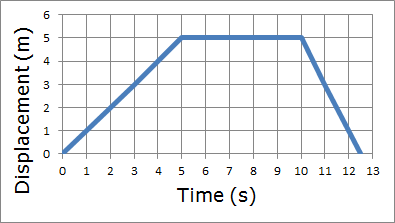
What is the average speed of the person during the first 5 seconds?
a)
0 m/s
b)
1 m/s 
c)
3 m/s
d)
6 m/s 
37.
What is the object's average speed from 0-20 seconds?
a)
0.5m/s
b)
10m/s
c)
2m/s
d)
10m
38.
What is the person doing from 5 seconds to 10 seconds?
a)
Walking at a constant speed
b)
Running at a constant speed
c)
Standing Still 
d)
Walking Fast
39.
What is the person doing from 0 to 5 seconds?
a)
Walking forward at a constant speed
b)
Walking back home at a constant speed
c)
Standing Still 
40.
At what TIME did the boy turn and start WALKING HOME?
a)
0 s
b)
6 s
c)
10 s
d)
8 s
41.
During what times is the object not moving?
a)
B to C
b)
C to D
c)
E to F
d)
only at point A
42.
Which part of the trip was the FASTEST?
a)
B to C
b)
D to E
c)
F to G
d)
C to D
43.
What is occurring in this graph?
a)
The object is accelerating
b)
The object is going back to start
c)
The object is moving at a constant speed
d)
The object is at rest
44.
Which of the following is a unit of SPEED ?
a)
sec
b)
mi
c)
m/s
d)
min
45.
What is the equation to calculate speed?
a)
speed = distance/time
b)
speed = time/distance
c)
speed = time x distance 
d)
speed = speed/time 
46.
Which line represents a faster speed? Careful!
a)
dashed line
b)
solid line
47.
What is the overall average speed of the object?
a)
10 cm/s
b)
5 cm/s
c)
2 cm/s
d)
1 cm/s
48.
What is the speed of a car that travels 400 m in 20 minutes?
a)
20 miles/hr
b)
20 m/min
c)
800 m/min
d)
200 miles/hr
49.
A train travels 25 km in .5 hrs. How fast is the train going?
a)
25 miles/hr
b)
5 miles/hr
c)
125 km/hr
d)
50 km/hr
50.
Mr. Rudman speed walked 2 miles in 10 minutes, what is his speed?
a)
0.2 miles/min
b)
2 miles/min
c)
20 miles/min
d)
40 miles/min
51.

What is happening at D?

a)

Stopped

b)

Accelerating

c)

Fast constant speed; moving away from the starting position

d)

Slower constant speed; moving away from the starting position

52.

What is happening at A?

a)

Stopped

b)

Accelerating

c)

Slower constant speed; moving away from the starting position

d)

Constant speed; returning to start position

53.

What is happening at E?

a)

Stopped

b)

Accelerating

c)

Fast constant speed; moving away from the starting position

d)

Constant speed; returning to start position

54.
What two measurements are necessary for calculating speed?
a)
Mass and time
b)
Temperature and mass
c)
Mass and distance
d)
Distance and time
55.
A runner races in the 100 meter dash.  It takes her 10 seconds to finish.  What is her average speed?
a)
10 m/s
b)
1000 m/s
c)
100 seconds
d)
10 seconds
56.
A unusually fast zombie was chasing after Carl to eat him. What was the zombie’s speed at 6 seconds if he traveled 36 meters?
a)
6 meters/seconds
b)
6 seconds/meters
c)
.17 meters/second
d)
None of the above
57.
Soccer ball A goes 15 feet in 3 seconds, and Ball B goes 12 feet in 2 seconds. Which ball moved the fastest?
a)
Soccer Ball A
b)
Soccer Ball B
c)
Their speeds are equal.
58.
At what point is the object resting/not moving?
a)
A-B
b)
 B-C , D-E
c)
E-F
d)
E-G
59.
What is this objects speed at 2 s?
a)
5 m/s
b)
5 s/m
c)
20 m/s
d)
20 s/m
60.
What is the speed of the object at point A? *Distance/Time
a)
3 m/s
b)
12 m/s
c)
4 m/s
d)
6 m/s
61.
How long did one of the runner's rest?
a)
8 seconds
b)
13 seconds
c)
5 seconds
d)
50 seconds
62.
How long did it take this object to travel 10 m?
a)
0 s
b)
10 s
c)
15 s
d)
20 s
63.
  Between which two points show moving back towards the starting position?
a)
A-B
b)
B-C
c)
C-D
d)
E-F
64.
Which runner had a head start?
a)
A
b)
B
c)
C
d)
None of them
65.
Which runner won the race?
a)
A
b)
B
c)
C
d)
It was a tie
66.
What does this graph represent?
a)
Constant speed
b)
Acceleration
c)
Not moving
67.
What is this graph showing?
a)
Constant Speed
b)
Acceleration (speeding up)
c)
Deceleration (slowing down)
d)
No motion
68.
 Myra drove at an average speed of 30 miles per hour for the first 30 miles of a trip & then at an average speed of 60 miles/hr for the remaining 30 miles of the trip. If she made no stops during the trip what was her average speed in miles/hr for the entire trip?
a)
35
b)
40
c)
45
d)
50
69.

Belle drove 40 miles to see her cousin and at 20 mph. The trip took Belle 2 hours. Then, Belle drove from her cousin’s house and drove another 30 miles to the store at a speed of 10m/hr. It took Belle 3 hours to arrive at the store. What was Belle’s average speed for the trip?

a)

14 mph

b)

16 mph

c)

18 mph

d)

20 mph

70.
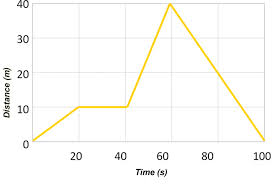
Every morning, Tom walks along a straight road from his home to the bus stop. Below, is a graph representing Tom’s trip to school.
-
 What is the distance covered through the second segment, which is between 50 seconds, and 70 seconds?
a)
40 meters
b)
60 meters
c)
80 meters
d)
20 meters
71.
Find the average speed (round the answer to the hundredths place, if necessary):
distance = 867 cm; time = 56 hr
a)
25.48 cm/hr
b)
17.23 cm/hr
c)
15.48 cm/hr
d)
17.23 hr per cm