
 Worksheets
Microscopes
Total questions: 87
Worksheet time: 1hrs 23mins
Name
Class
Date
1.
When would you use the diaphragm?
a)
When you wanted to move the stage
b)
When you wanted to adjust the light
c)
When you wanted to put the microscope away
d)
When you sneeze
2.
You can find total magnification by which of the following methods?
a)
ocular PLUS objective
b)
ocular TIMES objective
c)
ocular MINUS objective
d)
ocular DIVIDED BY objective
3.
Find the total magnification:
Eyepiece = 10X
Objective lens = 55X
Eyepiece = 10X
Objective lens = 55X
a)
10x
b)
55x
c)
65x
d)
550x
4.

What is number 14?
a)
stage clips
b)
stage
c)
diaphragm
d)
light source
5.

What is number 15?
a)
light source
b)
base
c)
coarse adjustment
d)
fine adjustment
6.

What is number 17?
a)
body tube
b)
arm/neck
c)
stage
d)
base
7.
You should always carry the microscope by the
a)
arm and base
b)
arm and body tube
c)
arm only
d)
the objectives
8.
When looking at a specimen on your slide, you should always start with the
a)
low objective lens
b)
medium objective lens
c)
high objective lens
d)
super extra high power lens
9.
When looking through your microscope, you move your slide to the right- It appears
a)
to move to the right
b)
to stay the same
c)
to move to the left
d)
vanish
10.
The _______focuses the image under low power.
a)
revolving nosepiece
b)
fine adjustment knob
c)
coarse adjustment knob
d)
arm/neck
11.
The__________ sharpens the image under high magnification.
a)
the diaphragm
b)
fine adjustment knob
c)
coarse adjustment knob
d)
the ocular
12.
The ________ of the microscope would show you the MOST zoomed in image, or the SMALLEST field of view.
a)
low power objective
b)
medium power objective
c)
high power objective
d)
stage
13.
What power do you start with when using a microscope?
a)
High power
b)
Medium power
c)
Low power
d)
Extra high power
14.
Never use this when on high power.
a)
Fine adjustment
b)
Diaphragm
c)
Course adjustment
d)
Stage clips
15.
What is the function of stage clips?
a)
To move the objectives
b)
To keep the slide secure
c)
To adjust the focus
d)
To look through
16.
The diaphragm helps to
a)
focus
b)
allow light to pass through the stage
c)
change the lens size
17.
A compound light microscope will use _______ or more lenses at the same time.
a)
1
b)
2
c)
3
18.
You can find total magnification by which of the following methods?
a)
adding the eyepiece and the objective lens
b)
multiplying the eyepiece and the objective lens
c)
adding the eyepiece and all of the objective lenses
d)
multiplying the eyepiece and all of the objective lenses
19.
Find total magnification for:
Eyepiece = 10X
Objective lens = 4X
Eyepiece = 10X
Objective lens = 4X
a)
4x
b)
6x
c)
14x
d)
40x
20.
Find the total magnification:
Eyepiece = 10X
Objective lens = 10X
Eyepiece = 10X
Objective lens = 10X
a)
0x
b)
10x
c)
20x
d)
100x
21.
Find the total magnification:
Eyepiece = 10X
Objective lens = 40X
Eyepiece = 10X
Objective lens = 40X
a)
10x
b)
50x
c)
40x
d)
400x
22.

What is number 13?
a)
revolving nosepiece
b)
eyepiece
c)
objective lens
d)
base
23.

What is number 14?
a)
stage clips
b)
stage
c)
diaphragm
d)
light source
24.

What is number 15?
a)
light source
b)
base
c)
coarse adjustment
d)
fine adjustment
25.

What is number 16?
a)
revolving nosepiece
b)
objective lense
c)
body tube
d)
eyepiece
26.

What is number 17?
a)
body tube
b)
arm
c)
stage
d)
base
27.

What is number 18?
a)
stage
b)
stage clips
c)
coarse adjustment
d)
fine adjustment
28.

What is number 19?
a)
diaphragm
b)
coarse adjustment
c)
fine adjustment
d)
light source
29.

What is number 20?
a)
eyepiece
b)
body tube
c)
arm
d)
base
30.
What is the function of stage clips?
a)
To move the objectives
b)
To keep the slide secure
c)
To adjust the focus
d)
To look through
31.

Number 10
a)
Stage
b)
Stage Clips
c)
Diaphragm
d)
Base
32.

Name this part of the microscope
a)
arm
b)
scanning objective
c)
diaphragm
d)
eyepiece/ ocular
33.
A light microscope that has more than one lens, the ocular and objective lens, is called a _______________.
a)
compound microscope
b)
microscope
c)
electrical microscope
d)
telescope
34.
Lenses consist of low 4X, medium 10X, and high 40X
a)
Eyepiece
b)
Ocular Lens
c)
Objective Lenses
d)
Illuminators
35.
Projects and provides light upward to view specimen; illuminator
a)
Diaphragm
b)
Light Source
c)
Stage
d)
Stage Clips
36.

Number 12
a)
Course Adjustment
b)
Fine Adjustment
c)
Small Adjuster
d)
Large Adjuster
37.

Number 6
a)
Insulator
b)
Objective Lens
c)
Ocular Lens
d)
Light
38.

Number 13
a)
Arm
b)
Light
c)
Base
d)
Stand
39.
The higher the magnification, the ________ you see of the specimen.
a)
more
b)
less
c)
higher
d)
lower
40.
A microscope is an instrument that.
a)
makes faraway objects look closer.
b)
makes small objects appear larger.
c)
decreases the size of small objects.
d)
increases the size of small objects.
41.

If your teacher asks you to move a microscope to table, how do you carry it?
a)
by the body tube and the eyepiece
b)
with one hand
c)
one hand on the arm and the other under the base
d)
with one hand on the base and the other on the eyepiece.
42.

Which part of the microscope controls the amount of light available?
a)
coarse adjustment knob
b)
diaphragm
c)
objective lens
d)
revolving nosepiece
43.

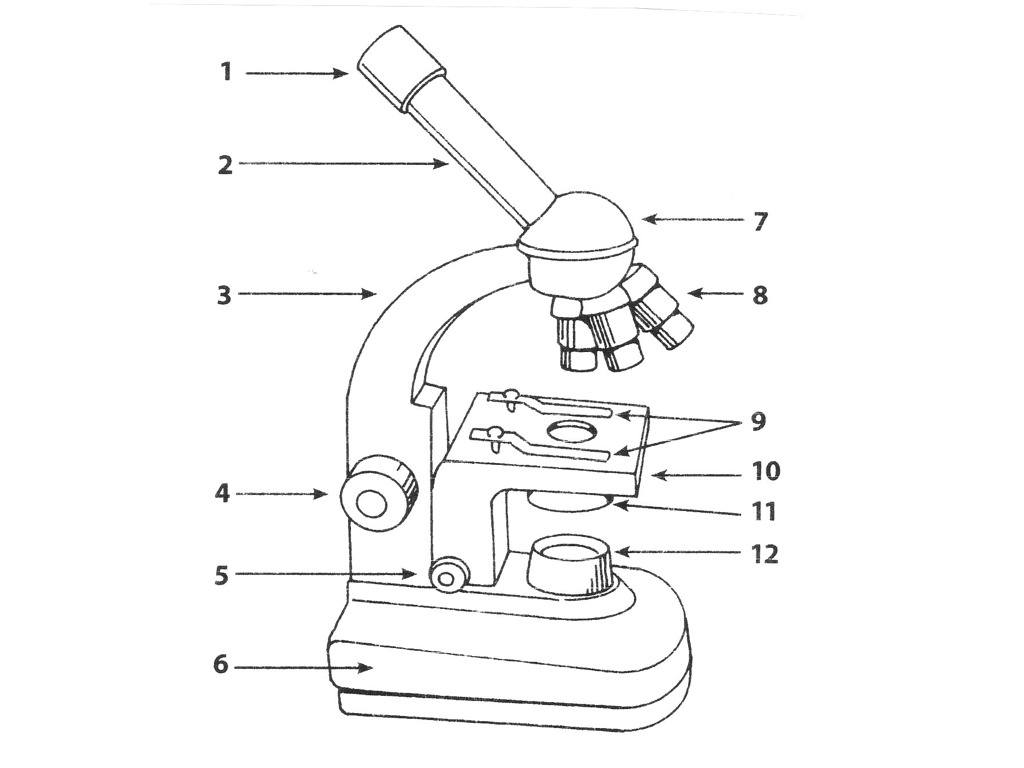
What is part 1?
a)
eye piece
b)
body tube
c)
arm
d)
coarse adjust
44.

What part is 3?
a)
eye piece
b)
base
c)
arm
d)
coarse adjust
45.

What part is 5?
a)
coarse adjustment
b)
fine adjustment
c)
diaphragm
d)
stage
46.

What is part 11?
a)
coarse adjustment
b)
fine adjustment
c)
diaphragm
d)
stage
47.

What is part 2?
a)
arm
b)
base
c)
body tube
d)
illuminator
48.

What is part 6?
a)
arm
b)
base
c)
body tube
d)
illuminator
49.
If you accidentally break a microscope slide, you should...
a)
clean it up yourself.
b)
try to hide it from your teacher.
c)
tell your teacher.
50.
When looking at a specimen on your slide, you should always start with the
a)
low power objective lens
b)
medium power objective lens
c)
high power objective lens
51.
The diaphragm helps to
a)
focus the image.
b)
change the amount of light that passes through the stage.
c)
change the objective lens size.
52.
When looking through your microscope, you move your slide to the right. It appears to
a)
move to the right.
b)
stay the same
c)
move to the left
53.
The ___ focuses the image under low power.
a)
revolving nosepiece
b)
fine adjustment knob
c)
coarse adjustment knob
54.
A compound light microscope will use __ or more lenses.
a)
1
b)
2
c)
3
55.
The ___ sharpens the image under high magnification.
a)
revolving nosepiece
b)
find adjustment knob
c)
coarse adjustment knob
56.

What part of the microscope is used while carrying it?
a)
2 and 7
b)
8 and 10
c)
3 and 6
d)
6 and 2
57.
What part of the microscope is number 4?
a)
diaphragm
b)
coarse adjustment knob
c)
objective lens
d)
body tube
58.
What part of the microscope is number 8?
a)
revolving nosepiece
b)
objective lenses
c)
fine adjustment knobs
d)
arm
59.
What part of the microscope is number 11?
a)
body tube
b)
arm
c)
diaphragm
d)
stage clips
60.
What part of the microscope is number 5?
a)
fine adjustment knob
b)
revolving nosepiece
c)
base
d)
light source
61.
What part of the microscope is number 11?
a)
body tube
b)
arm
c)
diaphragm
d)
stage clips
62.
What part of the microscope magnifies (makes them appear bigger) objects?
a)
1
b)
7
c)
10
d)
3
63.
What part of the microscope increases resolution (makes the image less blurry)?
a)
12
b)
11
c)
5
d)
2
64.
What part of the microscope is number 12?
a)
stage
b)
base
c)
diaphragm
d)
light source
65.
What part of the microscope is number 9?
a)
stage clips
b)
objective lenses
c)
light source
d)
fine adjustment knob
66.
What part of the microscope controls the amount of light allowed through the stage?
a)
1
b)
4
c)
9
d)
11
67.
Objective lens magnification: 5x
Eyepiece magnification: 5x
What is the total magnification?
Eyepiece magnification: 5x
What is the total magnification?
a)
5x
b)
10x
c)
25x
d)
50x
68.
Objective lens magnification: 40x
Eyepiece magnification: 10x
What is the total magnification?
Eyepiece magnification: 10x
What is the total magnification?
a)
4x
b)
40x
c)
50x
d)
400x
69.

Part 9
a)
Body tube
b)
Eyepiece
c)
Objective
d)
Light Source
70.

Part 10
a)
Stage
b)
Arm
c)
Base
d)
Diaphragm
71.

Part 11
a)
Stage Clips
b)
Stage
c)
Diaphragm
d)
Illuminator
72.
This holds the eye piece and connects it to the objective
a)
Arm
b)
Base
c)
Body Tube
d)
Objective
73.
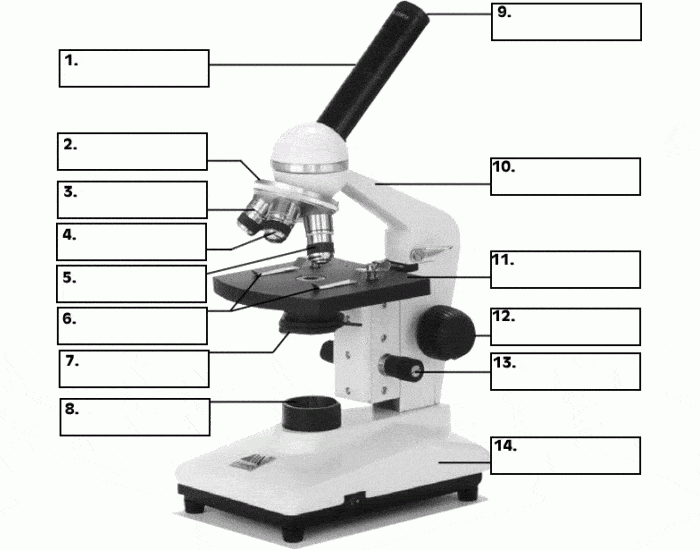
Part 12
a)
Fine Adjustment Knob
b)
Coarse Adjustment Knob
c)
Diaphragm
d)
Objective
74.

Part 13
a)
Fine Adjustment Knob
b)
Course Adjustment Knob
c)
Stage
d)
Diaphragm
75.

Part 14
a)
Stage
b)
Diaphragm
c)
Base
d)
Illuminator
76.
This bring the specimen into sharp focus
a)
Coarse Adjustment Knob
b)
Fine Adjustment Knob
c)
Eyepiece
d)
Diaphragm
77.
Connects to the base and helps carry the microscope easily
a)
Arm
b)
Base
c)
Body Tube
d)
Revolving Nosepiece
78.
This moves the specimen up or down to adjust the slide containing specimen
a)
Fine Adjustment Knob
b)
Coarse Adjustment Knob
c)
Stage
d)
Diaphragm
79.
Used to hold the slides in place
a)
Stage
b)
Stage Clips
c)
Diaphragm
d)
Arm
80.
Part that holds two or more objectives
a)
Stage
b)
Stage Clip
c)
Revolving Nosepiece
d)
Body Tube
81.

Part 1
a)
Eyepiece
b)
Body Tube
c)
Arm
d)
Objective
82.

Part 2
a)
Objectives
b)
Body Tube
c)
Revolving Nosepiece
d)
Stage
83.

Part 3
a)
Low Objective
b)
Medium Objective
c)
High Objective
d)
Revolving Nosepiece
84.

Part 6
a)
Stage
b)
Stage Clips
c)
Diaphragm
d)
Arm
85.

Part 7
a)
Stage
b)
Stage Clips
c)
Light Source
d)
Diaphragm
86.
A slide is placed on the ___ to view.
a)
diaphragm
b)
clips
c)
stage
87.
Never use this knob on high power.
a)
Fine
b)
Large
c)
Course
d)
Small
100 %

