wayground logo

Free Printable Worksheets

NEW

Font size

S
M
L
XL
Worksheets

Uncertainty

Total questions: 33

Worksheet time: 23mins

Name
Class
Date
1.

Which of these is NOT true for systematic errors?

a)

They arise due to errors in the measuring instruments used.

b)

Repeating the observations or increasing the sample size can eliminate them

c)

They are reproducible inaccuracies that are consistently in the same direction.

d)

They arise from the design of the study.

2.

Which of these is NOT true for random errors?

a)

They are difficult to detect.

b)

They do not arise from the design of the study.

c)

They are less likely for small sample sizes.

3.

Systematic errors lead to a lack of:

a)

accuracy in the measurement.

b)

significant digits in the measurement.

c)

precision in the measurement.

d)

gradation of the measuring instrument

4.

Random errors lead to a lack of:

a)

accuracy in the measurement.

b)

significant digits in the measurement.

c)

precision in the measurement.

d)

gradation of the measuring instrument

5.

Repeated measurements of a quantity can reduce the effects of

a)

both random errors and systematic errors

b)

neither random errors nor random errors

c)

random errors

d)

systematic errors

6.

How close a measurement is to the true value is called..

a)

Accuracy

b)

Precision

c)

Significant

d)

Estimate

7.

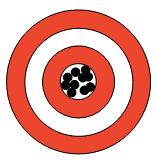
This bullseye demonstrates...

a)

High Accuracy & High Precision

b)

High Accuracy & Low Precision

c)

Low Accuracy & High Precision

d)

Low Accuracy & Low Precision

8.

length?

a)

3.2 cm

b)

3.12 cm

c)

3 cm

d)

3.219 cm

9.

The metal is 7.1 cm long

a)

7 is the estimated digit

b)

1 is the estimated digit

c)

7 is the uncertain digit

d)

Both 7 and 1 are estimated digits

10.

You place a rock on the electronic balance an it measures a mass of 12.38 g. The estimated digit is....

a)

1

b)

2

c)

3

d)

8

11.
?
a)
High Accuracy & High Precision
b)
High Accuracy & Low Precision
c)
Low Accuracy & High Precision
d)
Low Accuracy & Low Precision
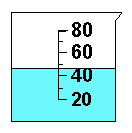
12.

volume?

a)

48 mL

b)

48.2 mL

c)

48.25 mL

d)

4 mL

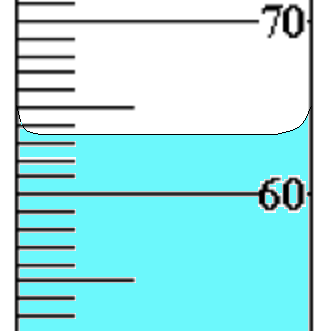
13.

Volume?

a)

63.5 mL

b)

63 mL

c)

63.55 mL

d)

6 mL

14.

Which of the following is the answer for the problem with the correct number of significant digits?

23.91 x 12.861 = 307.50651

a)

308

b)

307.51

c)

307.5

d)

307

15.
Which of the following is the answer for the problem with the correct number of significant digits?
0.0025 x 1.41 = 0.003525
a)
0.00
b)
0.004
c)
0.00353
d)
0.0035
16.
Solve & Round to Correct Sig Figs.
4.5 + 4.32 = 
a)
8.8
b)
8.7
c)
8
d)
8.0
17.
Divide these numbers and show the correct number of significant figures
0.04263 
÷
0.306
a)
0.139
b)
0.1393
c)
0.13931
d)
0.14
18.
What is 0.0568 rounded to 1 significant figure?
a)
0.0
b)
0.06
c)
0.6
d)
0.057
19.
What is 67,490 rounded to 2 significant figures?
a)
67 500
b)
60 000
c)
68,000
d)
67, 000
20.
A set of data are all close to each other, but they are not close to the actual value.  This set of data can be described as...
a)
accurate
b)
precise
c)
both precise and accurate
21.
A set of data are not close to each other, but the average of the data is very close to the actual value.  This set of data can be described as...
a)
accurate
b)
precise
c)
both precise and accurate
22.
There are __?__ significant digits in the number 0.00076
a)
2
b)
4
c)
5
d)
6
23.
There are __?__ significant digits in the number 90,000.00
a)
1
b)
2
c)
5
d)
7
24.

Hypotheses are best described as

a)

confirmations

b)

replications

c)

assumptions

d)

predictions

25.
When experimenting with the growth of a plant, a scientist uses three (of the same type of) plants, two different fertilizers, equal light, and equal water. What type of variable is the fertilizer?
a)
Dependent
b)
Independent
c)
Control
26.
Which variable is the same for each test subject in an experiment?
a)
Dependent
b)
Independent
c)
Control
27.
This is the step of the scientific method where you record OBSERVATIONS in a DATA TABLE, and then make a GRAPH.
a)
Hypothesis
b)
Data/Results
c)
Procedure
d)
Conclusion
28.
There are two types of data. Which type of data involves descriptions/photographs/illustrations that cannot be counted or measured?
a)
qualitative
b)
quantitative
29.

Which of these things is an example of quantitative data?

a)

465 cm

b)

The car swerved to the right

c)

The data was not accurately collected

d)

The car ran into someone's foot

30.
Maria wants to know if birds prefer to eat in one place over another. She makes three feeders out of 2-liter bottles and paints all of them red. She fills each of the feeders with the same amount of mixed birdseed, and plans to keep the feeders out for 10 days before measuring how much seed is eaten from each feeder. She puts each of the feeders in her back yard: one feeder in a large dead tree, another feeder she sits on the dog house, and the last she sits in a small bushy tree.
What is the dependent variable?
a)
Length of the birdfeeders
b)
Amount of time feeders are outside
c)
Amount of seed eaten
d)
Location the feeders are put in.
31.
Ms. S set up an experiment to see how the mass of a ball affects the distance it rolls off a ramp. What is the dependent variable?
a)
Distance traveled by the ball
b)
Height of the ramp
c)
Mass of the ball
d)
Where the experiment took place.
32.

Which of the following does not exist?

a)

The Xavier Table Tennis Team

b)

The Xavier Chess Club

c)

The Xavier Botany Club

d)

The Xavier Cricket Team

33.

Which of the following things about KD are true?

a)

Was raised by polar bears

b)

Only eats broccoli and asparagus

c)

Has a pet penguin named Pengu

d)

Has met Bill Nye