wayground logo

Free Printable Worksheets

NEW

Font size

S
M
L
XL
Worksheets

Weather Unit Study Guide

Total questions: 73

Worksheet time: 38mins

Name
Class
Date
1.

The change of water vapor to liquid water (ex. fog or dew) is called ______.

a)

evaporation

b)

condensation

c)

precipitation

d)

transpiration

2.

A scientist who studies and predicts the weather is called a _______.

a)

meteorologist

b)

mycologist

c)

weatherologist

d)

ecologist

3.

The term that describes the boundary between two different air masses is called a ___________.

a)

climate

b)

occluded

c)

stationary

d)

front

4.

An intense storm that forms in the ocean with swirling winds up to 150 miles per hour is a(n)______.

a)

flood

b)

tornado

c)

hurricane

d)

flash flood

5.

The theory that states certain gases are causing the Earth's surface temperature to get warmer is called the _____ Effect.

a)

Outhouse

b)

Greenhouse

c)

Garden

d)

Warming

6.

The weather instrument that measures the temperature of the air is a(n) _________.

a)

anemeometer

b)

barometer

c)

psychrometer

d)

thermometer

7.

Average weather conditions in a certain place over time is _______.

a)

weather

b)

climate

8.

The weather instrument that shows the direction wind is blowing is a(n) ________.

a)

weather (wind) vane

b)

anemometer

c)

thermometer

d)

barometer

9.

A visible collection of tiny water drops and ice crystals floating above Earth's surface is called ___________.

a)

dew

b)

rain

c)

cloud

d)

smog

10.

The name of the layer of gases that surround Earth is ________.

a)

hydrosphere

b)

atmosphere

c)

biosphere

d)

lithosphere

11.

The name for water in any form falling from clouds is ____.

a)

evaporation

b)

transpiration

c)

condensation

d)

precipitation

12.

A severe lack of rainfall in an area over a certain time period is called a(n) ________.

a)

tornado

b)

hurricane

c)

flood

d)

drought

13.

The pressure system that brings clear skies and calm weather is called a ______ pressure system.

a)

high

b)

low

c)

mild

d)

cold

14.

A cloud on the ground that reduces visibility in an area is called _________.

a)

a cirrus cloud

b)

a stratus cloud

c)

fog

d)

dew

15.

The stage of the water cycle where water enters the atmosphere from the leaves of plants is called _____.

a)

condensation

b)

evaporation

c)

transpiration

d)

precipitation

16.

The weather instrument that measures air pressure is called a(n) __________.

a)

barometer

b)

psychrometer

c)

weather (wind) vane

d)

anemometer

17.

The movement of air due to the uneven heating of Earth's surface is called ________.

a)

tornado

b)

hurricane

c)

fog

d)

wind

18.

The transfer of heat when warm air rises and cooler air sinks creating a circular motion is called a _____ current.

a)

conduction

b)

convection

c)

convention

19.

The four different types of weather fronts are called ____.

a)

arid, wispy, cool, mild

b)

stagnant, cold, hot, stopped

c)

cold, warm, nonmoving, obstructed

d)

warm, cold, stationary, occluded

20.

A spinning column of air with wind speeds up to 300 miles per hour is called a(n) ________.

a)

hurricane

b)

dust devil

c)

tornado

d)

flash flood

21.

The type of pressure system that brings clouds and precipitation is a _______ pressure system.

a)

high

b)

low

c)

mild

22.

The term that describes days of heavy rainfall that causes rivers to rise over their banks is called a(n) _____.

a)

tornado

b)

hurricane

c)

flood

d)

drought

23.

The short-term outdoor conditions at a specific time and place is called _______.

a)

climate

b)

weather

c)

a pattern

d)

status

24.

The weather instrument that measures wind speed is called a(n) __________.

a)

anemometer

b)

wind (weather) vane

c)

barometer

d)

psychrometer

25.

What type of clouds are found below 6,000 feet and are considered "low clouds"? (usually thin, layered clouds)

a)

alto

b)

cirrus

c)

stratus

d)

vertical

26.
Which clouds are called "vertical clouds"?
a)
cirrostratus
b)
stratocumulus
c)
altocumulus
d)
cumulonimbus
27.
What is latitude?
a)
A way to measure distance east and west on Earth
b)
A way to measure distance north and south on Earth
c)
A way to measure elevation on Earth
d)
A way to measure temperature on Earth
28.
Tropical climates:
a)
are warm
b)
are cold
c)
have very warm summers and very cold winters
d)
are always hot and dry
29.
How does climate change as you move north of the Equator towards the North Pole?
a)
climate gets warmer
b)
climate gets colder
30.
What climate is found between the Tropic of Cancer and the Arctic Circle? 
a)
tropical climate
b)
temperate climate
c)
polar climate
31.

Regions near the North and South Pole are colder because:

a)

there is greater solar radiation

b)

there is less solar radiation

c)

there is less water near the poles

d)

there is more water near the poles

32.
Temperate forests are most often found:
a)
Near the North Pole
b)
Near the Equator
c)
at low latitudes (between the Tropic of Cancer and Equator)
d)
at mid latitudes (between the Tropic of Cancer and Arctic Circle)
33.
What other factor can influence where biomes are found?
a)
wind currents 
b)
ocean currents
c)
elevation
d)
all of these have influence
34.
Where are warmer biomes found?
a)
closer to the Poles
b)
closer to the Equator
c)
at mid latitudes
35.
What type of pressure is created by warm air rising?
a)
low pressure
b)
high pressure
36.
What is the air like at the North and South Pole?
a)
hot and dry
b)
cold and dry
c)
hot and wet
d)
cool and dry
37.
What is an ocean current?
a)
a continuous flow of air
b)
a continuous flow of ocean water
c)
the movement of freshwater into the ocean
d)
the movement of ocean water from high to low elevations
38.
Ocean currents that flow from the Equator are usually:
a)
cold
b)
warm
c)
fast moving
d)
slow moving
39.
What type of ocean current originates at or near Poles?
a)
cold
b)
warm
c)
fast moving 
d)
slow moving
40.
Temperature is:
a)
A. a measurable weather factor
b)
Both A. and B.
c)
B. how warm or cold the air is
41.
Which weather factor is described by its speed and direction?
a)
temperature
b)
wind
c)
precipitation
d)
barometric pressure
42.
Which of the following is NOT a type of precipitation?
a)
rain
b)
snow
c)
hail
d)
fog
43.

El Nino and La Nina are:

a)

natural weather events

b)

caused by human activity

c)

lead to changes in weather patterns around the globe

d)

natural weather events but can also be caused by human activity

44.

El Nino usually causes:

a)

very cold winters across Northern US

b)

warm or mild winters across the Northern US

c)

wet conditions across the entire Northern US

d)

hot temperatures in the Midwest US

45.
What is barometric pressure?
a)
A measure of the weight of air over a location
b)
A measure of the volume of air over a location
c)
A measure of the temp of air over a location
d)
A way to describe the type of gases in the atmosphere
46.
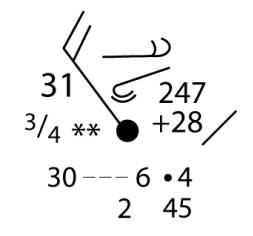
What is the wind direction at this station
a)
Wind is blowing to the west
b)
Wind is blowing from the north
c)
Wind is blowing to the Northwest
d)
Wind is blowing from the Northwest
47.
What are the weather conditions at this station?
a)
rain
b)
snow
c)
fog
d)
hail
48.
What is the wind speed at this weather station
a)
2 knots
b)
10 knots
c)
20 knots
d)
25 knots
49.
What is the cloud coverage at this station?
a)
Not cloudy
b)
Partially cloudy
c)
Overcast
d)
Stormy
50.
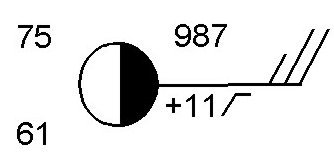
What is the dew point at this station?
a)
75 degrees
b)
61 degrees
c)
987 degrees
d)
11 degrees
51.
What is the temperature at this station
a)
75 degrees
b)
61 degrees
c)
987 degrees
d)
11 degrees
52.
What is the wind direction at this station?
a)
Wind is blowing from the north
b)
Wind is blowing to the East
c)
Wind is blowing from the East
d)
Wind is blowing to the North
53.
What is temperature?
a)
a measure of moisture in the air
b)
a way to describe the sky
c)
a way to describe wind speed and direction
d)
a measure of how warm or cold it is
54.
Which of the following is NOT a factor that describes weather?
a)
elevation
b)
temperature
c)
sky conditions
d)
precipitation
55.
Which factor that determines weather is NOT measurable (measured using tools)?
a)
temperature
b)
wind speed 
c)
wind direction
d)
sky conditions
56.
What is an air mass?
a)
a mass of air with the same type of clouds
b)
a mass of air with the same temp. and moisture content
c)
a dense region in the atmosphere
d)
a large storm that forms in the upper atmosphere
57.
What type of air mass would form over warm water near the Equator?
a)
maritime polar
b)
maritime tropical
c)
continental polar
d)
continental tropical
58.
What type of air is associated with a continental polar air mass?
a)
warm and humid
b)
hot and dry
c)
cold and dry
d)
cool and moist
59.
How does elevation affect a location's climate?
a)
high elevations are warmer than low elevations
b)
high elevations are colder than low elevations
60.
How does latitude affect a location's climate?
a)
low latitudes are warmer than high latitudes
b)
low latitudes are colder than high latitudes
61.
Distance above or below sea level is called ______.
a)
elevation
b)
latitude
c)
topogrphy
d)
wind pattern
62.
Distance north or south of the Equator is called _______.
a)
latitude
b)
elevation
c)
topography
d)
wind pattern
63.
Which of these can help stabililze a location's temperature during the summer and winter?
a)
mountain ranges
b)
large bodies of water (ocean)
c)
a location near the Equator
d)
wind patterns
64.
What is responsible for driving the water cycle?
a)
the Sun
b)
heat within Earth
c)
ocean currents
d)
wind currents
65.
What is evaporation?
a)
The change of solid water (ice) into liquid water
b)
The change of liquid water into water vapor
c)
The change of water vapor into liquid water
d)
The falling of liquid water from the atmosphere
66.
What do you call water that flows on Earth's surface from high elevation to low elevation?
a)
clouds
b)
precipitation
c)
runoff
d)
groundwater
67.
What do you call water that collects in "pools" under the soil?
a)
clouds
b)
precipitation
c)
runoff
d)
groundwater
68.
What do you call the process of water evaporating out of LEAVES through small openings?
a)
transpiration
b)
condensation
c)
precipitation
d)
infiltration
69.
A biome is characterized by:
a)
its climate
b)
the animals that live in it
c)
the latitude of a location
d)
the plants that can survive in it
70.
What is the coldest biome?
a)
polar region
b)
temperate deciduous 
c)
taiga
d)
desert
71.
Which biome is characterized by being warm, ONLY raining in summer and having a dry winter?
a)
temperate forest
b)
taiga
c)
savanna
d)
tropical rainforest
72.
Which biome  has hot days, cold nights, and very little precipitation throughout the year?
a)
taiga
b)
tropical rainforest
c)
desert
d)
temperate forest
73.
Which biome is just south of tundra, is cold, and has moderate precipitation?
a)
polar region
b)
desert
c)
savanna
d)
taiga