wayground logo

Free Printable Worksheets

NEW

Font size

S
M
L
XL
Worksheets

Earth's History and Plate Tectonics (Unit Final A)

Total questions: 70

Worksheet time: 2hrs 44mins

Name
Class
Date
1.

Which type of plate boundary would cause mountains to form?

a)

Transform

b)

Convergent

c)

Divergent

d)

Reform

2.
What are the two types of crust
a)
continental and oceanic
b)
ocean and upper
c)
lower and upper
d)
pizza and subway
3.

Subduction zones can create which features?

a)

islands

b)

volcanoes

c)

earthquakes

d)

all of the above

4.
Earthquakes and volcanoes are most likely found in which locations?
a)
At plate boundaries
b)
in oceans
c)
in the middle of continents
d)
in the middle of plates
5.
The Himalayas in Asia are an example of what type of plate boundary?
a)
divergent
b)
continent-to-continent convergent
c)
ocean-to-continent convergent
d)
transform
6.
When an oceanic plate and a continental plate collide, which one will subduct?
a)
oceanic
b)
continental
c)
neither
7.
Which of the following is NOT a tectonic boundary?
a)
Convergent
b)
Divergent
c)
Sedergent
d)
Transform
8.
Two tectonic plates collide at a _______ plate boundary.
a)
convergent
b)
divergent
c)
transform
9.
The area where two tectonic plates meet.
a)
mantle
b)
focus
c)
plate boundary
d)
convection
10.
Most volcanoes and earthquakes occur...
a)
along the coast
b)
along tectonic plate boundaries
c)
in the Arctic
d)
in the ocean
11.
What is the name of the plate boundary that slides past each other?
a)
Divergent
b)
Convergent
c)
Transform
d)
Mr. C the Slide Man
12.
Which of the following occurs because of convection currents?
a)
Tectonic plates on the crust move.
b)
The mantle increases in size.
c)
Pressure in the crust increases.
d)
Pressure in the crust decreases.
13.
The mantle of Earth is made partly of magma. When magma rises and sinks, this is called ______________. 
a)
a conduction current
b)
a hot spot
c)
a volcanic eruption
d)
a convection current
14.
Where does the heat come from that drives this convection current in the mantle? 
a)
The sun
b)
The crust
c)
the mantle
d)
the core
15.

The theory that states that the Earth is divided into plates that float and move in slow, constant motion.

a)

Continental Drift

b)

Seafloor Spreading

c)

Plate Tectonics

d)

Tectonic Plates

16.
Faults and tectonic plate boundaries are the same thing.
a)
True
b)
False
17.
The circular pattern of heating, rising, cooling, sinking of magma in the mantle causing tectonic plates to move.
a)
Plate Tectonics
b)
Convection Currents
c)
Pangaea
d)
Subduction
18.
A fossil's location in the Earth's strata can help us know if it is older or younger than other fossils found in the strata.
a)
True
b)
False
19.
_______ are formed when two continental plates collide.
a)
Mountain ranges
b)
Transform faults
c)
Rift valleys
d)
Volcanoes
20.
What is the correct order (starting from the surface) of Earth’s layers?
a)
mantle, outer core, inner core, crust
b)
crust, mantle, outer core, inner core
c)
outer core, inner core, crust, mantle
d)
crust, outer core, inner core, mantle
21.
_________ currents carry heat from the hot inner core to the cooler outer mantle and back again.
a)
River
b)
Radiation
c)
Convection
d)
Conduction
22.
Plates move apart at _________ boundaries.
a)
volcanic
b)
divergent
c)
convergent
d)
transform
23.
The San Andreas Fault in California is an example of a ________.
a)
divergent boundary
b)
convergent boundary
c)
transform fault
d)
subduction zone
24.
Which type of plate boundary occurs at B?
a)
convergent
b)
divergent
c)
transform
d)
country
25.
The age of a rock given as the number of years since the rock formed.
a)
relative age
b)
half-life
c)
absolute age
d)
radioactive decay
26.
The age of a rock compared to the ages of other rocks.
a)
relative age
b)
half-life
c)
absolute age
d)
radioactive decay
27.
The time it takes half of the atoms of a radioactive element to decay
a)
relative age
b)
half-life
c)
absolute age
d)
radioactive decay
28.
Preserved remains or traces of an organism that lived in the past.
a)
vertebrate
b)
carbon film
c)
invertebrate
d)
fossil
29.
An animal without a backbone.
a)
vertebrate
b)
carbon film
c)
invertebrate
d)
fossil
30.
An animal with a backbone.
a)
vertebrate
b)
carbon film
c)
invertebrate
d)
fossil
31.

What do we call the Geologic Principle that states: in horizontal layers of sedimentary rock, each layer is older than the layer above it?

a)

mass extinct

b)

geologic time scale

c)

era

d)

law of superposition

32.

How old do Paleontologists believe the Earth is?

a)

2018 years old

b)

3.6 billion years old

c)

4.6 billion years old

d)

4.6 million years old

33.
According to the law of superposition, which layer is the youngest?
a)
A
b)
B
c)
C
34.

What do scientists call the permanent disappearance of a species?

a)

Evolution

b)

Extinction

c)

Migration

d)

Mutation

35.
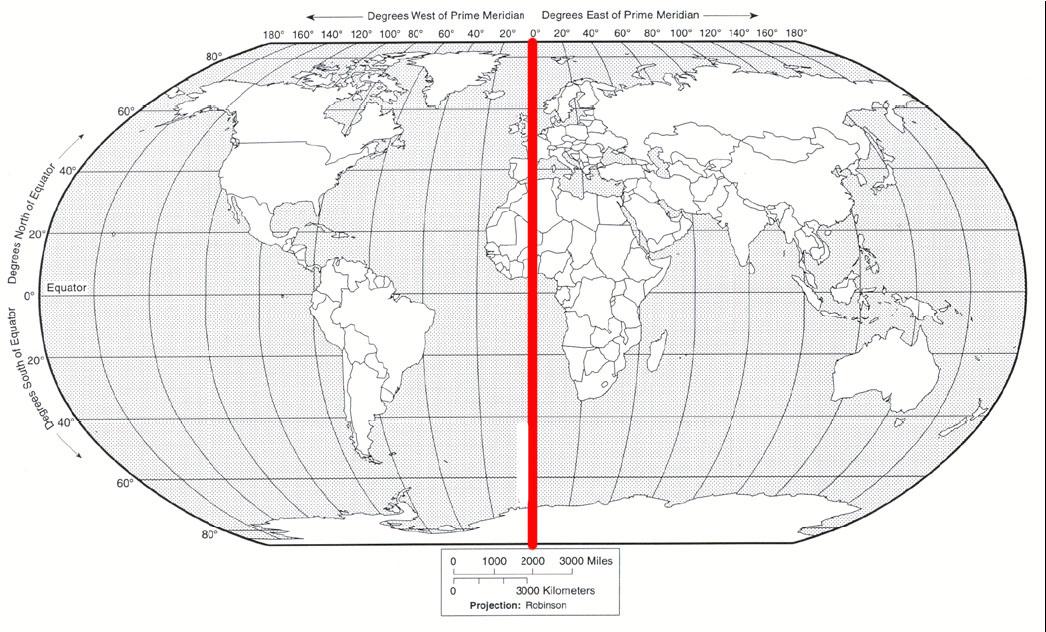
What is the name of this line at 0 degrees latitude?
a)
Prime Meridian
b)
Equator
c)
North Pole
d)
South Pole
36.
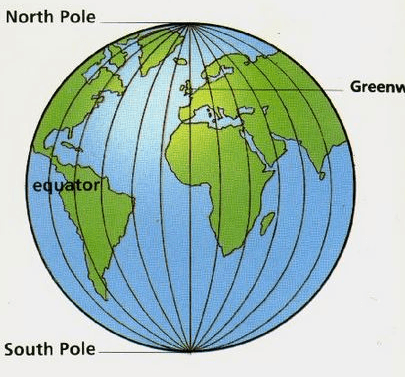
What is the reason why latitude lines NEVER intersect? 
a)
They converge at the poles
b)
They are cool
c)
They are vertical lines 
d)
They are parallel
37.
What is the name of the line at zero degrees longitude?
a)
Equator
b)
Prime Meridian
c)
North Pole
d)
South Pole
38.
a)
The map shows the lines of longitude.
b)
The map shows the lines of latitude.
39.
What is this object known as?
a)
map symbol
b)
map key
c)
map scale
d)
compass rose
40.
Which letter would you find at 15oS, 60oW?
a)
A
b)
C
c)
L
d)
H
41.
Which of the following correctly lists the layers in order from oldest to youngest?
a)
A, B, C, D, E
b)
E, B, C, D, A
c)
E, D, C, B, A
d)
C, B, A, D, E
42.
Which Rock layer or intrusion is the youngest?
a)
A
b)
B
c)
C
d)
D
43.
The Law of Superposition helps scientists to determine what?
a)
The absolute age of rock layers
b)
The age of fossils
c)
The relative age of rock layers
d)
the super powers of rocks
44.
According to the law of superposition, the oldest fossils are found 
a)
At the top of the rock layers
b)
Near the bottom of the rock layers
c)
In the middle of the rock layers
d)
Somewhat near the surface
45.
Which rock layer in the diagram seems to be the oldest?
a)
F
b)
E
c)
B
d)
A
46.
_______ _______ means the age of one object compared to the age of another object.
a)
Relative Age
b)
Relative Fossils 
c)
Index Fossils
d)
Mass Extinction
47.
Which of the following are true?
a)
Relative age does not tell the exact age of an object
b)
Relative age tells the exact age of an object
48.
Which of the following causes Earth's tectonic plates to move?
a)
Energy from the Sun
b)
Magnetic Pole Reversal
c)
Convection currents in the mantle
d)
Faults in Mountain Ranges
49.
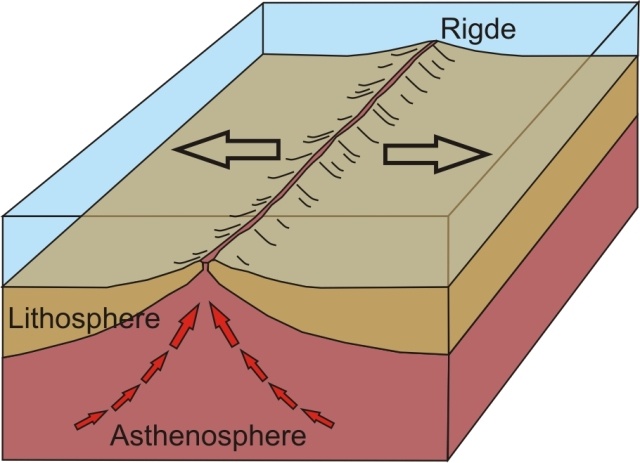
What type of plate boundary is this?
a)
Plate
b)
Divergent
c)
Convergent
d)
Transform
50.
How is it possible for new crust to be formed without increasing the surface area of the Earth?
a)
Crust is destroyed at the same time it is created
b)
New crust is underwater where it sinks
c)
New crust breaks more easily than old crust
51.
Which of the following is where one plate slides under another plate?
a)
submarine zone
b)
divergence zone
c)
subduction zone
d)
lower zone
52.
What is represented by the picture? 
a)
Sea-floor spreading
b)
Pangea
c)
How the continents are arranged today
d)
Volcanoes
53.
How do most fossils form?
a)
Living things die and their remains are covered by sediment
b)
The hard parts of an organism dry out in the air
c)
The soft parts of an organism change to stone
d)
Freezing preserves the remains of an organism
54.
Scientists use radioactive decay to measure...
a)
relative time
b)
absolute time
c)
half-lives
d)
time of day
55.
Analyze the seashell found in the white layer.  Which statement is true of the rock layer that contains this fossil?
a)
It could also contain a fossil from the bottom layer.
b)
It is older than the layers below it.
c)
It is younger than the layers above it.
d)
It is older than the layers above it.
56.
The diagram shows fossils in different rock layers. Which of these statements about the age of these fossils is most likely correct?
a)
Fossil A and C are the same age
b)
Fossil B is older than fossil C
c)
Fossils A is older than fossil B
d)
Fossil D is older than fossil C
57.
According to the diagram, which organism is older: the ammonite or the coral?
a)
ammonite
b)
coral
58.
The huge pieces of the earth's crust are called ____________________________. 
a)
crust
b)
plates
c)
directions
d)
seismos
59.
Describe how geologists separate time periods.
a)
by special events that have happened in that period.
b)
By looking at the Relative Time of a Fossil
c)
By counting the years a fossil has been preserved
60.
Plate tectonics may affect changes in a species because movement of plates causes a change in  _____________.
a)
Environment
b)
Climate
c)
Earth's surface
d)
All of these choices are true
61.
What is the Cambrian explosion?
a)
sudden appearance of new, complex species
b)
a sudden volcanic eruption
c)
a sudden decrease in species
d)
a mass extinction event
62.
In what order do these appear in the geologic record (oldest to youngest)?
a)
Bacteria, fish, birds, humans
b)
Bacteria, birds, fish, humans
c)
Humans, birds, fish, bacteria
d)
Humans, fish, birds, bacteria
63.
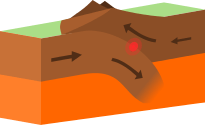
What kind of plate boundary is shown here?
a)
divergent
b)
convergent
c)
transform
d)
subducting
64.
Which of the following is most likely to occur at a transform boundary?
a)
earthquakes
b)
volcanoes
c)
mountain formations
d)
all of the above
65.
What happens to density, pressure, and heat as you go from the crust to the core of the Earth?
a)
They all increase as you move inward
b)
They all decrease as you move inward
c)
Density and pressure increase while heat decreases inward
d)
Pressure and heat increase while density decreases as you move inward
66.
What is the result of the collision of (crashing) of continental tectonic plates?
a)
Beach erosion
b)
Convection Currents
c)
Mountain Building
d)
Faults
67.
How does absolute age differ from relative age?
a)
only absolute dating indicates which rock is older than another
b)
only absolute dating finds the age in years
c)
only relative dating finds the age in years
68.
If the half-life of a radioactive group of atoms is 100 years, then how old is the rock if there have been two half-lives?
a)
25 years
b)
200 years
c)
400 years
d)
800 years
69.
states that the geologic feature which cuts another is the younger of the two features
a)
law of horizontality
b)
cross cutting relationships
c)
law of superposition
d)
uniformitarianism
70.

Radiometric Dating measures :

a)

Absolute Time

b)

Relative Time