
 Worksheets
Tectonics - Edexcel B
Total questions: 159
Worksheet time: 2hrs 0mins
Name
Class
Date
1.
The type of plate boundary where two plates come together is a .....
a)
Convergent Boundary
b)
Divergent Boundary
c)
Transform Boundary
d)
Plate Boundary
2.
Which of the following causes Earth's tectonic plates to move?
a)
Energy from the Sun
b)
Magnetic Pole Reversal
c)
Convection currents in the mantle
d)
Faults in Mountain Ranges
3.
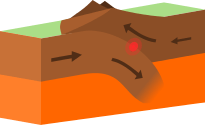
What type of plate boundary is this?
a)
Plate
b)
Divergent
c)
Convergent
d)
Transform
4.

What type of event will occur at this boundary?
a)
Earthquake
b)
Volcano Eruption
c)
Tornado
d)
Mountain Building
5.
A divergent boundary occurs when plates ....
a)
Pull apart
b)
Come together
c)
Slide past each other
d)
subducting
6.
Which of the following is the name of the ancient supercontinent formed 28 Million Years ago.
a)
Pangea
b)
Gondwanda
c)
Laurasia
d)
Neverland
7.
Which of the following is NOT evidence to support the theory of plate tectonics?
a)
Fossils
b)
Mountains
c)
Glaciers
d)
Sand Erosion
8.
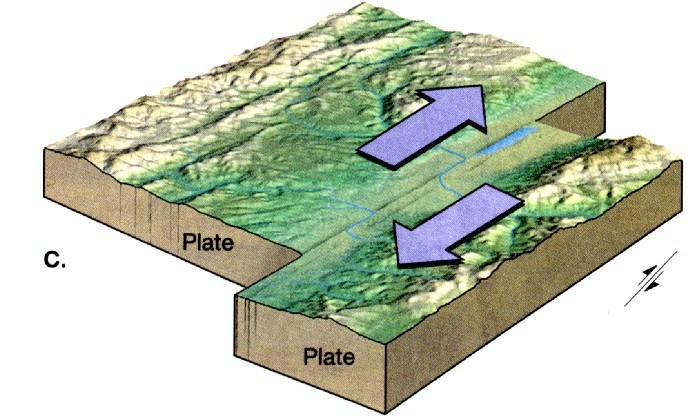
What type of plate boundary is this?
a)
Transform
b)
Convergent
c)
Divergent
d)
Plate
9.
The theory that says Earth's continents once made up an ancient supercontinent, and have been drifting apart ever since, is called the theory of...
a)
Pangea
b)
Plate Tectonics
c)
Natural Selection
d)
Gravity
10.
Oceanic Trenches are formed by _______ plate boundaries
a)
Convergent
b)
Transform
c)
Plate
d)
Divergent
11.
A fault is formed by the movement of a __________ plate boundary
a)
Transform
b)
Convergent
c)
Divergent
12.
Islands can from from magma which is pushed up at a __________ plate boundary
a)
Divergent
b)
Convergent
c)
Transform
13.
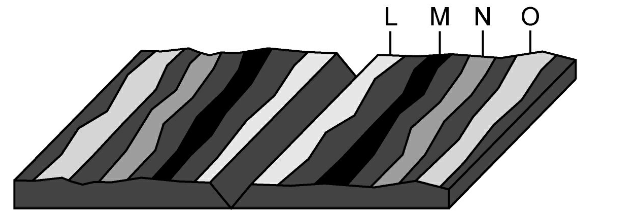
Where would the oldest rock be found?
a)
L
b)
M
c)
N
d)
O
14.
How is it possible for new crust to be formed without increasing the surface area of the Earth?
a)
Crust is destroyed at the same time it is created
b)
New crust is underwater where it sinks
c)
New crust breaks more easily than old crust
15.
Mountains are created when....
a)
Two continental plates collide
b)
Two oceanic plates pull apart
c)
An Oceanic plate subducts under a Continental Plate
d)
Two continental plates pull apart
16.
This layer of Earth is the thickest part
a)
crust
b)
outer core
c)
mantle
d)
inner core
17.
What is Pangaea?
a)
The name of a German Scientist
b)
the name of the supercontinent that existed millions of years ago
c)
another name for continental drift
d)
the name of an ancient fossil
18.
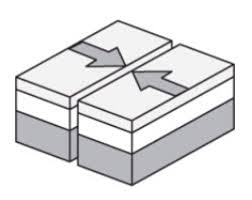
Name the boundary
a)
convergent boundary
b)
divergent boundary
c)
transform boundary
d)
sergent boundary
19.

Name the boundary
a)
convergent boundary
b)
divergent boundary
c)
transform boundary
d)
sergent boundary
20.
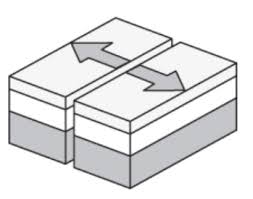
Name the boundary
a)
convergent boundary
b)
divergent boundary
c)
transform boundary
d)
sergent boundary
21.
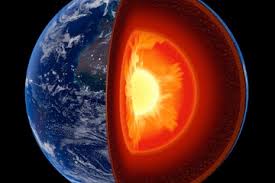
As you travel from the inner core to the crust, how would temperature, pressure and density of the material change?
a)
The would all increase
b)
The would all decrease.
c)
They would stay the same.
d)
Temperature would decrease, but pressure and density would increase.
22.
A subduction zone is formed...
a)
when one tectonic plate sinks below another
b)
at every type of convergent plate boundary
c)
at every type of divergent plate boundary
d)
at transform boundaries
23.
Whenever a subduction zone is formed a ______ is formed.
a)
Mountain
b)
Island Arc
c)
Rift
d)
Volcano
24.
Plate movement is caused by ______________.
a)
the rotation of the Earth
b)
ocean tides
c)
convection currents in the mantle
d)
the moon's gravity
25.
What are mid-ocean ridges?
a)
A chain of underwater waterfalls
b)
A chain of underwater volcanos
c)
A chain of underwater mountains
d)
A chain of underwater rocks
26.
What does the theory of continental drift state?
a)
The continents were once joined in a super-continent and have moved over time
b)
Continents are stationary and do not move
c)
The Earth is broken into lithospheric plates that move due to convection currents
d)
none of the above
27.

Who is the person credited with developing the theory of continental drift?
a)
Harry Hess
b)
Galileo
c)
Alfred Wegener
d)
Newton
28.
Which type of plate boundary would cause mountains to form?
a)
Transform
b)
Convergent
c)
Divergent
d)
Reform
29.
This layer of Earth is solid Iron and Nickel
a)
Outer Core
b)
Mantle
c)
Inner Core
d)
Crust
30.
The Great Rift Valley in Africa and the Mid-Ocean Ridge were all created by this boundary
a)
Divergent
b)
Convergent
c)
Reform
d)
Transform
31.
This layer of Earth is the thickest part
a)
crust
b)
outer core
c)
mantle
d)
inner core
32.
What are the two types of crust
a)
continental and oceanic
b)
ocean and upper
c)
lower and upper
d)
pizza and subway
33.
Which layer has convection currents?
a)
Inner Core
b)
Outer Core
c)
Mantle
d)
Crust
34.
subduction zones in the ocean can create which features?
a)
islands
b)
volcanoes
c)
earthquakes
d)
all of the above
35.
Earthquakes and volcanoes are most likely found in which locations?
a)
At plate boundaries
b)
in oceans
c)
in the middle of continents
d)
in the middle of plates
36.
When one plate sides under neath another, it _________ and the magma _________.
a)
hardens, sinks
b)
melts, sinks
c)
hardens, rises
d)
melts, rises
37.
The Himalayas in Asia are an example of what type of plate boundary?
a)
divergent
b)
continent-to-continent convergent
c)
ocean-to-continent convergent
d)
transform
38.
When one plate sides under neath another, it _________ and the magma _________.
a)
hardens, sinks
b)
melts, sinks
c)
hardens, rises
d)
melts, rises
39.
Transform boundaries are most likely to produce what phenomenon?
a)
volcanoes
b)
deep sea trenches
c)
underwater mountain ranges
d)
earthquakes
40.
When an oceanic plate and a continental plate collide, which one will subduct?
a)
oceanic
b)
continental
c)
neither
41.
Which of the following is NOT a tectonic boundary?
a)
Convergent
b)
Divergent
c)
Sedergent
d)
Transform
42.

What is this image...
a)
Revolving boundary
b)
San Andreas (Transform)
c)
Convergent
43.
Two tectonic plates collide at a _______ plate boundary.
a)
convergent
b)
divergent
c)
transform
44.
The area where two tectonic plates meet.
a)
mantle
b)
focus
c)
plate boundary
d)
convection
45.
Most volcanoes and earthquakes occur...
a)
along the coast
b)
along tectonic plate boundaries
c)
in the Arctic
d)
in the ocean
46.
This landform can occur at a divergent plate boundary.
a)
ocean trench
b)
mid-ocean ridge
c)
tall mountains
d)
transform fault
47.
A continental rift valley can be formed from stretching continental crust at...
a)
transform plate boundaries
b)
convergent plate boundaries
c)
divergent plate boundaries
d)
all plate boundaries
48.
A mid-ocean ridge occurs at a ________ plate boundary.
a)
transform
b)
convergent
c)
divergent
49.

What is the name of the plate boundary that slides past each other?
a)
Divergent
b)
Convergent
c)
Transform
d)
Mr. C the Slide Man
50.

Which of these events can ONLY happen on a DIVERGENT BOUNDARY?
a)
Rift Valley
b)
Mountain
c)
A peninsula
d)
An Insanely complex, long answer that you will click out of instinct.
51.

Scientists think that convection currents that move the plates flow in Earth's
a)
Continental crust
b)
Oceanic crust
c)
Asthenosphere
d)
Lithosphere
52.
The mantle of Earth is made partly of magma. When magma rises and sinks, this is called ______________.
a)
a conduction current
b)
a hot spot
c)
a volcanic eruption
d)
a convection current
53.

As you travel from the inner core to the crust, how would temperature, pressure and density of the material change?
a)
They would all increase
b)
They would all decrease.
c)
They would stay the same.
d)
Temperature would decrease, but pressure and density would increase.
54.

What would happen to the convection currents if the heat from the inner core disappeared?
a)
They would stop.
b)
They would change directions.
c)
It would not change.
d)
They would speed up.
55.
Where does the heat come from that drives this convection current in the mantle?
a)
The sun
b)
The crust
c)
the mantle
d)
the core
56.
Mountains form from ...
a)
plates sliding past one another
b)
collision of plates
c)
plates moving away from each other
57.
The area around the pacific plate where boundaries form is called...
a)
death ring
b)
fire zone
c)
ring of fire
d)
zone of fire
58.
Which is true about hotter material in the mantle?
a)
more dense, sinks
b)
less dense, sinks
c)
less dense, rises
d)
more dense, rises
59.
During sea floor spreading, molten material rises up from the mantle...
a)
along the continents
b)
at the mid ocean ridges
c)
deep ocean trenches
d)
at north and south poles
60.
Which of the following is where one plate slides under another plate?
a)
submarine zone
b)
divergence zone
c)
subduction zone
d)
lower zone
61.
Which ocean is expanding due to a mid-ocean ridge (divergent boundary)?
a)
Indian
b)
Dead Sea
c)
Atlantic
d)
Artic
62.
This layer of Earth is the thickest part
a)
crust
b)
outer core
c)
mantle
d)
inner core
63.
Which of the following occurs because of convection currents?
a)
Tectonic plates on the crust move.
b)
The mantle increases in size.
c)
Pressure in the crust increases.
d)
Pressure in the crust decreases.
64.
Scientists think that convection currents that move the plates flow in Earth's
a)
Continental crust
b)
Oceanic crust
c)
Asthenosphere
d)
Lithosphere
65.
As you travel from the inner core to the crust, how would temperature, pressure and density of the material change?
a)
They would all increase
b)
They would all decrease.
c)
They would stay the same.
d)
Temperature would decrease, but pressure and density would increase.
66.
What is the shaking of the Earth’s crust caused by a release of energy?
a)
Earthquake
b)
Epicenter
c)
Fault
d)
Plate
67.
Which of the following is NOT a cause of an earthquake?
a)
Collapse of Cavern
b)
Eruption of Volcano
c)
Lightning Strikes
d)
Moving Tectonic Plates
68.
What is a break in the lithosphere along which movement in an earthquake has first occurred?
a)
Earthquake
b)
Epicenter
c)
Fault
d)
Focus
69.
Where is the point at which the first movement occurs during an earthquake?
a)
Epicenter
b)
Focus
c)
Fault
d)
Plate
70.
Where is the point on the Earth’s surface directly above the focus of an earthquake?
a)
Epicenter
b)
Fault
c)
Hypocenter
d)
Tremor
71.
Which type of wave is the first to arrive after an earthquake occurs?
a)
P Wave
b)
Rayleigh Wave
c)
S Wave
d)
Shear Wave
72.
Which body wave squeezes and stretches rock materials as they pass through the Earth?
a)
Body Waves
b)
P Waves
c)
S Waves
d)
Surface Waves
73.
Which body waves cause particles of rock material to move at right angles to the direction in which the waves are traveling?
a)
Body Waves
b)
P Waves
c)
S Waves
d)
Surface Waves
74.
What is another term for P Wave?
a)
Compression Wave
b)
Principal Wave
c)
Shear Wave
d)
Secondary Wave
75.
What is an instrument that detects and records waves produced by earthquakes? (This piece of equipment can measure the magnitude of an earthquake.)
a)
Epicenter
b)
Fault
c)
Seismogram
d)
Seismograph
76.
What is the measure of the amount of energy released in an earthquake?
a)
Earthquake
b)
Epicenter
c)
Magnitude
d)
Seismogram
77.
Which scale rates earthquakes based on the amount of damage done?
a)
Mercalli Scale
b)
Richter Scale
c)
Seismogram Scale
d)
Bernoulli Scale
78.
Which scale measures the intensity of the ground movement?
a)
Mercalli Scale
b)
Richter Scale
c)
Seismogram Scale
d)
Bernoulli Scale
79.
What is a large ocean wave that results from an underwater earthquake, landslide, or volcanic eruption?
a)
Aftershock
b)
Liquefaction
c)
Seismic Gap
d)
Tsunami
80.
The epicenter of an earthquake is
a)
The point below the surface where rock begins to break and the first motion occurs
b)
The seismic station closest to the earthquake
c)
The place where the greatest damage occurs
d)
The point on the surface directly above the focus
81.
The Richter scale measures:
a)
the amount of radon gas released
b)
the movement of plates
c)
the strength of an earthquake
d)
the weight of tectonic plates
82.
How much bigger is a magnitude 8 earthquake compared to magnitude 7 one on the Richter Scale?
a)
1 time bigger
b)
10 times bigger
c)
100 times bigger
d)
1000 times bigger
83.
When the force on rocks is great enough, they break and produce vibrations called
a)
Stresses
b)
Strains
c)
Faults
d)
Earthquakes
84.

What starts a Tsunami?
a)
COOKIE CAT
b)
when rock underground suddenly breaks along a fault.
c)
An underwater Earthquake
d)
Dante
85.

The word tsunami comes from
______
______
a)
Japan
b)
Australia
c)
Africa
d)
Gurgens off Route 109!
86.
All of the following are ways in which scientists try to predict tsunamis EXCEPT:
a)
Satellites that gather seismic data
b)
Sensors that detect sea level change
c)
sensors that record change in water pressure
d)
Sensor that detect change in air pressure
87.
Most tsunamis occur here.
a)
Atlantic Ocean
b)
Indian Ocean
c)
Arctic Ocean
d)
Pacific Ocean
88.
The raising and lowering of the sea floor is what causes a tsunami.
a)
True
b)
False
89.
This was created in 1946 for people living on or near the Pacific Ocean.
a)
Hurricane Warning System
b)
Volcano Warning System
c)
Earthquake Warning System
d)
Tsunami Warning System
90.
In Japan, residents have to worry about...
a)
active volcanoes
b)
earthquakes
c)
tsunamis
d)
all of these
91.
What year was the major tsunami that hit Japan?
a)
2015
b)
2014
c)
2012
d)
2011
92.
The formation of the Hawaiian Islands is one example of
a)
volcanoes forming over a hot spot
b)
volcanoes forming along a plate boundary
c)
the Ring of Fire
d)
continental drift
93.

What is a tsunami?
a)
a large a long, high sea wave
b)
a moving of the earth
c)
magma flowing from inside the earth
d)
a column of rotating air
94.

Earthquakes can have aftershocks or another smaller earthquake after the big one.
a)
True
b)
False
95.
What is a fault?
a)
A place where two tectonic plates meet
b)
A break in the Earth's lithosphere
c)
A shaking of the ground cause by the movement of large rocks
d)
An opening in the Earth's crust where magma comes up
96.
Where are most faults located?
a)
Along plate boundaries
b)
Along mountain ranges
c)
Near volcanoes
d)
In the ocean
97.
An __________ on the ocean floor causes a tsunami.
a)
tidal wave
b)
earthquake
c)
aftershock
d)
underquake
98.
What is the opening in Earth's crust through which molten rock, gases, and ash erupt?
a)
Divergent Boundary
b)
Magma
c)
Subduction Boundary
d)
Volcano
99.
What is molten rock that has formed deep within the Earth?
a)
Hot Spot
b)
Magma
c)
Lava
d)
Volcano
100.
Why does magma tend to rise to the surface?
a)
It has large amounts of silica.
b)
It contains very little silica.
c)
It is denser than the surrounding material.
d)
It is less dense than the surrounding material.
101.
The formation of magma depends on which set of conditions?
a)
Pressure, Density, and Water Content
b)
Temperature, Density, and Pressure
c)
Temperature, Density, and Water Content
d)
Temperature, Pressure, and Water Content
102.
The volcanoes on the Hawaiian Islands form due to which of the following?
a)
Divergent Boundary
b)
Hot Spot
c)
Subduction Boundary
d)
Transform Boundary
103.
What is the principal ingredient to all types of magma?
a)
Iron
b)
Magnesium
c)
Silica
d)
Water
104.
What is the resistance of a liquid, such as lava, to flow?
a)
Elasticity
b)
Pyroclasticity
c)
Silica
d)
Viscosity
105.
What are solid rock fragments that are ejected during a volcanic eruption?
a)
Lahar
b)
Magma
c)
Pyroclastic Material
d)
Silica
106.
What type of volcano has steep slopes made of alternating layers of ash and silica rich lava?
a)
Caldera
b)
Cinder Cone
c)
Composite Volcano
d)
Shield Volcano
107.
What type of volcano is made of lava fragments that have been ejected from a volcanic vent?
a)
Caldera
b)
Cinder Cone
c)
Composite Volcano
d)
Shield Volcano
108.
What type of volcano is Kilauea, which is located in Hawaii?
a)
Caldera
b)
Cinder Cone
c)
Composite Volcano
d)
Shield Volcano
109.
What kind of magma produces violent volcanic eruptions?
a)
Magma low in silica
b)
Magma that is fluid, and runny
c)
Magma that is high in gas content
d)
Magma rich in iron
110.
Where do volcanoes come from?
a)
Places where plates move apart
b)
Places where plates are moving together
c)
Hot Spots
d)
All of these options
111.
What factor(s) determine(s) whether an eruption will be explosive?
a)
The amount of gases in the magma
b)
The amount of silica in the magma
c)
The amount of gas and silica in the magma
d)
None of these affect the explosiveness of the volcano
112.
In volcanic areas, groundwater heated by magma is a source of
a)
lava flows
b)
silicia
c)
geothermal energy
d)
pyroclastic flows
113.
Tall, cone-shaped mountains in which layers of lava alternate with layers of ash are called
a)
shield volcanoes
b)
cinder cone volcanoes
c)
composite volcanoes
d)
lava plateaus
114.
The main hazard from a quiet volcanic eruption is
a)
volcanic bombs
b)
lava flows
c)
volcanic cinders
d)
volcanic ash
115.
Before lava reaches the surface it is called
a)
rock
b)
magma
c)
volcanic ash
d)
liquid fire
116.
A volcano that may erupt again at some time in the distant future is
a)
active
b)
dormant
c)
explosive
d)
extinct
117.
If geologists detect many small earthquakes in the area near a volcano, what can they infer about the volcano?
a)
It is dormant
b)
It is probably about to erupt
c)
It is extinct
d)
It is a good source of geothermal energy
118.
What % of Volcanoes occur at Convergent Plate Boundaries?
a)
60%
b)
75%
c)
90%
d)
99%
119.
Plate boundaries where plates are moving apart are called
a)
Transform
b)
Convergent
c)
Divergent
d)
Hot Spot
120.
What is the theory that states that the crust is broken into pieces that move around?
a)
Continental Drift
b)
Plates and Forks
c)
Plate Tectonics
d)
Pangea
121.
Which is more dense: Continental Crust or Oceanic Crust?
a)
Continental
b)
Oceanic
122.
Which gets pushed back into the mantle when converging: Continental Crust or Oceanic Crust?
a)
Continental
b)
Oceanic
123.
Volcano that will never erupt again
a)
Active
b)
Dorment
c)
Extinct
124.
Melted rock that is still inside of the Earth
a)
Lava
b)
Magma
c)
Metal
125.
Melted rock that is outside of the Earth’s surface
a)
Magma
b)
Lava
c)
Toothpaste
126.
What is another word for magma thickness?
a)
Phatty
b)
Viscosity
c)
Liquidy
d)
Fluid
127.
What makes magma denser/thicker?
a)
More silica
b)
Less silica
c)
More sulfur
d)
Less sulfur
128.
Tall cone shaped mountains in which layers of ash/cinders and lava alternate
a)
Shield
b)
Composite
c)
Cinder
d)
Dome
129.
What type of boundary does Haiti sit on?
a)
Constructive
b)
Destructive
c)
Conservative
d)
Collision
130.
Which of these is not a secondary effect of the earthquake?
a)
1 in 5 people lost their jobs because so many buildings were destroyed. Haiti’s largest industry, clothing was one of the worst affected
b)
The large number of bodies meant that diseases, especially cholera, became a serious problem
c)
250,000 homes and 30,000 other buildings, including the President’s Palace and 60% of government buildings, were either destroyed or badly damaged
d)
It was difficult getting aid into the area because of issues at the airport and generally poor management of the situation
131.
Which of these is not a long term response to the earthquake?
a)
4.3 million people provided with food rations in the weeks following the earthquake
b)
Water and sanitation eventually supplied for 1.7 million people
c)
1 million people still without houses after 1 year so still have to live in aid camps
d)
Temporary schools created and new teachers trained
132.
Which of these is not a short term response to the earthquake?
a)
4.3 million people provided with food rations in the weeks following the earthquake
b)
Water and sanitation eventually supplied for 1.7 million people
c)
115,000 tents and 1,000,000+ tarpaulin shelters provided
d)
$100 million in aid given by the USA and $330 million by the European Union
133.
What happened to Haiti in 2010?
a)
tsunami
b)
hurricane
c)
earthquake
d)
fire storm
134.
Earthquakes occur most often
a)
along plate boundaries
b)
over Hot Spots
c)
along coast lines
d)
in the mountains
135.
How do mountains form?
a)
An ocean plate sinks beneath another plate and begins to melt, sending melted rock to the surface, which forms volcanic mountains or islands.
b)
Hot rock from within the earth risies through ocean floor as plates separate. This forms a volcanic mountain chain, or ridge, on the ocean floor.
c)
Two continental plates collide, and the land folds and crumples like paper.
d)
All of the above.
136.
The cycle that powers the ocean currents, weather, and tectonic plates it called
a)
conduction current
b)
radiation
c)
condition current
d)
convection current
137.
The energy from the sun is transmitted through movement of electromagnetic waves by
a)
conduction
b)
convection
c)
contraction
d)
radiation
138.
The transmission of energy by two objects touching is called
a)
conduction
b)
convection
c)
contraction
d)
radiation
139.
The main reason that we have currents in the ocean and air is
a)
the sun heats the air and ocean evenly everywhere
b)
the heat inside the earth heats the ocean and the ocean heats the air
c)
the sun cannot heat both the air and water, so one must heat the other
d)
the sun heats air and water more at the equator because it receives more direct sunlight
140.
Energy for convection on the Earth comes from...
a)
The sun
b)
The moon
c)
Solar winds
d)
The ocean
141.
In convection, WARM air
a)
Rises
b)
Sinks
142.
What is one role of the ocean in convection?
a)
to provide a home for animals
b)
to absorb & release heat
c)
To surf on
d)
To drink from
143.
What are the two types of crust?
a)
continental and oceanic
b)
ocean and basin
c)
lower and upper
d)
thick and thin
144.

Who is the scientist who proposed Continental Drift Theory?
a)
Albert Einstein
b)
Alfred Wegener
c)
Isaac Newton
d)
John Dalton
145.

What is the theory that states that parts of the Earth's crust slowly drift atop a liquid core.
a)
Theory of Evolution
b)
Heliocentric Theory
c)
Geocentric Theory
d)
Continental Drift Theory
146.
What do you call the evidence of Wegener's Theory that tells about the remains of an organism that lived long time ago?
a)
Ashes
b)
Bones
c)
Follicles
d)
Fossils
147.

What do you call the supercontinent landmass formed million years ago?
a)
Pangea
b)
Asia
c)
Pantallasa
d)
Eurasi
148.

It is the southern part of Pangea.
a)
Eurasia
b)
Gondwanaland
c)
South America
d)
South Africa
149.

What causes the continents to move?
a)
Magma
b)
Tectonic Plates
c)
Earthquake
d)
All of the choices
150.

What are the two continents the fits together based on Wegener's Theory?
a)
Asia and Russia
b)
India and Asia
c)
South America and Africa
d)
Africa and Asia
151.

What are the remains of organism noticed by Wegener that are found the same in two continents?
a)
Leaves and flowers
b)
Ice and mountains
c)
Plants and animals
d)
Dinosaurs and reptiles
152.

What is a theory?
a)
An idea based on hypothesis and problems observed using five senses
b)
A belief, policy, or procedure that is not proposed or followed as the basis of action
c)
A supposition or a system of ideas intended to explain something, especially one based on general principles independent of the thing to be explained.
d)
A set of concepts that uses tests without evidences but uses the scientific method in order to prove a specific phenomena that happened on Earth or may happen to Earth
153.
In the early 20th century, Wegener published a paper explaining his theory that the continental land masses were _______.
a)
Gliding
b)
Sliding
c)
Drifting
d)
They're not moving
154.

What countries were once "together"?
a)
South America & Africa
b)
Africa & Australia
c)
Antartica & South America
155.
Which evidence was not used by Wegener to support his continental drift theory?
a)
South America & Africa coastlines
b)
Coal beds in Antarctica & Britain
c)
Plant & reptile fossils
d)
Earthquake patterns
156.
Wegener's evidence supports his theory of a super continent that he named?
a)
Ultima
b)
Pangaea
c)
Plate Tectonics
d)
Continental Drift
157.
Other scientists rejected Wegener's Continental Drift Theory because...
a)
He did not have evidence
b)
He couldn't explain how the continents moved
c)
He wasn't a scientist
d)
He was a bad communicator
158.
What is Pangaea?
a)
an icy sheet which covered many continents
b)
fossil of a fern found on many continents
c)
a mountain belt connecting many continents
d)
a super continent that contained all the continents
159.
What is the theory of continental drift?
a)
the continents move slowly over Earth's surface
b)
continents moved millions of years ago but are now fixed
c)
the continents were once fixed, but have just now begun to move
d)
the continents are fixed in position
100 %

