
 Worksheets
Forces and Motion AZ 5th Grade Science
Total questions: 39
Worksheet time: 34mins
Name
Class
Date
1.
What is a PUSH or PULL of an object?
a)
Motion
b)
Force
c)
Friction
d)
Gravity
2.
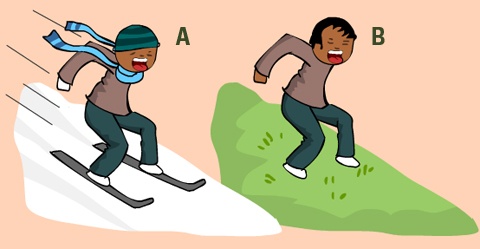
Why is it harder for the boy in Image B to get down the hill?
a)
Motion
b)
Friction
c)
Work
d)
Displacement
3.
Which force produces a change in motion?
a)
unbalanced force
b)
balanced force
c)
gravitational force
d)
frictional force
4.
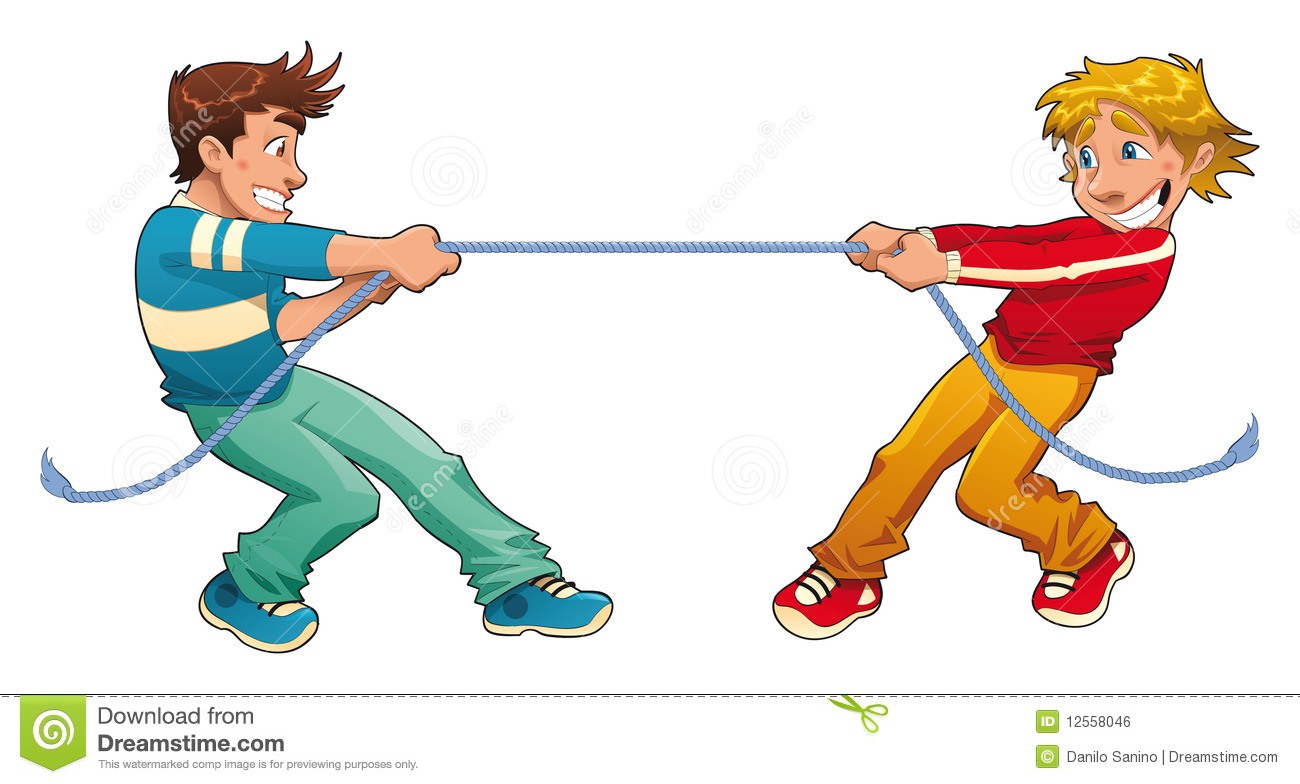
If these boys are pulling with the same amount of force. What will happen?
a)
The boy in blue will win.
b)
They will not move at all.
c)
The boy in red will win.
d)
Both will fall down.
5.
What happens when two forces act in the same direction?
a)
They cancel each other out.
b)
The stronger one prevails.
c)
Their strengths are added.
d)
Their sum divided by the two is the total force.
6.
Any time the forces are unbalanced, an object will remain at rest. True or false?
a)
true
b)
false
7.
When you tell the direction and speed of an object, you give its
a)
motion
b)
velocity
c)
acceleration
d)
mass
8.
Which of the following statements is true?
a)
Balanced forces cause a change in motion.
b)
Unbalanced forces cause a change in motion.
c)
Forces do not effect the change in motion.
9.
Speed is different from velocity because
a)
Velocity has a direction
b)
Speed uses Distance /Time
c)
Velocity doesn't include time
d)
Velocity doesn't include distance
10.
Objects that are changing their speed or their direction
a)
force
b)
energy
c)
acceleration
d)
friction
11.
two or more forces act upon an object in such a way as to exactly counteract each other
a)
friction
b)
balanced force
c)
unbalanced force
d)
force
12.
the ability to do work
a)
energy
b)
force
c)
friction
d)
inert
13.
the close interaction between two surfaces that are sliding across each other
a)
force
b)
friction
c)
centripetal force
d)
gravitational force
14.
Any two objects with mass attract each other with a type of force
a)
kinetic energy
b)
potential energy
c)
inertia
d)
gravitational force
15.
a tendency of an object to resist change in its state of motion
a)
inertia
b)
kinetic energy
c)
potential energy
d)
force
16.
the energy possessed by an object because of its motion
a)
force
b)
inertia
c)
kinetic energy
d)
potential energy
17.
the energy possessed by an object because of its height above the ground
a)
kinetic energy
b)
potential energy
c)
inertia
d)
speed
18.
the amount of material in a substance
a)
inertia
b)
force
c)
mass
d)
motion
19.
the quantity of motion that an object possesses
a)
momentum
b)
kinetic energy
c)
potential energy
d)
inertia
20.
An object at rest will remain at rest or in the same uniform motion unless acted upon by an unbalanced force: law of inertia.
a)
Newton's First Law of Motion
b)
Newton's Second Law of Motion
c)
Newton's Third Law of Motion
21.
as mass increases, the acceleration has to decrease: the law of acceleration
a)
Newton's First Law of Motion
b)
Newton's Second Law of Motion
c)
Newton's Third Law of Motion
22.
If one object exerts a force on a second object, the second object exerts a force equal in magnitude and opposite in direction on the object body; law of interaction
a)
Newton's First Law of Motion
b)
Newton's Second Law of Motion
c)
Newton's Third Law of Motion
23.
a measurement of how fast an object is moving
a)
force
b)
speed
c)
weight
d)
velocity
24.
the speed and direction in which it moves
a)
weight
b)
velocity
c)
speed
d)
energy
25.
a measurement of the gravitational force acting on an object
a)
weight
b)
speed
c)
velocity
d)
inertia
26.
no longer feeling an external force acting upon your body
a)
weight
b)
weightlessness
c)
gravitational force
d)
centripetal force
27.
A _____ is a pull or a push.
a)
force
b)
friction
c)
gravity
d)
speed
28.
A _____ moves an object closer to you.
a)
push
b)
pull
c)
friction
d)
cat
29.
How are a push and a pull alike?
a)
You can hear them both.
b)
They are both names of cats.
c)
You can do them both at the same time.
d)
They are both forces.
30.
What force moves an object away from you?
a)
pull
b)
push
c)
gravity
d)
Jedi force
31.
Which has the least friction?
a)
snowboard on a snowy hill
b)
running on the playground
c)
sandpaper on wood
d)
a racer on a track
32.
Why is there less friction between two ice cubes touching than between sandpaper on wood?
a)
They have rough surfaces.
b)
They have loud surfaces.
c)
They have smooth surfaces.
d)
They have bright surfaces.
33.
What is one way to reduce friction?
a)
Put sandpaper between the surfaces that touch.
b)
Push the surfaces closer together.
c)
Shine a light on the surfaces.
d)
Put a slippery substance between the surfaces.
34.
How does friction help us move from place to place?
a)
Friction does not help us.
b)
Friction keeps us from slipping and sliding.
c)
Friction only helps cats.
d)
Friction makes us slip and fall.
35.

Why do air planes and race cars have sleek shapes?
a)
to reduce friction from air resistance
b)
to increase air resistance
c)
to look more appealing than cats
d)
so people will buy them
36.

In the image, what force is acting on arrow A?
a)
friction
b)
gravity
c)
push
d)
Jedi force
37.
Is gravity a push or a pull?
a)
push
b)
pull
c)
neither
d)
both
38.

What keeps the Moon in orbit around Earth?
a)
Earth's rotation.
b)
Earth's atmosphere.
c)
Earth's gravity.
d)
Earth's shape.
39.
Which would require the most force to move?
a)
a toy car
b)
a sleeping cat
c)
a science book
d)
a chair with a friend sitting in it
100 %

