wayground logo

Free Printable Worksheets

Font size

S
M
L
XL
Worksheets

Waves

Total questions: 65

Worksheet time: 1hrs 28mins
Name
Class
Date
1.

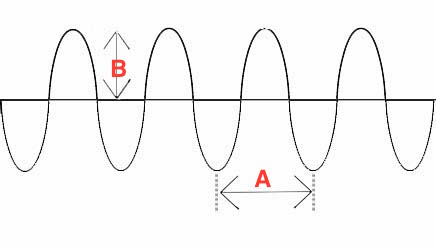
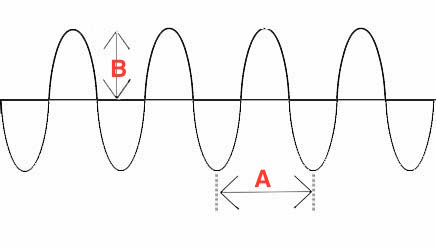
What property of this wave is represented by the letter "A"

a)

amplitude

b)

crest

c)

trough

d)

wavelength

2.
What property of the wave is represented by the letter "B"?
a)
amplitude
b)
crest
c)
trough
d)
wavelength
3.
The highest point on a wave is:
a)
the crest
b)
the trough
c)
the top
d)
the coast 
4.
The lowest point on a wave is the:
a)
Amplitude
b)
Crest
c)
Trough
d)
Wavelength
5.
The number of wavelengths that pass a point each per second is:
a)
frequency
b)
period
c)
longitudinal 
d)
transverse wave 
6.

The type of waves that require medium to pass:

a)

Mechanical Waves

b)

Electromagnetic Waves

c)

Microwaves

d)

Radio Waves

7.
Which vocabulary term is used to identify the distance between points C & G?
a)
Amplitude
b)
Crest
c)
Frequency
d)
Wavelength
8.
When the frequency of a wave increases, what happens to the wavelength?
a)
The wavelength is not directly affected by the frequency of a wave.
b)
The wavelength increases.
c)
The wavelength decreases.
d)
More specific information is needed to form a conclusion about the wavelength.
9.
A mechanical wave cannot travel through...
a)
a vacuum(empty space).
b)
water.
c)
air. 
d)
glass.
10.
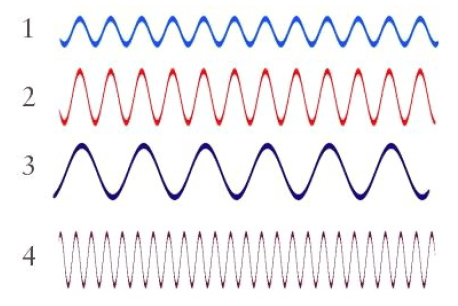
Which wave in the diagram has the greatest frequency?
a)
1
b)
2
c)
3
d)
4
11.
Which of the following can sound travel through?
a)
solid
b)
liquid
c)
gas
d)
all of the above
12.
regular disturbances that carry energy through matter or space
a)
crest
b)
energy
c)
wave
d)
trough
13.

which material does sound travel the fastest?

a)

solid

b)

liquid

c)

gases

d)

gel

e)

plasma

14.
A wave carries...?
a)
energy only
b)
matter only
c)
the matter carries the energy
d)
neither
15.

What can you say about waves A and B?

a)

A has a lower frequency than B but their amplitudes are the same

b)

A has a higher frequency than B but their amplitudes are the same

c)

A has a lower amplitude than B but their frequencies are the same

d)

A has a higher amplitude than B but their frequencies are the same

16.
Waves that require a medium are called 
a)
mechanical waves
b)
transverse waves
c)
light waves
d)
gamma rays
17.

What do we call the part of a compressional wave that is spread apart?

a)

compression

b)

rarefaction or expansion

c)

amplitude

d)

wavelength

e)

speed

18.
How would a person measure the wavelength on this sound wave?
a)
dense to less dense
b)
trough to crest
c)
compression to compression
d)
beginning of illustration to the end
19.
When you shake a rope, this looks like what kind of wave?
a)
compressional
b)
seismic
c)
transverse
d)
electromagnetic
20.

What is the frequency of a wave where 64 troughs pass by you in 2 seconds?

a)

32 degrees

b)

32Hz

c)

320 cm

d)

320Hz

21.

What is the speed of a wave if the wavelength is 15m and the frequency is 10Hz?

a)

15

b)

2

c)

50

d)

150

22.

What travels faster ?

a)

Sound waves

b)

Light waves

c)

Water waves

d)

Seismic waves

e)

Mechanical Waves

23.

Choose all that are true

a)

The energy of mechanical waves depends on its amplitude

b)

The energy of electromagnetic waves depends on its amplitude

c)

The energy of mechanical waves depends on its frequency

d)

The energy of electromagnetic waves depends on its frequency

24.

What kind of wave is this?

a)

microwave

b)

electromagnetic

c)

transverse

d)

logitudinal

25.
All electromagnetic waves have the same...
a)
frequency
b)
speed
c)
wavelength
d)
energy
26.
electromagnetic waves with the longest wavelengths are
a)
gamma rays
b)
x-rays
c)
infrared waves
d)
radio waves
27.

which of the following does NOT belong in the electromagnetic spectrum:

a)

X-ray

b)

sound wave

c)

ultra violet rays

d)

microwaves

28.
Which waves are used to show heat loss with heat sensitive cameras?
a)
Infrared radiation
b)
ultraviolet radiation
c)
microwaves
d)
gamma rays
29.
Which waves are the type that can give us suntans and sunburns?
a)
Infrared radiation
b)
Ultraviolet radiation
c)
Radio waves
d)
X-rays
30.
In visible light, which color has the longest wavelength?
a)
Red
b)
Violet
c)
Yellow
d)
Green
31.
________________ are waves used by cops to test the speed of your car with RADAR.
a)
Ultraviolet
b)
Infrared
c)
Radio
d)
Microwaves
32.
Electromagnetic waves________________travel through space.
a)
Never
b)
Cannot
c)
Can
d)
Wish they could
33.
The acronym (letters) used to remember visible light is____________
a)
KTPERRY
b)
ROYGBIV
c)
DOGPOUND
d)
ROMERO
34.
_____________________light is the only type of EM wave detected by the human eye.
a)
Red
b)
Gamma
c)
Microwave
d)
Visible
35.
_______ carry the greatest amount of energy. 
a)
x-rays
b)
gamma rays
c)
infrared rays
d)
visible light
36.

Select the correct order of waves on the Electromagnetic Spectrum from lowest to highest frequency

a)

Radio, Micro, Infra, Visible, Ultra, X-ray, Gamma

b)

Gamma, X-ray, Ultra, Vis, Infra, Micro, Radio

c)

Vis, Micro, Infra, Ultra, X-ray, Gamma, Radio

d)

Micro, Radio, Vis, Infra, Ultra, X-ray, Gamma

37.
A tuning fork starts to vibrate when a certain note is played on the piano, This is an example of _______.
a)
resonance
b)
refraction
c)
diffraction
d)
reflection
38.
The change in frequency of a sound due to motion of the source is called...
a)
pitch
b)
amplitude
c)
Doppler effect
d)
diffraction
39.
When an object starts to vibrate at its natural frequency by absorbing energy from another object vibrating at the same frequency
a)
diffraction
b)
resonance
c)
loudness
d)
amplitude
40.

When an object is driven at its natural frequency, resulting in large amplitudes

a)

doppler effect

b)

resonance

c)

reflection

d)

refraction

e)

diffraction

41.

An observer moves away from a 500 Hz sound source with a speed of 30 m/s.

The frequency heard by the moving observer is

a)

less than 500 Hz

b)

500 Hz

c)

more than 500 Hz

d)

530 Hz

42.

When an ambulance move TOWARD you it sounds ________ pitched.

a)

high

b)

low

c)

medium

d)

unchanged

43.
What can you tell about this object's motion?
a)
Moving to the North (up).
b)
Moving to the South (down). 
c)
Moving to the West (left). 
d)
Moving to the East (right). 
44.

In this wave motion particle vibrate parallel to the direction of propagation

a)

Longitudinal

b)

Transverse

c)

Electromagnetic

d)

Radio

45.

In this wave motion particle vibrate perpendicular to the direction of propagation

a)

Longitudinal

b)

Transverse

c)

Sound

d)

Compression

46.

Frequencies above the human hearing range are called

a)

subsonic

b)

infrasonic

c)

ultrasonic

d)

supersonic

e)

variasonic

47.

Frequencies below the human hearing range are called

a)

subsonic

b)

infrasonic

c)

ultrasonic

d)

supersonic

e)

variasonic

48.

Velocities of objects faster than the speed of sound are called

a)

subsonic

b)

infrasonic

c)

ultrasonic

d)

supersonic

e)

variasonic

49.

Velocities of objects moving slower than the speed of sound are called

a)

subsonic

b)

boom sonic

c)

ultrasonic

d)

supersonic

e)

variasonic

50.

Which type of interaction is this?

a)

reflection

b)

refraction

c)

diffraction

51.

Which type of interaction is this?

a)

reflection

b)

refraction

c)

diffraction

52.

Which type of interaction is this?

a)

reflection

b)

refraction

c)

diffraction

53.

Which type of interaction is this?

a)

reflection

b)

refraction

c)

diffraction

54.

Which type of interaction is this?

a)

reflection

b)

refraction

c)

diffraction

55.

The bending of a wave due to the change in speed is called

a)

interference

b)

diffraction

c)

reflection

d)

refraction

56.

Interference in which waves combine to form a wave with larger amplitude than either wave originally had is called

a)

destructive interference

b)

amplitude enhancement

c)

constructive interference

d)

resonance

57.

A wave that appears to stand in one place

a)

diffraction

b)

constructive interference

c)

standing wave

d)

resonance

58.

Two waves approach each other as shown in the diagram. What will the amplitude of the wave be produced if the crests from each wave meet?

a)

35 cm

b)

20 cm

c)

15 cm

d)

5 cm

59.

What is being shown in the diagram?

a)

resonance

b)

constructive interference

c)

standing wave

d)

destructive interference

60.

What is being shown in the diagram?

a)

resonance

b)

constructive interference

c)

standing wave

d)

destructive interference

61.

Which type of interaction is this?

a)

reflection

b)

refraction

c)

diffraction

62.
a)

refraction

b)

diffraction

c)

angle of reflection

d)

angle of incidence

63.
In a standing wave, destructive interference creates points of zero amplitude called nodes. Which letters represent this.
a)
A,E,F
b)
B,D,F
c)
B,C,D
d)
A,C,F
64.
In a standing wave, constructive interference creates larger amplitudes.  The points of maximum amplitude are antinodes.  The letters for these are?
a)
B,C,D
b)
A,E,F
c)
A,C,F
d)
B,D,E
65.
The stationary dot is called:
a)
a node.
b)
an anti-node.
c)
the amplitude.
d)
the not moving bit.