
NEW
Font size
S
M
L
XL
 Worksheets
Relative Dating
Total questions: 24
Worksheet time: 22mins
Name
Class
Date
1.
States that younger rocks lie above older rocks if the layers have not been disturbed
a)
Law of crosscutting
b)
Law of superposition
c)
Relative Dating
d)
Unconformity
2.
How does the law of crosscutting explain the age of a fault?
a)
The fault is younger than the rocks above it.
b)
The fault is younger than the rocks it cuts through.
c)
The fault is older than the rocks above it.
d)
The fault is older than the rocks it cuts through.
3.

Analyze the seashell found in the white layer. Which statement is true of the rock layer that contains this fossil?
a)
It could also contain a fossil from the bottom layer.
b)
It is older than the layers below it.
c)
It is younger than the layers above it.
d)
It is older than the layers above it.
4.
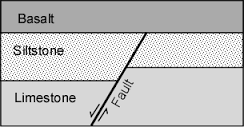
What are the relative ages of the features in order from oldest to youngest?
a)
Limestone, Basalt, Fault, Siltstone
b)
Siltstone, Fault, Basalt, Limestone
c)
Limestone, Fault, Basalt, Siltstone
d)
Limestone, Siltstone, Fault, Basalt
5.
Relative dating of rock layers tells us that the deeper we dig, _______.
a)
the younger the rocks get
b)
the smellier the rocks get
c)
the harder the rocks get
d)
the older the rocks get
6.

According to the law of superposition, the oldest fossils are found
a)
At the top of the rock layers
b)
Near the bottom of the rock layers
c)
In the middle of the rock layers
d)
Somewhat near the surface
7.

According to the law of superposition, which layer is the youngest?
a)
A
b)
B
c)
C
8.

Which of the following is the oldest?
a)
Layer L
b)
Intrusion D
c)
Intrusion H
d)
Layer E
9.

Which of the following correctly lists the layers in order from oldest to youngest?
a)
A, B, C, D, E
b)
E, B, C, D, A
c)
E, D, C, B, A
d)
C, B, A, D, E
10.
How does sedimentary rock usually form?
a)
Vertically
b)
Diagonally
c)
Folding
d)
Horizontally
11.
Used to determine whether an object is older or younger than other objects
a)
Superposition
b)
Relative Dating
c)
Fossil
d)
Unconformity
12.
An ordered arrangement of rock layers that is based on the relative ages of the rocks
a)
Superposition
b)
Unconformity
c)
Layered
d)
Geologic Column
13.
In which type of rock are most fossils found?
a)
igneous
b)
sedimentary
c)
volcanic
d)
metamorphic
14.
Rocks
formed when magma or lava cools and hardens
a)
Igneous
Rocks
b)
Metamorphic
Rocks
c)
Sedimentary
Rocks
d)
Minerals
15.
Rocks formed when sediments compact and cement together
a)
Igneous
Rock
b)
Metamorphic Rock
c)
Sedimentary Rocks
d)
juicy j
16.
Processes that break rocks into sediment
a)
I don't know science like that
b)
Compaction
c)
Cementation
d)
Erosion
17.
Transform boundaries are most likely to produce what phenomenon?
a)
volcanoes
b)
deep sea trenches
c)
underwater mountain ranges
d)
earthquakes
18.
This land form can occur at a divergent plate boundary.
a)
trench
b)
mid-ocean ridge
c)
folded mountains
d)
fault
19.
According to Wegener's hypothesis (pangaea) of continental drift,
a)
Earth's surface is made up of seven major landmasses
b)
the continents DO NOT move
c)
Earth is slowly cooling and shrinking
d)
the continents were once joined together in a single landmass
20.

The youngest material of the ocean floor is found at mid-ocean _________.
a)
ridges
b)
trenches
c)
basins
d)
rifts
21.

Name this type of boundary
a)
Convergent boundary
b)
Divergent Boundary
c)
Transform
d)
Volcanoes
22.
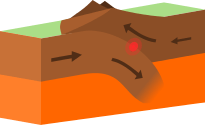
What type of plate boundary is this?
a)
Plate
b)
Divergent
c)
Convergent
d)
Transform
23.
The type of plate boundary where two plates come together is a .....
a)
Convergent Boundary
b)
Divergent Boundary
c)
Transform Boundary
d)
Plate Boundary
24.
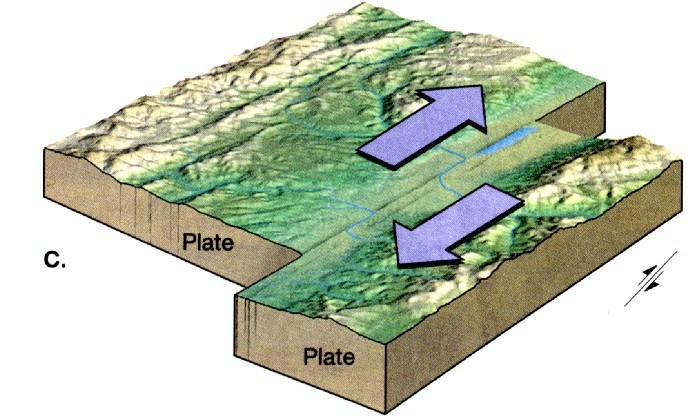
What type of plate boundary is this?
a)
Transform
b)
Convergent
c)
Divergent
d)
Plate
Reset

