wayground logo

Free Printable Worksheets

Font size

S
M
L
XL
Worksheets

Earth & Environmental Science Final Test Review

Total questions: 110

Worksheet time: 1hrs 8mins
Name
Class
Date
1.
What does erosion do?
a)
Break down rock
b)
changes rock chemically
c)
changes sediment in rock
d)
moves broken pieces of rock, or sediment, from one place to another
2.
A _______________ prevents flooding during  heavy rainstorms and can often be seen on the sides of streets.
a)
contour plowing
b)
storm drains
c)
terracing
d)
dam
3.
A ________________________ structure is built across a river to control its flow.
a)
dam
b)
transform
c)
fault
d)
storm drain
4.
Volcanoes and earthquakes are both _______________ and ______________ processes because they can destroy AND build up the Earth.
a)
divergent and destructive
b)
constructive and destructive
c)
convergent and divergent
d)
sediment and weathering
5.
Erosion helps move ___________ from one place in order to deposit it someplace else.
a)
sediment
b)
transform
c)
erosion
d)
weathering
6.
Farmers use different methods like, ________________ and ______________________ to prevent the loss of soil on their land.
a)
transform and plates
b)
divergent and sediment
c)
contour plowing and terracing
d)
terracing and erosion
7.
An earthquake is caused by a crack in the crust called a __________.
a)
fault
b)
dam
c)
plates
d)
transform
8.
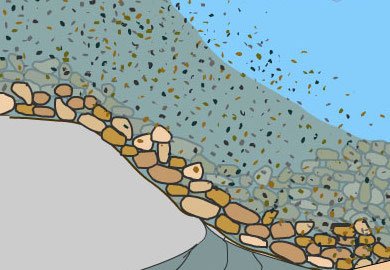
Deposition is a process that ______________.
a)
Dissolves sediment
b)
Removes sediment from landforms
c)
breaks down rock to form sediment
d)
drops sediment to form landforms
9.
Where do deltas form?
a)
in desert areas
b)
on the banks of rivers
c)
at river mouths
d)
in valleys formed by glaciers
10.
What is weathering?
a)
the break down of rock
b)
the transport of sediment
c)
a type of climate
d)
the aging of rock
11.
How do earthquakes form?
a)
a.  energy from a hurricane or tornado
b)
a.  energy that builds up inside a volcanic mountain
c)
a.  energy being released when crustal plates move
d)
a.  the crust expands due to the heat.
12.
How are earthquakes CONSTRUCTIVE?
a)
they are only destructive!
b)
convergent boundaries build up the crust and form mountains
c)
They construct buildings
d)
The cause damage to buildings and other landforms
13.
what is deposition?
a)
volcanoes erupting
b)
water freezing into a glacier
c)
water flowing to the mouth of a river
d)
dropping off of sediment 
14.
what are 3 agents of depostion
a)
water, wind, ice
b)
ice, water, sand
c)
soild, liquid, and gas
d)
wind, ice, glacier
15.
The process by which sediments settle out of water or wind
a)
deposition
b)
cementation
c)
weathering
d)
erosion
16.
Which landform is created by plates pushing together?
a)
Canyon
b)
Delta
c)
Mountain
d)
Sea arch
17.
Which of these things cause weathering?
a)
Wind
b)
Water
c)
Ice
d)
All of these
18.
Which of the following has the layers of Earth in order from outside to inside?
a)
lithosphere, outer core, inner core, asthenosphere 
b)
inner core, outer core, lithosphere, asthenosphere
c)
outer core, asthenosphere, lithosphere, inner core
d)
lithosphere, asthenosphere, outer core, inner core
19.
What type of plate boundary is shown in the picture? 
a)
convergent
b)
divergent
c)
transform
20.
What type of boundary does the picture show and what does it form? 
a)
divergent; mountains
b)
divergent; mid ocean ridge
c)
convergent; mid ocean ridge
d)
transform; earthquake
21.
What will eventually happen to the hole in this sea arch?
a)
it will stay the same
b)
it will fill with dirt
c)
it will get bigger
d)
it will fill up with water
22.
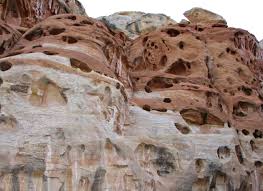
What natural activity is responsible for breaking down Stone Mountain?
a)
weathering
b)
water erosion
c)
faulting
d)
thunder
23.
What happens to sediments are moved into the ocean by crashing waves?
a)
Beaches get larger
b)
Beaches will be the same
c)
Beaches get smaller
d)
Beach area has more people
24.
Which would be a landform where melted rock is forced out of an opening in the Earth's surface?
a)
sand dune
b)
mountain
c)
erosion
d)
volcano
25.
This dam at Lake Blackshear Georgia is used to control...
a)
water
b)
land
c)
weather
d)
people
26.
This Georgia river twists and turns because...
a)
the river deposits rocks and soil
b)
the water temperature has changed
c)
people build a bridge over the river
d)
ice melting
27.
Which force in nature causes the sand dunes in a desert to change?
a)
earthquakes
b)
wind storms
c)
hurricanes
d)
lightning
28.
How are new islands in Hawaii formed?
a)
wind erosion
b)
volcanic activity
c)
sediment deposits
d)
weathering
29.
A tree seed fell between these rocks.  What happened?
a)
the tree roots cracked the rock
b)
the rock absorbed the tree
c)
the tree died
d)
the rock will turn to dirt
30.
How does igneous rock form from metamorphic rock?
a)
weathering and erosion
b)
Compacting and concreting
c)
heat and pressure
d)
melting and cooling
31.
A crescent moon that is seen after a new moon is known as what?
a)
Waning Crescent
b)
Waxing Cresecent
c)
First Quarter
d)
Last Quarter
32.
After a full moon, the moon starts to become less illuminated. What do we call this?
a)
Waxing
b)
Power outage
c)
Waning
d)
Apocalypse
33.
During the winter in the northern hemisphere, the northern hemisphere is tilted in what direction?
a)
toward the sun
b)
away from the sun
c)
the earth is straight up and down
d)
there is no tilt
34.
What is the name given to the boundary between two tectonic plates when they are sliding past each other
a)
Insurgent
b)
Four
c)
Divergent
d)
Transform
35.
What type of rock would you think to be the oldest?
a)
Sedimentary rock near the surface
b)
Igneous Rock near the surface
c)
Sedimentary rock deep in the ground
d)
Metamorphic Rock near the surface
36.
Beaches that have eroded are reclaimed through____________.
a)
weathering
b)
Building of sea walls
c)
beach nourishment
d)
building of terraces
37.
Farmers use different methods like, ________________ and ______________________ to prevent the loss of soil on their land.
a)
transform and plates
b)
divergent and sediment
c)
contour plowing and terracing
d)
terracing and erosion
38.
An earthquake is caused by a crack in the crust called a __________.
a)
fault
b)
dam
c)
plates
d)
transform
39.

What step in the water cycle occurs when a water turns into water vapor?

a)

condensation

b)

precipitation

c)

evaporation

40.

What is the difference in air pressure at the peak of a mountain versus the base of the mountain?

a)

Air pressure is greater at the base of the mountain.

b)

The Air pressure depends on the weather.

c)

Air pressure is lower at the base of the mountain.

41.

Choose the correct steps a scientist follows to predict a hurricane.

a)

Scientists take information from satellites above Earth's surface to predict the path of hurricanes.

b)

Scientists use weather instruments to collect data and create a digital model of the hurricane's path.

c)

Scientists use special planes to fly into the eye of the hurricane.

42.

What tool do scientists use to study wind speeds inside a thunderstorm to learn about a tornado?

a)

Fujita Scale

b)

Doppler Radar

c)

Space Satellites

43.

A plate moving along a fault often causes...

a)

an earthquake.

b)

a tornado.

c)

a hurricane.

44.

Choose the correct definition and example of a fossil fuel.

a)

a rock rich in minerals that can be removed from Earth. Ex. metal

b)

cell that changes energy from the Sun into electrical energy. Ex. solar panels

c)

items made from organisms that lived long ago. Ex. coal

45.

Contamination of the ocean or land is...

a)

the greatest risk of from using an oil drill.

b)

caused by sediment.

c)

a nonrenewable energy source.

46.

Chemical weathering...

a)

is when rock is broken into smaller pieces, and the material that makes up the rock or soil also changes.

b)

is when only the size of the rocks is changed.

c)

is when nothing changes.

47.

Physical weathering...

a)

is when only the size of the rock changes.

b)

is when nothing changes.

c)

is when rock is broken into smaller pieces, and the material that makes up the rock or soil also changes.

48.

What option shows an example of a renewable and nonrenewable natural resources?

a)

trees and solar energy

b)

plants and oxygen

c)

water and natural gas

49.

Hurricanes can be harmful.

a)

True, rain and storm surges can cause flooding. Strong winds can destroy homes and other buildings.

b)

False, hurricanes are not harmful.

50.

Hurricanes can be helpful.

a)

True, hurricanes provide a lot of rain that keeps wells flowing. They may also remove non-native plant species from the ground so native species have room to grow.

b)

False, hurricanes cannot be helpful.

51.

Complete the statement: 1.______________ breaks rock down into tiny particles (sediment). Over time, 2.__________________, along with particles of organic material, are formed. The top layers 3.____________ on the bottom layers, forming sedimentary rocks.

a)
  1. Weathering 2. many layers of particles 3. press
b)
  1. Many layers of particles 2.press 3.weathering
c)
  1. Weathering 2. press 3. many layers of particles
52.

Cause: Erosion of land next to the ocean.

a)

Effect: Waves erode the shoreline and carry grains of sand away. People can use sandbags to stop erosion along the coast.

b)

Effect: Rain can wash away the topsoil, which is the soil with the most nutrients for plants. Farmers can slow erosion by planting trees around their fields. Their roots will help keep the soil in place.

c)

There is no effect of erosion on land next to the ocean.

53.

The elevation above sea level is ___.

a)

altitude

b)

amplitude

c)

equinox

54.

Basalt is ______ rock

a)

an igneous

b)

a metamorphic

c)

a sedimentary

55.

A plate boundary where two plates move away from each other is a _______ boundary.

a)

convergent

b)

transformative

c)

divergent

56.

The portion of the Earth that consists of water is the ____.

a)

lithosphere

b)

stratosphere

c)

hydrosphere

57.

The type of fault where the hanging wall slides downward is

a)

a normal fault

b)

a reverse fault

58.

The spinning motion of a planet on its axis is

a)

rotation

b)

revolution

59.
Use the diagram of a stream to answer the following questions.  Which of the following statements best describes the water flow in the table?
a)
The container material determines the flow and direction of the water
b)
Obstacles such as rocks determine the flow and direction of the water
c)
Air temperature determines the flow and direction of the water.
d)
Water flow remains the same and never changes direction.
60.
Which of the following is an energy source that people can renew through good conservation practices?
a)
oil
b)
coal
c)
wood
d)
metals
61.
Which of the following can cause erosion?
a)
falling leaves
b)
flowing water
c)
growing grass
d)
rising temperatures
62.
What happens when people add harmful things to land, water, or air?
a)
pollution
b)
recycling
c)
protection
d)
reusing
63.
What is a mixture of clay, sand, and humus?
a)
rock
b)
soil
c)
sand
d)
boulder
64.
What is sand made of?
a)
soil
b)
boulders
c)
tiny pieces of rock
d)
gold and silver
65.
What sentence is true about natural resources?
a)
They are never useful to people.
b)
They come from the Earth
c)
None of them can be replaced after they are used.
d)
All of them can be replaced after they are used.
66.
What is a refuge?
a)
a place where people build their homes
b)
a place where all the trees are cut down
c)
a safe place for people to work and live
d)
a safe place for plants and animals to live
67.
To change something so it can be used again is called
a)
pollution
b)
erosion
c)
recycle
d)
weathering
68.
Which is NOT a mineral?
a)
gold
b)
iron
c)
silver
d)
sand
69.
How does a delta form?
a)
It forms when sediments are deposited at the mouth of a river.
b)
It forms when sediments are carried away from an ocean or lake.
c)
It forms when sediments are deposited at the base of a mountain. 
d)
It forms when sediments are deposited along the banks of a river. 
70.

Which statement describes how deposition builds up the surface of a floodplain?

a)

Lava flows from a volcano and piles up.

b)

Rainwater seeps into the ground and freezes.

c)

A river flows over its banks and slows down.

d)

A river slows down as it flows into the ocean.

71.

Scientists place several seismographs along a mountain chain. Which question will the scientists MOST LIKELY answer with information they collect from the seismographs?

a)

Where do faults occur?

b)

How tall are the mountains?

c)

How can earthquakes be prevented?

d)

Which parts of the mountains are formed by volcanic eruptions?

72.

Which are possible effects of beach nourishment? Select TWO answers.

a)

Beaches become smaller.

b)

Eroded beaches are moved.

c)

Eroded beaches are restored.

d)

Beach deposition is stopped.

e)

Animals and plants are harmed.

73.

When cold air pushes up warm air it caused thunderstorms. What type of front is this?

a)

cold

b)

warm

c)

stationary

d)

occluded

74.

Cumulionimbus clouds are usually a sign of what type of weather?

a)

thunderstorms

b)

sunny

c)

fair

d)

snow

75.
How do hurricanes get energy?
a)
warm water
b)
cold water
c)
dry air
d)
cold air
76.
Tornadoes & Hurricanes contain fast moving wind, which creates what kind of pressure?
a)
high 
b)
low
c)
stationary
d)
none of these
77.
How are global winds affected by temperature?
a)
warm air from equator rises, cold air at poles sinks
b)
cold air from poles rise, warm air from equator sinks
c)
warm & cold air stay in their zone
d)
there is no relationship between temperature and global wind
78.
Why do hurricanes form over water surrounding the equator?
a)
warm air rises & evaporates creating a spiral of wind over the ocean
b)
warm water is pulled into a vortex in the ocean
c)
because there is more water than land in these regions
d)
because they are attracted to the beach/shore
79.
What is the correct sequence of the water cycle?
a)
evaporation, condensation, precipitation, run-off
b)
run-off, infilitration, condensation, evaporation
c)
precipitation, condensation, evaporation, run-off
d)
condensation, evaporation, precipitation, run-off
80.
What 2 air masses meet to form tornado alley?
a)
maritime tropical & continental polar
b)
maritime continental & continental polar
c)
martime tropical & maritime contental
d)
arctic & polar
81.

Clouds form due to what process in the water cycle?

a)

condensation

b)

evaporation

c)

precipitation

d)

transpiration

82.

What gas makes up most of the atmosphere?

a)

nitrogen

b)

oxygen

c)

carbon dioxide

d)

water vapor

83.

What happens to air pressure as you climb a mountain?

a)

it increases

b)

it does not change

c)

it decreases

d)

it neutralizes

84.

In which layer of the atmosphere does weather occur?

a)

thermopshere

b)

troposphere

c)

stratosphere

d)

ionsphere

85.

In what layer of the atmosphere is the ozone?

a)

troposphere

b)

mesosphere

c)

thermosphere

d)

stratosphere

86.

Auroras, the Northern Lights, occur due to electromagnetic radiation in what layer of the atmosphere?

a)

mesopshere

b)

troposphere

c)

thermosphere

d)

stratosphere

87.

Type of breeze that occurs at night as wind blows from land to sea.

a)

land breeze

b)

sea breeze

c)

cool breeze

d)

jet stream

88.

Auroras, the Northern Lights, occur due to electromagnetic radiation in what layer of the atmosphere?

a)

mesopshere

b)

troposphere

c)

thermosphere

d)

stratosphere

89.

Happy days with clear skies are due to what kind of pressure?

a)

Low

b)

High

c)

Stationary

d)

Under

90.

Water released from plants and trees during the water cycle is called

a)

concensation

b)

infiltration

c)

transpiration

d)

evaporation

91.

The process of water soaking into the ground during the water cycle.

a)

infilitration

b)

transpiration

c)

precipitation

d)

condensation

92.

Thunderstorms are more frequent in the summer due to higher levels of moisture in the air, also called

a)

humidity

b)

rain

c)

fog

d)

air pressure

93.

The boundary between 2 air masses is called

a)

a climate zone

b)

a rift

c)

air pressure

d)

a front

94.

A flight to Colorado takes longer than the return trip home because of

a)

gulf stream

b)

jet stream

c)

trade winds

d)

global conveyor belt

95.

The amount of moisture in the air is called

a)

air pressure

b)

humidity

c)

precipitation

d)

wind

96.

Georgia's weather is most influenced by a warm humid air mass called

a)

maritime tropical

b)

maritime polar

c)

continental tropical

d)

continental polar

97.

If you want to go on a picnic what kind of weather forecast would be best?

a)

stationary front

b)

cold front

c)

low pressure

d)

high pressure

98.

Which of these would increase the speed of evaporation?

a)

warmer temperatures

b)

colder temperatures

c)

precipitation

d)

fog

99.

When cold air pushes up warm air it caused thunderstorms. What type of front is this?

a)

cold

b)

warm

c)

stationary

d)

occluded

100.
What is a fault where rocks pull apart from TENSION, that can form Fault Block Mountains?
a)
Normal Fault
b)
Reverse Fault
c)
Strike Slip Fault
d)
Orbell Fault
101.
What is a fault where rock squeezes together from COMPRESSION?
a)
Normal Fault
b)
Reverse Fault
c)
Strike Slip Fault
d)
Bekken Fault
102.
What is a fault where rocks move side by side from SHEARING, this makes earthquakes?
a)
Normal Fault
b)
Reverse Fault
c)
Strike Slip Fault
d)
Fold
103.
What are energy waves made by an earthquake?
a)
Folds
b)
Epicenter
c)
Focus
d)
Seismic Waves
104.
What is the point IN THE EARTH where an earthquake happened
a)
Epicenter
b)
Focus
c)
Seismic Waves
d)
Break Point 
105.
What is the point ON EARTH'S SURFACE where an earthquake happened: above the focus?
a)
Fault
b)
Focus
c)
Seismic Waves
d)
Epicenter
106.
What is the crater formed when a volcano collapses?
a)
Fault
b)
Caldera
c)
Focus
d)
Rock
107.
What is a naturally occurring, inorganic solid that has a crystal structure and definite chemical composition?
a)
Rock
b)
Caldera
c)
Mineral
d)
Fault
108.
What is a scale ranking minerals 1 (softest) to 10 (hardest)?
a)
Mohs Hardness Scale
b)
Richter Scale
c)
Big ole mineral scale
d)
Fujita Scale 
109.
What is a solid mineral mixture that makes up Earth's surface?
a)
Mineral
b)
Fold
c)
Normal Fault
d)
Rock
110.
Uses information collected by seismographs to determine the relative strength of an earthquake.
a)
Epicenter
b)
Fault
c)
Topography
d)
Richter Scale