
 Worksheets
SCIENCE RPA 3 Review
Total questions: 35
Worksheet time: 34mins
Name
Class
Date
1.
About how many days does it take to moon to go through a complete cycle?
a)
7 days
b)
365 days
c)
29 days
d)
20 days
2.
Why do we always see the same side of the moon from Earth?
a)
because the phases change
b)
because it rotates and revolves at the same rate
c)
because half of the moon always receives sunlight
d)
The moon changes positions
3.
Mrs. Smith says "the moon looks larger than the stars!" What explains this?
a)
The moons soaks up the star's light
b)
The moon is larger than Earth
c)
The moon is larger than stars
d)
the moon is closer to Earth than stars
4.
Tides are caused by ___________
a)
wind
b)
gravitational pull of moon
c)
waves gravitation toward land
d)
rain
5.
What is illuminating the Moon?
a)
Nuclear Fusion
b)
Sunlight
c)
Mirrors
d)
Flood Lights
6.
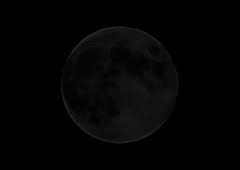
Name the moon phase
a)
First Quarter
b)
Last Quarter
c)
New Moon
d)
Full Moon
7.
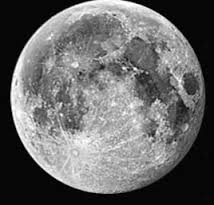
Name the moon phase
a)
First Quarter
b)
Last Quarter
c)
New Moon
d)
Full Moon
8.
What time of day are shadows the shortest?
a)
Early morning
b)
Late Morning
c)
Noon
d)
Sunset
9.
True or False: The shadows are longest in the early morning and late afternoon.
a)
True
b)
False
10.

What causes the seasons to change?
a)
The warming and cooling of Earth's core.
b)
The distance from the sun.
c)
Earth's tilt in relation to the sun.
d)
Earth's rotation on its axis.
11.
Which characteristic would most likely be inherited by a baby?
a)
brown hair
b)
crying a lot
c)
ability to jump high
d)
his ability to talk
12.
A dog rolls over and receives a treat. The dog rolls over again. This is an example of...
a)
learned behavior
b)
adaptive behavior
c)
inherited behavior
d)
instinctive behavior
13.
Which characteristic is inherited?
a)
hair color
b)
sleeping late
c)
enjoying hiking
d)
loving to read
14.
Which trait does a puppy inherit from its parents?
a)
fur color and pattern
b)
obedience to commands
c)
food brand preference
d)
affection for a specific home
15.
True or False: The shadows are longest in the early morning and late afternoon.
a)
True
b)
False
16.
A student draws his shadow at 9am. How will his shadow look at noon?
a)
shorter than the morning shadow, or no shadow at all
b)
longer than the morning shadow
c)
the same length as the morning shadow
d)
it is impossible to predict how his shadow will change size
17.
The higher the sun is in the sky, the ________ the shadows are
a)
tall
b)
shorter
c)
darker
18.
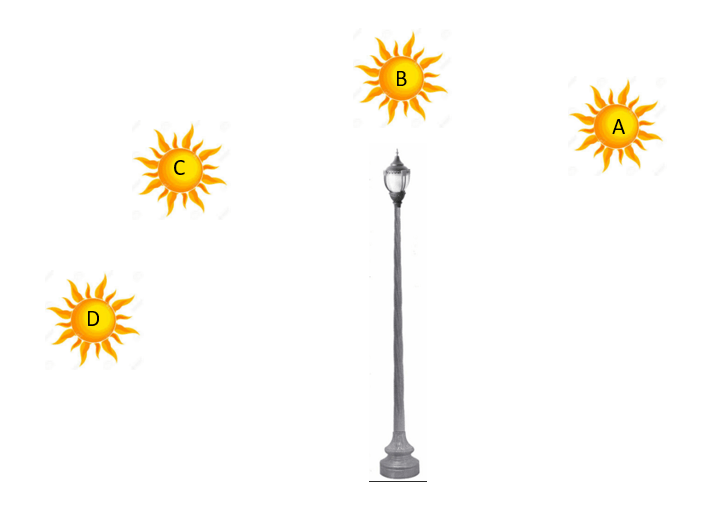
At which location of the sun would the shadow of the light pole be the longest?
a)
A at 11 a.m
b)
B at noon
c)
C at 2 p.m.
d)
D at 6 p.m.
19.
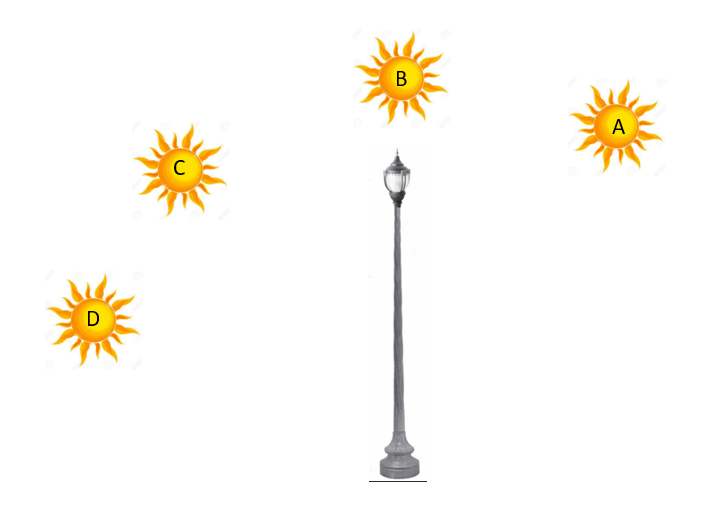
At which location of the sun would the shadow of the lamp post be the shortest?
a)
A
b)
B
c)
C
d)
D
20.
Which of these is an example of precipitation?
a)
snow
b)
air
c)
clouds
d)
vapor
21.

What part of the water cycle does this picture show?
a)
condensation
b)
precipitation
c)
evaporation
22.
Which is the opposite of condensation?
a)
runoff
b)
evaporation
c)
precipitation
d)
transpiration
23.
What is the water cycle?
a)
the 3 forms of water
b)
the movement of water on, above, or below the surface of the Earth
c)
when water melts
d)
when clouds form
24.
What is condensation?
a)
The part of the water cycle when the sun heats up water, turning it from a liquid into water vapor or steam. It rises from the ground into the air.
b)
The part of the water cycle when the water vapor in the air gets cold. The water turns back into a liquid and forms clouds.
c)
The part of the water cycle when clouds get heavy and can no longer hold the liquid water. This causes the water to fall from the sky to the earth as rain, snow, sleet, or hail.
25.
Which of the following causes all of the water on the planet to change its state (solid, liquid, gas) and move through the water cycle?
a)
amount of plant matter
b)
location of ice caps
c)
size of ocean
d)
temperature
26.

What is D?
a)
Evaporation
b)
Condensation
c)
Precipitation
d)
Runoff
27.

What is C?
a)
Evaporation
b)
Condensation
c)
Precipitation
d)
Runoff
28.

What is B?
a)
Evaporation
b)
Condensation
c)
Precipitation
d)
Runoff
29.

What is A?
a)
Evaporation
b)
Condensation
c)
Precipitation
d)
Runoff
30.
Which of the following natural resources are nonrenewable?
a)
Water
b)
Animals
c)
Natural gas
d)
Wind
31.
A resource that is not easily replaced...
a)
Renewable
b)
Nonrenewable
32.
Any useful material that is found in nature:
a)
Natural Resource
b)
Human Resource
c)
Plants
33.
Which group includes ALL renewable resources?
a)
Coal, trees, water, oil
b)
Water, wind, sun, plants
c)
Minerals, sun, natural gas, water
34.
Which best describes the potential of solar power for future energy use?
a)
It is not likely to be used because it pollutes the environment and contaminates drinking water supplies.
b)
It is likely to be used because its capture and storage does not require special equipment.
c)
It is likely to be used because it is a renewable resource that is indefinitely available.
d)
It is not likely to be used because it is less expensive than fossil fuel resources.
35.
Which is a group of nonrenewable resources?
a)
coal, oil, natural gas
b)
coal, plants, animals
c)
natural gas, water, air
d)
air, water, animals
100 %

