Wayground logo

Free Printable Worksheets

Font size

S
M
L
XL
Worksheets

Geology Unit Review

Total questions: 100

Worksheet time: 1hrs 29mins

Name
Class
Date
1.

Outermost layer

a)

Crust

b)

Mantle

c)

Inner Core

d)

Outer Core

2.
The thinnest layer of the Earth is the ___________.
a)
mantle
b)
crust
c)
core
3.
Tectonic plates are made up of continental crust and ________ crust.
a)
continental
b)
oceanic
c)
plates
d)
mantle
4.
There are how many different types of crust?
a)
1
b)
2
c)
5
d)
3
5.
What is the thickest layer of the Earth?
a)
the crust
b)
the mantle
c)
the outer core
d)
the inner core
6.
What is the core made of?
a)
steel
b)
iron 
c)
aluminum
d)
iron and nickel
7.
What describes the outer core?
a)
solid
b)
liquid
c)
viscous
d)
gas
8.
Why is the inner core solid?
a)
its unknown
b)
what it's made of
c)
the pressure
d)
it is colder than the outer core
9.
Which layer of the Earth is the only liquid layer?
a)
Outer Core
b)
Inner Core
c)
Mantle
d)
Lithosphere
10.
What is the correct order (starting from the surface) of Earth's layers?
a)
crust, outer core, inner core, mantle
b)
mantle, outer core, inner core, crust
c)
crust, mantle, outer core, inner core
d)
outer core, inner core, crust, mantle
11.
What layer is a semisolid and acts like a plastic?
a)
Lithosphere
b)
Mantle
c)
Asthenosphere
d)
crust
12.
What happens to pressure as we move from the crust to the inner core?
a)
Pressure Decreases
b)
Pressure Increases
c)
Nothing
13.
What happens to temperature as we move from the crust to the inner core?
a)
Decreases
b)
Increases
c)
Nothing
14.
How many layers are there in the Earth?
a)
40
b)
5
c)
89
d)
4
15.
which one is hotter?
a)
the crust
b)
mantle 
c)
Inner core
16.
Is the Outer core solid or liquid?
a)
solid
b)
liquid
17.
What is the driving force to plate tectonics occurring when warm magma rises and cooler magma sinks? 
a)
An oceanic current
b)
A conventional current
c)
A convection current
d)
A magnetic current
18.
Which layer of the earth is in the very center?
a)
Crust
b)
Mantle
c)
Outer Core
d)
Inner Core
19.
Which layer of the earth creates the earth's magnetic field?
a)
Crust
b)
Mantle
c)
Outer Core
d)
Inner Core
20.
Which layer of the earth is under the highest pressure?
a)
Crust
b)
Mantle
c)
Outer Core
d)
Inner Core
21.
What would you be most likely to find at a transform boundary?
a)
Earthquakes
b)
Volcanoes
c)
Mountains
d)
Rift
22.

What would you be most likely to find at a divergent boundary between two pieces of oceanic crust?

a)

Rift Valley

b)

Mid-Ocean Ridge

c)

Volcanoes

d)

Flat land

23.

What would you be most likely to find at a convergent boundary between a continental and oceanic plate?

a)

Mountains

b)

Volcanoes

c)

Mid-Ocean Ridge

d)

Rift

24.
A subduction zone is formed...
a)
when one tectonic plate sinks below another
b)
at every type of convergent plate boundary
c)
at every type of divergent plate boundary
d)
at transform boundaries
25.
Plates slide past one another at ____________ boundaries.
a)
divergent
b)
convergent
c)
transform
d)
submergent
26.
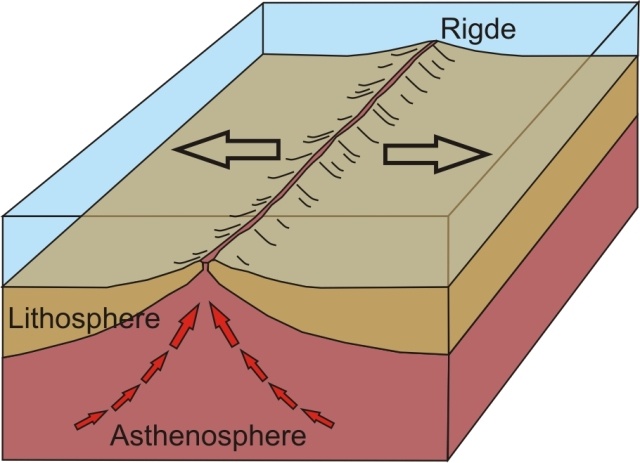
What kind of plate boundary is shown here?
a)
divergent
b)
convergent
c)
transform
d)
subducting
27.
What kind of plate boundary is shown here?
a)
divergent
b)
convergent
c)
transform
d)
submergent
28.
Plate movement is caused by ______________.
a)
the rotation of the Earth
b)
ocean tides
c)
convection currents in the mantle
d)
the moon's gravity
29.
Plates move away from one another at ___________ boundaries.
a)
divergent
b)
convergent
c)
transorm
d)
submergent
30.

Two plates come together or collide at what boundary?

a)

Convergent

b)

Divergent

c)

Transform

31.
An enormous single large mass.
a)
Pannotia
b)
Pangaea
c)
Rodinia
32.

Other scientists rejected Wegener's Continental Drift Theory because...

a)

He did not have evidence

b)

He couldn't explain how the continents moved

c)

He wasn't a scientist

d)

He was a bad communicator

33.
What is Pangaea?
a)
an icy sheet which covered many continents
b)
fossil of a fern found on many continents
c)
a mountain belt connecting many continents
d)
a super continent that contained all the continents
34.
What is the theory of continental drift?
a)
the continents move slowly over Earth's surface
b)
continents moved millions of years ago but are now fixed
c)
the continents were once fixed, but have just now begun to move
d)
the continents are fixed in position
35.
Which scientist posed the theory of continental drift?
a)
Harry Hess
b)
Drummond Matthews
c)
Fred Vine
d)
Alfred Wegener
36.
What did scientists use to map the oceans floor?
a)
Echo-location
b)
Sonar
c)
Space Shuttles
d)
Animals
37.
True or False : Sea-floor Spreading adds new material to the ocean floor?
a)
True
b)
False
38.
What are Mid-Ocean Ridges?
a)
A chain of underwater waterfalls 
b)
A chain of underwater volcanos
c)
A chain of underwater mountains
d)
A chain of underwater rocks
39.
The OLDEST seafloor is located? 
a)
Closest to the mid-ocean ridge
b)
Farthest from the mid-ocean ridge
40.

What is seafloor spreading?

a)

The seafloor comes together, bridging the continents

b)

rift valleys form

c)

The continents spread apart

d)

ocean spreads and magma rises to fill in gaps creating a Mid Ocean Ridge

41.
Scientist behind Seafloor Spreading Evidence
a)
Harry Hess
b)
Dan McKenzie
c)
Alfred Wegener
d)
Albert Einstein
42.
Which type of mountain is formed when two continental plates squeeze together?
a)
Block
b)
Dome
c)
Fold
d)
Volcanic
43.
Which type of mountain is formed when slabs of rock tilt or drop?
a)
Block
b)
Dome
c)
Fold
d)
Volcanic
44.
Which type of mountain is formed when magma erupts onto Earth’s surface?
a)
Block
b)
Dome
c)
Fold
d)
Volcanic
45.
Which type of mountain is shown in the image provided?
a)
Block
b)
Dome
c)
Fold
d)
Volcanic
46.
Which type of mountain is shown in the image provided?
a)
Block
b)
Dome
c)
Fold
d)
Volcanic
47.
Which type of mountain is shown in the image provided?
a)
Block
b)
Dome
c)
Fold
d)
Volcanic
48.
Shield volcanoes erupt violently.
a)
true
b)
false
49.
This volcano is most likely which type of volcano?
a)
Felsic
b)
Composite
c)
Shield
d)
Cinder cone
50.
A huge hole left behind when a volcano collapses is a __________.
a)
caldera
b)
volcanic neck
c)
sill
d)
vent
51.
5. What are the most explosive types of volcanoes?
a)
Shield
b)
Composite
c)
Cinder Cone
52.

What type of volcano is built by alternating layers of ASH and LAVA flows? It can be very explosive

a)

Caldera

b)

Cinder Cone

c)

Composite Volcano

d)

Shield Volcano

53.

What type of volcano has steep side and erupts ONLY ASH?

a)

Caldera

b)

Cinder Cone

c)

Composite Volcano

d)

Shield Volcano

54.

Which type of volcano has the widest base and erupts ONLY LAVA (SLOWLY)?

a)

Cinder

b)

Composite

c)

Shield

55.
What is another term for P Wave?
a)
Compression Wave
b)
Principal Wave
c)
Shear Wave
d)
Secondary Wave
56.
P Waves can move through which of the following?
a)
Gas
b)
Liquid
c)
Solid
d)
All of these
57.
S Waves can move through which of the following?
a)
Gas
b)
Liquid
c)
Solid
d)
All of these
58.
What is an instrument that detects and records waves produced by earthquakes? (This piece of equipment can measure the magnitude of an earthquake.)
a)
Epicenter
b)
Fault
c)
Seismogram
d)
Seismograph
59.
The most destructive type of wave is a 
a)
P-wave
b)
S-wave
c)
Surface wave
d)
transverse wave
60.
The seismic wave that allowed scientists to discover the liquid part of the core are the
a)
S-waves
b)
P-waves
c)
Love waves
d)
Rayleigh waves
61.
The Richter scale measures:
a)
the amount of radon gas released
b)
the movement of plates
c)
the strength of an earthquake
d)
the weight of tectonic plates
62.
Also known as shear or secondary wave; a seismic wave  that causes particles of rock to move in a side-to- side direction.
a)
P-wave
b)
Seismic wave 
c)
Focus 
d)
S-wave
63.
P waves and S waves are both types of ___ waves.
a)
Body
b)
Surface
c)
Hand
64.
Which is faster?
a)
p-waves
b)
s-waves
c)
surface waves
65.
Scientists use the difference in arrival times between which two waves to determine the distance where the rocks fractured?
a)
P and L waves
b)
P and P waves
c)
S and S waves
d)
P and S waves
66.
Where is the epicenter for this earthquake located based on triangulation?
a)
A
b)
B
c)
C
d)
D
67.
a numerical scale for expressing the MAGNITUDE of an earthquake based on seismogram readings
a)
Moment Magnitude Scale
b)
Richter Scale
c)
Modified Mercalli Scale
d)
Seismogram
68.
amount of damage caused by an earthquake
a)
magnitude
b)
intensity
c)
scale
d)
mercalli
69.

The origin (start) of an earthquake?

a)

Epicenter

b)

Fault

c)

Hypocenter

d)

Tremor

70.
How light reflects off of a mineral is called the mineral's 
a)
luster
b)
streak
c)
cleavage
d)
fracture
71.
By definition, a mineral has which of the following characteristic(s)?
a)
definite chemical composition
b)
crystal structure
c)
naturally occuring
d)
all of the above
72.
The solid, geometric form of a mineral produced by a repeating pattern of atoms
a)
crystal
b)
density
c)
element
d)
fracture 
73.
A mineral's resistance to being scratched is called?
a)
streak
b)
luster
c)
hardness
d)
heft
74.
Fracture or cleavage of a mineral tells you the:
a)
color
b)
harness
c)
temperature
d)
breakage pattern
75.
The most obvious, but also least useful property when identifying minerals
a)
Streak
b)
Luster
c)
Cleavage
d)
Color
76.
Which mineral property is being shown here?
a)
luster
b)
hardness
c)
cleavage
d)
streak
77.
All __________________ are minerals, but not all minerals are _________________. 
a)
minerals- rocks
b)
rocks-minerals
c)
rocks rocks
d)
minerals minerals
78.

When a minerals breaks with rough edges, it is said to have the property of ________________________.

a)

cleavage

b)

luster

c)

Fracture

d)

hardness

79.

When a minerals breaks with smooth edges, it is said to have the property of ________________________.

a)

cleavage

b)

luster

c)

Fracture

d)

hardness

80.
What does the Moh's scale measure?
a)
luster
b)
texture
c)
hardness
d)
color
81.
True or False: Minerals make up rocks. 
a)
True
b)
False
82.
The process by which water, wind, ice, and changes in temperature break down rock into fragments called sediments.
a)
Deposition
b)
Erosion
c)
Weathering
d)
Igneous Rock
83.
Rock that forms when magma or lava cools and hardens to become solid, either beneath or on Earth’s surface
a)
Sedimentary Rock
b)
Metamorphic Rock
c)
Igneous Rock
d)
Rock Cycle
84.
The process by which sediment is moved from one place to another.   Can be caused by water, wind, ice, and gravity.
a)
Rock Cycle
b)
Uplift
c)
Deposition
d)
Erosion
85.
Rock that forms when pressure, temperature, or chemical processes change existing rock.
a)
Igneous Rock
b)
Sedimentary Rock
c)
Metamorphic Rock
d)
Rock Cycle
86.
What type of rock is this?
a)
Metamorphic Rock
b)
Sedimentary Rock
c)
Igneous Rock
87.
rock altered, changed, by pressure and heat
a)
sedimentary rock
b)
metamorphic rock
c)
igneous
d)
erosion
88.
True or False:  Rocks can change only by melting.
a)
True
b)
False
89.
What are the three rock cycles called
a)
Igneous, Metamorphic, and Sedimentary
b)
Minerals, Rocks, and Grains
c)
Grains, Composition, and Texture
90.
8. What type of rock is made from volcanoes?
a)
Metamorphic rock
b)
Igneous Rock
c)
Sedimentary Rock
91.
Which is NOT a way to classify minerals?
a)
streak
b)
color
c)
hardness
d)
mass
92.
Rocks that are formed from melting and cooling...
a)
metamorphic
b)
igneous
c)
sedimentary
d)
minerals
93.
Rocks that formed from erosion and make layers
a)
metamorphic
b)
igneous
c)
sedimentary
d)
minerals
94.
Rocks formed by small fragments of other rocks
a)
sedimentary rocks
b)
metamorphic rocks
c)
igneous rocks
d)
fragmented rocks
95.
sandstone
a)
sedimentary rock
b)
metamorphic rock
c)
igneous rock
96.
basalt
a)
sedimentary rock
b)
metamorphic rock
c)
igneous rock
97.
marble
a)
sedimentary rock
b)
metamorphic rock
c)
igneous rock
98.
Which of the words below describe mud, sand, and tiny bits of rocks?
a)
stalactites
b)
magmas
c)
metamorphs
d)
sediments
99.
Formed by weathering & erosion
a)
magma
b)
sediments
c)
sedimentary rock
d)
intrusive igneous
100.
Each rock type can follow only one pathway of the rock cycle.
a)
True
b)
False