
 Worksheets
Hop States of Matter
Total questions: 96
Worksheet time: 3hrs 5mins
Name
Class
Date
1.
One of the states of matter. Atoms constantly move in a random pattern.
a)
gas
b)
solid
c)
liquid
d)
evaporation
2.
A phase change from a liquid to a gas.
a)
condensation
b)
evaporation
c)
sublimation
d)
deposition
3.
Atoms flow but do not have enough energy to move too far apart in this state of matter
a)
solid
b)
liquid
c)
gas
d)
plasma
4.
A gas changing directly to a solid.
a)
deposition
b)
sublimation
c)
evaporation
d)
condensation
5.
The change from a gas to a liquid.
a)
condensation
b)
evaporation
c)
sublimation
d)
deposition
6.
When we remove heat from a liquid
a)
it will freeze and turn into a solid
b)
it will freeze and turn into a gas
c)
it will freeze and turn into a liquid
d)
it will freeze and turn into plasma
7.
Sublimation:
a)
when a solid turns to a gas
b)
when a gas turns into a plasma
c)
when a liquid turns into a gas
d)
when a gas turns into a solid
8.
When you add heat to a liquid, turning it to gas, the process is called
a)
evaporation
b)
sublimation
c)
condensation
d)
deposition
9.
Deposition is a change from
a)
a gas to a solid
b)
a solid to a liquid
c)
water to ice
d)
a liquid to a solid
10.

Which state of matter do the particles represent?
a)
gas
b)
liquid
c)
solid
11.
Adding more heat energy to molecules will
a)
make them move slower
b)
make them move faster
c)
make them stop moving
d)
destroy them
12.
snow
a)
solid
b)
liquid
c)
gas
13.
Boiling is a change of state from
a)
liquid to gas
b)
gas to liquid
c)
solid to liquid
d)
liquid to solid
14.
A phase change from solid to gas like dry ice is called
a)
melting
b)
boiling
c)
evaporation
d)
sublimation
15.

Which form of matter has a definite shape and takes up space (has definite volume)?
a)
liquid
b)
solid
c)
gas
d)
clay
16.
What is happening when my ice cream changes from a solid to a liquid?
a)
freezing
b)
melting
c)
burning
d)
evaporation
17.
Which form of matter does not take the shape of its container?
a)
liquid
b)
gas
c)
solid
d)
air
18.
Particles slide past each other
a)
solid
b)
liquid
c)
gas
d)
solid, liquid and gas
19.
Definite shape and definite volume
a)
solid
b)
liquid
c)
gas
d)
solid, liquid and gas
20.
Matter changing states creates a new substance
a)
True
b)
False
21.
Which of the following is NOT matter?
a)
Air
b)
Oxygen
c)
Cells
d)
Gravity
22.
Condensation and _____ occur at the same temperature.
a)
boiling
b)
evaporation
c)
freezing
d)
sublimination
23.

What state of matter is shown?
a)
Solid
b)
Liquid
c)
Gas
24.
No definite shape or volume
a)
solid
b)
liquid
c)
gas
d)
solid, liquid and gas
25.

Which of the following statements is NOT true of all different types of matter?
a)
They are made of atoms and molecules
b)
The particles are always in motion
c)
The particles always move at the same speed
d)
They are made of particles that are too small to see
26.
Definite volume but not definite shape
a)
solid
b)
liquid
c)
gas
d)
solid, liquid and gas
27.
Molecules are closest together in a
a)
Solid
b)
Liquid
c)
Gas
d)
plasma
28.

The steam coming off the pot of boiling water is an example of....
a)
a solid becoming a liquid
b)
a liquid becoming a solid
c)
a liquid becoming a gas
d)
a gas becoming a liquid
29.
In which state of matter do the particles spread apart and fill all the space available to them?
a)
crystal
b)
liquid
c)
gas
d)
solid
30.
What is matter?
a)
Anything that has volume and takes up space
b)
Anything that you can think of
c)
Anything that has mass and takes up space
d)
Anything in the dictionary
31.
For the same substance, a ________ has the most energy and a _______ has the least energy.
a)
solid, liquid
b)
liquid, solid
c)
solid, gas
d)
gas, solid
32.
As temperature decreases, the molecules collide more, move faster, and spread out.
a)
true
b)
false
33.
Helium
a)
solid
b)
liquid
c)
gas
34.
The phase change that is the reverse of evaporation is
a)
freezing
b)
condensation
c)
melting
d)
sublimation
35.
Most of the matter in the universe exists in which state?
a)
solid
b)
gas
c)
plasma
d)
Bose-Einstein condensate
36.
How does a plasma differ from a gas?
a)
A plasma has a definite volume
b)
A plasma has a definite shape
c)
A plasma can conduct electricity
d)
The particles in a plasma move slowly
37.
steam
a)
solid
b)
liquid
c)
gas
38.
What Is Volume?
a)
How heavy something is.
b)
The amount of space taken up by and object.
c)
How a liquid flows.
d)
The international unit of measurement.
39.

The drops of water that appear on the outside of a glass of cold juice on a warm day are an example of?
a)
sublimation
b)
condensation
c)
evaporation
40.
On a hot summer day chocolate candy can melt in your pocket. How can you get the chocolate to return to a solid?
a)
add heat
b)
leave it in your pocket
c)
cool it in the refrigerator
d)
leave it outside
41.
True or False: Matter can changes states by adding heat or removing heat.
a)
True
b)
False
42.
smoke
a)
solid
b)
liquid
c)
gas
43.

Which thing in this picture represents a gas?
a)
ice cubes
b)
bubbles
c)
soda
d)
glass
44.
Which state of matter has no definite shape or volume and the particles have broken apart?
a)
solid
b)
gas
c)
liquid
d)
plasma
45.
rubbing alcohol evaporates
a)
physical change
b)
chemical change
46.
Which
of the following occurs when a liquid becomes a gas?
a)
The
particles create energy.
b)
The
particles break away from one another.
c)
The
particles clump together.
d)
The
particles stop moving.
47.
This
is a state of matter in which atoms and molecules are close together but can
slide past each other.
a)
Liquid
b)
Gas
c)
Solid
d)
Plasma
48.
desk
a)
solid
b)
liquid
c)
gas
d)
plasma
49.

What state of matter is the timer?
a)
solid
b)
liquid
c)
gas
50.
Which state has the highest temperature and energy?
a)
Solid
b)
Liquid
c)
Gas
d)
Plasma
51.

What is the boiling point of water?
a)
0 degrees Celsius
b)
32 degrees Celsius
c)
212 degrees Celsius
d)
100 degrees Celsius
52.

Which state of matter do the particles in this picture represent?
a)
solid
b)
liquid
c)
gas
d)
plasma
53.
______ is the amount of matter an object has
a)
mass
b)
volume
54.
diamonds
a)
solid
b)
liquid
c)
gas
55.
When the temperature of matter decreases the particles ...
a)
speed up and move farther apart
b)
speed up and move closer together
c)
slow down and move farther apart
d)
slow down and move closer together
56.
The opposite phase change of melting is
a)
freezing
b)
sublimation
c)
condensation
d)
deposition
57.

A graduated cylinder is used to measure
a)
weight
b)
volume
c)
mass
d)
inertia
58.

What process is represented in the figure?
a)
sublimation
b)
freezing
c)
deposition
d)
vaporization
59.
What do you call the conversion of a substance from one physical form to another?
a)
melting
b)
Bose - Einstein Condenstes
c)
transfer of energy
d)
change of state
60.
When liquid water is placed in a freezer, the particles move:
a)
slower and closer together
b)
faster and farther apart
c)
slower and farther apart
d)
faster and closer together
61.
A pile of snow slowly disappears into the air, even though the temperature remains below freezing. Which process explains this?
a)
Condensation
b)
Deposition
c)
Evaporation
d)
Sublimation
62.
Which is NOT an example of condensation?
a)
steam from a pot
b)
water on a glass after showers
c)
water outside of a cold glass
d)
clouds in the sky
63.
All of the following are types of solids EXCEPT...
a)
sand
b)
oil
c)
an ice cube
d)
a balloon
64.
ketchup
a)
solid
b)
liquid
c)
gas
65.
All of these are examples of gasses except
a)
oxygen
b)
carbon dioxide
c)
helium
d)
shampoo
66.
The temperature at which a liquid becomes a solid
a)
melting point
b)
freezing point
c)
boiling point
67.
How is a gas defined?
a)
Indefinite shape, indefinite volume
b)
Definite shape, definite volume
c)
Found in stars
d)
Definite volume, indefinite shape
68.

Which cube is more dense?
a)
left cube
b)
right cube
69.
For deposition to occur, thermal energy has to be ________ from the gas.
a)
added
b)
absorbed
c)
removed
70.

Which state of matter do the molecules represent?
a)
liquid
b)
solid
c)
gas
71.

Blow drying your hair is an example of
a)
condensation
b)
precipitation
c)
evaporation
d)
sublimation
72.

Dew on the ground in the morning is an example of
a)
condensation
b)
precipitation
c)
evaporation
d)
sublimation
73.

This is an image of particles in a
a)
solid
b)
liquid
c)
gas
74.
What would cause a decrease in particle movement?
a)
decrease the number of atoms
b)
increase the space between atoms
c)
decrease the temperature
d)
increase the mass
75.

What is #1 on the chart?
a)
freezing
b)
melting
c)
boiling
d)
evaporating
76.
All matter is made of tiny particles.
a)
True
b)
False
77.

Which state of matter is shown in the diagram?
a)
SOLID
b)
LIQUID
c)
GAS
78.
As the temperature increases, the ______ increases.
a)
space between atoms
b)
number of electrons
c)
number of atoms
d)
number of solid atoms
79.

If a balloon is cooled, what will happen to the volume?
a)
Volume will increase
b)
Volume will decrease
c)
Volume will not change
80.
The temperature at which a liquid can change to a gas.
a)
Boiling Point
b)
Color
c)
Density
d)
Melting Point
81.

Which state of matter do the molecules represent?
a)
SOLID
b)
LIQUID
c)
GAS
82.

In a solid, the particles
a)
vibrate in place
b)
slide past one another
c)
overcome the strong attraction
83.

What does the experiment show?
a)
Water has mass
b)
Water occupies space
c)
Water has no definite shape
d)
Water has no definite volume
84.
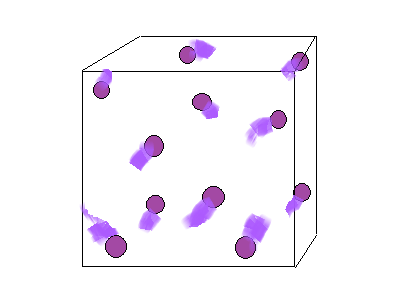
What state of matter does this picture show?
a)
Liquid
b)
Gas
c)
Solid
d)
Matter
85.
How are solids and liquids the same?
a)
They take the shape of their container.
b)
They both have mass and volume.
c)
They keep their shape.
86.
What happens to particles at absolute zero?
a)
Particles move really fast.
b)
Particles move fast.
c)
Particles move slow.
d)
Particles do not move.
87.

Which state of matter do the molecules represent?
a)
SOLID
b)
LIQUID
c)
GAS
88.
In which state of matter is the interparticle (between particles) force the strongest?
a)
solid
b)
liquid
c)
gas
d)
plasma
89.

Rank these in order from least dense to most dense.
a)
Solid, Liquid, Gas
b)
Liquid, Gas, Solid
c)
Gas, Solid, Liquid
d)
Gas, Liquid, Solid
90.

If condensation forms on the inside of a window, then
a)
the air inside the room is warmer than the window pane.
b)
the air inside the room is cooler than the window pane.
c)
the air inside the room is the same temperature as the window pane.
d)
the air inside the room is the same temperature outside.
91.

What happens in condensation?
a)
gas turns to liquid
b)
liquid turns to a gas
c)
liquid turns to a solid
d)
solid turns to a liquid
92.
Absolute zero is
a)
Zero Kelvin
b)
where there is no molecular movement
c)
the coldest temperature possible
d)
all of these
93.
Where can natural plasmas be found?
a)
hydrogen and helium
b)
ice and water
c)
lightning and fire
d)
plasma balls and florescent lights
94.
What does the state of matter depend on?
a)
The atoms and molecules
b)
The motion of the particles
c)
the physical form of the substance
d)
the shape and volume of the substance
95.
Which state(s) of substance required that energy be removed?
a)
Evaporation and condensing
b)
Freezing and condensation
c)
sublimation and condensation
d)
melting and sublimation
96.
Which of the following is NOT a plasma?
a)
Lightning
b)
A fire
c)
A lava lamp
d)
Northern Lights
100 %

