
 Worksheets
Atmosphere Review
Total questions: 100
Worksheet time: 1hrs 25mins
Name
Class
Date
1.
What is the name of the steady winds that flow from west to east between latitudes 30*N and 60*N and 30*S and 60*S?
a)
trade winds
b)
land breeze
c)
westerlies
d)
jet stream
2.
What global wind is located from 0 to 30 degrees North and South of the Equator?
a)
Trade Winds
b)
Prevailing Westerlies
c)
Polar Easterlies
d)
Doldrum
3.
A sea breeze blows from the ocean toward the shore. Why does this occur?
a)
High pressure over the land causes a downdraft to occur.
b)
The tide carries the wind to the shore as it moves back and forth.
c)
Conduction of heat from the warm water produces wind from the ocean.
d)
Air over land heats faster than air over water, which causes convection.
4.
Land and water absorb and release the sun’s heat in different ways. One result of this is a sea breeze. Which statement is true of sea breezes?
a)
They originate in the day and blow toward the land.
b)
They originate in the day and blow toward the water.
c)
They originate in the evening and blow toward the land.
d)
They originate in the evening and blow toward the water.
5.
Which global winds have the greatest impact on the weather in the US?
a)
trade winds
b)
prevailing westerlies
c)
doldrums
d)
polar easterlies
6.
Which gas in our atmosphere is most abundant?
a)
Argon
b)
Oxygen
c)
Nitrogen
d)
Carbon Dioxide
7.
Temperature in the stratosphere warms as altitude increases.
a)
True
b)
False
8.
What causes the temperature to increase in the stratosphere?
a)
Nitrogen
b)
Ozone
c)
Water Vapor
d)
carbon dioxide
9.
What is the percentage of oxygen in Earth's atmosphere?
a)
1%
b)
21%
c)
78%
d)
90%
10.
What is the percentage of nitrogen in Earth's atmosphere?
a)
1%
b)
21%
c)
78%
d)
90%
11.
What percentage of our atmosphere is made up of other gases such as argon, water vapor, and carbon dioxide?
a)
1%
b)
21%
c)
78%
d)
90%
12.
What is N2?
a)
Nitrogen Gas
b)
Neon
c)
Helium
d)
Nabs
13.
What is CO2?
a)
Carbon Dioxide
b)
Carbon Oxygen
c)
Crackers and oranges
d)
Carbon monoxide
14.
What is O3?
a)
Oxygen
b)
Ozone
c)
Oranges
d)
Opposites
15.
In which layer of the atmosphere does weather occur?
a)
Troposphere
b)
Stratosphere
c)
Mesosphere
d)
Thermosphere
16.
Where are the Aurora Borealis located?
a)
Troposphere
b)
Stratosphere
c)
Mesosphere
d)
Thermosphere
17.
In what layer of earth's atmosphere do meteoroids burn up?
a)
Troposphere
b)
Stratosphere
c)
Mesosphere
d)
Thermosphere
18.
In what layer of earth's atmosphere is the ozone layer?
a)
Troposphere
b)
Stratosphere
c)
Mesosphere
d)
Thermosphere
19.
What protects us from dangerous ultraviolet radiation from the sun?
a)
Ozone
b)
Nitrogen
c)
Haramabe
d)
Carbon Dioxide
20.
Which of the following is the correct order of the atmosphere layers from Earth to space?
a)
troposphere, stratosphere, mesosphere, thermosphere
b)
troposphere, mesosphere, thermosphere, stratosphere
c)
thermosphere, stratosphere, mesosphere, troposphere
d)
mesosphere, stratosphere, troposphere, thermosphere
21.
What is ozone?
a)
3 nitrogen atoms
b)
3 oxygen atoms
c)
2 oxygen atoms
d)
1 oxygen atom
22.
The measure of average kinetic energy of all the particles within an object is called ____________.
a)
temperature
b)
conduction
c)
radiation
d)
heat
23.
The total amount of energy in a substance
a)
Heat
b)
Temperature
c)
Albedo
d)
Fahrenheit
24.
Land heats up and cools down faster than water.
a)
True
b)
False
25.
Temperatures vary more over water than over land.
a)
True
b)
False
26.
Which areas of the Earth receive the most sunlight?
a)
The poles
b)
The upper latitudes
c)
The middle latitudes
d)
The tropics
27.
Which areas of the Earth receive the least amount of sunlight?
a)
The poles
b)
The upper latitudes
c)
The middle latitudes
d)
The tropics
28.
Why does the northern hemisphere have greater temperature variations than the southern hemisphere?
a)
The S. hemisphere has more land.
b)
The S. hemisphere has more water.
c)
The N. hemisphere has more land.
d)
The N. hemisphere has more water.
29.

What happens to most of incoming solar radiation?
a)
It's reflected into space
b)
It's absorbed by the atmosphere
c)
It's absorbed by the land and sea
d)
It's reflected by clouds
30.
Increased altitude leads to
a)
Increased temperature
b)
Decreased temperature
c)
Increased pressure
d)
Decreased wind
31.
State of the atmosphere at a time and place
a)
Climate
b)
Weather
c)
Temperature
d)
Heat
32.
Patterns of weather over long periods of time
a)
Climate
b)
Weather
c)
Temperature
d)
Heat
33.
Does cold air rise or sink?
a)
Rise
b)
Sink
34.

Why is it colder on a cloudy day?
a)
False, it's warmer on a cloudy day.
b)
Clouds reflect heat back towards Earth
c)
Clouds don't effect the temperature
d)
Clouds reflect sunlight out into space
35.

Why is it warmer on a cloudy night?
a)
False, it's colder on a cloudy night.
b)
Clouds reflect heat back towards Earth
c)
Clouds don't effect the temperature
d)
Clouds reflect sunlight out into space
36.
___________is the result of the weight of a column of air pushing on an area.
a)
air pressure
b)
density
c)
volume
d)
none of the above
37.
A _____________ is the scientific instrument used to measure air pressure.
a)
barometer
b)
thermometer
c)
mercury
d)
watch
38.
At the seashore late in the afternoon on a hot, sunny day, a person often feels a strong breeze coming in from the ocean. Which of the following is the reason for the breeze?
a)
pounding waves generate air currents
b)
warm air over the ocean rushes in to replace the cool air that rises over land
c)
there are no clouds to block wind coming in
d)
heavy cool air over the ocean rushes in to replace warm air that rises over the land
39.
Michael observes the air pressure daily. Over the last couple of days, the air pressure has been dropping. What weather will Michael most likely observe as a result?
a)
increasingly clear skies and more wind
b)
increasingly clear skies and dry weather
c)
increasingly cloudy skies and possible storms
40.

Altitude is greater __________.
a)
at the bottom of the mountain
b)
at the top of the mountain
c)
at the center of the mountain
41.
How do we characterize an air mass that forms over the ocean?
a)
Dry
b)
Wet
c)
Cold
d)
Warm
42.
How do we characterize an air mass that forms over land?
a)
Dry
b)
Wet
c)
Cold
d)
Warm
43.
How do we characterize an air mass that forms over near the equator?
a)
Dry
b)
Wet
c)
Cold
d)
Warm
44.
How do we characterize an air mass that forms near the poles?
a)
Dry
b)
Wet
c)
Warm
d)
Cold
45.
What types of air masses form over oceans?
a)
Maritime
b)
Continental
c)
Polar
d)
Tropical
46.
What's the humidity and temperature of a continental tropical air mass?
a)
Wet and cold
b)
Dry and warm
c)
Wet and warm
d)
Dry and cold
47.
What's the humidity and temperature of a maritime tropical air mass?
a)
Wet and cold
b)
Dry and warm
c)
Wet and warm
d)
Dry and cold
48.
A wet and cold air mass would be a...
a)
Maritime polar
b)
Continental polar
c)
Maritime tropical
d)
Continental tropical
49.
A dry and cold air mass would be...
a)
Maritime polar
b)
Continental polar
c)
Maritime tropical
d)
Continental tropical
50.
A dry and hot air mass would be...
a)
Maritime arctic
b)
Maritime tropical
c)
Continental tropical
d)
Continental polar
51.
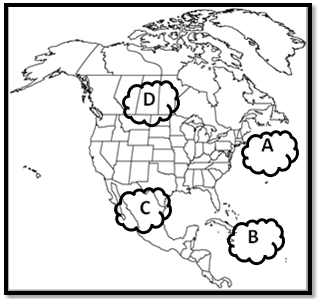
Which type of air would you find at air mass A?
a)
cold, dry
b)
warm, humid
c)
warm, dry
d)
cold, humid
52.
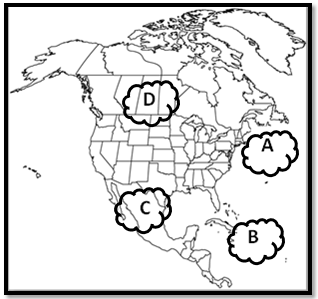
Which type of air would you find at air mass B?
a)
cold, dry
b)
warm, humid
c)
warm, dry
d)
cold, humid
53.
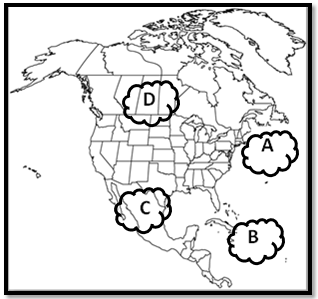
Which type of air would you find at air mass C?
a)
cold, dry
b)
warm, humid
c)
warm, dry
d)
cold, humid
54.
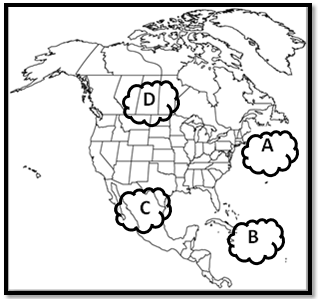
Which type of air would you find at air mass D?
a)
cold, dry
b)
warm, humid
c)
warm, dry
d)
cold, humid
55.
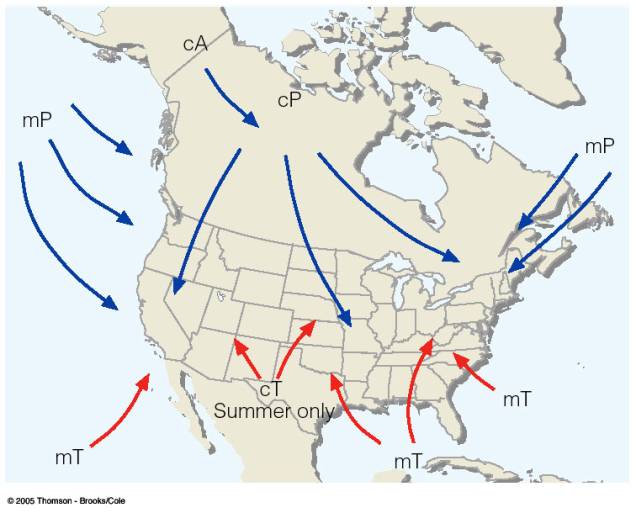
Which abbreviation of an air mass can be identified as dry and hot?
a)
cP
b)
mP
c)
cT
d)
mT
56.
Which abbreviation of an air mass can be identified as cold and moist?
a)
cP
b)
mP
c)
cT
d)
mT
57.

What kind of breeze is this & what time of day/night would it form?
a)
Land breeze - daytime
b)
Land breeze - nighttime
c)
Sea breeze - daytime
d)
Sea breeze - nighttime
58.

What type of storm front if this?
a)
Warm Front
b)
Cold Front
c)
Stationary Front
d)
Occluded Front
59.

What type of storm front is this?
a)
Warm Front
b)
Cold Front
c)
Occluded Front
d)
Stationary Front
60.

Which front this image represent ?
a)
Cold front
b)
Stationary front
c)
Occluded Front
d)
Warm front
61.

Which front this image represent ?
a)
Cold front
b)
Stationary front
c)
Occluded Front
d)
Warm front
62.
_________front forms when warm air moves over cold air and slowly replaces the cold air
a)
warm front
b)
cold front
c)
occluded front
d)
stationary front
63.

A __________ is a boundary separating two air masses of different densities.
a)
weather front
b)
air
c)
water
d)
land
64.

Which type of pressure system is pictured?
a)
high
b)
low
c)
medium
d)
none
65.

What type of weather would you expect with the pressure system pictured?
a)
clear
b)
cloudy
c)
severe storms
d)
hot
66.

Which type of pressure system is pictured?
a)
high
b)
low
c)
medium
d)
none
67.

What type of weather would you expect from the pressure system pictured?
a)
clear
b)
cloudy
c)
hot
d)
stormy
68.
Cold air traveling south from Canada is:
a)
continental tropical
b)
continental polar
c)
maritime tropical
d)
maritime polar
69.
Warm air moving upwards from the Gulf of Mexico is:
a)
continental tropical
b)
continental polar
c)
maritime tropical
d)
maritime polar
70.

Which location is most likely experiencing the greatest wind speeds?
a)
Location A
b)
Location B
c)
Location C
d)
Location D
71.
In which part of the water cycle do plants release excess water vapor into the atmosphere?
a)
transpiration
b)
photosynthesis
c)
condensation
d)
evaporation
72.

Which type of front is near Seattle?
a)
cold front
b)
warm front
c)
occluded front
d)
stationary front
73.

Which front is located near San Diego?
a)
cold front
b)
warm front
c)
occluded front
d)
stationary front
74.

Which type of front is located near Chicago?
a)
warm front
b)
cold front
c)
occluded front
d)
stationary front
75.

Which type of front is near Tulsa?
a)
cold front
b)
warm front
c)
occluded front
d)
stationary front
76.

Which type of weather would you expect near Seattle?
a)
stormy
b)
rain for several days
c)
sunny
d)
fair
77.

What kind of weather will Pennsylvania (upper east coast) be getting in the next day and why?
a)
Heavy precipitation and warm temps due to a warm front.
b)
Cold temps and clear skies because of a cold front
c)
Heavy precipitation and cold temps due to a cold front.
d)
Light rain and warm temps due to a warm front.
78.

What part of the water cycle does this picture show?
a)
condensation
b)
precipitation
c)
evaporation
79.
Which of these is an example of precipitation?
a)
snow
b)
air
c)
clouds
d)
vapor
80.
Which is the opposite of condensation?
a)
runoff
b)
evaporation
c)
precipitation
d)
transpiration
81.
Snow, sleet, hail, and rain are all examples of ________________.
a)
evaporation
b)
condensation
c)
accumulation
d)
precipitation
82.

What is it called when plants give off water vapor as a waste product?
a)
condensation
b)
evaporation
c)
sublimation
d)
transpiration
83.
When water _________, dew forms.
a)
Melts
b)
Evaporates
c)
Condenses
d)
Precipitates
84.
What is the energy source for the water cycle?
a)
the sun
b)
the earth
c)
water
d)
the moon
85.
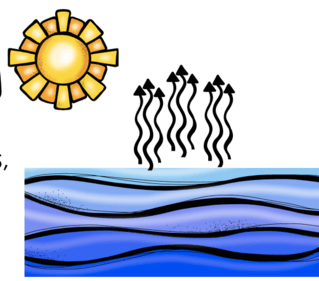
What part of the water cycle does this picture show?
a)
condensation
b)
precipitation
c)
evaporation
86.

When water condenses, the water vapor in the air gets ___________ and changes back into liquid.
a)
cold
b)
hot
c)
warm
d)
solid
87.
Which of these is not an example of precipitation?
a)
rain
b)
clouds
c)
sleet
d)
snow
88.
What is the definition of CONDUCTION?
a)
When heat is transferred from objects like rays of light or electromagnetically.
b)
a hot liquid or air that expands, becomes less dense, and rises or becomes more dense, and sinks.
c)
When heat transfers from objects that are touching.
d)
When heat transfers through the heater or AC in your house.
89.
What is the definition of CONVECTION
a)
When heat transfers through waves.
b)
When heat transfers from objects that are touching.
c)
a hot liquid or air that expands, becomes less dense, and rises or becomes more dense, and sinks.
d)
Heat traveling from the sun
90.
What kind of heat transfer happens when the sun is heating your body?
a)
Conduction
b)
Radiation
c)
Convection
d)
Density
91.
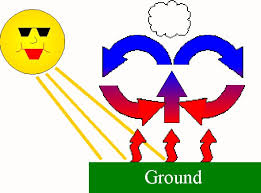
Warm air rises and the cool air sinks demonstrates this type of heat transfer.
a)
conduction
b)
convection
c)
radiation
d)
Insolation
92.
Near the ceiling of a room the air is warmer. The warm air rises because of
a)
conduction
b)
convection
c)
radiation
93.

What phase change is represented by the dry ice in this picture?
a)
evaporation
b)
condensation
c)
sublimation
d)
melting
94.

The drops of water that appear on the outside of a glass of cold juice on a warm day are an example of?
a)
Sublimation: A solid turning into a gas.
b)
Condensation: A gas changing to a liquid.
c)
Evaporation: A liquid changing to a gas.
d)
Deposition: A gas changing to a solid.
95.

How does the temperature on the windward side of the mountain compare to the temperature on the leeward side?
a)
Temperature on the leeward side is cooler
b)
Temperature on the leeward side is the same as the windward side
c)
Temperature on the windward side is cooler
d)
Temperature on the windward side is warmer
96.
The measure of how high a place is above sea level is called
a)
height
b)
altitude
c)
latitude
d)
longitude
97.
As you go higher in altitude, the climate will get
a)
drier
b)
cooler
c)
lighter
d)
warmer
98.
When moist winds go up a mountain, they often drop rain as they go up and over the mountain. The air coming down the other side of the mountain is
a)
cooler and drier
b)
cooler and wetter
c)
warmer and drier
d)
warmer and wetter
99.
As latitude ____________ temperature ____________.
a)
increases, decreases
b)
decreases, increases
c)
increases, increases
d)
decreases, decreases
100.
As altitude _____________ temperature ___________.
a)
decreases, decreases
b)
increases, increases
c)
increases, decreases
d)
decreases, increases
100 %

