
 Worksheets
other ques week 2 IP
Total questions: 97
Worksheet time: 49mins

On the H-R diagram, where are main sequence stars generally located relative to luminosity and temperature?
High luminosity and low temperature region
Diagonal band from hot-bright to cool-dim
Cluster at low luminosity and high temperature
Horizontal line at constant luminosity
Vertical line at constant temperature
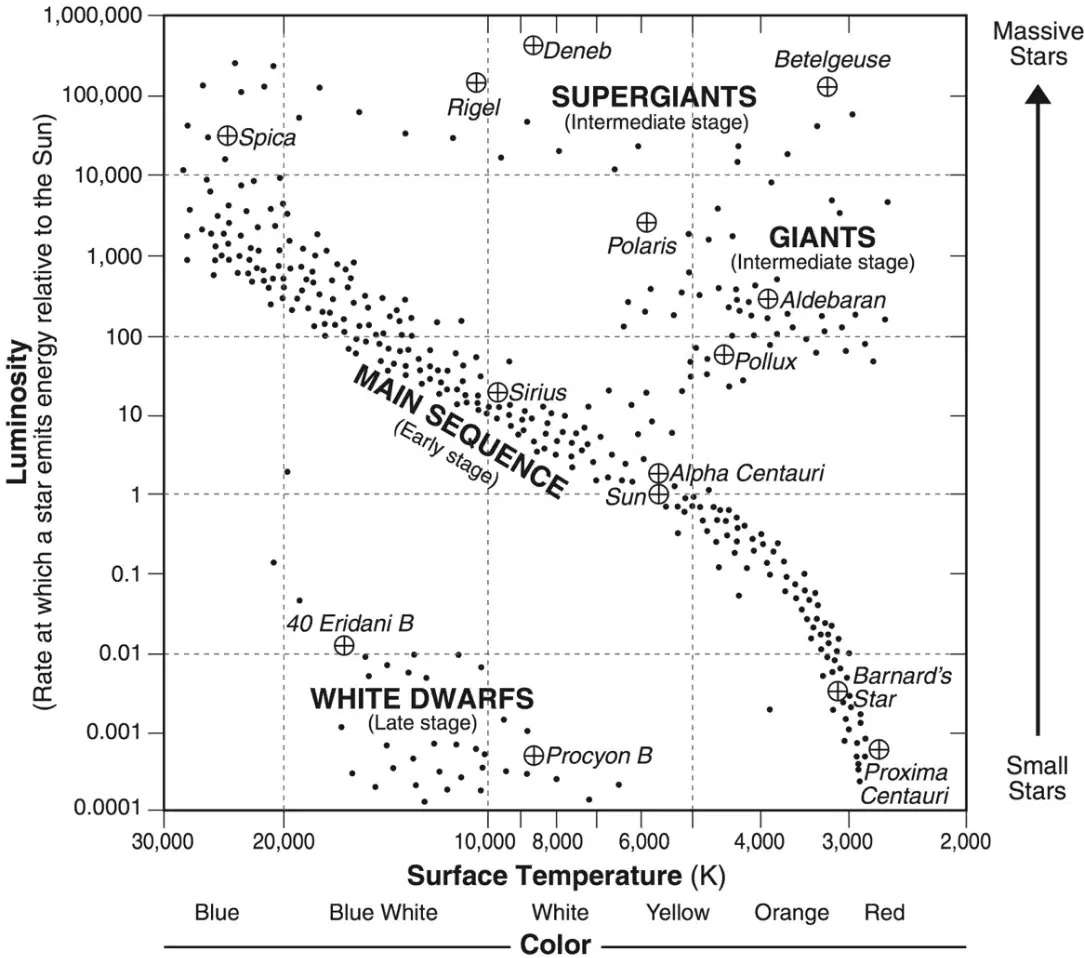
A star with surface temperature around 3,000 K and low luminosity would most likely appear what color and belong to which group?
Blue color, supergiants group
Red color, white dwarfs group
Red color, giants group
Red color, main sequence group
Orange color, main sequence group

Which trend best describes how luminosity relates to temperature for main sequence stars on the diagram?
Luminosity peaks at intermediate temperatures
Luminosity increases as temperature decreases
Luminosity is unrelated to temperature
Luminosity remains constant across temperatures
Luminosity increases with higher temperature
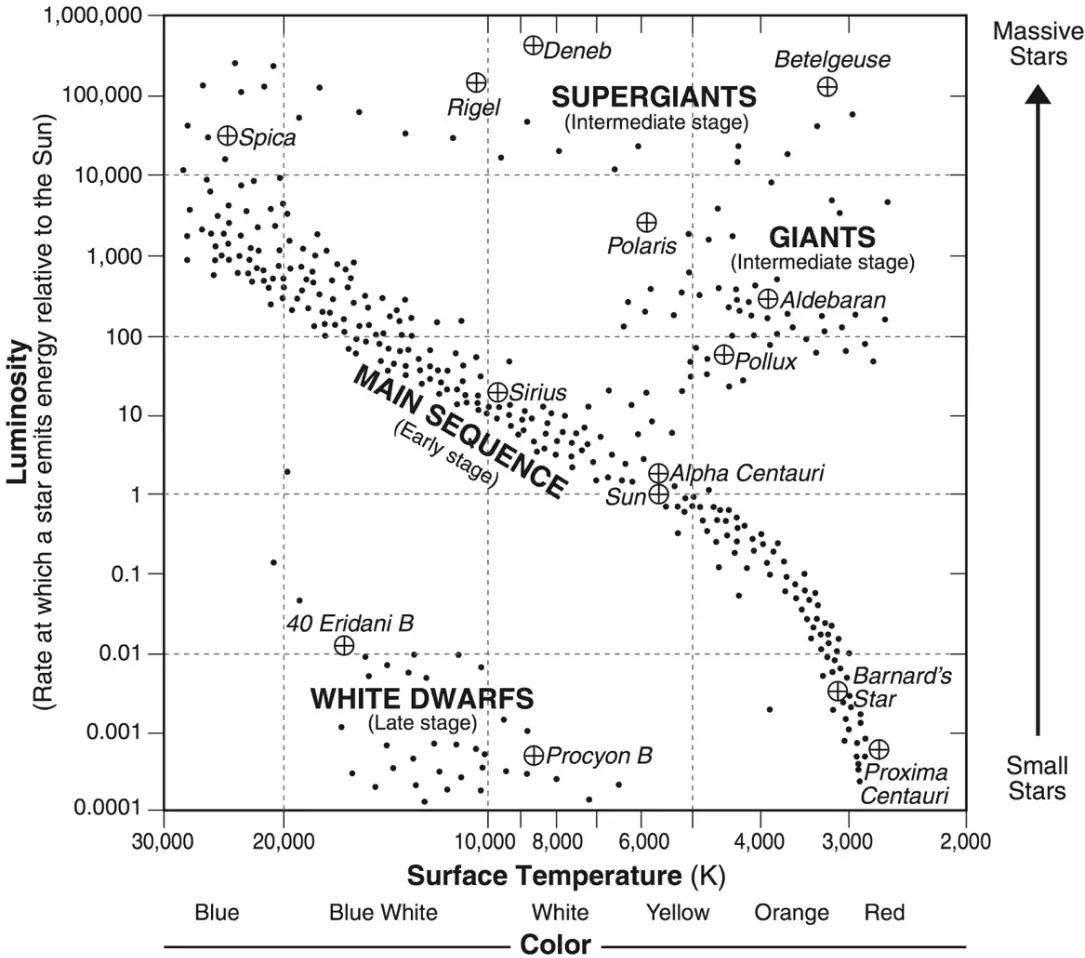
Where are white dwarfs positioned on the H-R diagram compared to giants and supergiants?
Center, moderate temperature and moderate luminosity
Upper-right, lower temperature and high luminosity
Lower-left, higher temperature and low luminosity
Lower-right, lower temperature and low luminosity
Upper-left, higher temperature and high luminosity
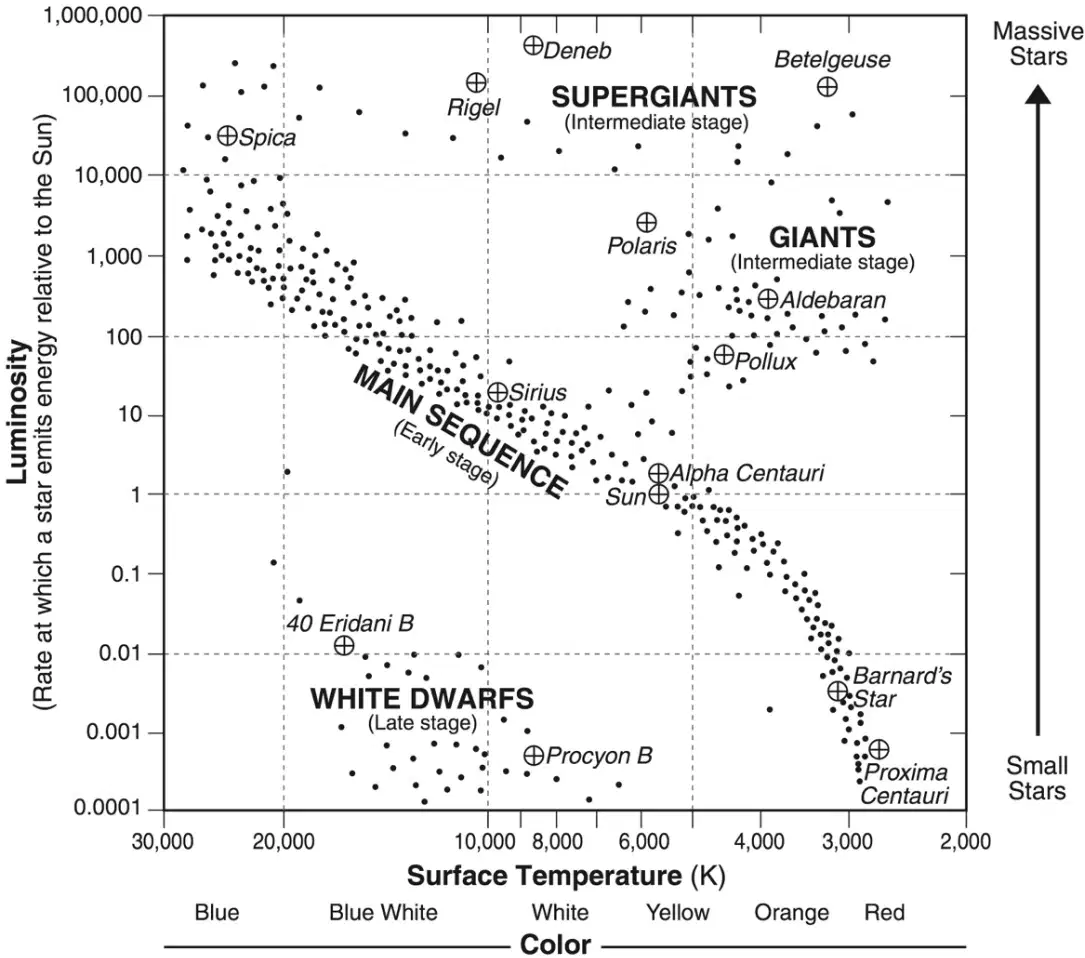
The Sun’s position on the H-R diagram indicates which classification and approximate color?
Main sequence star, yellow color
Supergiant star, blue color
White dwarf star, white color
Giant star, orange color
Main sequence star, red color
Which definition best describes a light year?
The average spacing between planets in a solar system
The time it takes for Earth to orbit the Sun once
The distance traveled by light in one year in space
The energy released by a distant star each year
Arrange these structures from largest to smallest: planet, universe, galaxy, solar system.
Solar system → galaxy → universe → planet
Universe → galaxy → solar system → planet
Galaxy → universe → solar system → planet
Universe → solar system → galaxy → planet
Which statement about galaxies is most accurate?
They are similar in size to a solar system
They contain one star and hundreds of planets
They may contain billions of stars held together by gravity
They exist only as regions between planetary orbits
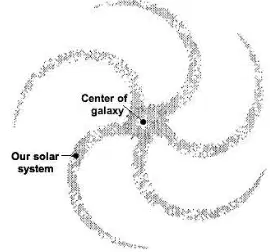
In the Milky Way, where is our solar system located relative to the galaxy’s structure?
Inside the axis of rotation at the center
In the middle of an outer spiral arm
Near the central bulge of the galaxy
At the very outer edge beyond the arms
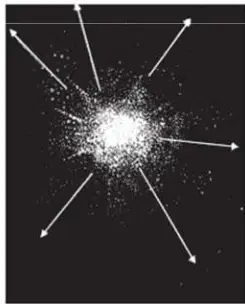
Which statement best describes the Big Bang?
An extremely dense matter concentration rapidly expanded
A gradual cooling produced matter without expansion
A small star exploded and created our solar system
A slow collapse of empty space formed galaxies
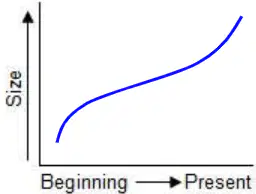
Based on the size graph shown, how has the universe’s size changed over time?
Constant size with minor oscillations
Expanded briefly and then remained fixed
Increasing overall with accelerating expansion
Decreasing steadily since the beginning
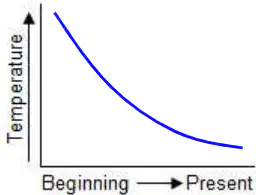
The temperature graph indicates what trend for the universe?
Repeated cycles of heating and cooling
Cooling continuously as expansion proceeds
Heating steadily as galaxies form
Stable temperature after early moments
What are stars, including the Sun?
Frozen balls of ice orbiting galaxies
Solid rocky bodies reflecting external light
Self-luminous spheres of gas producing energy
Metallic objects heated by nearby planets
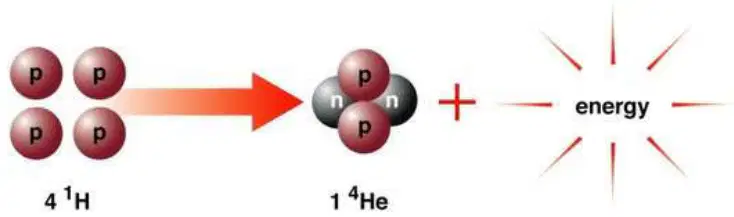
Which process allows stars to produce their energy?
Nuclear fusion of hydrogen into helium
Nuclear fission splitting heavy elements
Chemical combustion of oxygen gas
Gravitational collapse without reactions
Stars are primarily classified using which two properties?
Age and distance from Earth
Luminosity and temperature
Size and magnetic field strength
Mass and orbital speed
How does a star’s mass relate to its luminosity?
Only temperature determines luminosity entirely
Greater mass generally means lower luminosity
Greater mass generally means greater luminosity
Mass does not affect luminosity at all
Which color sequence correctly orders star temperatures from hottest to coolest?
Yellow, blue, white, orange, red
Blue, white, yellow, orange, red
Red, orange, yellow, white, blue
White, blue, yellow, red, orange
Which star has a similar temperature to the Sun based on the H-R diagram and comparisons?
Spica; Procyon B
Sirius; Betelgeuse
Alpha Centauri; Polaris
Deneb; Rigel
Which star is identified as having a similar luminosity to the Sun?
Betelgeuse
Rigel
Alpha Centauri
Spica
Which star is the largest among those compared?
Deneb
Procyon B
Proxima Centauri
Barnard's Star
Which are the smallest stars in the comparison set?
Deneb and Rigel
Alpha Centauri and Sirius
Spica and Polaris
Procyon B and Proxima Centauri
Which star is the hottest among the listed stars?
Spica
Deneb
Barnard's Star
Proxima Centauri
Which star is the coolest among the listed stars?
Proxima Centauri
Spica
Rigel
Polaris
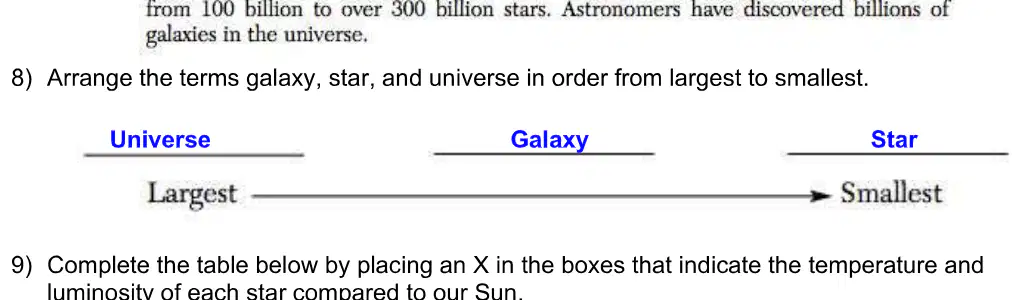
Order the terms from largest to smallest scale in the cosmos.
Universe, Star, Galaxy
Galaxy, Universe, Star
Star, Galaxy, Universe
Universe, Galaxy, Star
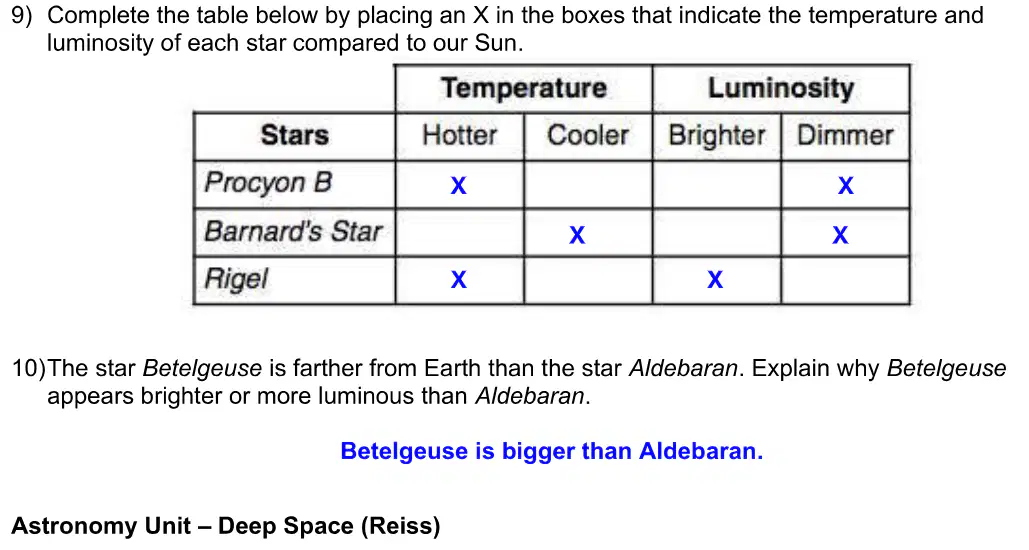
Compared to the Sun, which row correctly marks Procyon B’s properties?
Cooler and dimmer
Cooler and brighter
Hotter and brighter
Hotter and dimmer
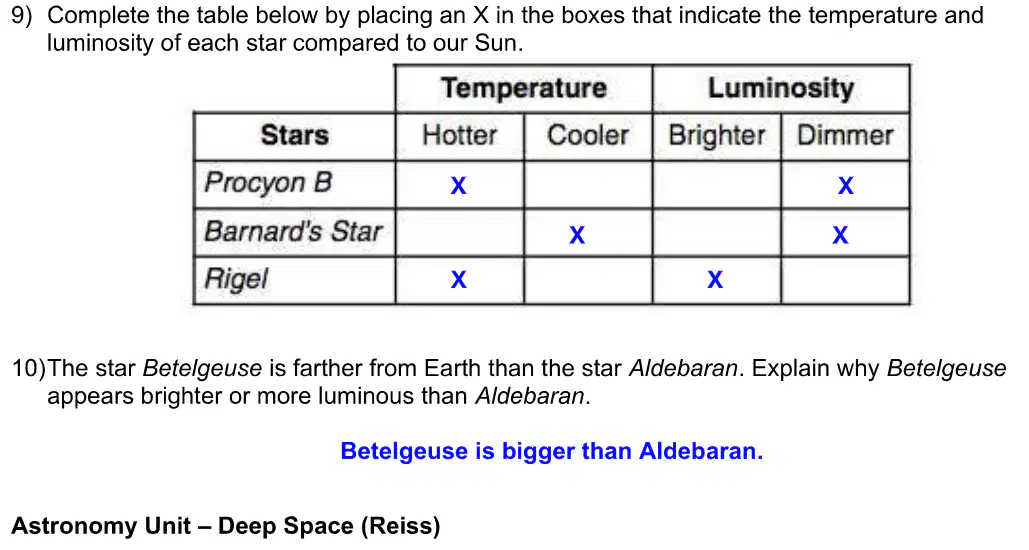
Compared to the Sun, which description matches Barnard’s Star?
Cooler and brighter
Hotter and brighter
Hotter and dimmer
Cooler and dimmer
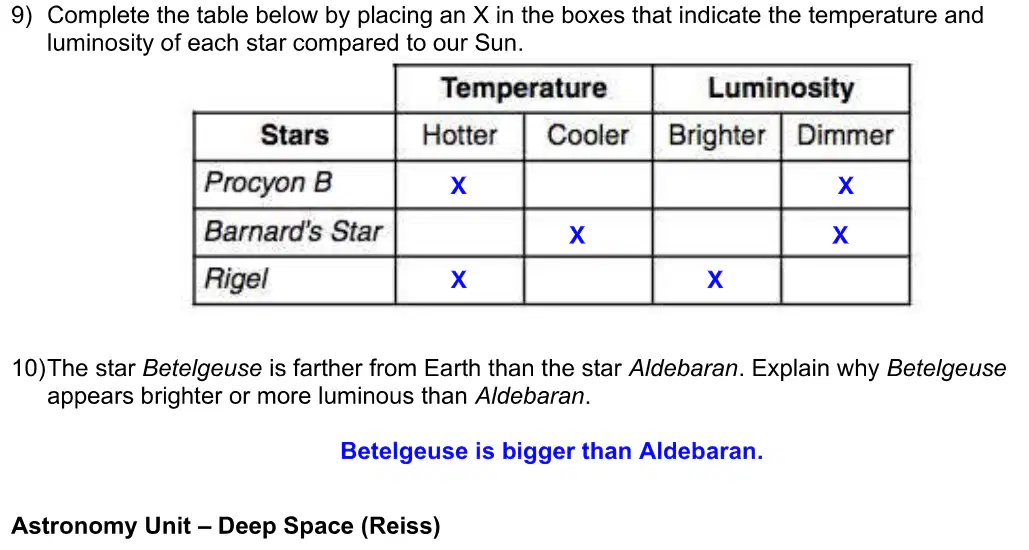
Compared to the Sun, which description matches Rigel?
Hotter and brighter
Cooler and brighter
Hotter and dimmer
Cooler and dimmer

In the diagram, which late-stage outcome is shown for a sun-like star after the planetary nebula phase?
Stable red supergiant
White dwarf remnant
Neutron star remnant
New protostar formation

According to the flow chart, which sequence correctly traces the sun-like star path from early to intermediate stage?
Protostar to red giant
Protostar to red supergiant
Low mass star to supernova
Star-forming nebula to neutron star

Which event on the massive star track can lead to either a neutron star or a black hole?
White dwarf cooling
Red dwarf fusion stop
Planetary nebula ejection
Core-collapse supernova

The diagram labels approximate time scales. Which path is associated with billions of years before reaching the red giant stage?
Sun-like stars evolution
Black hole accretion
Neutron star cooling
Massive stars evolution

On the sun-like star branch, which correct order of stages is shown from intermediate to late?
Red giant, red supergiant, black hole
Red giant, star-forming nebula, red dwarf
Red giant, supernova, neutron star
Red giant, planetary nebula, white dwarf
What is the primary difference between sun-like stars and massive stars in terms of their lifespan?
Sun-like stars live for billions of years while massive stars live for millions of years
Both types of stars live for millions of years
Massive stars live for billions of years while sun-like stars live for millions of years
Both types of stars live for billions of years
What is the minimum mass requirement for a star to be classified as a massive star?
More than 5 times the mass of the Sun
More than 8 to 10 times the mass of the Sun
More than 100 times the mass of the Sun
More than 0.8 times the mass of the Sun
Which stage is common to both sun-like stars and massive stars during their intermediate phase?
White Dwarf
Red Giant
Both become red in color but have different classifications
Neutron Star

What is the final stage possible for a massive star but not for a sun-like star?
Planetary Nebula
Black Hole
White Dwarf
Red Dwarf
What stage precedes a white dwarf in a sun-like star's life cycle?
Red Dwarf
Red Giant
Planetary Nebula
Supernova

Which of these is a characteristic of low mass stars?
They can become red dwarfs
They always end as black holes
They live for millions of years
They become supernovas
What is the minimum mass requirement for a sun-like star?
Less than 0.8 mass of the Sun
More than 0.8 mass of the Sun
Less than 0.5 mass of the Sun
More than 8 times the mass of the Sun

What event marks the end of a massive star's life before becoming a neutron star?
Red Dwarf formation
Supernova
Red Giant phase
Planetary Nebula
How long can a white dwarf stage last?
Billions of years
100s of billions of years
Thousands of years
Millions of years
Which sequence correctly shows the stages of a sun-like star's life?
Early stage → Red Giant → Black Hole
Early stage → Red Dwarf → White Dwarf
Early stage → Red Giant → Planetary Nebula → White Dwarf
Early stage → Supernova → Neutron Star
What distinguishes a red giant from a red supergiant?
Their color
Their age
The mass of their parent star
Their temperature

Which stage is unique to sun-like stars?
Early stage
Red Giant
Planetary Nebula
Supernova
What determines whether a star will end its life as a black hole or a neutron star?
Its initial mass
Its initial temperature
Its color
Its age

Which of these stages occurs only in massive stars?
Red Giant
White Dwarf
Red Supergiant
Planetary Nebula
What is the typical lifespan of a massive star?
Billions of years
Hundreds of billions of years
Thousands of years
Millions of years

Which statement about white dwarfs is correct?
They are a late stage for sun-like stars
They can only form from massive stars
They eventually become black holes
They are an early stage of star evolution
What stage do massive stars skip that sun-like stars experience?
Red Giant
Early stage
Supernova
Planetary Nebula
Which type of star has more potential end stages?
Massive stars
Red Dwarfs
Sun-like stars
White Dwarfs
What comes immediately after the red supergiant phase in massive stars?
Black Hole
Planetary Nebula
Supernova
White Dwarf
Which statement about star evolution is correct?
All stars end as white dwarfs
Star mass determines their evolutionary path
All stars go through the same stages
All stars eventually become black holes
Which statement best describes apparent magnitude on the astronomers’ scale?
Zero magnitude means invisible star
Higher number means brighter star
Lower number means dimmer star
Lower number means brighter star
Which star is identified as the brightest in the night sky with magnitude −1.46?
Betelgeuse
Sirius
Rigel
Vega

Which spectral class contains the hottest, blue stars?
Class K
Class O
Class M
Class G
Which spectral class represents the coolest, red stars?
Class B
Class F
Class A
Class M
Why do stars appear to twinkle when seen from Earth?
Nuclear flares in the star
Cloud shadows crossing light
Atmospheric interference wavers light
Human eye adjusting focus
What process powers a star by converting hydrogen into helium?
Fission reactions in the core
Fusion reactions in the core
Radioactive decay of iron
Gravitational collapse alone
What combines during fusion to create a helium nucleus with two protons?
Tritium and neon fuse
Hydrogen and carbon fuse
Two hydrogen nuclei fuse
Deuterium and oxygen fuse
Which hydrogen isotope contains one proton and one neutron?
Helium-3
Tritium
Deuterium
Protium
What element marks the limit of energy-producing fusion in stellar cores?
Oxygen
Carbon
Silicon
Iron
After hydrogen is exhausted, into which elements do stars initially convert helium?
Magnesium and sulfur
Oxygen and carbon
Neon and sodium
Nickel and chromium
Which initial condition leads a nebula to begin forming a protostar?
Cooling by radiation lowers internal pressure
External gravity or shock causes contraction
Random turbulence increases gas temperature
Magnetic fields disperse dust outward
What marks the start of a star’s main sequence phase?
Onset of stable hydrogen fusion
Formation of a planetary nebula
Cooling into a white dwarf
Expansion into a red giant
Which factor primarily determines how long a star remains in the main sequence?
Its rotational velocity
Its original mass
Its magnetic field strength
Its distance from nebulae
Compared to small stars, very massive stars in the main sequence will
Burn fuel much faster
Burn fuel far more slowly
Maintain constant luminosity
Expand into planetary nebulae
What happens when a typical average-mass star exhausts its outer layers after the red giant phase?
It becomes a blue giant
It leaves a planetary nebula
It starts deuterium burning
It collapses directly to black hole
A core that remains after planetary nebula ejection and cools over time is called a
Blue supergiant
Brown dwarf
Neutron star
White dwarf
If a star’s remaining core mass is about 1.4 times the Sun’s, the likely remnant is a
Main sequence blue giant
Brown dwarf with weak fusion
Neutron star formed by collapse
White dwarf supported by electrons
Collapsing cores with more than roughly three solar masses most plausibly become
Blue giants with strong winds
Neutron stars with crusts
White dwarfs with carbon cores
Black holes with intense gravity
Which statement best describes stellar fusion of hydrogen?
Fuses carbon directly into oxygen
Splits helium into hydrogen isotopes
Transforms iron into lighter elements
Combines protons to make helium nuclei
Which hydrogen isotope pairing in stars releases extra energy and a neutron?
Protium plus protium
Deuterium plus tritium
Helium-4 plus helium-3
Carbon plus oxygen
In massive stars, fusion proceeds up to which limiting core element before stopping?
Calcium due to rapid rotation
Silicon due to low pressure
Oxygen due to cooling
Iron due to required temperatures
Why does fusion cease when the core becomes primarily iron?
Iron nuclei emit intense neutrinos
Required temperature for iron fusion is too high
Iron decays quickly into nickel
Gravity becomes weaker than pressure
Main sequence stars generally experience small fluctuations in
Magnetic field and rotation
Radius and escape velocity
Luminosity and temperature
Orbit and parallax angle
Red giants appear reddish mainly because
Their outer surface expands and cools
Their outer layers heat dramatically
They are rich in iron oxides dust
They reflect surrounding nebula light
Very large red giants that reach extreme sizes are known as
White supergiants
Brown dwarfs
Red supergiants
Blue dwarfs
Which statement best describes a white dwarf star?
Dead stellar core no fusion continuing
Young protostar igniting nuclear fusion
Cold gas planet forming in a nebula
Massive supergiant actively producing energy
Why are white dwarfs extremely hot despite no fusion occurring?
Residual core heat slowly radiates away
Continuous meteor impacts add energy
External heating from nearby planets
Gravitational collapse starts new fusion
Which comparison of size and mass is accurate for white dwarfs?
Sun-sized with Earth-like mass
Jupiter-sized with Moon-like mass
Earth-sized yet Sun-like mass
Mars-sized with Jupiter-like mass
What makes a brown dwarf a failed star?
Loses gas through strong solar winds
Too close to a massive companion
Excessive rotation preventing collapse
Insufficient mass for sustained fusion
Which property is typical of brown dwarfs?
Shine brightly with strong fusion
Emit little to no light or heat
Display solid rocky crust surfaces
Contain heavy elements from supernovae
What distinguishes intrinsic from extrinsic variable stars?
Intrinsic change caused by interstellar dust
Intrinsic change due to eclipsing companion
Intrinsic change from internal conditions
Intrinsic change from telescope artifacts
Which description fits binary star systems?
Isolated star drifting through space
Single star with multiple planets
Cluster of thousands loosely bound
Two stars orbiting a shared center
How do spectroscopic binaries reveal themselves?
Doppler shifts in stellar spectra
Direct images as two separate points
Sudden radio bursts from pulsars
Infrared shadows cast by planets
What can astronomers learn by analyzing starlight?
Composition temperature mass and distance
Mainly its position in the galaxy
Only the star’s color and brightness
Just the star’s age and rotation
What does dispersing light into a rainbow allow scientists to study?
Different wavelengths carrying information
Reflections from water droplets only
Thermal noise from telescope mirrors
Magnetic fields of nearby planets
What do the dark lines observed in a spectrum indicate when viewing a rainbow of light from a star?
They show wavelengths scattered more strongly by dust
They are regions where light is amplified by atoms
They mark gaps where specific wavelengths are absorbed
They are artifacts caused by telescope mirror flaws
Why are absorption lines considered the fingerprints of atoms?
Fingerprints appear only in infrared observations
Absorption happens only at very high temperatures
All atoms emit identical continuous spectra
Each element absorbs unique specific wavelengths
What determines the amount of absorption at a given wavelength in a stellar spectrum?
The color of the star’s outer layers
The planet’s distance from the star
The telescope’s mirror size and shape
The number of atoms of that type present
By measuring how much light is missing at characteristic wavelengths, what can astronomers infer about the Sun’s atmosphere?
Only the total mass of the atmosphere
Only the age of the Sun’s outer layers
Which elements and their concentrations
Only the temperature at the photosphere
Radio waves are useful in astronomy partly because they can travel how through space?
Only when guided by magnetic fields
Faster than the speed of light
Only within planetary atmospheres
Unimpeded over vast distances
Because radio waves have traveled so far, what kind of information can they provide?
Clues to the very early universe
Precise colors of visible stars
Only data about nearby planets
Exact compositions of meteorites
Observing in the infrared helps astronomers study light emitted primarily by what kind of objects?
Extremely hot stars in clusters
Ionized nebulae emitting X-rays
Black holes at event horizons
Colder objects like gas and dust
Ultraviolet observations are especially useful for studying what?
Cool red dwarfs in the halo
Comet tails near the Sun
Hot, newly formed stars
Frozen surfaces on distant moons
Why do astrophysicists use several different kinds of telescopes across the spectrum?
Different wavelengths reveal different views
One telescope cannot track moving targets
Mirrors cannot function in cold space
Detectors only work in short exposures
What advantage do space telescopes offer compared with ground-based telescopes?
They detect light otherwise blocked by Earth’s atmosphere
They avoid all instrumental noise and errors
They always collect more light than any ground telescope
They never need maintenance or calibration

