
 Worksheets
Physical Science Post Test
Total questions: 93
Worksheet time: 47mins
Name
Class
Date
1.

A student must heat the contents of a test tube. Which of the following shows the correct technique to use to heat and hold the test tube?
a)
A
b)
B
c)
C
d)
D
2.

Of the following symbols, which represents a biological hazard?
a)
A
b)
B
c)
C
d)
D
3.
Students will conduct an experiment using the following materials: bunsen burner, beaker of water, glass tubing, four test tubes containing different chemicals, and rubber stoppers. Which of these steps is MOSTcritical for students to follow when using these materials in the lab?
a)
Wearing eye protection at all times
b)
writing the lab procedure in a notebook
c)
washing hands before starting the experiment
d)
placing a stopper on all test tubes before heating them
4.
While heating a test tube it is important to _
a)
make sure the liquid level is at the top of the test tube
b)
make sure the test tube is pointing away from people
c)
keep the test tube perfectly still while it is being heated
d)
heat the bottom tip of the test tube
5.
Two safety features found in most laboratories are a safety shower and a safety fountain with two water jets. What is the main purpose of the safety fountain?
a)
to irrigate nostrils is fumes are inhaled
b)
to rinse mouth if chemicals are ingested
c)
to wash hands if exposed to toxic material
d)
to flush the eyes if contaminated with chemicals
6.
While working on a class chemistry experiment, Victor dropped a glass test tube filled with an unknown liquid. What should Victor do first?
a)
put on gloves
b)
inform the teacher
c)
sweep up the broken glass
d)
clean up the spilled chemical
7.
Metals and nonmetals generally form ionic bonds with each other. Which of the following sets of elements will MOST LIKELY form an ionic bond?
a)
Na, F
b)
Cl, F
c)
Na, K
d)
He, O
8.
Which of the following is an important action to follow when heating a test tube?
a)
plug the mouth of the tube with a cork
b)
point the mouth of the tube away from everyone
c)
hold the test tube steady in the hottest part of the flame
d)
grasp the rim of the test tube with tongs
9.
When working in a laboratory, which one of the following actions does NOT represent safe and correct chemical handling?
a)
Pouring chemical waste down the drain
b)
Cleaning up chemical spills immediately
c)
Washing hands after handling chemicals
d)
Keeping noxious or dangerous chemicals under fume hoods
10.
Students are conducting an experiment to determine if sugars are present in foods. They heat a test tube containing a sugar solution in a beaker of water. Which of these is an unsafe laboratory practice in this experiment?
a)
heating the sugar solution in a closed test tube
b)
rinsing hands with water after handling the materials
c)
using a test tube clamp to hold the test tube
d)
wearing safety goggles while heating the sugar solution
11.

Use the picture to answer the following question.
Mark is using these materials to compare how water flows through 3 different soils. Which safety rules should he follow while doing the experiment?
Mark is using these materials to compare how water flows through 3 different soils. Which safety rules should he follow while doing the experiment?
a)
fire safety rules
b)
glassware safety rules
c)
electrical safety rules
d)
plant safety rules
12.

Use the data table to answer the question.
Damon measured the height of a plant 3 times with a metric ruler. He recorded the measurements in the data table. Which statement MOST LIKELY explains the variation in Damon's data?
Damon measured the height of a plant 3 times with a metric ruler. He recorded the measurements in the data table. Which statement MOST LIKELY explains the variation in Damon's data?
a)
The plant was growing while Damon measured it
b)
Damon used different rulers for each measurement
c)
Damon made small errors while measuring the plant
d)
The plant expanded and shrank because of temperature changes
13.
A scientist is performing an experiment to determine the melting point of a new substance. Which action could increase the likelihood of obtaining accurate results?
a)
repeating the experiment 3 times
b)
experimenting with multiple substances
c)
writing out the procedure after the experiment
d)
using 3 thermometers in the experiment
14.
Which process with MOST LIKELY lead to the scientific acceptance of a hypothesis?
a)
duplicating the results of an experiment
b)
revising the original hypothesis
c)
developing a theory based on the data
d)
changing the experimental procedures
15.
How does repeating an experiment improve the likelihood of obtaining accurate results?
a)
data can be compared
b)
time can be decreased
c)
equipment can be added
d)
procedures can be changed
16.
In order to advance to the level of a theory, a hypothesis should be _
a)
accepted by most people
b)
a fully functional experiment
c)
in alignment with past theories
d)
repeatedly confirmed by experimentation
17.
A student observes that an organism is green. A valid conclusion that can be drawn from this observation is that _
a)
the organism must be a plant
b)
the organism can not be single celled
c)
the organism must be an animal
d)
not enough information is given to determine whether the organism is a plant or an animal
18.
The analysis of data gathered during a particular experiment is necessary in order to _
a)
formulate a hypothesis for that experiment
b)
develop a research plan for that experiment
c)
design a control for that experiment
d)
draw a valid conclusion for that experiment
19.
A science researcher is reviewing another scientist's experiment and conclusion. The reviewer would most likely consider the experiment INVALID if __
a)
the sample size produced a great deal of data
b)
other individuals are able to duplicate the results
c)
it contains conclusions not explained by the evidence given
d)
the hypothesis was not supported by the data obtained
20.

The picture shows a small, shelled animal. Which tool should be used to measure the MASS of the shelled animal?
a)
ruler
b)
stopwatch
c)
triple beam balance
d)
graduated cylinder
21.

A student puts water into a graduated cylinder and carefully adds 2 small rocks - in the image shown. What is the volume of the rocks?
a)
2 mL
b)
3 mL
c)
5 mL
d)
12 mL
22.

Maria checked the outside temperature before and after school. According to the thermometers shown, how much did the temperature change during the day?
a)
increased by 2
b)
increased by 14
c)
decreased by 2
d)
decreased by 14
23.

The image shows part of a graduated cylinder containing liquid. Based on the sensitivity of the graduated cylinder, what is the volume of the liquid?
a)
70.5 mL
b)
73.0 mL
c)
76.7 mL
d)
87.0 mL
24.
Students measure the time for toy cars of different masses to roll down a hill. Which of the following units should the students use to measure time?
a)
centimeters
b)
grams
c)
milliliters
d)
seconds
25.
Jessica wants to measure the temperature outside. Which tool and unit of measure will she use for this task?
a)
a stopwatch in seconds
b)
a rain gauge in millimeters
c)
a thermometer in degrees celsius
d)
an anemometer in kilometers per hour
26.
Which tool when properly used, would BEST help a student classify a basket of apples into groups based on mass?
a)
balance
b)
thermometer
c)
meter stick
d)
graduated cylinder
27.
Which is the BEST tool to measure the volume of a liquid?
a)
balance
b)
thermometer
c)
measuring tape
d)
graduated cylinder
28.
Which is the best metric unit for measuring the distance a student kicks a football?
a)
liters (L)
b)
meters (m)
c)
kilograms (kg)
d)
centimeters (cm)
29.
Which of the following can NOT be used to measure volume?
a)
balances
b)
beakers
c)
pipettes
d)
graduated cylinders
30.
Which tool would be the best instrument to measure the growth of a plant's stem?
a)
ruler
b)
thermometer
c)
magnifier
d)
cup
31.
To find the volume of a few small marbles, a student will need which of the following scientific tools?
a)
a balance and a centimeter ruler
b)
a spring scale and a calculator
c)
a graduated cylinder and water
d)
a microscope and a micron ruler
32.
Which of the following has 6 valence electrons?
a)
Magnesium (Mg)
b)
Silicon (Si)
c)
Sulfur (S)
d)
Argon (Ar)
33.
Which of the following is the same for both hydrogen and potassium?
a)
atomic mass
b)
total mass of neutrons
c)
# of valence electrons
d)
# of filled energy levels
34.
How many electrons are in the outermost energy shell (level) of a calcium atom?
a)
1
b)
2
c)
6
d)
8
35.
Which element has the same number of valence electrons as krypton (Kr)?
a)
neon (Ne)
b)
fluorine (F)
c)
chlorine (Cl)
d)
selenium (Se)
36.
How many electrons are in the outermost energy level of an electronically neutral atom of aluminum?
a)
13
b)
8
c)
3
d)
2
37.
Which 2 elements have the same # of valence electrons?
a)
C and O
b)
Na and MG
c)
Cl and F
d)
Ga and GE
38.
Which of the following subatomic particles can be found inside the nucleus of an atom?
a)
electrons only
b)
neutrons only
c)
protons and neutrons
d)
protons, neutrons, and electrons
39.
Which of the following BEST describes an atom?
a)
protons and electrons grouped together in a random pattern
b)
protons and electrons grouped together in an alternating pattern
c)
a core of protons and neutrons surrounded by electrons
d)
a core of electrons and neutrons surrounded by protons
40.
Which of the following is found farthest from the center of an atom?
a)
nucleus
b)
proton
c)
neutron
d)
electron
41.
Which accounts for most of the mass of an atom?
a)
electrons
b)
protons
c)
neutrons and protons
d)
electrons and neutrons
42.
Use the periodic table of elements to answer the following question(s).
Which sentence about the periodic table of elements is TRUE?
Which sentence about the periodic table of elements is TRUE?
a)
all elements in period 2 are metals
b)
all elements in group 18 are metals
c)
metals are found on the left side of the periodic table
d)
metals are found on the right side of the periodic table
43.
What do the elements sulfur (s), nitrogen (N), phosphorus (P), and bromine (Br) have in common?
a)
they are noble (inert) gases
b)
they are nonmetals
c)
they have the same thermal conductivity
d)
they have the same number of protons
44.

Use the image (diagram) of the periodic table of elements.
In which region of the table would nonmetals be found?
In which region of the table would nonmetals be found?
a)
1
b)
2
c)
3
d)
4
45.
Metals and nonmetals generally form ionic bonds with each other. Which of the following sets of elements will MOST LIKELY form an ionic bond?
a)
Na, F
b)
Cl, F
c)
Na, K
d)
He
46.
Which of the following occurs in an ionic bond?
a)
2 ions share protons
b)
2 ions share electrons
c)
similarly charged ions attract
d)
oppositely charged ions attract
47.
Which of the following are most directly involved in chemical bonding?
a)
protons
b)
neutrons
c)
alpha particles
d)
valence electrons
48.

Lewis dot diagrams for sodium and chlorine are shown in the image. Why is the compound sodium chloride stable?
a)
sodium gains one electron and chlorines loses one electron
b)
sodium loses one electron and chlorine gains one electron
c)
Sodium gains seven electrons and chlorine loses seven electrons
d)
sodium loses seven electrons and chlorine gains seven electrons
49.

Sara wants to know if lithium (Li) and bromine (Br) will bond. She uses the following table to find the properties of the 2 elements. Which statement describes the type of bond formed from these 2 elements?
a)
both Li and Br are metals that will form a metallic bond
b)
Li is a metal and Br is a nonmetal that will form an ionic bond
c)
Li is a nonmetal and Br is a metal that will form a covalent bond
d)
Both Li and Br are transition metals that will form a metalloid bond
50.
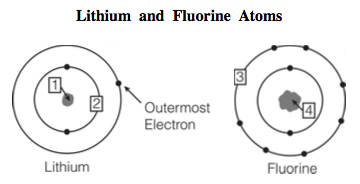
A diagram of a lithium atom and a fluorine atom is shown.
When lithium reacts chemically with fluorine, the outermost electron of lithium will transfer to which numbered area in the diagram?
When lithium reacts chemically with fluorine, the outermost electron of lithium will transfer to which numbered area in the diagram?
a)
1
b)
2
c)
3
d)
4
51.
Oxygen (O) atoms have 6 valence electrons and beryllium (Be) atoms have two valence electrons. Which of the following is the CORRECT formula for a compound made of oxygen and beryllium?
a)
BeO
b)
BeO2
c)
Be2O6
52.
Magnesium has two valence electrons. Oxygen has six valence electrons. What is the correct chemical formula for magnesium oxide?
a)
MgO
b)
MgO2
c)
Mg2O
d)
Mg2O
53.
Based on valence electron configurations, which of the following is a formula for a compound formed from sodium (Na) and oxygen (O)?
a)
NaO
b)
NaO2
c)
Na2O
d)
Na2O3
54.
Barium and iodine combine to form an ionic compound. What is the chemical formula for this compound?
a)
BaI
b)
BaI2
c)
Ba2I
d)
Ba2I2
55.
How can 2 different nonmetals form a compound?
a)
by sharing protons
b)
by sharing electrons
c)
by transferring protons
d)
by transferring electrons
56.
Which is an example of a different substance being formed?
a)
glass breaking
b)
metal melting
c)
water freezing
d)
wood burning
57.
Which of the following describes a chemical change?
a)
a metal fork was melted
b)
a metal fork became bent
c)
a metal fork was cut in half
d)
a metal fork become rusted
58.
Which is an example of a chemical change?
a)
Milk cooling in a refrigerator
b)
pouring milk into a glass
c)
stirring a glass of milk
d)
milk turning sour
59.
Students combined baking soda and vinegar to demonstrate a chemical reaction. Which indicates that a chemical reaction occurred?
a)
the formation of bubbles
b)
a reduction in total mass
c)
the disappearance of atoms
d)
an increase in the number of atoms
60.
Which of the following is an example of a chemical change?
a)
melting chocolate
b)
freezing water
c)
turning iron to rust
d)
adding salt to water
61.
2Na(s) + Cl2(g) -> 2NaCl(s)
s= solid
g=gas
The equation represents a chemical change because ____.
s= solid
g=gas
The equation represents a chemical change because ____.
a)
it is balanced
b)
the product is solid
c)
a new substance is produced
d)
there are two substances on the reactant side
62.
Jessi is completing an investigation. She could conclude a chemical change is taking place if which of the following occurs?
a)
the size gets smaller
b)
a new substance forms
c)
the state of matter changes
d)
the shape becomes different
63.
Which of the following is a characteristic of ALL chemical changes?
a)
a different state of matter is produced
b)
some mass is converted to energy
c)
some form of light is given off
d)
a new material is found
64.
A balanced chemical equation reflect the idea that the mass of the products __
a)
is greater than the mass of the reactants
b)
is less than the mass of the reactants
c)
equals the mass of the reactants
d)
is not related to the mass of the reactants
65.

The law of conservation of mass can be demonstrated by a chemical reaction. Which of the following models of a chemical reaction BEST represents the law of conservation of mass?
a)
A
b)
B
c)
C
d)
D
66.
Which is the correctly balanced equation?
a)
Cl2 + 2NaI -> 2NaCl + I2
b)
Cl2 + 2NaI -> NaCl + 2I2
c)
Cl2 + NaI -> NaCl + I2
d)
2Cl2 + NaI -> 2NaCl + I2
67.
This is an unbalanced equation representing a chemical reaction.
HgO -> Hg + O2
Which equation is the correctly balanced chemical equation for this reaction?
HgO -> Hg + O2
Which equation is the correctly balanced chemical equation for this reaction?
a)
HgO -> Hg + 2O2
b)
2HgO -> Hg + O2
c)
2HgO -> 2Hg + O2
d)
2HgO -> Hg + 2O2
68.
This equation represents an unbalanced chemical reaction:
NaI + Cl2 -> NaCl + I2
When the equation is balanced, which coefficient should be placed before NaCl?
NaI + Cl2 -> NaCl + I2
When the equation is balanced, which coefficient should be placed before NaCl?
a)
2
b)
3
c)
4
d)
5
69.
A runner records the distance and time he ran around a track. What can be determined from this data?
a)
direction
b)
force
c)
speed
70.

The image is a type of graph used to describe something about an object.
What could this graph describe?
What could this graph describe?
a)
friction
b)
volume
c)
mass
d)
speed
71.

The graph in the image relates distance and time for a moving object.
What is the speed of the object represented by the graph?
What is the speed of the object represented by the graph?
a)
0.5 m/s
b)
2 m/s
c)
10 m/s
d)
20 m/s
72.

This graph represents the changing motion of a horse. Which BEST explains the motion of the horse between 3 and 4 on the graph?
a)
The horse is moving faster and faster
b)
the horse is not moving
c)
the horse is slowing down
73.

Based on the graph, which is constant?
a)
displacement
b)
position
c)
time
d)
velocity (or speed)
74.
3 meters per second is an example of a(n) ___.
a)
velocity
b)
position
c)
speed
d)
acceleration
75.
What is the average speed of a car that travels 60 kilometers in 2 hours?
a)
30 km/hr
b)
30 km/hr/sec
c)
60 km/hr
d)
60 km/hr/sec
76.
A car travels 300 meters in 15 seconds. What is the average velocity of the car?
a)
5.0 m/sec
b)
15 m/sec
c)
20 m/sec
d)
30 m/sec
77.
Which of the following represents the velocity of a moving object?
a)
40
b)
40 m North
c)
40 m/s
d)
40 m/s North
78.

Which of the following statements best describes the relationship between speed speed and time shown in the graph?
a)
speed remains constant over time
b)
speed increasesover time
c)
speed decreases over time
d)
there is no relationship between speed and time
79.

This graph contains information about the motion of a bicycle. At which of the following times is the bicycle's acceleration zero?
a)
1 second
b)
2 seconds
c)
4 seconds
d)
8 seconds
80.
What forces are equal in size but opposite in direction?
a)
balanced
b)
frictional
c)
gravitational
d)
unbalanced
81.
A student pushed a large rubber ball on a flat, frictionless frictionless surface. The ball rolled at a speed of 1 meter per second. Which statement BEST describes the motion of the ball when the student stopped pushing the ball?
a)
the ball accelerated
b)
the ball did not move
c)
the ball changed direction
d)
the ball continued to move in the same direction
82.
An object is moving in a straight line at a constant speed. What will happen to the object if no outside force acts on the object?
a)
the speed and direction of the object will change
b)
the speed and direction of the object will not change
c)
the direction of the object will change; the speed will remain constant
d)
The speed of the object will change; the direction will remain constant
83.
A secured object in an orbiting spacecraft remains at rest unless acted upon by ___
a)
an electrical force
b)
an external force
c)
a magnetic force
d)
a frictional force
84.

A teacher leaves a coffee mug on top of a car, as shown in the diagram.
The teacher drives the car in a straight line and then stops suddenly. What happens to the coffee mug when the car stops?
The teacher drives the car in a straight line and then stops suddenly. What happens to the coffee mug when the car stops?
a)
the mug moves forward
b)
the mug moves backward
c)
the mug moves side to side
d)
the mug stays in the same position
85.
Which situation is explained by Newton's fist law of motion?
a)
A basketball bounces upward when it is dropped on the floor
b)
you can lift more mass with the same force using a longer lever
c)
even though you stop pedaling your bicycle, you keep moving forward
d)
more fuel is required to accelerate a large truck than is required to accelerate a small car
86.
The acceleration due to gravity is ___.
a)
98 m/s
b)
9.8 m/s2
c)
0.98 m/s2
d)
9.8 m/s
87.
The force of gravity on an object depends primarily on the object's __
a)
density
b)
mass
c)
momentum
d)
volume
88.
A real car moving at 10 km/hr has more momentum than a toy car moving at the same speed because the real car ___.
a)
generates less friction
b)
has a greater mass
c)
has less mass
d)
has a greater forward motion
89.
As the unbalanced force exerted on an object is increased, the object's acceleration will___
a)
decrease
b)
increase
c)
remain the same
90.
A force of 50 newton's causes an object to accelerate at 10 meters per second squared. What is the mass of the object?
a)
500 kg
b)
60 kg
c)
5.0 kg
d)
0.20 kg
91.
If an unbalanced force of 12 newtons acts on a 6 kilogram mass, the acceleration of the mass is __
a)
0.5 m/sec2
b)
2 m/sec2
c)
10 m/sec2
d)
72 m/s2
92.
Which situation is an example of Newton's third law of motion?
a)
A ball in a vacuum container moves in a straight line at a constant velocity
b)
a ball in a vacumm container accelerates when kicked with a great amount of force
c)
A person riding in a forward-moving car continues to move forward when the car stops suddenly
d)
A person in a canoe moves the paddle backward in the water, and the canoe moves forward in the water
93.

This diagram represents a balloon that is moving in one direction while escaping air is moving in the opposite direction. What causes the ballon to move?
a)
action-reaction forces
b)
electrical forces
c)
friction
d)
gravitational potential energy
100 %

