
 Worksheets
GENERAL PHYSICS 1_Q1_REVIEWER
Total questions: 88
Worksheet time: 1hrs 11mins
How many significant figures are in the measurement 0.004561?
3
4
5
6
The slope of the line of the best fit of a linearized Position-Time graph is used to calculate:_______
Average Velocity
Acceleration due to gravity
Average acceleration
Average speed
Convert 5 kilometers (km) to meters (m).
50 m
500m
5000m
50,000m
Given the following set of data points: 15.8, 16.0, 15.7, 16.1, and 15.9, what is the variance?
A. 0.020
B. 0.025
C. 0.015
D. 0.030
A 10 N force is applied to an object at an angle of 30° to the horizontal, and another 8 N force is applied horizontally. What is the magnitude of the resultant force?
A. 12 N
B. 15 N
C. 17 N
D. 10 N
Here's a similar question:
A cyclist rides west at 25 km/h and then turns north and rides at 40 km/h. If both segments of the trip are of equal duration, what is the magnitude of the cyclist's resultant velocity?
A. 30.5 km/h
B. 3.5 km/h
C. 45.2 km/h
D. 47. 2 km/h
Given the following set of data points: 12.5, 12.7, 12.6, 12.8, and 12.4, what is the standard deviation?
A. 0.10
B. 0.15
C. 0.20
D. 0.25
A 15 N force is applied to an object at an angle of 45° to the horizontal, and another 10 N force is applied vertically. What is the magnitude of the resultant force?
A. 20 N
B. 25 N
C. 30 N
D. 35 N
Convert 3 miles to kilometers (km).
4.8 km
5.0 km
4.2 km
6.0 km
1. A ball is dropped from a height of 45 meters. Assuming free fall and neglecting air resistance, how long does it take for the ball to hit the ground?
A. 2.5 seconds
B. 3.0 seconds
C. 3.5 seconds
D. 4.0 seconds

This velocity time graph shows constant velocity. How are you going to interpret this graph in terms of acceleration?
A. zero
B. directly proportional
C. inversely proportional
D. equal
A cyclist is moving along a circular track. Which of the following statements is true about the cyclist's acceleration?
A. The acceleration is directed radially outward
B. The acceleration is directed along the direction of velocity
C. The acceleration is directed towards the center of the circle
D. The acceleration is zero
A block is initially at rest on a horizontal surface. When a horizontal force is applied to the block, it remains stationary until the force reaches a certain magnitude. Once this force is exceeded, the block begins to slide. Which of the following statements is true?
A. The static friction force is greater than the kinetic friction force when the block is sliding.
B. The kinetic friction force is greater than the static friction force when the block is at rest.
C. The static friction force is equal to the applied force when the block is about to slide.
D. The kinetic friction force is always equal to the applied force when the block is sliding.
A 5 kg box is at rest on a frictionless surface. A horizontal force of 20 N is applied to the box. What is the acceleration of the box?
A. 2 m/s²
B. 4 m/s²
C. 5 m/s²
D. 10 m/s²
A student measures the length of a metal rod to be 18.5 cm. The actual length of the rod is known to be 19.0 cm. What is the percent accuracy of the student’s measurement?
A. 96.4%
B. 97.4%
C. 98.5%
D. 99.5%
In a scientific experiment, you are measuring the density of a liquid multiple times using the same method. The measurements consistently show a density value that is slightly higher than the known density of the liquid. This consistent deviation is an example of:
A) Systematic error
B) Random error
C) Instrumental error
D) Human error
Which of the following is NOT true about free-fall?
A.
Any object that is being acted upon only by the force of gravity is said to be in a state of free fall
B.
Free-falling objects do not encounter air resistance.
C.
All free-falling objects (on Earth) accelerate downwards at a rate of 9.8 m/s/s
D.
None of the above.
What happens to the acceleration of a free-falling object as it gets closer to the surface of the Earth?
A. It increases
B. It decreases
C.
It becomes zero.
D.
It becomes constant.
If an object is dropped from rest from a height of 100 meters and experiences no air resistance, what is its speed just before hitting the ground?
A. 44 m/s
B. 98 m/s
C. 70.7 m/s
D. 20 m/s
. A particle starts from rest and accelerates at a constant rate of 2 m/s2 for 10 seconds. What is the total distance traveled during this time?
A. 50 m
B. 100 m
C. 150 m
D. 200 m
456km S+789km S
(a)
543m N + 210m S
(a)
The total length traveled is known as
distance.
displacement.
reference point.
wrong answer.
A ______________ quantity is fully described by a number and unit alone.
scalar
vector
A __________ quantity will always include a direction, not just a number and unit.
scalar
vector
You walk 5 meters. Is this 1) distance or displacement, and 2) a scalar or a vector quantity?
distance, scalar
displacement, scalar
distance, vector
displacement, vector
You walk 10 meters to the west. Is this 1) distance or displacement, and 2) a scalar or vector quantity?
distance, scalar
displacement, scalar
distance, vector
displacement, vector
Which of the following is a scalar quantity?
2 miles up I-35
10 feet closer to your car
2 meters
1 centimeter to the right
You drive 2 km to school and then 2 km back home. What is your displacement?
0 km. You are back where you started.
4 km. 2+2 = 4.
5 km. 2+2 = 5.
You drive 2 km to school and then 2 km back home. What is your distance travelled?
0 km. You are back where you started.
4 km. 2+2 = 4.
5 km. 2+2 = 5.
Ricky-Bobby races in the Indy 500, an oval shaped track that is 2.5 miles per lap. The race is 200 laps long. The distance he traveled during the race is 500 miles, because:
Distance is a vector quantity.
Distance is a scalar quantity.
Ricky-Bobby races in the Indy 500, an oval shaped track that is 2.5 miles per lap. The race is 200 laps long, and he ends up exactly where he started. His displacement over the race is 0 miles, because:
Displacement is a vector quantity.
Displacement is a scalar quantity.

Juan rides his bike from point A to point B, then on to point C. What is the distance he has traveled?
3m
4m
5m
7m
Juan rides his bike from point A to point B, then on to point C. What is his displacement?
3m
4m
5m
7m

A skier moves from point A to point B, then moves backwards to point C, before travelling forwards again to point D. What is her displacement? (ignore the time listed)
40m
100m
140m
420m
A skier moves from point A to point B, then moves backwards to point C, before travelling forwards again to point D. What is the distance that she traveled? (ignore the time listed)
40m
100m
140m
420m


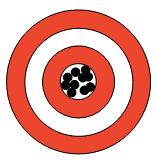
How close a measurement is to the accepted value is called..
Accuracy
Precision
Significant
Estimate
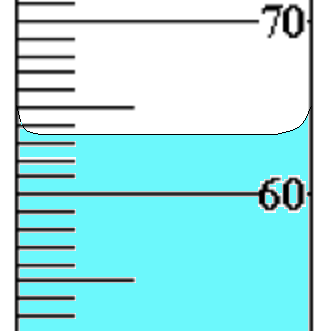
Which is the more precise measurement?
4 mL
4.3 mL
4.30 mL
4.300 mL

Any measurement will have some ____________. This will come from variation in the data obtained and be subject to systematic or random effects. This can be estimated by considering the instruments and the method and will usually be expressed as a range such as 20 ± 2 °C.
Error
Precision
Reproducibility
Uncertainty
Accuracy means
the measurements are close to each other
the measurement is close to the true value
the measurements are close to each other
the measurements are close to each other and the true value.

Which result is not accurate but precise?
A
B
C
D
Which of these is NOT true for systematic errors?
They arise due to errors in the measuring instruments used.
Repeating the observations or increasing the sample size can eliminate them
They are reproducible inaccuracies that are consistently in the same direction.
They arise from the design of the study.
True or False? The law of inertial holds in an inertial frame of reference.
True
False
A change in an object's position is called ______.
Speed
Motion
direction
Friction
What is Newton's First Law
the object at rest will always move
Every action has an equal and opposite reaction
An object at rest stays at rest, an object in motion stays in motion.
Friction
. If an object is moving at a set speed and in a set direction it will remain at that same ____
none
force
motion
velocity

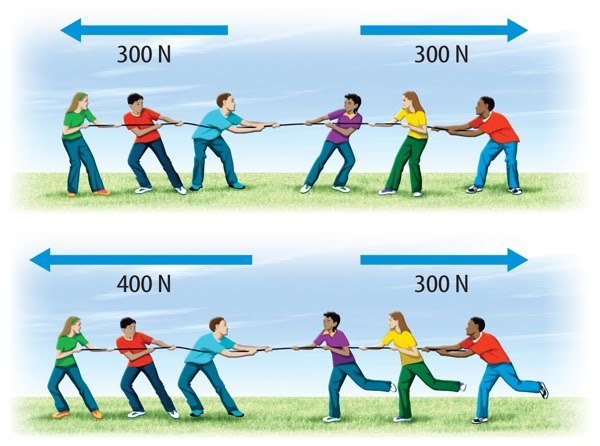
is this an example of first law of motion?
yes
no
don't know


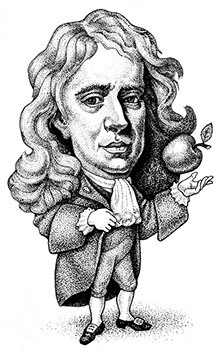


Using Newton's 2nd law, a 3400 kg mass has what kind of acceleration if it has a +400 kg m/s2 force acted on it?
1.09 m/s2
0.12 m/s2
8.7 m/s2
2.41 m/s2
0.45 m/s2

What is the walker's speed from the observer's perspective?
30 mph right
30 mph left
50 mph right
50 mph left
A train is moving at a velocity of 15 m/s East. A passenger at the back of a train throws a baseball with a speed of 15 m/s West. What is the velocity of the baseball relative to the ground? (In other words: how fast does a person on the ground see the ball move?)
30 m/s East
30 m/s west
0m/s
60m/s west
For us humans, what is our basic reference frame?
Earth
The Sun
The Universe
The Milky Way Galaxy

A woman on a bicycle travels at 9 m/s relative to the ground as she passes a little boy on a tricycle going in the opposite direction. If the boy is traveling at 1 m/s relative to the ground, how fast does the boy appear to be moving relative to the woman?
9 m/s
8 m/s
0 m/s
10 m/s
If a car passes you in the left lane going 90 km/hr north while you are driving 80 km/hr north, how fast is the car moving relative to your car?
170 km/hr
90 km/hr
80 km/hr
10 km/hr
What is the vertical velocity of a projectile at the highest point of its trajectory, assuming it was launched vertically upward with an initial speed of 10 m/s?
10 m/s upward
0 m/s
10 m/s downward
20 m/s downward

The Coffee cup in the picture is resting on a table. What force(s) are missing from the free body diagram?
No forces are missing
The normal force from the table pushing the cup up.
The normal force form the table pushing the cup down.
The friction force from the table pushing the cup left and right.

The car in the picture is moving at a constant velocity. What forces does the car experience?
Gravity
Gravity and Normal
Gravity, Normal, and Friction
Gravity, Normal, Friction, and Applied

A man pushes a box across the floor at a constant velocity. There is a force on the box pulling it toward the center of the earth. This is called the
force of gravity
normal force
friction force
applied force
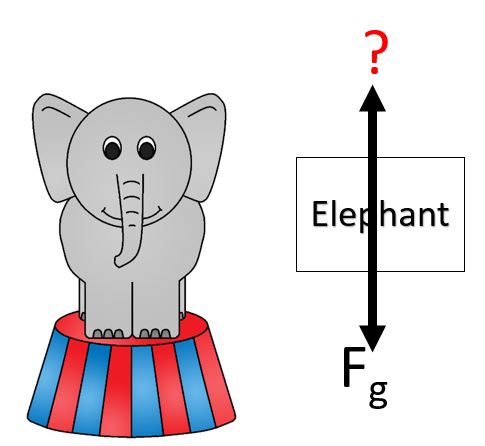
What is the formula to calculate the force of kinetic friction?
Fk = μk + N
Fk = μk / N
Fk = μk * N
Fk = μs * N
A 10kg box is pushed with a force of 30N. If the coefficient of kinetic friction is 0.3, what is the acceleration of the box?
5 m/s^2
0.5 m/s^2
2 m/s^2
10 m/s^2
Explain the difference between static and kinetic friction.
Static friction prevents an object from moving, while kinetic friction opposes the motion of an object.
Static friction only occurs on rough surfaces, while kinetic friction only occurs on smooth surfaces.
Static friction and kinetic friction are the same thing.
Static friction allows an object to move freely, while kinetic friction prevents the motion of an object.
What are the different types of friction?
Static friction, kinetic friction, rolling friction, and fluid friction
Fast friction, slow friction, medium friction, and high friction
Smooth friction, rough friction, bumpy friction, and sticky friction
Magnetic friction, electrical friction, heat friction, and sound friction
A force of 32.5 N is needed to start a 4.00 kg block moving across a horizontal surface. (a) Calculate the coefficient of static friction.
(a)
Which of these is an example of sliding friction?
a badminton shuttlecock flying over the net
a basketball rolling across a wooden floor
a flying kite pushed by a gentle breeze
a hockey puck moving across the ice
Normal force is
Always opposite the weight
Always parallel and down the incline
Always perpendicular to the surface
It depends on the direction of motion
What is the SI unit of force?
A) Joule
B) Newton
C) Watt
D) Pascal
A car travels 100 kilometers to the north. Is this 1) distance or displacement, and 2) a scalar or vector quantity?
distance, scalar
displacement, scalar
distance, vector
displacement, vector
Which of the following best describes precision?
Measurements are close to the true value
Measurements are consistent with each other
Measurements are close to the average value
Measurements are random and varied
A runner completes a lap around a 400-meter track and returns to the starting point. What is the runner's displacement?
400 meters
0 meters
200 meters
800 meters

