
 Worksheets
Physics Fall Final Exam Review
Total questions: 92
Worksheet time: 2hrs 26mins
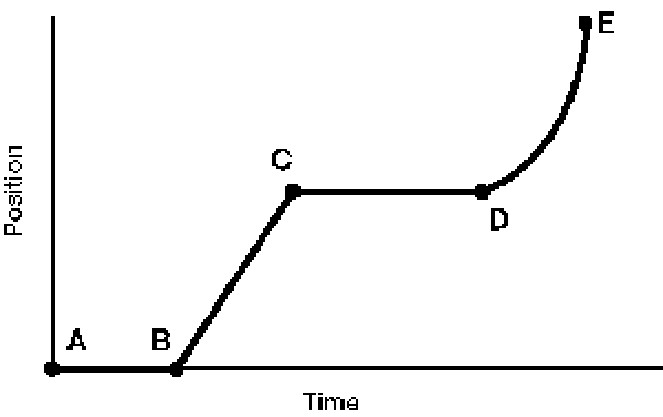
What is happening in this graph from point B to C?
The object is going down a hill.
The object is returning to its starting location.
The object is slowing down.
The object is staying still.

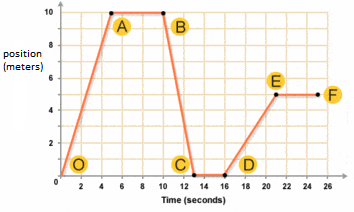
from 3rd second to 5th second, the object is
moving at a constant speed
speeding up
not moving
slowing down


What acceleration does this object have from 1 s to 4 s?
3 m/s2
15 m/s
5 m/s2
4 m/s2

During which time interval is this object moving forward?
0 s to 4 s
1 s to 6 s
1 s to 4 s
4 s to 6 s

Which chart is correct for the problem: "A car accelerates from 20 m/s to a stop in 4 seconds. Determine acceleration?"
A
B
C
D

"A police officer slams on his brake pedal." Which of the 4 vector pairs would be the most appropriate to match this scenario?
1
2
3
4

The dot diagram represents the motion of a rightward-moving truck. What is the direction of the truck's acceleration?
Right
Left
The truck is not accelerating
Can not be deduced from the given information
which of the following is a vector?
velocity
discance
position
speed
How do scalars and vectors differ?
scalers have units
scalers have direction
vectors have units
vectors have direction
Select the scalars:
time
velocity
speed
acceleration
distance
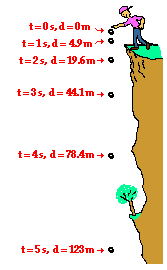

A textbook is dropped from a second floor window and falls to the ground. What happens to the acceleration as the book falls to the ground
the acceleration increases
the acceleration decreases
the acceleration remains constant

You want to conduct an investigation to determine the average speed of a boat. Which of the following measurements would you need to take in order to be able to calculate the speed?
mass and time
mass and acceleration
distance traveled and time
distance traveled and mass
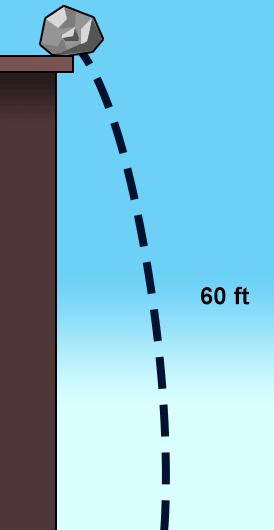
The rock in the picture is pushed over the edge and it begins to fall. Which type of energy conversion is taking place?
mechanical to heat
sound to mechanical
potential to kinetic
kinetic to potential
Energy that is stored in a system, ready to be used, is called ____________ energy.
Kinetic
Potential
Conserved
Power
Energy in a system that is moving is called _______________ energy.
Kinetic
Potential
Mechanical
Power
How much kinetic energy (K) does a baseball with a mass of 0.143 kg have if it is travelling at a velocity of 41.1 m/s?
HINT: K = 1/2mv2
120.8 joules
89.7 joules
108.3 joules
156.6 joules
The sum of the kinetic and potential energy in a system is known as the system's _____________________ energy.
mechanical
chemical
thermal
combined
A 1.0 kg ball is stationary at the top of a hill that is 10.0 meters in height. The ball rolls all the way down the hill. What is its gravitational potential energy at the bottom of the hill?
0 joules
98 joules
49 joules
38 joules

This drawing illustrates which of the following?
Conservation of Mechanical Energy
Conservation of Mass
Conservation of Momentum
Conservation of Matter
At which point in the picture must the cart have the most MECHANICAL energy?
Point 1
Point 2
Point 3
They would all be the same
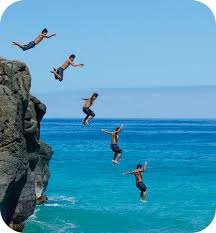
A cliff diver with a mass of 125 kg jumps off a 50m high cliff, how fast will he be traveling just before he hits the water? (His height at this point is 0m)
(HINT: Find PE first.) KE = 1/2mv2
g = 9.8 m/s2
61,250 m/s
980 m/s
31.3 m/s
247.5 m/s
A cliff diver with a mass of 125 kg jumps off a high cliff, at a height of 10m he is moving at 15.5 m/s. What is his MECHANICAL energy.
(HINT: ME = KE + PE)
g = 9.8 m/s2
15,015.6 J
12,250 J
27,265.6
2,765.6
if you push a cart with a force of 60 N for 2 m... how much work have you done
120 J
30 J
120 N
30 N
The Law of Conservation of Momentum states:
The total momentum before a collision is equal to the total momentum after a collision.
The total momentum before a collision is greater than the total momentum after a collision.
The total momentum before a collision is less than the total momentum after a collision.
The total momentum before a collision is not related to the total momentum after a collision.
If two objects collide or explode, they experience
the same force for the same amount of time.
different forces for the same amount of time.
different forces for different amounts of time.
the same force for different amounts of time.

A 5 N force is applied to a 3 kg ball to change its velocity from 9 m/s to 3 m/s. What is the impulse on the ball?
-2.5 N⋅s
-10 N⋅s
-18 N⋅s
-45 N⋅s
A boy kicks a football with a force of 20 N, the time the force acts for is 0.3 s. Calculate the impulse on the ball.
1 N⋅s
6 N⋅s
33.3 N⋅s
If you push an object with a force of 10 N for 5 seconds , you will change it’s momentum by:
2 N s
50 n s
2 N/s
50 N/s
If a big truck is driving down the highway and runs into an insect, which of these is true?
The truck applies more force to the insect than the insect applies to the truck.
The insect's momentum changes more than the truck's.
The insect accelerates more than the truck.
The insect applies a greater impulse to the truck than the truck applies to the insect.
A very light ping-pong ball moving east at a speed of 4 m/s collides with a very heavy stationary bowling ball. The Ping-Pong ball bounces back to the west, and the bowling ball moves very slowly to the east. Which object experiences the greater magnitude impulse during the collision?
Neither, both experienced the same magnitude impulse.
The Ping-Pong ball
The bowling ball

What is the resultant vector of the two labeled vectors?
+2 km
+14 km
-2 km
-14 km

What is the magnitude of the resultant vector, r?
3
4
5
7

What is the resultant of the two vectors shown above?
+5
-5
+15
-15


At what point is vy= 0 m/s?
A
B
C
D
None of these points
At what point is vx= 0 m/s?
A
B
C
D
None of these points

A package is dropped from an airplane, where will the package hit the ground?
A
B
C
A student draws velocity vectors on a football after being punted. As the football rises, the vertical velocity arrows
become shorter
become longer
stay the same length
point down
A student draws velocity vectors on a football after being punted. As the football rises, the horizontal velocity arrows
become shorter
become longer
stay the same length
point down
Who do you agree with?
Anita: “A projectile’s vx changes because of gravity, and its vy remains constant.”
Barry: “Both vx and vy are constant.”
Chris: “A projectile has no acceleration in the vertical dimension but it does accelerate horizontally.”
Dave: “A projectile has vertical acceleration and a constant horizontal velocity”
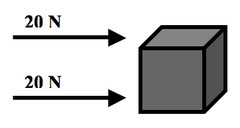
Jenny applies a 60 N force to a 20 Kg cart, what is the acceleration of the cart if friction can be neglected?
1200 m/s2
0.33 m/s2
20 m/s2
3 m/s2
A person is attracted towards the center of Earth by a 440N gravitational force. The force with which Earth is attracted toward the person is
More than 440N
Less than 440N.
The same, 440N.

An unfortunate bug splatters against the windshield of a moving car. Compared to the force of the car on the bug, the force of the bug on the car is
larger.
the same.
smaller
need more information to say.
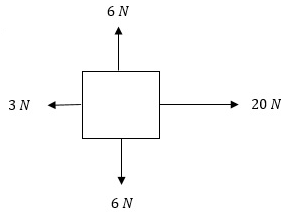
What is the NET FORCE of this diagram?
17 N, right
17 N, left
23 N, right
12 N, up
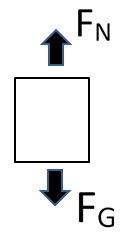
Which of the following is true about this free-body diagram?
the forces are are balanced
the object is free-falling
the object is moving upward
the forces are unbalanced
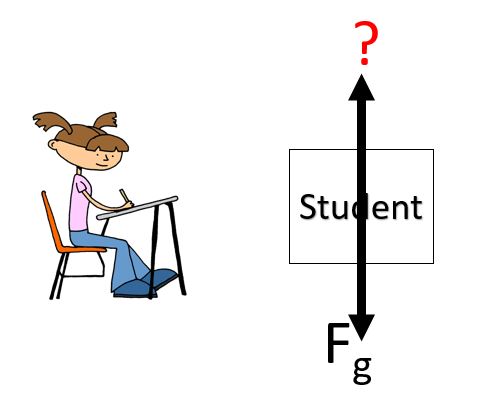
A leftward force is applied to a crate to push it across the floor at a constant speed. Which is the correct force diagram?


A rightward force is applied to a dresser to accelerate it to the right across the bedroom floor.


What is the mass and weight of a 15 kg object?
mass: 15 kg; weight: 15 kg
mass: 147 kg; weight: 15 kg
mass: 9.81 kg; weight: 147 N
mass: 15 kg; weight: 147 N


