wayground logo

Free Printable Worksheets

Font size

S
M
L
XL
Worksheets

REVISION ON ELECTRICITY

Total questions: 91

Worksheet time: 1hrs 12mins

Name
Class
Date
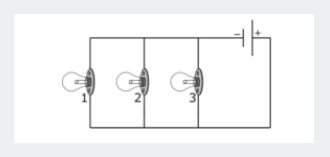
1.
What kind of circuit is this?
a)
series
b)
parallel
2.
If bulb 1 burns out, what will occur?
a)
bulbs 2 and 3 will go out
b)
bulbs 2 and 3 receive more volts
c)
bulbs 2 and 3 will stay lit
d)
nothing will happen
3.
Does this statement best describe a parallel or a series circuit.
 
When more light bulbs are added they all remain bright. 
a)
Parallel circuit
b)
Series circuit
4.
A material in which electrons are not able to move easily is called _______.
a)
Circuit 
b)
Insulator 
c)
Resistance 
d)
Conductor
5.
What is static electricity?
a)
The buildup of neutrons
b)
Electricity flowing through a current
c)
Particles staying still
d)
The buildup of electric charges on an object
6.
What will happen to the other bulbs in the circuit if one bulb goes out?
a)
The other bulbs will go out
b)
The other bulbs will get brighter
c)
The other bulbs will get dimmer
d)
They will flash on and off
7.
What will happen when a light bulb is removed from the circuit below?
a)
The remaining bulbs will go out
b)
The remaining bulbs will brighten
c)
The remaining bulbs will dim
d)
The brightness of the remaining bulbs will not change
8.

What type of circuit is shown in the picture?

a)

Series circuit

b)

Parallel circuit

c)

Open circuit

9.

What is the effect of changing the wire in a circuit from a thick wire to a thin wire?

a)

The overloaded bulb will blow out.

b)

The bulb brightness stays the same.

c)

The bulbs become dimmer.

d)

The bulbs become brighter.

10.
An example of a parallel circuit is
a)
the wiring in a house
b)
a flashlight
c)
a single circular path
11.

What is a circuit?

a)

The buildup of electric charges

b)

A complete, closed path through which electric charges flow

c)

Opposition to the flow of charge

d)

Electric potential

12.
Copper is used in wiring because it is an excellent______________ of electricity.
a)
circuit breaker
b)
conductor
c)
insulator
d)
fuse
13.

Why do electricians always wrap wires in plastic?

a)

Plastic comes in many different colors

b)

Plastic is a good electrical conductor

c)

Plastic makes the wires easy to bend

d)

Plastic is a good electrical insulator

14.
The unit for current is the 
a)
Volt
b)
Ohm
c)
Electron
d)
Amp
15.
What is the unit for resistance?
a)
Volts
b)
Amperes
c)
Ohms
16.
If the battery produced 12.6 Volts and what would be the current flow be for a 6 Ohm resistor
a)
2.1 Amps
b)
2.4 Amps
c)
1.71 Amps
d)
15 Amps
17.
What voltage is needed to cause a 2A current flow through a 10Ω resistor?
a)
5V
b)
0.2V
c)
20V
d)
200V
18.

What voltage is needed to cause a 50A current flow through a 10Ω resistor?

a)

15V

b)

500V

c)

500 kV

d)

0.2V

19.
Tiny particles that have a negative charge
a)
protons
b)
neutrons
c)
electrons
d)
circuits
20.
You measure a potential difference with..
a)
a voltmeter
b)
An Ammeter 
21.
The charge on a proton is
a)
positive
b)
negative
c)
neutral
22.
Ms. Jo Jo rubbed two balloons with a piece of wool. What will happen when the balloons are brought near each other?
a)
The balloons will repel each other.
b)
The balloons will attract each other.
c)
The balloons will become positively (+) charged.
d)
The balloons will pop.
23.
What is resistance?
a)
a measure of how difficult it is for electrons to flow
b)
a measure of the difference in electrical potential between objects that have opposite charges
c)
the continuous flow of electrons around a circuit
d)
the fast sudden movement of electrons from a negative to a positive material
24.
Which on the following is NOT an example of an insulator.
a)
Rubber
b)
Glass
c)
Penny 
d)
Wood
25.
The flow of electric charges is 
a)
voltage
b)
current 
c)
resistance
d)
electricity 
26.
A closed path that electric current flows is a
a)
circuit
b)
series circuit
c)
parallel circuit
27.
Which way do electrons flow?
a)
Positive to Negative
b)
Negative to Positive
28.
What does a resistor do? 
a)
Reduces the flow of electrons
b)
Reduce the flow of the current
c)
Increase flow of electrons
d)
Decreases the flow of electrons 
29.
Where do electrons pick up their energy from? 
a)
Battery
b)
wire
c)
Lightbulb
30.
Which of the following is not a source of electricity 
a)
Windmills
b)
Batteries
c)
wires
d)
Hydroelectric dams
31.
The job of the electron is to ...?
a)
Control which way the current flows.
b)
Use electricity in a circuit
c)
Carry electricity around a circuit
32.
What it the formula to find voltage. 
a)
I= V/R
b)
R=V/I
c)
V= I x R 
33.
In an electrical circuit, what does this symbol represent?
a)
wire
b)
resistor
c)
lightbulb
d)
switch
34.
What is the unit of measurement for resistance?
a)
Amperes
b)
Ohm's
c)
Volts
35.
Voltage difference is related to the force that causes electric charges to flow. 
a)
True
b)
False
36.
In a neutral atom, the number of electrons is equal to the number of _______.
a)
Neutrons
b)
Orbits
c)
Protons
d)
subatomic particles
37.
What types of charges attract?
a)
Positive and Positive
b)
Positive and Neutral
c)
Negative and Neutral
d)
Positive and Negative
38.

Current is described as...

a)

movement of electrons

b)

a circuit of electrons

c)

Rate of flow of electrons

d)

Rate of flow of negative charge

39.
this is the symbol for a _____?
a)
switch
b)
light 
c)
battery
d)
wires
40.
This is the circuit symbol for ...
a)
an AC current source
b)
a DC current source
c)
an ammeter
d)
a voltmeter
41.
This is the circuit symbol for ...
a)
an AC current source
b)
a DC current source
c)
a battery
d)
a single cell
42.
This is the symbol for a _____?
a)
Lamp
b)
Water wheel
c)
Loudspeaker
d)
Motor
43.
a)
Closed switch
b)
Push switch
c)
Trap door
d)
AC Power supply
44.

What is this symbol?

a)

Cell

b)

Fuse

c)

Bulb

d)

Resistor

45.

An ammeter measures what?

a)

current

b)

current in a circuit

c)

current at a specific point in the circuit

d)

flow of electrons

46.
If I add more light bulbs to a series circuit what happens?
a)
The current speeds up and the lights get brighter
b)
The current slows down and the lights dim lower
c)
The current speeds up and the lights dim lower
d)
The current slows down and the lights get brighter
47.

When a switch is open...

a)

the circuit is working and gives energy

b)

the circuit is broken and charges cannot flow

c)

the circuit is turning lights on

d)

I don't know...ask Ms. Cednick

48.
What will happen if one light bulb is removed from this circuit?
a)
The other bulbs will go out.
b)
The other bulbs will stay on
c)
The other bulbs will get dimmer.
d)
The battery will become stronger.
49.
How does resistance affect current?
a)
less resistance - less current
b)
more resistance - less current
c)
more resistance - more current
d)
resistance does not affect current
50.
Which one, top or bottom, offers more resistance?
a)
top
b)
bottom
c)
neither
51.

Super heated steam is used to turn a ______________?

a)

Transformer

b)

Battery

c)

Turbine

d)

Toothed Gear

52.
What is meant by fossil fuels?
a)
Fuels that are derived from fossils
b)
Fuels that are derived from old people
c)
Fuels that are derived from using plant material
d)
Fuels that are derived from the decomposition of faeces
53.
Most forms of electrical generation rely on a turbine. Which form doesn't?
a)
Tidal
b)
Hydro
c)
Solar
d)
Wind
54.

How is electricity measured and billed by the power company?

a)

watts

b)

kilowatts

c)

watt hours

d)

kilowatt hours

55.

How is electricity measured and billed by the power company?

a)

watts

b)

kilowatts

c)

watt hours

d)

kilowatt hours

56.

which type of renewable energy is currently creating the most electricity generation?

a)

geothermal

b)

hydroelectric

c)

solar

d)

wind

57.

Which of the following are the most energy efficient light bulbs?

a)

incandescent

b)

compact florescent

c)

LED

d)

halogen

58.

which of the following is the least energy efficient light bulbs?

a)

incandescent

b)

compact fluorescent

c)

LED

d)

halogen

59.

if a tractor trailer truck is 20% efficient, what happened to the other 80%

a)

energy is destroyed

b)

energy is lost as heat

c)

the 80% is still in the gas tank

d)

energy is converted into matter

60.

You use an LED light bulb that consumes 7 watts that you use for 8 hours in a day. How much would it cost you to run for a month (30 days) if the energy company charges $.15 per KwHr?

a)

$.056

b)

$.0084

c)

$.25

d)

$8.4

61.
Where does geothermal energy come from?
a)
The Earth's atmosphere
b)
The Earth's asthenosphere
c)
The Earth's crust
d)
The Earth's troposphere
62.
How is energy transported in a circuit with a solar panel and an electronic device?
a)
neutrons
b)
electrons
c)
protons
d)
nucleus
63.
What does bio mean
a)
life
b)
living
c)
animals
d)
plants
64.
What does geo mean
a)
minerals
b)
rock
c)
earth
d)
crust
65.
Which is the BEST definition for hydroelectricity
a)
energy from water
b)
electricity from  water
c)
electricity generated from moving water
d)
moving water that creates energy
66.
Petroleum and natural gas form from...
a)
strong winds
b)
cooled magma
c)
radioactive materials
d)
remains of plants and animals 
67.
Thicker wires have _______ resistance than thinner wires.
a)
more
b)
less
c)
the same
68.
As the resistance in a circuit increases, the electric current __________.
a)
increases
b)
decreases
c)
stays the same
69.
Electric current is measured in ______.
a)
Watts
b)
Volts
c)
Amperes
70.
Which formulas represents Ohm's law?
a)
V=IR
b)
R=IV
c)
I=RV
71.
How many volts are in a circuit with a battery that has a resistance of 10 Ohms and a current of 2 Amps? 
a)
.5 Volts
b)
5 Volts
c)
20 Volts
72.
What is the unit for resistance?
a)
Volts
b)
Amperes
c)
Ohms
73.

10C of charge flows in a wire every 2 seconds. Calculate the current in the wire.

a)

5 Ohms

b)

5 Amps

c)

0.2 Volts

d)

0.2 Amps

74.

What happens to an LDR in bright light

a)

Resistance remains constant

b)

Resistance increase

c)

Resistance decreases

d)

Resistance is unchanged

75.

Which graph represents a diode?

a)

A

b)

B

c)

C

d)

D

76.

Which graph represents a Filament bulb?

a)

A

b)

B

c)

C

d)

D

77.

If a cell provides 12 V to a circuit and 4 Coulombs of charge flows. How much energy is being provided by the cell?

a)

3 J

b)

0.25 J

c)

48 J

d)

16 J

78.

Calculate the voltage of the 4 Ohm resistor in the circuit and use this answer to find the voltage of the across the heater.

a)

4.8 V and 7.2 V

b)

3 V and 9 V

c)

6 V and 6 V

d)

3.2 V and 9.8 V

79.

This component measures the (a)   in a circuit.

80.

This is an example of a _________ circuit.

a)

open

b)

closed

c)

parallel

d)

series

81.

What causes a current to flow in a circuit?

a)

Ammeter

b)

Ohmmeter

c)

Battery

d)

Bulb

82.

it is the conducting path through which electric current can flow.

a)

wire

b)

current

c)

circuit

d)

voltage

83.

Electric current is measured...

a)

using an ammeter and in units of amperes

b)

using a ammeter and in units of volts

c)

using a voltmeter and in units of amperes

d)

using a voltmeter and in units of volts

84.

Identify the part of the circuit that is labeled 1.

a)

battery

b)

wire

c)

switch

d)

bulb

85.

Identify the part of a circuit that is labeled 2.

a)

battery

b)

wire

c)

switch

d)

bulb

86.

Identify the part of a circuit that is labeled 3.

a)

battery

b)

wire

c)

switch

d)

bulb

87.
The circuit  lights the light bulb. What is the purpose of the switch in the circuit?
a)
to push the electric current
b)
to open and close the circuit
c)
to insulate the circuit
d)
to make the electricity
88.

In parallel circuit, there are _________ pathways for charge to flow.

a)

One

b)

Two or more

c)

None

d)

Zero

89.
In a parallel circuit which of the following is the same value throughout the circuit?
a)
Voltage
b)
Current
c)
Resistance
d)
Charge
90.
The charge of an electron is:
a)
Positive. 
b)
Negative. 
c)
Electrons have no charge
91.
Two like charges:
a)
 neutralize each other.
b)
repel each other. 
c)
must be neutrons. 
d)
attract each other.