
 Worksheets
9_CH2-Fluid Mechanics and Thermal Physics
Total questions: 95
Worksheet time: 48mins
Which statement best defines pressure in physics?
The total force acting tangentially on any surface
The total force acting normally on the surface in contact
The thrust acting on a unit area of the surface in contact
The ratio of area to thrust
Using the formula Pressure = Thrust (T) / Area (A), what happens to pressure when the same thrust is applied to a smaller area?
Pressure decreases
Pressure remains the same
Pressure becomes zero
Pressure increases
Which of the following correctly lists units of pressure mentioned in the lesson?
Nm, Pa, bar
Nm², Pa, bar, millibar
N/m², joule, bar
Pa, watt, Nm²
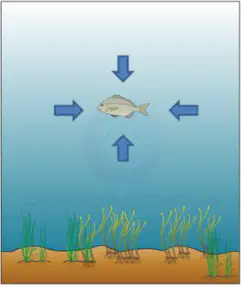
A figure shows a fish surrounded by arrows pointing equally in all directions. Which law of liquid pressure does this diagram best represent?
Pressure depends on depth
Pressure is same in all directions about a point in a liquid
Pressure depends on density
Liquid finds its own level
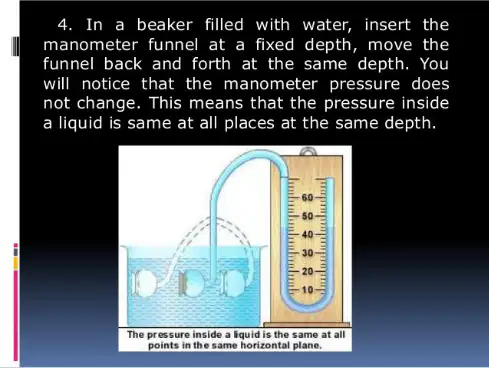
When a manometer is moved back and forth at the same depth in a beaker of water, its reading does not change. What conclusion follows?
Pressure varies horizontally at the same depth
Pressure is same at all points in a horizontal plane in a liquid
Pressure only depends on the vessel’s shape
Pressure is greater near the container walls
Which statement best describes the fifth law of liquid pressure?
Liquids exert no pressure at the surface
Liquid pressure is maximum at the top
Liquid finds its own level regardless of vessel shape
Pressure depends only on temperature
Which formula gives the pressure at a point inside a liquid of density d at depth h under gravitational field g?
P = h d g
P = d/h
P = g/h
P = h/g
A vertical liquid column of cross-sectional area A and height h has volume Ah. Using mass = volume × density, what is the expression for the mass of this column?
A/d
A h d
h/d
A g h
Two points are located in the same liquid: Point X at depth 0.5 m and Point Y at depth 1.0 m. The liquid density is 1000 kg/m³ and g = 10 N/kg. Which statement is correct about the pressures at X and Y?
Pressure at X equals pressure at Y.
Pressure at X is greater than pressure at Y.
Pressure at Y is greater than pressure at X.
Pressures at both points are zero.
Which instrument uses a column of mercury to measure atmospheric pressure by the height of the mercury column?
Aneroid barometer
Simple mercury barometer
Altimeter
Thermometer
Who invented the aneroid barometer, and in what year was it introduced?
Evangelista Torricelli, 1643
Isaac Newton, 1687
Lucien Vidi, 1844
Blaise Pascal, 1654
A body immersed in a fluid experiences an upward force due to the fluid. What is this force called?
Weight
Friction
Upthrust or buoyant force
Centripetal force
Which expression correctly gives the upthrust (resultant upward force) on a fully immersed object in a liquid?
Upthrust = mg/A
Upthrust = Vdg
Upthrust = d/A
Upthrust = g/V
A solid is submerged in a liquid of density d. If its true weight is 50 N and its apparent weight in the liquid is 35 N, what is the upthrust acting on the solid? Use the relation: Upthrust = True weight − Apparent weight.
15 N
35 N
50 N
85 N
Which formula correctly defines density of a substance?
Density = Mass × Volume
Density = Mass / Volume
Density = Volume / Mass
Density = Weight × Volume
Relative density (specific gravity) of a solid can be expressed as which of the following according to Archimedes’ principle?
Density of substance × Density of water at 4°C
Weight of substance / Upthrust
Upthrust / Weight of substance
Density of water at 4°C / Density of substance
A floating body will be in stable equilibrium when slightly disturbed if which condition is satisfied?
Its centre of base is below its centre of gravity when W = F_B
Its centre of base and centre of gravity are at the same point
Its centre of base is above its centre of gravity when W = F_B
It cannot return to its original position after disturbance
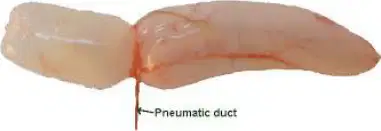
Which statement best explains how a fish rises in water using its swim bladder?
It increases its weight by absorbing more water.
It fills the swim bladder with gases, increasing volume and up-thrust.
It releases gases from the swim bladder to decrease up-thrust.
It swims faster to generate lift like an airplane wing.
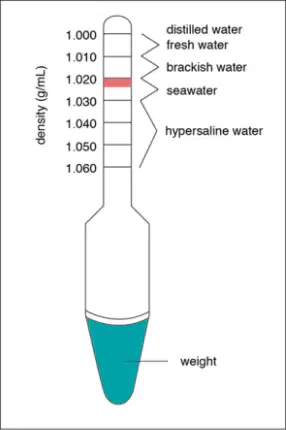
A hydrometer sinks lower in a liquid compared to another. What does this indicate about the two liquids?
The first liquid is denser than the second.
Both liquids have the same density.
The first liquid is less dense than the second.
The hydrometer is faulty and cannot measure density.
A temperature is 25 °C. Using the conversion relationship between Celsius and Kelvin given (T = C + 273), what is the temperature in Kelvin?
248 K
273 K
298 K
300 K
During winter vacation the temperature of Haa is 270 K. What is this temperature in degrees Celsius?
-3 °C
-0.15 °C
-273 °C
-270 °C
3 °C
A Fahrenheit thermometer shows a reading of 90 °F. What is the temperature in the Celsius scale?
32.2 °C
45.0 °C
20.0 °C
37.0 °C
50.0 °C
Alcohol starts boiling at 78.37 °C. What would be the corresponding temperature reading in Fahrenheit?
173.1 °F
172.0 °F
180.0 °F
150.7 °F
100.0 °F
Which statement best describes the zeroth law of thermodynamics as it relates to heat transfer?
Thermal energy is transferred from higher temperature to lower temperature until no further temperature change occurs, indicating thermal equilibrium.
Heat can only be transferred by radiation in a vacuum.
Heat is the same as temperature and does not depend on energy.
Thermal energy increases only when potential energy increases.
Convection is the transfer of heat by particle-to-particle contact without movement.
Which statement best describes convection in heat transfer?
Heat transfer through direct contact between particles without bulk movement
Heat transfer by electromagnetic waves through a vacuum
Heat transfer by the actual movement of the particles of the medium
Heat transfer only in solids due to lattice vibrations
A patient’s body temperature is measured at 103 °F. What is the equivalent temperature in degrees Celsius? Use the standard conversion relation between the Fahrenheit and Celsius scales.
39.4 °C
40.6 °C
37.0 °C
35.0 °C
Which feature of a thermos flask primarily reduces heat loss by radiation?
The vacuum between the double walls
The silvered inner surface of the walls
The cork on the top
The wooden or plastic outer casing
A flat metal sheet that expands when heated is best described as undergoing which type of thermal expansion?
Linear expansion
Superficial (area) expansion
Cubical (volumetric) expansion
No expansion
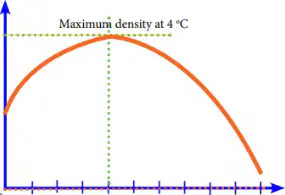
Which statement best describes the anomalous expansion of water?
Water’s volume decreases continuously as it cools from 10°C to 0°C.
Between 4°C and 0°C, cooling makes water’s volume increase and its density decrease.
Water has maximum density at 0°C.
Water behaves like all other substances on cooling.
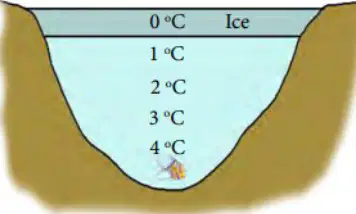
A pond in a very cold region begins to freeze at the surface while fish survive below. Which reasoning best explains this phenomenon?
Ice sinks to the bottom, keeping the surface liquid.
Water is densest at 4°C, so colder water (near 0°C) stays on top and forms ice while denser 4°C water remains below, allowing fish to survive.
Water expands linearly as it cools, keeping the entire pond liquid.
Fish generate heat that prevents freezing below the surface.
What is the temperature of 0 °C in Kelvin?
273 K
0 K
100 K
-273 K
Which principle explains why a ship floats on water?
Archimedes' principle
Bernoulli's principle
Pascal's principle
Newton's third law
What happens to the pressure in a fluid as the depth increases?
Pressure decreases
Pressure remains constant
Pressure increases
Pressure fluctuates
What happens to the buoyant force acting on an object as it is submerged deeper in a fluid?
It becomes zero at a certain depth.
It decreases with depth.
It remains constant regardless of depth.
It increases with depth.
Which of the following statements is true regarding the relationship between pressure and area when a force is applied?
Pressure increases as area decreases.
Pressure increases as area increases.
Pressure decreases as area decreases.
Pressure is independent of the area.
In a fluid at rest, which statement best describes the pressure at different depths?
Pressure is highest at the surface.
Pressure increases linearly with depth.
Pressure decreases with depth.
Pressure is the same at all depths.
Which of the following statements is true about the behavior of gases under pressure?
Gases do not expand to fill their container.
Gases compress more easily than liquids.
Gases exert pressure equally in all directions.
Gases have a fixed volume regardless of pressure.
What is the boiling point of water in Kelvin?
0 K
100 K
212 K
373 K
Which of the following statements is true regarding the relationship between pressure and depth in a fluid?
Pressure decreases with increasing depth
Pressure is only dependent on the temperature of the fluid
Pressure is constant at all depths
Pressure increases with increasing depth
What is the relationship between pressure and depth in a fluid at rest?
Pressure remains constant regardless of depth
Pressure increases with depth
Pressure decreases with depth
Pressure is highest at the bottom
Which of the following correctly describes the effect of temperature on the density of a liquid?
Density remains constant regardless of temperature
Density decreases as temperature increases
Density increases as temperature increases
Density is independent of the state of matter
What is the effect of temperature on the density of a liquid?
Density fluctuates randomly with temperature
Density remains constant regardless of temperature
Density decreases as temperature increases
Density increases as temperature increases
Which of the following statements is true regarding the buoyancy of an object in a fluid?
Buoyant force is independent of the fluid density
Buoyant force acts downward
Buoyant force is always greater than the weight of the object
Buoyant force is equal to the weight of the fluid displaced
If the temperature is 100 °C, what is the equivalent temperature in Kelvin using the conversion formula (T = C + 273)?
100 K
373 K
273 K
0 K
Which law of thermodynamics states that energy cannot be created or destroyed, only transformed from one form to another?
First Law of Thermodynamics
Third Law of Thermodynamics
Zeroth Law of Thermodynamics
Second Law of Thermodynamics
What is the freezing point of water in Kelvin?
273 K
100 K
0 K
373 K
What is the primary reason a submarine can dive and surface in water?
By changing its shape
By adjusting the amount of water in its ballast tanks
By increasing its speed
By using propellers to push down
How does the density of an object affect its ability to float in a fluid?
All objects float regardless of density
Objects with higher density than the fluid sink
Density has no effect on floating
Objects with lower density than the fluid sink
What is the relationship between pressure and temperature in a gas at constant volume?
Pressure decreases as temperature increases
Pressure increases as temperature increases
Pressure remains constant regardless of temperature
Pressure is inversely proportional to temperature
What is the primary reason that objects with a density greater than that of the fluid sink?
They have a larger volume than the fluid.
They displace more fluid than their weight.
They are heavier than the fluid they displace.
They create a vacuum around them.
Which of the following best describes the concept of thermal equilibrium?
Heat flows from a cooler object to a warmer object.
Temperature is constant in all materials regardless of heat transfer.
Two objects at different temperatures will eventually reach the same temperature.
Heat transfer occurs only through conduction.
How does increasing the temperature of a gas at constant pressure affect its volume?
Volume increases.
Volume decreases.
Volume fluctuates randomly.
Volume remains constant.
What is the primary factor that determines whether an object will float or sink in a fluid?
The temperature of the fluid
The object's density compared to the fluid's density
The volume of the object
The object's shape
Which of the following statements is true regarding the behavior of liquids in a closed container?
Pressure in a liquid increases with depth.
Liquids exert pressure only at the surface.
Pressure is uniform throughout the liquid regardless of depth.
Liquids do not exert pressure in a vacuum.
What is the effect of temperature on the density of most liquids?
Density fluctuates randomly with temperature
Density remains constant regardless of temperature
Density decreases as temperature increases
Density increases as temperature increases
What is the principle that explains why a ship floats on water?
Bernoulli's Principle
Pascal's Law
Newton's Third Law
Archimedes' Principle
How does the volume of a gas change with an increase in temperature at constant pressure?
Volume remains constant
Volume decreases
Volume fluctuates
Volume increases
What is the effect of increasing the density of a fluid on the buoyant force experienced by an object submerged in it?
Buoyant force remains constant
Buoyant force increases
Buoyant force decreases
Buoyant force becomes zero
What happens to the pressure in a fluid when the temperature increases, assuming the fluid is incompressible?
Pressure increases.
Pressure remains constant.
Pressure fluctuates randomly.
Pressure decreases.
Which of the following best describes the principle of Archimedes?
Buoyant force acts only on objects with a density less than that of the fluid.
Pressure in a fluid is constant at all depths regardless of the shape of the container.
The weight of an object is always greater than the buoyant force acting on it.
An object submerged in a fluid experiences a buoyant force equal to the weight of the fluid displaced.
How does the shape of an object affect its buoyancy in a fluid?
Objects with streamlined shapes always float.
Only spherical objects can float in a fluid.
Shape has no effect on buoyancy.
Buoyancy is affected by the volume of fluid displaced, which can vary with shape.
What happens to the volume of a gas when its temperature increases at constant pressure?
Volume decreases
Volume remains constant
Volume increases
Volume fluctuates randomly
Which of the following best describes the relationship between pressure and temperature in a gas at constant volume?
Pressure increases as temperature decreases
Pressure is inversely proportional to temperature
Pressure decreases as temperature decreases
Pressure remains constant regardless of temperature
What is the effect of increasing the density of a liquid on the buoyant force experienced by an object submerged in it?
Buoyant force decreases
Buoyant force remains constant
Buoyant force increases
Buoyant force becomes zero
What is the primary reason that ice floats on water?
Ice is made of a different substance than water.
Ice is denser than water.
Ice has a lower density than water.
Ice is heavier than water.
Which of the following best describes the process of conduction in heat transfer?
Heat transfer that occurs only in gases.
Heat transfer through the movement of fluids.
Heat transfer through direct contact between materials.
Heat transfer through electromagnetic radiation.
What happens to the buoyant force acting on an object if it is submerged deeper in a fluid?
The buoyant force decreases.
The buoyant force becomes zero.
The buoyant force increases.
The buoyant force remains constant.
If the temperature is 0 °C, what is the equivalent temperature in Fahrenheit using the conversion formula (F = C × 9/5 + 32)?
273 °F
32 °F
0 °F
100 °F
What is the pressure at a depth of 2 meters in a fluid with a density of 800 kg/m³ and g = 9.81 N/kg?
7.84 kPa
9.81 kPa
19.6 kPa
15.7 kPa
Which of the following statements is true regarding the behavior of gases when heated at constant pressure?
Pressure decreases as volume increases
Volume increases as temperature increases
Volume remains constant regardless of temperature
Volume decreases as temperature increases
Which of the following correctly describes the relationship between pressure and volume of a gas at constant temperature?
Pressure decreases as volume increases
Pressure and volume are directly proportional
Pressure increases as volume increases
Pressure is independent of volume
What happens to the buoyant force acting on an object submerged in a fluid if the density of the fluid increases?
Buoyant force increases
Buoyant force remains constant
Buoyant force decreases
Buoyant force becomes zero
What is the absolute zero temperature in Kelvin?
273.15 K
-100 K
-273.15 K
0 K
How does the density of a gas compare to that of a liquid at the same temperature and pressure?
Gas is denser than liquid
Density cannot be compared
Gas is less dense than liquid
Gas and liquid have the same density
What is the relationship between temperature and the kinetic energy of particles in a substance?
Temperature does not affect kinetic energy
Kinetic energy is constant regardless of temperature
Higher temperature means lower kinetic energy
Higher temperature means higher kinetic energy
What happens to the pressure in a fluid when the temperature increases, assuming the fluid is incompressible?
Pressure decreases.
Pressure remains constant.
Pressure fluctuates randomly.
Pressure increases.
In a hydraulic system, if the area of the output piston is larger than that of the input piston, what can be said about the force exerted?
The output force is greater than the input force.
The output force is equal to the input force.
The output force is independent of the input force.
The output force is less than the input force.
Which of the following best describes the concept of buoyancy?
It is the upward force exerted by a fluid on an object immersed in it.
It is the weight of the fluid displaced by an object.
It is the pressure difference between the top and bottom of an object.
It is the force that causes an object to sink in a fluid.
What happens to the pressure in a fluid when the temperature increases, assuming the fluid is incompressible?
Pressure fluctuates randomly.
Pressure decreases.
Pressure increases.
Pressure remains constant.
Which of the following statements is true regarding the relationship between temperature and the kinetic energy of particles in a substance?
Kinetic energy increases as temperature increases.
Kinetic energy increases as temperature decreases.
Kinetic energy decreases as temperature increases.
Kinetic energy is independent of temperature.
What is the primary reason that ice floats on water?
Ice is less dense than water.
Ice is more viscous than water.
Ice has a lower mass than water.
Ice has a higher temperature than water.
What is the relationship between pressure and temperature in a gas at constant volume?
Pressure increases as temperature increases
Pressure decreases as temperature increases
Pressure remains constant regardless of temperature
Pressure increases as temperature decreases
Which of the following best describes the principle of Archimedes?
An object submerged in a fluid experiences a buoyant force equal to the weight of the fluid displaced
Pressure in a fluid increases with depth but does not affect buoyancy
All objects float in fluids regardless of their density
Buoyant force is always equal to the weight of the object
What happens to the density of a gas when it is compressed at constant temperature?
Density increases
Density remains the same
Density fluctuates randomly
Density decreases
Which condition must be met for an object to float in a fluid?
The object must be rigid and not deform.
The volume of the object must be greater than the volume of the fluid.
The density of the object must be less than the density of the fluid.
The weight of the object must be greater than the weight of the fluid displaced.
What is the relationship between pressure and depth in a fluid?
Pressure is only affected by the temperature of the fluid.
Pressure remains constant regardless of depth.
Pressure increases with increasing depth.
Pressure decreases with increasing depth.
What happens to the pressure in a fluid when the depth increases?
Pressure decreases with depth
Pressure remains constant regardless of depth
Pressure increases with depth
Pressure is only dependent on the fluid's temperature
Which of the following statements is true regarding buoyancy?
Buoyant force only acts on solids
Buoyant force is independent of the object's volume
Buoyant force is equal to the weight of the fluid displaced
Buoyant force acts downward on the object
How does the density of a gas change with an increase in temperature at constant pressure?
Density increases
Density decreases
Density remains constant
Density fluctuates randomly
What is the primary factor that determines the buoyant force acting on an object submerged in a fluid?
The volume of the object
The shape of the object
The density of the fluid
The temperature of the fluid
Which of the following statements is true about the relationship between pressure and area in a fluid?
Pressure increases as area increases
Pressure is inversely proportional to area
Pressure is independent of area
Pressure decreases with depth only
What happens to the density of a liquid when it is heated?
Density remains unchanged
Density decreases
Density increases
Density fluctuates
What is the pressure at a depth of 2 m in a liquid with a density of 800 kg/m³ and g = 9.81 N/kg?
15.68 kPa
16.00 kPa
20.00 kPa
19.62 kPa
Which of the following statements is true regarding the buoyant force acting on an object submerged in a fluid?
It is always equal to the weight of the object.
It is equal to the weight of the fluid displaced by the object.
It increases as the object is submerged deeper.
It depends on the shape of the object.
How does the pressure change when a liquid is heated while contained in a rigid vessel?
Pressure fluctuates randomly
Pressure decreases
Pressure remains constant
Pressure increases

