wayground logo

Free Printable Worksheets

Font size

S
M
L
XL
Worksheets

Motion and Newton's Laws

Total questions: 87

Worksheet time: 5hrs 15mins

Name
Class
Date
1.
You can measure _____ by dividing distance over time.
a)
motion
b)
position
c)
speed
d)
velocity
2.
When runners are running around a track, they are constantly changing their _____.
a)
motion
b)
speed
c)
velocity
d)
force
3.
_____ is when there is a change in a object's position as compared to other objects around it.
a)
motion
b)
position
c)
speed
d)
velocity
4.
An object's location is its _____.
a)
force
b)
motion
c)
velocity
d)
position
5.
The measure of an object's speed in a certain direction is its ________.
a)
force
b)
position
c)
speed
d)
velocity
6.
Speed is a measure of the _____ an object travels in a certain amount of time.
a)
distance
b)
force
c)
motion
d)
velocity
7.

A change in speed or ______ can cause a change in velocity.

a)

time

b)

position

c)

direction

d)

acceleration

8.
You walk 10 meters to math class in 20 seconds. Your average speed is
a)
2 m/s
b)
0.5 m/s
c)
200 m/s
d)
5 m/s
9.
What is the SI unit for speed
a)
Km
b)
s
c)
m/s
d)
m/s2
10.
Carlos lives 100 meters from his friend's house. What is his average speed if he reaches his friends house in 50 seconds?
Distance= 100 m
time = 50 seconds
a)
1 m/s
b)
2 m/s
c)
3 m/s
d)
4 m/s
11.
A soccer ball is kicked from 40 meters out. It takes 5 seconds to reach the goal. What speed was the ball traveling?
d= 40 m
t= 5 s
a)
6 m/s
b)
7 m/s
c)
8 m/s
d)
9 m/s
12.

Changing direction is an example of a kind of

a)

acceleration

b)

speed

c)

velocity

d)

constant rate

13.

The moon accelerates because it is

a)

in a vacuum in space

b)

continuously changing direction

c)

a very large sphere

d)

constantly increasing its speed of orbit

14.

Which situation is NOT acceleration?

a)

an object speeding up

b)

an object slowing down

c)

an object moving at constant speed in one direction

d)

an object moving forward and then moving in reverse

15.
What is the difference between distance and displacement?
a)
distance is the total length of the path an object travels. Displacement is the straight line distance from starting point to ending point with a certain direction
b)
displacement is the total length of the path an object travels. Distance is the straight line distance from starting point to ending point.
c)
displacement uses no direction whereas distance does
d)
there is no difference. they are the same!
16.

What is displacement?

a)

how far an object is from it's starting point

b)

the total length of an object's path

c)

weight that is displaced from a body of water

d)

the change in an object's path

17.

A student walks 10 m east, then turns around and walks 8 m west. What is the displacement of the student?

a)

2 m east

b)

2 m west

c)

10 m east

d)

8 m west

18.

A speed at any given time is called

a)

changing speed

b)

constant speed

c)

average speed

d)

instantaneous speed

19.

If a car neither speeds up or slows down it is traveling at ____

a)

a changing speed

b)

a constant speed

c)

an instantaneous speed

d)

an undetermined speed

20.

A car's speedometer indicates its instantaneous speed.

a)

False

b)

True

21.

The velocity of an object is the same as its speed.

a)

true

b)

False

22.

Directing someone to walk north and west is describing a position in two dimensions.

a)

True

b)

False

23.
What is the difference between describing position in one dimension and two dimension?
a)
One dimension involves two directions, while two dimension involve one direction.
b)
One dimension involves no directions, while two dimension involve two directions.
c)
One dimension looks at one direction, while two dimension looks at two directions.
d)
One dimension involves two or more directions, while two dimension involves no directions.
24.
What is the SI unit for acceleration?
a)
m/s
b)
m
c)
m/s2
d)
s
25.

The formula below is used to find what?

 ?=Displacement÷Time?=Displacement\div Time  

a)

Velocity

b)

Speed

c)

Force 

d)

Acceleration

26.
Acceleration of an object happens when things ________
a)
slow down
b)
go faster
c)
change direction (turn)
d)
All of the above
27.
Acceleration only takes place when things speed up. 
a)
True
b)
False
28.

A roller coasters accelerates from an initial speed of 6.0 m/s to a final speed of 70 m/s over 4 seconds. What's the acceleration?

a)

24 m/s2

b)

18 m/s2

c)

16 m/s2

d)

16 m/s

29.
Scott drives a Jeep 12 km east, then 4 km north, then finally 3 km west. He traveled a total distance of:
a)
5 km
b)
10 km
c)
13 km
d)
19 km
30.

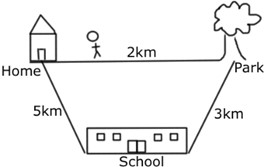
Jerry walked from home to school, then from the school to the park. What is his total displacement?

a)

2 km

b)

5 km

c)

8 km

d)

10 km

31.

Jerry walked from home to school, then from the school to the park. What is his total distance?

a)

2 km

b)

5 km

c)

8 km

d)

10 km

32.

The sum of all movements from start to the end of motion is best described as____.

a)

distance

b)

displacement

c)

motion

d)

donkey

33.

The change in an objects position from the final position to initial position.

a)

displacement

b)

distance

c)

motion

d)

reference point

34.
Vector quantities need both a magnitude and a _____.
a)
distance
b)
displacement
c)
direction
d)
velocity
35.
Find the distance Sara walks from A to B,  B to C then C to D?
a)
11m
b)
3m
c)
5m
36.
The scientific (SI) unit for measuring distance is the ________ .
a)
mile
b)
foot
c)
kilometer
d)
meter
37.
What two measurements are necessary for calculating speed?
a)
Mass and time
b)
Temperature and mass
c)
Mass and distance
d)
Distance and time
38.
What is the speed of an object that travels 60 meters in 4 seconds?
a)
240 m/s
b)
15 m/s
c)
0.067 m/s
d)
15 mph
39.
A measurement of how fast an object is moving
a)
Velocity
b)
Speed
c)
Vector
d)
Acceleration
40.
A runner races in the 100 meter dash.  It takes her 10 seconds to finish.  What is her average speed?
a)
10 m/s
b)
1000 m/s
c)
100 seconds
d)
10 seconds
41.
Which of the following represents a velocity?
a)
40 m
b)
40 m north
c)
40 m/s
d)
40 m/s north
42.
When you look at the speedometer of your car, it tells you your....
a)
Average speed
b)
Instantaneous speed
43.

What is the speed of a cheetah that travels 112.0 m in 4.0 s?

a)

0.0357 m/s

b)

30 m/s

c)

0.036 m/s

d)

28.0 m/s

44.
How do you calculate velocity?
a)
Distance divided by time.
b)
Displacement divided by time.
c)
Speed multiplied by time.
d)
Displacement divided by velocity.
45.
An object is _____ if its position changes relative to another object.
a)
in motion
b)
at reset
c)
a frame of refence
d)
magical
46.
Km (kilometers) is a unit for...
a)
Speed
b)
Distance
c)
Time
d)
Direction
47.
65mi/hr South is an example of...
a)
Speed
b)
Velocity
c)
Acceleration
d)
Direction
48.
88 m/s
a)
Speed
b)
Velocity
c)
Acceleration
49.
88 m/s north
a)
Speed
b)
Velocity
c)
Acceleration
50.
Which of the following is a unit for acceleration?
a)
km/s
b)
m/s2
c)
mi/hr
d)
ft
51.
Can be measured in meters per second (m/s)
a)
Distance
b)
Time
c)
Speed
d)
Acceleration
52.
What is velocity?
a)
the quickness of an object
b)
the location of an object
c)
acceleration
d)
speed in a specific direction
53.
When a car goes around a corner at 20 mph, why do we say it  accelerates?
a)
The car is accelerating because of the velocity is constant
b)
The car accelerates because it's going 20 mph
c)
Cars always accelerate when they are in motion
d)
The car is accelerating because it's changing direction
54.
Acceleration is defined as the CHANGE in 
a)
time it takes for one place to move to another place. 
b)
velocity of an object.
c)
distance divided by the time interval 
d)
velocity divided by the time interval 
55.
In each of the following cases, determine where the car has no acceleration ?
a)
A car shortly after a stoplight turns green.
b)
A car approaching a red light
c)
A car with the cruise control set at 80 km/h
d)
A car turning a curve at a constant speed
56.
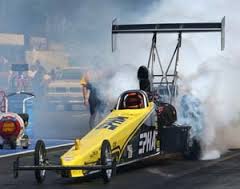
A drag racer accelerated from 0 m/s to 200 m/s in 5 s.  What was the acceleration?
a)
0 m/s
b)
40 m/s2
c)
-40 m/s2
d)
40 m/s
57.
A dog runs with an initial speed of 7.5 m/s on a waxed floor.  It slides to a stop in 15 seconds.  What is the acceleration?
a)
-7.5 m/s
b)
-7.5 m/s2
c)
-0.5 m/s2
d)
7.5 mi//hr
58.
A magician pulls a tablecloth out from under dishes and glasses on a table without disturbing them.
a)
Newton's 1st Law
b)
Newton's 2nd Law
c)
Newton's 3rd Law
d)
None of them
59.

A person’s body is thrown outward as a car rounds a curve on a highway.

a)

Newton's 1st Law

b)

Newton's 2nd Law

c)

Newton's 3rd Law

d)

None of them

60.
Rockets are launched into space using jet propulsion where exhaust accelerates out from the rocket and the rocket accelerates in an opposite direction.
a)
Newton's 1st Law
b)
Newton's 2nd Law
c)
Newton's 3rd Law
d)
None of them
61.
A picture is hanging on a wall and does not move.
a)
Newton's 1st Law
b)
Newton's 2nd Law
c)
Newton's 3rd Law
d)
None of them
62.
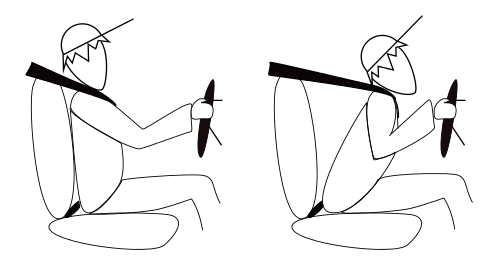
A person not wearing a seatbelt flies through a car window when someone slams on the breaks because the person’s body wants to remain in continuous motion even when the car stops.
a)
Newton's 1st Law
b)
Newton's 2nd Law
c)
Newton's 3rd Law
d)
None of them
63.

Pushing a child on a swing is easier than pushing an adult on the same swing, because the adult has more mass.

a)

Newton's 1st Law

b)

Newton's 2nd Law

c)

Newton's 3rd Law

d)

None of them

64.
Acceleration is produced when a force acts on a mass. The greater the mass (of the object being accelerated) the greater the amount of force needed (to accelerate the object).
a)
Newton's 1st Law
b)
Newton's 2nd Law
c)
Newton's 3rd Law
d)
None of them
65.
A soccer ball accelerates more than a bowling ball when thrown with the same force.
a)
Newton's 1st Law
b)
Newton's 2nd Law
c)
Newton's 3rd Law
d)
None of them
66.
A student leaves a pencil on a desk and the pencil stays in the same spot until another student picks it up.
a)
Newton's 1st Law
b)
Newton's 2nd Law
c)
Newton's 3rd Law
d)
None of them
67.
Two students are in a baseball game. The first student hits a ball very hard and it has a greater acceleration than the second student who bunts the ball lightly.
a)
Newton's 1st Law
b)
Newton's 2nd Law
c)
Newton's 3rd Law
d)
None of them
68.
The swimmer moves her hand down and to the left and her body goes forward to the right.
a)
Newton's 1st Law
b)
Newton's 2nd Law
c)
Newton's 3rd Law
69.
A rocket is sent into space.  When the power dies out, the rocket will just keep floating and moving in space forever (unless an unbalanced force, such as a meteor, runs into it).
a)
Newton's 1st Law
b)
Newton's 2nd Law
c)
Newton's 3rd Law
d)
None of them
70.
According to Newton’s first law of motion, a moving object that is not acted on by an unbalanced force will
a)
remain in motion.
b)
eventually come to a stop.
c)
change its momentum.
d)
accelerate.
71.
A sled sliding on a flat, icy surface with a constant velocity is best described by
a)
Newton’s first law of motion for objects at rest.
b)
Newton’s first law of motion for objects in motion.
c)
Newton’s second law of motion.
d)
Newton’s third law of motion.
72.
An empty truck and a fully loaded truck are next to each other at a traffic light. When the light turns green, the lighter truck increases speed more quickly. Which of these best explains this situations
a)
Newton's first law
b)
Newton's second law
c)
Newton's third law
d)
Conservation of momentum
73.
F = MxA
a)
1st
b)
2nd
c)
3rd
74.
A magician pulls a tablecloth out from under dishes and glasses on a table without disturbing them.
a)
Newton's 1st Law
b)
Newton's 2nd Law
c)
Newton's 3rd Law
75.
A person not paying attention while skateboarding hits a rock. The skateboard stops...they don't.
a)
The Law of Inertia
b)
The Law of Acceleration
c)
The Law of Conservation of Momentum
76.

Which of the following is an example of Newton’s 1st Law of motion?

a)

a chromebook sitting on a desk

b)

a train traveling at a constant speed

c)

Earth orbiting the Sun

d)

all of the above

77.

Which of Newton's laws does this picture represent

a)

Newtons 2nd law

b)

Law of gravity

c)

Newtons 1st law

d)

Newtons 5th law

78.
When you step on a Lego. You push on the Lego and the Lego pushes back on you.
a)
Newton's 1st Law
b)
Newton's 2nd Law
c)
Newton's 3rd Law
79.
"For every action, there is an equal and opposite reaction."
a)
Newton's 1st Law
b)
Newton's 2nd Law
c)
Newton's 3rd Law
d)
Newton's 4th Law
80.
This person bought coffee and put it on the seat next to them. If they stopped quickly and the coffee spilled which law would that represent?
a)
Newton's 1st Law
b)
Newton's 2nd Law
c)
Newton's 3rd Law
81.

Which of Newton's Laws of motion is described by the example?


A fireman turns on his hose and is knocked backwards.

a)

1st

b)

2nd

c)

3rd

82.

Which of Newton's Laws of motion is described by the example?


If air lets out of a balloon quickly, it pushes down and the balloon moves up.

a)

1st

b)

2nd

c)

3rd

83.

Which of Newton's Laws of motion is described by the example?


A bowling ball hits the pins and they fly off in all directions.

a)

1st

b)

2nd

c)

3rd

84.

While sitting in a rolling desk chair, you push on a wall. Which of Newton's Laws explain why you move backwards (away from the wall)?

a)

Newton's First Law (Inertia)

b)

Newton's Second Law (Net force = mass x acceleration)

c)

Newton's Third Law (Action/Reaction)

d)

Law of Universal Gravitation

85.
When a cannon fires a cannonball we observe Newton's third law. Which force is the reaction force?
a)
The cannon moving forward
b)
The cannonball moving forward
c)
The cannon moving backward
d)
The cannonball moving backward
86.
Which law best explains why people remain in motion when a car crashes, if they are not wearing a seat belt?
a)
Newton's Law of Inertia
b)
Newton's Law of F=ma
c)
Newton's Law of Force Pairs
d)
Newton's Law of Biology
87.

Which law best explains why the boat moves in the opposite direction that Sally moves as she jumps to shore?

a)

Newton's 1st Law

b)

Newton's 2nd Law

c)

Newton's 3rd Law