wayground logo

Free Printable Worksheets

Font size

S
M
L
XL
Worksheets

Physical Science Final Exam

Total questions: 88

Worksheet time: 2hrs 43mins

Name
Class
Date
1.

Which explains why the fork looks different under water?

a)

light can't pass through the glass

b)

the wavelength of light lengthens

c)

the amount of light increases when going through water

d)

light is refracted at an angle

2.

The Law of Reflection:

The angle of incidence is _________ the angle of reflection.

a)

bigger than

b)

the same as

c)

smaller than

3.
_____ is a lens that is thicker in the middle and makes an object appear bigger.
a)
prism
b)
convex lens
c)
concave lens
d)
mirror
4.
The bending of waves as they pass from one substance into another.
a)
Reaction
b)
Reflection
c)
Refraction
d)
Repost
5.
Which color absorbs all light?
a)
White
b)
Black
c)
Orange
d)
Green
6.
The amount of space an object takes up
a)
mass
b)
volume
c)
buoyancy
7.
How could you turn steam into a liquid?
a)
By heating it
b)
By cooling it 
c)
By evaporating it
d)
Using a magnet
8.
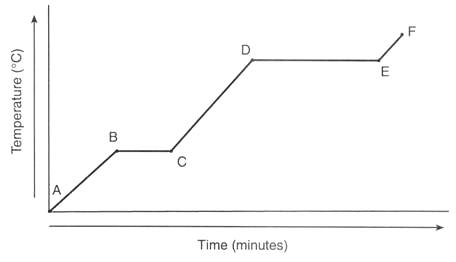
Between which points is the substance changing state?
a)
A-B only. 
b)
A-B, C-D, E-F
c)
B-C only. 
d)
B-C, D-E
9.
True or false: melting and freezing occur at the same temperature!
a)
True
b)
False
c)
I don't know
10.
A substance's heating curve is shown in the graph.  What is its boiling point?
a)
100 C
b)
60 C
c)
80 C
d)
20 C
11.
Which of these conditions is always true for an exothermic process?
a)
They leave the surroundings feeling cold
b)
They release energy into the surroundings.
c)
They absorb energy from the surroundings
d)
The reactants gain energy as they form the products
12.
Which of the following terms identifies the change from a liquid to gas?
a)
Vaporization
b)
Condensation
c)
Deposition
d)
Sublimation
13.
When the temperature of matter increases the particles...
a)
speed up and move closer
b)
speed up and move farther apart
c)
slow down and move closer together
d)
slow down and move farther apart
14.
What pressure does a 4000N horse exert on the ground if each foot is 10cm2?
a)
40 N/cm2
b)
100 N/cm2
c)
400 N/cm2
d)
10 N/cm2
15.
Which of these animals would probably cause the greatest pressure on the ground?
a)
A fat cow with big feet
b)
A fat cow with small feet
c)
 A calf with big feet
d)
A calf with small feet
16.

When the weight of an object is greater than the buoyant force, the object will ...

a)

Sink

b)

Float

c)

Expand

d)

Shrink

17.
The ship was able to float in the water because its weight was the same as the weight of the water it displaced.
a)
True
b)
False
18.
What happens when you heat a gas?
a)
It gains mass.
b)
It loses mass.
c)
It increases in volume.
d)
It decreases in volume.
19.

What is 50 degrees C in Kelvin?

a)

223 K

b)

323 K

c)

100 L

d)

50 :

20.
If 200 mL of a gas at 27°C is cooled to -33°C at a constant pressure, the volume will be
a)
250 mL
b)
204 mL
c)
196 mL
d)
160 mL
21.
The volume of a sample of a gas at 273 oC is 200 liters. If the volume is decreased to 100 liters at constant pressure, what will be the new temperature of the gas?
a)
0 K
b)
546 K
c)
273 K
d)
100 K
22.

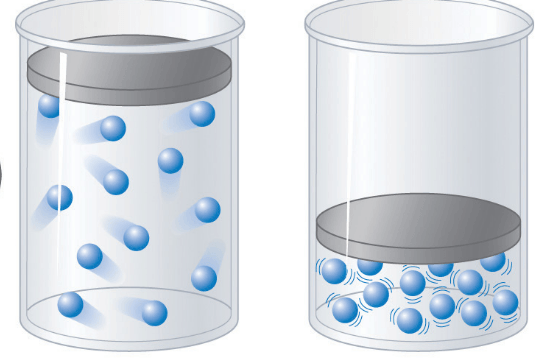
Which container will have a lower pressure?

a)

left

b)

right

c)

they both have the same pressure

d)

There is no relationship between volume and pressure.

23.
Flammability (burns): Chemical or Physical Property
a)
Chemical Property
b)
Physical Property
24.
Reacts with Acid: Chemical or Physical Property
a)
Chemical Property
b)
Physical Property
25.
Boiling Point: Chemical or Physical Property
a)
Chemical Property
b)
Physical Property
26.

Mass cannot be created or__________ during a chemical reaction.

a)

Reacted

b)

Transferred

c)

Born

d)

Destroyed

27.

Which compounds are the PRODUCTS of this reaction?

a)

CO2 + H2O

b)

C6H12O6 + O2

c)

C6H12O6 + CO2

d)

H2O + O2

28.

To balance a chemical equation, there must be the same number of atoms of each kind of element on both sides of the arrow.

a)

True

b)

False

29.

How many atoms of Al are in the PRODUCTS of this balanced equation?

a)

10

b)

2

c)

3

d)

4

30.

Which of these equations is correctly balanced?

a)

CH4 + 2 O2 -> CO2 + 2 H2O

b)

CH4 + O2 -> CO2 + 2 H2O

c)

3 CH4 + 2 O2 -> 3 CO2 + 2 H2O

d)

CH4 + O2 -> CO2 + H2O

31.
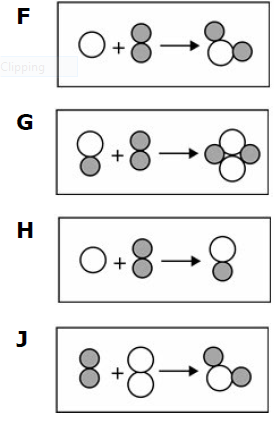
Which of the following models best demonstrates a balanced chemical equation?
a)
F
b)
G
c)
H
d)
J
32.
The formula below represents the most common carbohydrate known as glucose. Which information can be determined from the chemical formula?
C6H12O6
a)
The structural arrangement of the atoms in a glucose molecule
b)
The color of a glucose molecule
c)
The size of a glucose molecule
d)
The number of atoms of each element in a glucose molecule
33.
For an investigation a student poured a blue solution of CuSO4 into a beaker. The student placed a shiny, silver-colored strip of zinc metal in the solution and observed the changes.
The student inferred that a chemical reaction occurred. What evidence supports this inference?
a)
A dark solid formed on the zinc metal.
b)

The zinc metal remained silver-colored and shiny
c)
The CuSO4 solution turned blue when the zinc metal was added.
d)
None of these
34.
Coal contains carbon and other elements. Carbon dioxide forms when coal burns in the presence of oxygen. Which of these is the best evidence that a chemical reaction occurs when coal burns?
a)
The shape of the coal changes
b)
Oxygen is present
c)
A new substance is produced
d)
Coal is made up of more than one element
35.
4Si + S8 --> 2Si2S4
a)
Synthesis
b)
Decomposition
c)
Single displacement
d)
Double displacement
36.
3Ca + 2AlCl3 --> 3CaCl2 + 2Al
a)
Synthesis
b)
Decomposition
c)
Single diplacement
d)
Double displacement
37.
2Pb(NO3)2 --> 2PbO + 4NO2 + O2
a)
Synthesis 
b)
Decomposition
c)
Single displacement
d)
Combustion
38.

A reaction in which the system absorbs energy from its surroundings; usually in the form of heat

a)

Endothermic Reaction

b)

Exothermic Reaction

c)

Diffusion

d)

Fission

39.
Is burning wood a chemical or physical change?
a)
chemical
b)
physical
40.
The positive particles of an atom are 
a)
electrons 
b)
positrons 
c)
neutrons 
d)
protons 
41.
Particles in an atom that are neutral and have no charge are 
a)
negatrons 
b)
electrons 
c)
neutrons 
d)
protons 
42.
A particle that moves around the nucleus is a(n)...
a)
Proton
b)
Neutron
c)
Electron
d)
Quark
43.
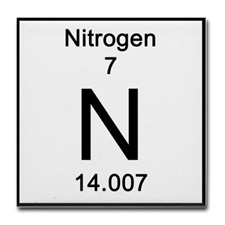
What is the number of protons that the element in this image contain?
a)
14
b)
7
c)
15
d)
18
44.
Ions are: 
a)
atoms with a positive or negative charge
b)
atoms with no charge
c)
atoms with ONLY a positive charge
d)
atoms with ONLY a negative charge
45.

Two atoms of the same element but with different mass numbers are called________

a)

electrons

b)

isotopes

c)

variables

d)

electron cloud

46.
How many neutrons does the isotope of lithium have?
a)
8
b)
3
c)
4
d)
5
47.

Pure forms of these group 1 elements are stored in oil so they won't react with oxygen and water in the air.

a)

Alkali Metals

b)

Alkaline-earth metals

c)

Halogens

d)

Noble Gases

48.
All of the actinides are ___________.
a)
stable
b)
radioactive
c)
shiny
d)
named after scientists
49.

Elements which are shiny, conduct electricity and heat are called

a)

metals

b)

nonmetals

c)

metalloids

d)

nonexistent

50.
Which is a halogen?
a)
Helium
b)
Chlorine
c)
Oxygen
d)
Neptune
51.
How many Valance electrons does Iodine Have?
a)
6
b)
16
c)
7
d)
17
52.
Group 18 elements are known as the _____ _____ and have full valence shells.
a)
royal gases.
b)
supreme solids.
c)
noble gases.
d)
legit liquids.
53.
How many electrons should Oxygen have around its Lewis dot model?
a)
5
b)
6
c)
7
d)
8
54.
A covalent bond is
a)
a bond that shares electrons metallicaly
b)
A bond that shares electrons with non metals
c)
Metalloids bonding
d)
metals and nonmetals bonding
55.
What is the correct formula for this molecule?
a)
NH
b)
N3H
c)
NH3
d)
NH4
56.

Identify the atom pictured.

a)

Helium

b)

Hydrogen

c)

Argon

d)

Silver

57.

Which electrons will be used for compound formation?

a)

The 2 inner energy level electrons.

b)

The 8 electrons on the 2nd energy level.

c)

The 3 electrons on the 3rd energy level.

d)

Aluminum does not form compounds.

58.
How many electrons are in the outer shell of Sodium?
a)
1
b)
8
c)
2
59.

Which of these have 8 valence electrons?

a)

Carbon

b)

Helium

c)

Neon

d)

Boron

60.
Which of these is least likely to bond?
a)
Hydrogen
b)
Potassium
c)
Argon
d)
Aluminum
61.

An atom of oxygen has 8 protons, 8 neutrons, and 8 electrons. If the oxygen atom gains 2 electrons to become an oxygen ion, what will its charge be?

a)

-2

b)

+2

c)

-8

d)

+8

62.

The oxidation number of Lithium is

a)

+1

b)

-1

c)

+3

d)

-7

63.

Holly has an unknown substance in a beaker. She wants to determine the relative pH of the unknown substance. She places a piece of red litmus paper into the substance, and the litmus paper turns blue.

The substance in the beaker

a)

is a base.

b)

has a neutral pH.

c)

is an acid.

d)

does not have a pH.

64.
The pH of a solution is tested, and it is found to be a basic solution. Of the following choices, what could the pH have been?
a)
3
b)
9
c)
7
d)
5
65.
Human blood has a pH between 7.35 and 7.45. Which of the following best describes human blood?
a)
strongly acidic
b)
slightly acidic
c)
strongly basic
d)
slightly basic
66.

When dissolved in water, acids produce:

a)

bases

b)

salts

c)

hydrogen ions and hydronium ions

d)

hydroxide ions

67.
Which type of ion does a base produce when it is dissolved in water?
a)
oxide
b)
oxygen
c)
hydrogen
d)
hydroxide
68.
What is a substance that is dissolved in another substance? 
a)
solution
b)
solute
c)
solvent
d)
compound
69.
What is a solvent?
a)
The substance that does the dissolving in a solution.
b)
The substance that is being dissolved in a solution.
c)
The mixing of different substances.
d)
The process in which neutral molecules lose or gain electrons
70.
The concentration of a mixture can be increased in which of the following ways?
a)
Heating the mixture
b)
Adding more water “solvent”
c)
Adding more powder “solute”
d)
Stirring the mixture
71.
A solution that is considered dilute would be....
a)
Dark in color
b)
Have a strong scent
c)
Have a large amount of solute
d)
Have a small amount of solute
72.

Salt water is a

a)

compound

b)

element

c)

heterogeneous mixture

d)

solution

73.
Another name for a homogeneous mixture is 
a)
an element.
b)
a solution.
c)
a compound.
74.
When Koolaid mix is light colored and tastes watery it is a _______ solution.
a)
saturated 
b)
diluted
75.

The reaction is _______________ and the temperature will _______________.

a)

exothermic; decrease

b)

exothermic; increase

c)

endothermic; decrease

d)

endothermic; increase

76.
Why can water have no net charge but have slight charges in different parts of the molecule?
a)
The oxygen end is slightly negative and the hydrogen end is slightly positive
b)
The hydrogen end is slightly negative and the oxygen end is slightly positive
c)
The hydrogen and oxygen ends change in polarity
d)
Because it is hydrophobic
77.
Which types of compounds dissolve easily in water?
a)
Polar and Nonpolar
b)
Polar and Ionic
c)
Nonpolar and Ionic
d)
Covalent and Nonpolar
78.
How many grams of K2Cr2O7, are soluble in 100 g of water at 95 ºC?
a)
83 grams
b)
75 grams
c)
40 grams
d)
12 grams
79.

Which of the following actions will NOT

increase the rate of dissolution

(dissolving)?

a)

Stirring the solution

b)

Decreasing the temperature

c)

Increasing the surface area of the

solute

d)

Increasing the temperature

80.

What is the percent composition of a sugar solution where 10 grams of sugar is added to 100 grams of water?

a)

.10%

b)

0.091%

c)

9.090909%

d)

10 %

81.
What mass of solute is needed to make 75.0 g of a 3.4% solution?
a)
2.55 g
b)
22 g
c)
0.05 g
82.

What is the molar mass of NaOH?

a)

40.00 g/mol

b)

38.99 g/mol

c)

23.00 g/mol

d)

57.00 g/mol

83.
chromium (III) nitrate
a)
Cr3N2
b)
Cr2N
c)
Cr2NO3
d)
Cr(NO3)3
84.
Lithium fluoride
a)
LiF
b)
LiF2
c)
Li2F
d)
Li2F3
85.
P2O5
a)
phosphorus oxide
b)
phosphorus (II) oxide
c)
diphosphorus pentoxide
d)
phosphorus pentoxide
86.
What is the correct name for the compound Al2S3?
a)
Aluminum sulfide
b)
Dialuminum trisulfide
c)
Trisulfur dialuminide 
d)
Aluminum sulfur
87.

Name the following ionic compound: MgSO4.

a)

magnesium sulfoxide

b)

magnesium sulfide

c)

magnesium sulfate

d)

magnesium oxide

88.

The chemical reaction pictured is happening in a closed container. Which of the following is demonstrated by the picture of the chemical reaction between sodium sulfate and calcium chloride?

a)

The total mass of the system is constant.

b)

Energy is converted to mass during the chemical reaction.

c)

The product has more particles than the reactant.

d)

The reactant has more particles than the product.