wayground logo

Free Printable Worksheets

Font size

S
M
L
XL
Worksheets

CA 2 Review

Total questions: 93

Worksheet time: 1hrs 24mins

Name
Class
Date
1.
A runner races in the 100 meter dash.  It takes her 10 seconds to finish.  What is her average speed?
a)
10 m/s
b)
1000 m/s
c)
100 seconds
d)
10 seconds
2.
A train travels 25 km in .5 hrs. How fast is the train going?
a)
25 miles/hr
b)
5 miles/hr
c)
125 km/hr
d)
50 km/hr
3.

What type of energy transformation occurs, when a hawk eats a mouse and then uses the energy from the mouse to fly?

a)

mechanical energy to chemical energy

b)

thermal energy to mechanical energy

c)

chemical energy to mechanical energy

d)

mechanical energy to thermal energy

4.

What is the energy transformation that occurs in an electric pencil sharpener?

a)

mechanical energy to electrical energy

b)

electrical energy to mechanical energy

c)

radiant energy to sound energy

d)

chemical energy to mechanical energy

5.

When a car burns gasoline it creates hot air to move the pistons in the engine, which causes the car to move. What energy transformation occur from the fuel to the movement of a car?

a)

thermal energy to mechanical energy

b)

thermal energy to chemical energy to mechanical energy

c)

chemical energy to thermal energy to mechanical energy

d)

chemical energy to electrical energy

6.

The roller coaster cart has the most kinetic energy at position-

a)

W

b)

X

c)

Y

d)

Z

7.

Where is the kinetic energy the greatest?

a)

A

b)

B

c)

C

d)

D

8.
What is the density of a liquid that has a mass of 27g and a volume of 30mL?
a)
0.9 g/mL
b)
3 g/mL
c)
57 g/mL
d)
810 g/mL
9.
An eraser has a mass of 4g and a volume of 2cm3. What is its density?
a)
8 g/cm3
b)
2 g/cm3
c)
1/2 g/cm3
d)
24 g/cm3
10.
Is this equation balanced?
a)
yes
b)
no
c)
Not enough information
d)
Left side is balanced
11.
Which problem is balanced?
a)
PbO2 + 2H2--> H2SO4
b)
SO2 + H20 --> H2SO4
c)
2Na + 2H2O --> 2NaOH + H2
d)
2Na + 2H2O --> 2NaOH + H
12.
Balance this equation.
_Mg + _Cl--> _MgCl2
a)
1, 2,1
b)
already balanced
c)
2,1,1
d)
1,1,2
13.
When the Earth spins around its own axis one whole time, it is called a ....
a)
Revolution
b)
Rotation
c)
Hemisphere
d)
Seasons
14.
Does the Moon travel around Earth or around the Sun?
a)
Earth
b)
Sun
15.
The rotation of the Earth causes . . .
a)
day & night
b)
summer & winter
c)
fall & spring
d)
Leap Year
16.
Which moon is this
a)
First Quarter
b)
Waxing gibbous
c)
Waning gibbous
d)
Third Quarter
17.
a)
waxing gibbous
b)
full moon
c)
new moon
d)
waning gibbous
18.
Which moon comes after the full moon?
a)
new moon
b)
waning gibbous
c)
waxing gibbous
d)
first quarter
19.
What is the biggest cause of ocean tides?
a)
sun's gravity
b)
Earth's gravity
c)
moon's gravity
d)
people swimming
20.
a)
full moon
b)
new moon
c)
third quarter
d)
first quarter
21.
when the moon is gaining light
a)
waning
b)
waxing
c)
crescent
d)
eclipse
22.
Moon is losing light
a)
waxing 
b)
crescent
c)
waning
d)
full
23.
a)
waxing 
b)
waning
24.
a)
Waxing
b)
Waning
25.
When the Northern Hemisphere of Earth is Leaning away from the Sun, What season is the Southern Hemisphere experiencing?
a)
Summer
b)
Winter
c)
Spring
d)
Fall
26.
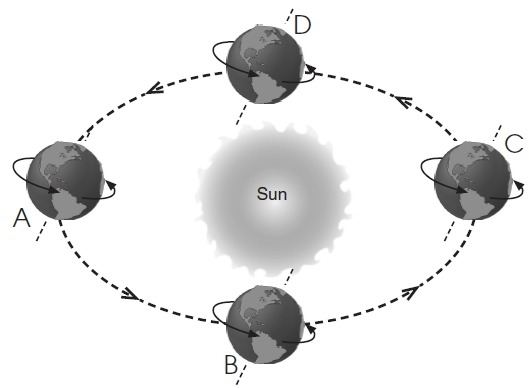
What season is it in the Northern Hemisphere at letter A?
a)
Winter
b)
Summer
c)
Spring
d)
Fall
27.
The earth orbits around...
a)
The sun.
b)
the moon
c)
other planets
d)
the Milky Way
28.
If the Earth rotated slower, how would that affect the length of the day?
a)
longer day
b)
shorter day
c)
same time,  24 hours
29.
What would happen if the Earth's axis was tilted at a greater angle than it is now? 
a)
Days would be more than 24 hours.
b)
Days would be less than 24 hours.
c)
Hotter summers, colder winters
d)
More tilt would not make a difference.
30.
When the Northern Hemisphere of Earth is leaning away from the Sun, What season is the Southern Hemisphere experiencing?
a)
Summer
b)
Winter
c)
Spring
d)
Fall
31.

Where is the element's atomic NUMBER located?

a)

the top

b)

the bottom

c)

the top + the bottom

d)

the number of protons + the number of neutrons

32.

What are the 3 subatomic particles of an atom?

a)

carbon atom, proton, electron

b)

quarks, neutrons, protons

c)

nucleus, protons, electrons

d)

protons, neutrons, electrons

33.

Which subatomic particle has a negative charge?

a)

proton

b)

neutron

c)

electron

34.

Which subatomic particle has a positive charge?

a)

proton

b)

neutron

c)

electron

35.

Which subatomic particle has a neutral or no charge?

a)

proton

b)

neutron

c)

electron

36.
a)
2
b)
8
c)
3
d)
13
37.
a)
2
b)
6
c)
10
d)
16
38.
What subatomic particle(s) would be found orbiting the nucleus?
a)
Neutrons only
b)
Electrons only
c)
Protons and Neutrons
d)
Protons and Electrons
39.

Valence electrons are the number of

a)

protons in the atom

b)

electrons in the atom

c)

protons + neutrons in the nucleus

d)

electrons in the outside shell of the atom

40.

Which star is hotter than Deneb

a)

Procyon

b)

Sun

c)

Regel

d)

Banard's Star

41.

Which star is brighter than the sun?

a)

Sirius B

b)

Procyon B

c)

Van Maanan's Star

d)

Aldebaran

42.

Which star is brighter than Alpha Centauri B, but dimmer than the sun?

a)

Pollux

b)

Spica

c)

Tau Ceti

d)

Mira

43.
In order for a hurricane to form, the water must be ________.
a)
Cool
b)
Warm
c)
Cold
d)
Hot
44.
The center of a hurricane is called the ______.
a)
center
b)
brain
c)
eye
d)
circle
45.
What provides the energy for hurricanes to be sustained?
a)
warm water
b)
cold air masses
c)
wind from Austrailia
d)
cold water
46.
What is the source for warming up ocean water?
a)
the sun
b)
water movement
c)
wind
d)
fish peeing in the ocean water
47.
a)
Warm Front
b)
High Air Pressure
c)
Cold Front
d)
High Temperatures
48.
Low Pressure is associated with this type of weather...
a)
Cloudy/Overcast Weather
b)
Cold Weather
c)
Warm Weather
d)
Fair Weather
49.
High Pressure is associated with this type of weather...
a)
Cloudy/Overcast Weather
b)
Cold Weather
c)
Warm Weather
d)
Fair Weather
50.
A cold front moving into an area can bring this type of weather...
a)
Warmer Temperatures, Clear Skies
b)
Colder Temperatures, Clear Skies
c)
Warmer Temperatures, Clouds
d)
Colder Temperatures, Clouds, and Precipitation
51.
____________ air sinks/falls because it is ____________dense.
a)
Cold, More
b)
Warm, Less
c)
Cold, Less
d)
Warm, More
52.
This Symbol is associated with a _____________________Front.
a)
Warm
b)
Occluded
c)
Cold
d)
Stationary
53.
This picture represents the symbol for a __________________________Front.
a)
Warm
b)
Occluded
c)
Cold
d)
Stationary
54.
A cold front is approaching Minneapolis. What will happen to the air temperature?
a)
stay the same
b)
increase
c)
decrease
55.
The Moon gets its light from the
a)
Earth
b)
Stars
c)
Sun
56.
About how long does it take the Moon to complete it's cycle?
a)
1 week
b)
1 month
c)
1 year
57.
When the Moon is between the Earth and the Sun, it is most likely in what phase?
a)
New
b)
3rd Quarter
c)
Full
58.
If a 10 kilogram object accelerates suddenly at 15 m/s2, how much force was applied to the object?
a)
150 Newtons
b)
15 Newtons
c)
150 kilograms
d)
100 kilograms
59.

You are moving a dresser that has a mass of 36kg. Its acceleration is 0.5 m/s2. What is the force being applied?

a)

72 N

b)

35.5 N

c)

1.8 N

d)

18 N

60.

Which of the following is not an acceleration?

a)

a. Turning your bike around a corner

b)

b. Applying the breaks as you approach an intersection

c)

c. Pedaling faster to beat a read light.

d)

d. Riding your bike straight down the street at a constant speed.

61.
What is this graph showing?
a)
Constant Speed
b)
Acceleration (speeding up)
c)
Deceleration (slowing down)
d)
No motion
62.
What does this graph represent?
a)
Constant speed
b)
Acceleration
c)
Not moving
63.
During what segments is the object returning to the reference point?
a)
A to B
b)
B to C
c)
C to D
d)
D to E
64.
How fast is the object traveling between points B and C?
a)
1 km/hr
b)
0 km/hr
c)
There is no way to tell from this graph
d)
0.9 km/hr
65.
What is the speed of this object at 3 seconds?
a)
5 m/s
b)
45 m/s
c)
5 s/m
d)
45 s/m
66.
What is the speed of the object shown in the graph?
a)
A)2 m/s  
b)
B)4 m/s
c)
C)1 m/s
d)
 D)10 m 
67.

How many different elements are in the compound?

a)

12

b)

3

c)

24

d)

6

68.

How many elements are in this compound?

a)

13

b)

6

c)

4

d)

3

69.
Classify the picture with the correct label.
a)
Element
b)
Compound
c)
Mixture of Elements and Compounds
d)
Mixture of Elements
70.
Classify the picture with the correct label.
a)
Compounds
b)
Mixture of Elements
c)
Mixture of Compounds
d)
Mixture of Elements & Compounds
71.
Classify the picture with the correct label.
a)
Element
b)
Compound
c)
Mixture of Elements and Compounds
d)
Mixture of Elements
72.
Classify the picture with the correct label.
a)
Element
b)
Compound
c)
Mixture of Elements
d)
Mixture of Compounds
73.
a)
Balanced
b)
Unbalanced
74.
a)
Balanced
b)
Unbalanced
75.

These forces are...

a)

Balanced

b)

Unbalanced

76.

These forces are...

a)

Balanced

b)

Unbalanced

77.

Which of the following statements is true?

a)

Balanced forces cause a change in motion.

b)

Unbalanced forces cause a change in motion.

c)

Forces do not effect the change in motion.

78.
Which could be an example of an unbalanced force?
a)
A plate sitting on a dining table
b)
A ball at the top of a hill that is not moving
c)
Earth orbiting the Sun 
d)
A baseball that has been thrown to home plate.
79.
Which could be an example of a balanced force?
a)
An asteroid moving at a constant speed through space 
b)
A car accelerating from a stop sign
c)
A box of dishes falling from a counter 
d)
A rocket taking off 
80.

Which of the following objects will experience an unbalanced force?

a)

A bike rider on a smooth and level road, pedaling at a constant rate.

b)

A train pulling on another train, each with the same amount of force.

c)

A chair sitting on the floor with balanced forces acting in opposite directions.

d)

A ball rolling across the floor with friction acting in the opposite direction.
81.
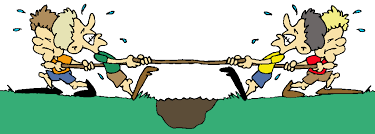
If these teams are pulling with the same amount of force what will happen?
a)
The boy in blue will win.
b)
They will not move at all.
c)
The boy in red will win.
d)
Both will fall down.
82.
One of the signs of a chemical reaction taking place is:
a)
Bubbles are produced 
b)
Reactants are not combining
c)
Products are not forming
d)
Color is not changing
83.
Which of the following describes a precipitate?
a)
a liquid forms when a block of metal is heated
b)
a solid forms when one liquid is poured into another
c)
a gas forms when a solid is placed in a liquid
d)
bubbles form when an acid is poured on a rock
84.
Which is NOT an indication of a chemical change?
a)
temperature change
b)
formation of a precipitate
c)
shape change
d)
production of light
85.
You know you a chemical reaction has occurred if 
a)
there is a precipitate.
b)
there is a color change.
c)
there is a temperature change.
d)
All of these answers are evidence.
86.
Which of the following is an example that includes evidence of a chemical reaction?
a)
A sample of zinc is placed in water and it settles to the bottom
b)
A solid block of ice is heated and it completely melts into a liquid. 
c)
Sugar that is burned gives off an odor and turns brown and then black.
d)
A tomato is placed into a blender and chopped up into smaller pieces.
87.

UP and DOWN columns on the periodic table are

a)

groups

b)

periods

88.

SIDE TO SIDE rows on the periodic table are

a)

groups

b)

periods

89.

Which elements have properties in common?

a)

elements in a group

b)

elements in a period

90.

The group number tells you the number of

a)

protons

b)

valence electrons

c)

energy levels

91.

The period number tells you the number of

a)

protons

b)

energy levels

c)

valence electrons

92.

Which two elements have properties in common?

a)

Nitrogen and Phosphorous

b)

Oxygen and Nitrogen

c)

Sulfur and Nitrogen

93.

How many electrons does Lithium have?

a)

3

b)

4

c)

7