
 Worksheets
Unit 2: Earth's History, Evolution, and Genetics
Total questions: 88
Worksheet time: 1hrs 6mins
the theory that species change over time. It can refer to the changes in a particular population or to the formation and extinction of species over the course of Earth’s history.
(a)
a distinguishing quality or characteristic of a person or thing.
(a)
any inherited trait that gives an organism an advantage in its particular environment.
(a)
body parts or behaviors that have lost their original purpose over time due to evolution. They are remnants from an ancestor that were once functional but are now reduced in size or purpose in a modern species.
Vestigial structures
Homologous Structures
Analogous Structures
Comparative Anatomy
body parts that are similar in different animals because they have a common ancestor, even if they are now used for different functions.
Vestigial structures
Homologous Structures
Analogous Structures
Comparative Anatomy
body parts that look different but do the same job for different animals because they evolved to solve the same problem.
Vestigial structures
Homologous Structures
Analogous Structures
Comparative Anatomy
the study of the similarities and differences in the anatomy of different species to understand their evolutionary relationships.
Vestigial structures
Homologous Structures
Analogous Structures
Comparative Anatomy
an organism that two or more different species or groups evolved from.
Homologous structure
Natural selection
Common ancestor
Genetic variation
the differences in DNA between individuals of the same species, which cause them to have unique traits like eye color or height.
Homologous structure
Natural selection
Common ancestor
Genetic variation
when members of a species that are best suited to their environment survive and reproduce at a higher rate than other members of the species.
Homologous structure
Natural selection
Common ancestor
Genetic variation
a permanent change in the genetic material (DNA) of an organism.
Common ancestor
mutation
trait
Adaptation
the geologic principle stating that in an undisturbed sequence of layered rocks, the oldest layers are at the bottom and the youngest are at the top.
Uniformitarianism
Law of Superposition
Cross-cutting relationships
Sedimentary rock
the principle that any geological feature that cuts across other rocks or structures must be younger than the features it cuts.
Uniformitarianism
Law of Superposition
Cross-cutting relationships
Sedimentary rock
the theory that the processes shaping Earth today, such as erosion, also shaped Earth in the past, and that these processes cause large changes over geologic time.
Uniformitarianism
Law of Superposition
Cross-cutting relationships
Sedimentary rock
forms from layers of sediment, such as sand or mud.
Sedimentary rock
Igneous rock
Metamorphic rock
Igneous intrusion
forms from existing rocks that have been transformed by heat and pressure without melting.
Sedimentary rock
Igneous rock
Metamorphic rock
Igneous intrusion
forms when molten rock cools (magma or lava).
Sedimentary rock
Igneous rock
Metamorphic rock
Igneous intrusion
when magma cools and solidifies BEFORE reaching the surface.
Sedimentary rock
Igneous rock
Metamorphic rock
Igneous intrusion
a break in the Earth's crust where blocks of rock move past each other.
Fault
Pangea
Continental Drift
Plate Tectonics
a hypothetical supercontinent that included all of the landmasses on Earth. It began breaking apart about 200 million years ago.
Fault
Pangea
Continental Drift
Plate Tectonics
the hypothesis that Earth’s continents move on Earth’s surface.
Fault
Pangea
Continental Drift
Plate Tectonics
the theory that Earth's outer shell is divided into large, rigid plates that are constantly moving.
Fault
Pangea
Continental Drift
Plate Tectonics
traces or remains of living things from long ago.
(a)
the actual age of an event or object.
absolute age
relative age
the age of an event or object in relation to other events or objects.
absolute age
relative age
a fossil of an organism that was common, lived in many areas, and existed only during a certain span of time. Index fossils are used to help determine the age of rock layers.
(a)


Whales have pelvic bones. What type of structure does this best represent?
Homologous structure
Analogous structure
Vestigial structure
None of the above

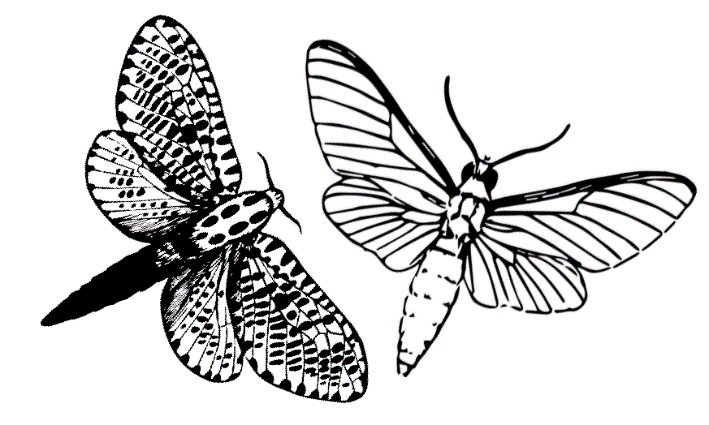
This image illustrates what type of structure
Homologous
Analogous
Vestigial
Bone

According the Law of Superposition, which layer has the most modern fossil in it?
Layer A
Layer B
Layer C

According to the Law of Superposition, which layer has the oldest fossil in it?
Layer A
Layer B
Layer C
The Law of Superposition helps us understand the age of fossils compared to other fossils.
true
false
Organisms with the Advantageous traits will
Die and go extinct
survive and reproduce

This is an example of
Homologous structure
Functional adaption
Structural adaption
Analogous structure
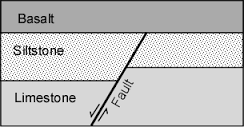

Which layer is OLDER? Layer E or Intrusion A?
Layer E
Intrusion A


Which part is the youngest?
C
F
the fault

Which part is the oldest?
C
the fault
F

Which part is the youngest?
F
E
D
C

Layer V is younger than layer X.
true
false

The intrusion is younger than layer Y.
true
false

Which part is the oldest?
W
X
Y
Z


Which represents the YOUNGEST rock layer?
B
C
D
E
Igneous intrusions are always ______ than the rocks they cut through.
younger
older

c
a
b
d
Gaps in rock layers.
Angular Unconformities
Cross-Cutting
Unconformities
Inclusions


You find shark tooth and fish fossils in an area that is now a forest. What can you infer about the history of this place?
The area was once a valley
The area was once a desert
The area was once covered in ice
The area was once an ocean
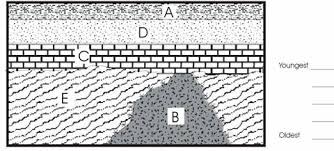

Which of the following letters represents an intrusion?
A
B
C
D
E

Which statement is correct regarding the relative age of the rock layers?
Layers P and J are the same age because they are on top.
Layers K and Q are the same age because they are both below the top layer.
Layers L and R are the same age because they are the same rock.
Layers M and R are the same age because they contain the same index fossils.
Index fossils must meet two criteria, they must have existed for a short period of time and...
be few in numbers
be widely distributed
lived for a long time
be really old in age

In what order were the rock layers likely deposited over time?
1, 2, 3, 4, 5, 6
5, 4, 3, 2, 1, 6
5, 4, 3, 6, 2, 1
6, 5, 4, 3, 2, 1

Several teeth were found in an area of flat land covered with trees and plants. The teeth were examined by a paleontologist, and it was determined that the teeth came from a shark. They found many other shark teeth in this area. However, the people who discovered the teeth were puzzled. There was no source of water near where the fossils were found. (8-LS4-1)
What is the paleontologist's BEST explanation for why the teeth were found in this area?
This area was once covered with saltwater.
Someone buried the shark teeth deep in the ground.
This area was once covered with freshwater.
Sharks used to live on flat land.

If scientists find fossils of a type of mosquito on the bottom layer and find fossils of beetles towards the top layer, what can scientists infer?
Mosquitos ate the beetles
Mosquitos are older fossils than beetles
Beetles are older fossils than mosquitos
Both mosquitos and Beetles must have lived at the same time.
If natural selection means "survival of the fittest", what does it mean to be "fit"?
you can migrate to new areas
you have a large territory
you can reproduce and pass on your genes
you have more genetic mutations
Wisdom teeth have no purpose and are often removed to make room for the other teeth. Wisdom teeth are
homologous structures
vestigial structures
analogous structures
Charles Darwin observed the plants and animals on his voyage to which of the following
The Galapagos Islands
South America
Hawaii
The South Pacific
Which of the following is most closely linked to Charles Darwin's concept of natural selection?
Predator-prey relationships influence change among organisms
Survival of the Fittest
Competition strongly influences change among organisms
Survival of the nicest
Which of the following best describes an adaptation?
A tight bundle of genetic material in the nucleus of cells
A segment of DNA that codes for a trait
A harmful trait that hurts an organism's chance of survival
trait that allows an organism to be better suit for survival

Darwin found the following finches on the Galapagos islands. What best describes why they have different beaks?
Genetic variation has made it possible for birds to feed on different forms of food due to their beak shape.
Genetic variation has made it possible for larger eyes on the birds to see.
Genetic variation has made it possible for the birds to camouflage themselves on the island.
Genetic has made it possible for the birds to feed at different times of the day due to competition.
Cats, dogs, humans, wales, birds and bats all have the same bones in their arms, wings and fins. How do we use this to support the "Theory of Evolution?"
Evidence they evolved from a common ancestor.
Evidence they evolved separately from each other.
Evidence they all evolved on different continents.
Evidence they all came from the same mom.
Geological evidence shows that the same fossils from the same living organism were found in Australia, China, South America and North America. Which best explains this?
All of these continents were once connected as a supercontinent called Pangea.
The same organism evolved separately on each continent.
Global climate change forced the organism to migrate.
Rocks containing these fossils were moved by ocean currents.
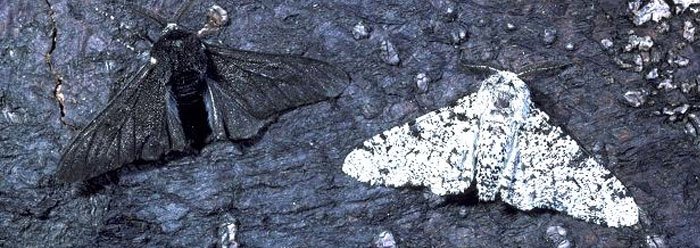
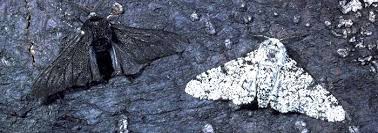
According to natural selection, light colored tree trunks would favor
light colored moths
dark colored moths
red colored moths
red and light colored moths

How do we measure the age of a fossil in years?
variation
absolute dating
selection
mutation

What is relative dating?
when you use radioactive isotopes
when you find a fossil’s exact age
when you take your cousin to prom
when you estimate a fossil’s age in sedimentary rock
_____ is referred to as survival of the fittest.
natural selection
mutating
evolution
adapting

Review the diagram showing a fault located among layers of sedimentary rock. What is the relative age of the fault?
The fault is older than layer B
The fault is older than layer C..
The fault is older than layer E.
The fault is older than layer F.
By studying fossil records, scientists have concluded that the horses that lived 50 million years ago were much smaller, weaker, and slower than modern horses. Which natural process is responsible for the evolutionary changes that have lead to increased size, strength, and speed in horses?
inbreeding
migration
mutualism
natural selection
Which type of rock is formed by the cooling and solidification of magma or lava?
Igneous rock
Fault rock
Sedimentary rock
Metamorphic rock
What is the term for a structure in different species that has a similar function but a different evolutionary origin?
Homologous structure
Analogous structure
Vestigial structure
Comparative anatomy
Which principle states that the oldest rock layers are found at the bottom of an undisturbed sequence?
Absolute dating
Uniformitarianism
Law of Superposition
Cross-cutting relationships

What does this graph demonstrate?
Cortisol levels
Natural selection
Both populations increased
Drought is causing the moths to become smaller

How do environmental pressures influence evolution?
They have no effect on evolution
They cause organisms to move to new environments
They select for organisms that are better adapted to survive and reproduce
They decrease genetic variation within a species
In a meadow, there are two colors of cone flowers: Pink and yellow. The bees and other pollinators seem to be more attracted to the pink flower and visit the pink flowers more often than the yellow flowers. Over time there are more pink flowers in the meadow than yellow. What principle is at work here?
speciation
environmental pressure
natural selection
homologous structures

You want to decide the absolute age of the fossil at the top, which of these statements is right? " Be careful absolute age!)
The fossil at top layer is younger that the one at the bottom
The fossil at the top lived between 60 and 200 millions years ago
The fossil at the top is 500 million years in age
It is not possible to know because there is no way to tell the absolute age of the rocks surrounding it

