
 Worksheets
Unit 8 Exam - Waves
Total questions: 86
Worksheet time: 1hrs 22mins
_____ waves NEED a medium to travel.
Seismic
Light
Mechanical
Radio Waves are an example of _________ waves.
mechanical
electromagnetic
light
The distance in between two waves.
wave speed
frequency
wavelength
Frequency is always measured in _________
kilometers
Hertz
centimeters
the number of waves that pass a certain point.
wave speed
frequency
when a wave hits a barrier and bounces
diffraction
reflection
You're in your room blasting music with the door shut, your mom opens your door. Now your music is heard throughout your home. This is an example of _______
interference
diffraction
reflection
When two waves overlap each other, this behavior is known as _______.
interference
refraction
frequency
If the amplitude increases during interference, this is __________
destructive interference
constructive interference

This is a high frequency wave. Which part of the wave is "B"
crest/peak
wavelength
trough

Look at this wave. "A" is which part of a wave?
Crest/Peak
Wave Speed
Resting Point

Which wave has the longest wave length?
top wave
bottom wave

Does this wave have a high frequency or low frequency?
High
Low
What is transferred from place to place by waves?
matter
energy
particles
light

What does the arrow in the picture represent?
amplitude
wavelength
frequency
trough

What does the arrow in the picture represent?
wavelength
echolocation
amplitude
peak
If the amplitude increases, the energy of the wave:
increases
decreases
stays the same
The highest point of a wave is called what?
trough
wavelength
peak
amplitude
Waves that require a medium to travel are:
mechanical waves
transverse waves
electromagnetic waves
light waves
What happens when you increase the amplitude of a sound?
it makes the sound louder
it makes the sound travel faster
it makes the sound softer
it changes the pitch or note of the sound

What kind of wave is pictured below?
compressional wave
transverse wave
longitudinal wave
mechanical wave
What can electromagnetic waves travel through (select all that apply)?
solids
empty space
liquids
gases

Which wave is pictured?
Transverse
Longitudinal
Electromagnetic
Light
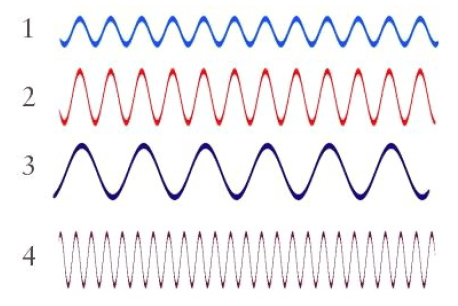
Which wave in the diagram has the greatest frequency?
1
2
3
4
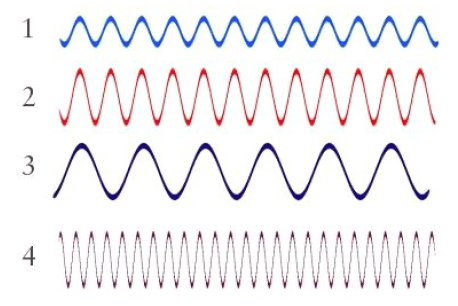
Which wave in the diagram has the longest wavelength?
1
2
3
4
Which of the following can a mechanical wave travel through (select all that apply)?
solid
liquid
gas
empty space
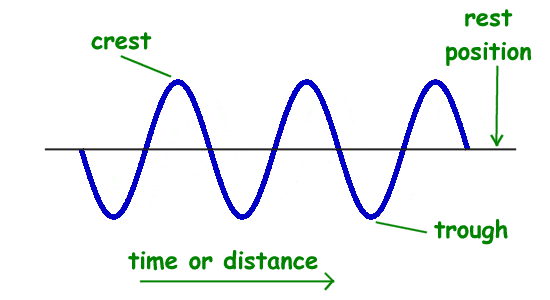
What is measured from crest to crest or trough to trough?
mediums
resting position
wavelength
origin
If a wave has a greater frequency, what happens to the wavelength?
increases
decreases
stays the same
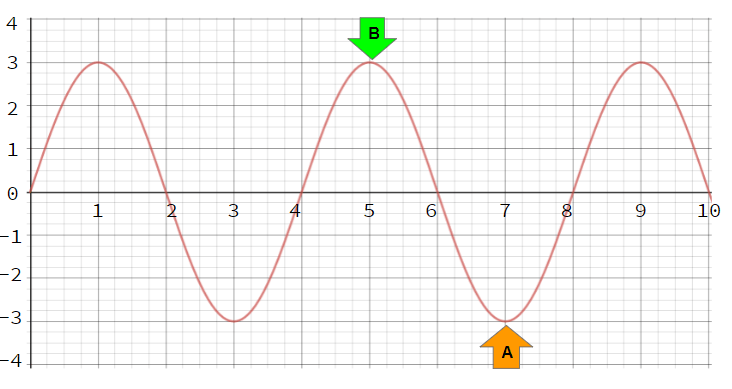
What property does the orange arrow (A) represent?
Crest
Trough
Wavelength
Peak
This sound has high pitch, which means it has a(n):
Higher frequency
Lower frequency
Higher amplitude
Lower amplitude
How are the frequency of a wave and the period related?
They both equal the wavelength.
They are both the inverse of the wavelength.
They are the inverse of each other
They are both related to the amplitude.
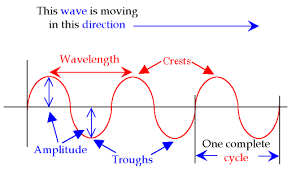
One hertz is equal to:
1 cycle or wave per second
the distance from crest to crest or trough to trough
the distance from one rarefaction to the next rarefaction.
the maximum displacement of the wave
Longitudinal waves move __________ to the energy of the wave (select all that apply).
Parallel
Perpendicular
At a 90 degree angle
In the same direction
Transverse waves move __________ to the energy in the wave (select all that apply).
Parallel
Perpendicular
At 90 degree angle
In the same direction
The area of a longitudinal wave where particles are pushed close together are called:
rarefactions
compressions
amplitude
wavelength
The areas of a longitudinal waves where particles are spread far apart from each other are called:
rarefactions
compressions
amplitude
wavelength
Sound waves can travel through a vacuum because they don't require particles.
True
False
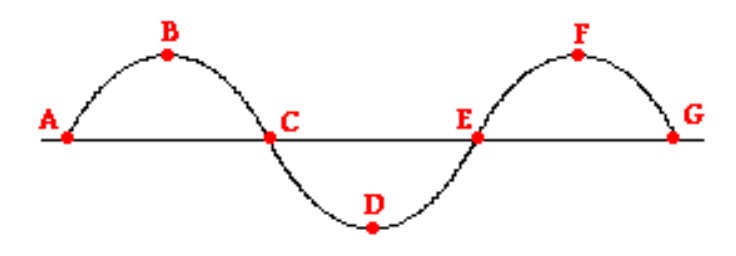
Which letter(s) represent the rest position of the wave (select all that apply)?
A & C
B & F
E & G
D
What is the definition of reflection?
The bending of waves as they enter a new medium
Bouncing back of waves from a surface that it can’t pass through
The bending of waves as they pass through openings or around corners
When two interfering waves have a displacement in the same direction, two crests and two troughs overlap. Increased amplitude.
What is the definition of refraction?
The bending of waves as they enter a new medium
When two interfering waves have a displacement in the opposite direction, crest and trough overlap. Zero amplitude.
When two interfering waves have a displacement in the same direction, two crests and two troughs overlap. Increased amplitude.


Light waves and sound waves are similar in that...
They are both longitudinal waves
They are both transverse waves
They both transmit energy
They both can travel through space.
As light travels through a lens it causes an object to appear larger, this is due to which behavior?
Transmission
Reflection
Absorption
Refraction


A guitar string vibrates with a frequency of 320 hz. If the wavelength of the vibration is 0.23 meters what is the speed of the wave?
320.23 m/s
1391.3 hz
73.6 m/hz
73.6 m/s

Sound is a form of energy produced by ______________.
Vibrations
Distances
Prisms
Forces
As the temperature of a medium increases, the sound waves will travel ____________.
Faster
Slower
As the same speed
True or False: The speed of sound depends on the loudness of the sound.
True
False
True or False: Sound waves can travel through space.
True
False
Sound waves travel the fastest through _______.
Gases
Solids
Liquids
Plasma
Sound waves are _______ waves.
Transverse
Seismic
Longitudinal
Slow
True or False: Sound waves are produced when something vibrates.
True
False
True or False: According to the Doppler Effect, if an sound source is moving TOWARDS you, the pitch should be getting higher.
True
False
True or False: The higher the pitch, the lower the frequency.
True
False
Pitch is _____.
How often a sound wave occurs
How high or low a sound seems to be
The energy behind a wave
Sound intensity is measured in _____.
Hertz
Nanometers
Decibels
The amount of energy a wave carries is the _________.
Amplitude
Height
Loudness
Volume


When the three primary colors mix they produce?
Red, Green, Blue
Black
White
Magenta, Yellow, Cyan

Which images are opaque?
A & C
A,C,E, & F
D, E, & F
A & E
Material that allows light to pass through allowing you to see "clearly" to the other side.
opaque
translucent
transparent

Which electromagnetic wave has the highest ENERGY?
Sound
Microwaves
X Rays
Gamma radiation
What type of light does sunblock actually block?
Radio waves
Ultraviolet
Visible Light
Infrared Light

