wayground logo

Free Printable Worksheets

Font size

S
M
L
XL
Worksheets

P-3: Waves Review

Total questions: 89

Worksheet time: 1hrs 21mins

Name
Class
Date
1.
What is the resulting direction of a surface wave?
a)
parallel
b)
circular
c)
opposite
d)
perpendicular
2.
Which type of wave has a wave perpedicular to the disturbance?
a)
surface
b)
mechanical
c)
transverse
d)
longitudinal
3.
What happens when a mechanical wave travels through a medium?
a)
Waves are transferred
b)
Energy is transferred
c)
Mass is transferred
d)
Particles are transferred
4.
Energy can be transferred from one medium to another through _________.
a)
vibrations
b)
stacking objects
c)
an ordered sequence
d)
colors
5.
Which of these waves cannot travel in a vacuum?
a)
light wave
b)
sound wave
c)
electromagnetic wave
d)
microwave
6.
Which is true of a mechanical wave?
a)
It must have a medium
b)
It must travel in empty space.
c)
It can travel in a vacuum.
d)
Both sound and light are examples.
7.
What is the amplitude of a wave?
a)
the amount of time that occurs in one full cycle
b)
the distance traveled by the wave during one full cycle
c)
the amount of cycles that occur in a given time
d)
the size of the disturbance
8.
What is the wavelength of a wave?
a)
the size of the disturbance
b)
the amount of time that occurs in one full cycle
c)
the distance between two crests of a wave
d)
the amount of cycles that occur in a given time
9.
Unlike a transverse wave, the disturbance in a longitudinal wave is
a)
in a circular motion.
b)
parallel to the wave motion.
c)
perpendicular to the wave motion.
d)
in the opposite direction of the wave motion
10.
Unlike a longitudinal wave, the disturbance in a transverse wave is
a)
perpendicular to the wave motion.
b)
in a circular motion.
c)
parallel to the wave motion.
d)
in the opposite direction of the wave motion.
11.
What is the speed of a wave if the wavelength is 100 m and the period is 20 s?
a)
2,000 m/s
b)
120 m/s
c)
80 m/s
d)
5 m/s
12.
What is the period of a wave if the wavelength is 100 m and the speed is 200 m/s?
a)
200,000 s
b)
0.5 s
c)
2 s
d)
100 s
13.

Waves that require a medium are known as

a)

Medium waves

b)

Mechanical waves

c)

Air waves

d)

Heat waves

14.

The material through which a wave travels is?

a)

a rope

b)

water wave

c)

snaves

d)

medium

15.

A disturbance involving the transfer of energy

a)

ocean

b)

wavelength

c)

wave

d)

snapes

16.

A wave that vibrates medium at right angles

a)

longitudinal

b)

crest

c)

trough

d)

transverse

17.

The high point of a transverse wave is called a

a)

crest

b)

peak

c)

gnarly wave

d)

sloth

18.

A low point of a transverse wave is known as a

a)

downside

b)

well

c)

trough

d)

flop

19.

An area where coils are close together

a)

compression

b)

compressor

c)

conductor

d)

composer

20.

An area where coils are far apart

a)

rarefaction

b)

raresteak

c)

rarefind

d)

faction

21.
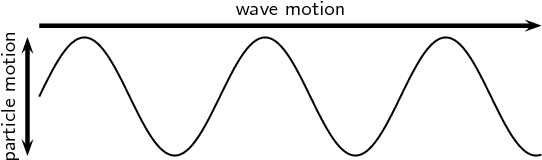
What kind of wave is pictured below?
a)
compressional wave
b)
transverse wave
c)
sound wave
d)
mechanical wave
22.
Waves are a transfer of what?
a)
Heat
b)
Light
c)
Energy
d)
Food
23.
Amplitude reflects the amount of ____________________ in a wave.
a)
energy
b)
compression
c)
rarefaction
d)
speed
24.
The units for frequency are measured in _____________.
a)
hertz
b)
seconds
c)
m/s
d)
m
25.
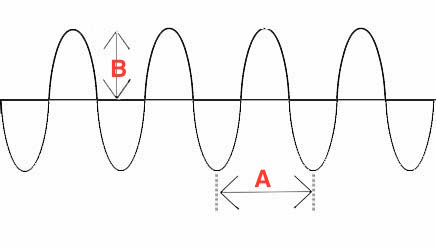
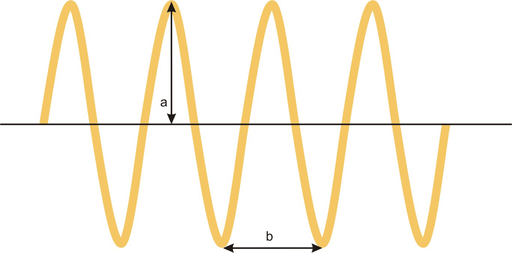
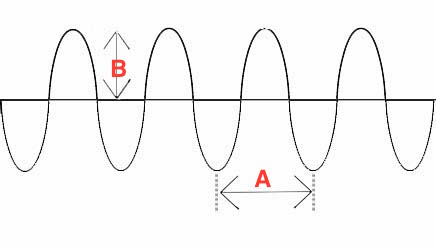
What property of this wave is represented by the letter "A"
a)
amplitude
b)
crest
c)
trough
d)
wavelength
26.
The number of wavelengths that pass a point each per second is:
a)
frequency
b)
period
c)
longitudinal 
d)
transverse wave 
27.
The type of waves that require medium to pass:
a)
Mechanical Waves
b)
Electromagnetic Waves
28.
When the frequency of a wave increases, what happens to the wavelength?
a)
The wavelength is not directly affected by the frequency of a wave.
b)
The wavelength increases.
c)
The wavelength decreases.
d)
More specific information is needed to form a conclusion about the wavelength.
29.
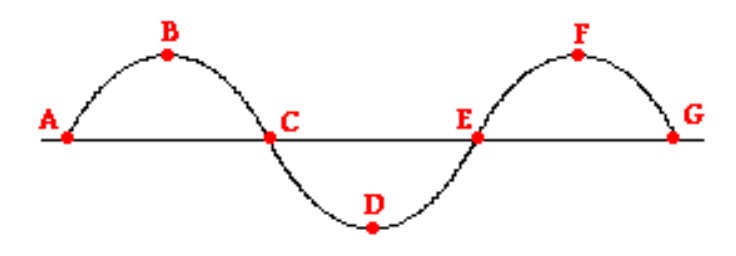
Which letter(s) represent the trough of the wave?
a)
A
b)
B & D
c)
D
d)
C & G
30.
Which letter(s) represent the crest of the wave?
a)
A
b)
B & D
c)
B & F
d)
F
31.
Which of the following can sound travel through?
a)
solid
b)
liquid
c)
gas
d)
all of the above
32.
What is the speed of a sound wave that has a frequency of 250 hertz and a wavelength of 8 meters? 
a)
31 m/s
b)
250 m/s
c)
2000 m/s
d)
5280 m/s
33.
The SI unit for frequency is ________.
a)
m
b)
m/s
c)
hertz
d)
s
34.
How many waves are in this wave chain?
a)
6
b)
3
c)
4
d)
5
35.
 A wave has frequency of 50 Hz and a wavelength of 10 m. What is the speed of the wave?
a)
500 m/s
b)
50 m/s
c)
5 m/s
d)
0.5 m/s
36.
This is an example of which type of wave behavior?
a)
Reflection
b)
Refraction
c)
Diffraction
d)
Interference
37.
This is an example of which type of wave behavior?
a)
Reflection
b)
Refraction
c)
Diffraction
d)
Interference
38.
This is an example of which type of wave behavior?
a)
Reflection
b)
Refraction
c)
Diffraction
d)
Interference
39.
This is an example of which type of wave behavior?
a)
Reflection
b)
Diffraction
c)
Constructive Interference
d)
Destructive Interference
40.
What kind of wave is pictured below?
a)
compressional wave
b)
transverse wave
c)
sound wave
d)
mechanical wave
41.
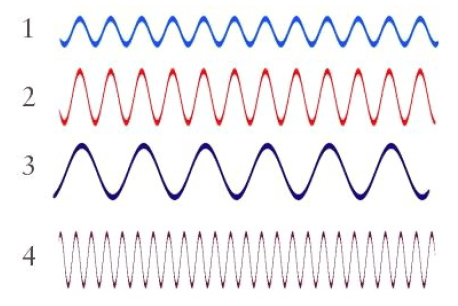
Which wave in the diagram has the greatest frequency?
a)
1
b)
2
c)
3
d)
4
42.
which material does sound travel the fastest?
a)
solid 
b)
liquid 
c)
gases
43.
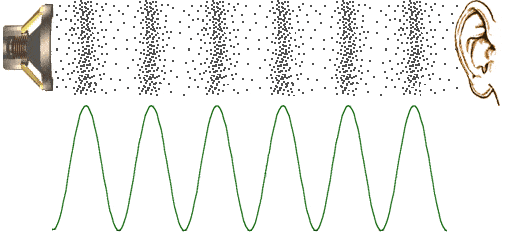
What are the spaced out sections of this wave called?
a)
Reflections
b)
Rarefactions
c)
Compressions
d)
Wavelengths
44.

The ___________________ of waves change when the waves move from one medium to another.

a)

frequency

b)

amplitude

c)

speed

d)

compression

45.
When the frequency of a wave increases, what happens to the wavelength if the medium is unchanged?
a)
The wavelength is not directly affected by the frequency of a wave.
b)
The wavelength increases.
c)
The wavelength decreases.
d)
More specific information is needed to form a conclusion about the wavelength.
46.
A mechanical wave cannot travel through...
a)
a vacuum(empty space).
b)
water.
c)
air. 
d)
glass.
47.
Sound is an example of which type of wave?
a)
Transverse
b)
Longitudinal
c)
Both
d)
Neither
48.

(a)   refers to the change in

observed frequency during the relative

motion between a wave source and its

observer.

49.

What property of a sound wave is a sound's volume related to?

a)

Period

b)

Frequency

c)

Amplitude

d)

Wavelength

50.

Which property of a sound wave is related to the pitch of the sound?

a)

Period

b)

Frequency

c)

Amplitude

d)

Wavelength

51.

Through which of these media do sound waves travel most slowly?

a)

Air

b)

Water

c)

Metal

d)

Silver

52.

A mechanical wave is traveling through medium A. When the wave enters medium B,it speeds up. Which of these statements could be true about medium A and medium B?

a)

Medium A is a solid and medium B is a gas

b)

Medium A is a liquid and medium B is a solid

c)

Medium A is a liquid and medium B is a vacuum

d)

Medium A is a vacuum and medium B is a liquid

53.

Which type of waves must have a medium in order to travel?

a)

electromagnetic wave

b)

mechanical wave

54.
All waves carry
a)
energy
b)
light 
c)
matter
d)
particles
55.

Mechanical waves usually travel fastest through:

a)

solids

b)

liquids

c)

gases

56.
What is a medium?
a)
something between a small and a large?
b)
the substance through which a wave can travel
c)
a pattern of vibration that simulates when a wave is standing still
d)
the distance from any point on a wave to an identical point on the next wave
57.

What type of wave is this?

a)

Electromagnetic

b)

Mechanical

c)

Both Electromagnetic and Mechanical

58.
What do you have at 10^3?
Wavelength Not Frequency
a)
Microwaves
b)
Infrared
c)
Radio
d)
X-Ray
59.
What do you have at 10^-5?
Wavelength Not Frequency
a)
Microwaves
b)
Infrared
c)
Radio
d)
X-Ray
60.
What do you have at 10^-2?
Wavelength Not Frequency
a)
Microwaves
b)
Infrared
c)
Radio
d)
X-Ray
61.
Which electromagnetic waves have the highest frequencies and the shortest wavelengths?
a)
microwaves
b)
visible light
c)
gamma rays
62.
Which electromagnetic waves are used in ovens and cell phone communications?
a)
Infrared rays
b)
ultraviolet rays
c)
microwaves
63.
Which type of waves are used in broadcasting?
a)
radio waves
b)
infrared rays
c)
x-rays
64.
Electromagnetic waves that help your body produce vitamin D are called?
a)
ultraviolet rays
b)
x-rays
c)
gamma rays
65.
How much of the electromagnetic spectrum is made up of visible light?
a)
only a small portion
b)
a very l;arge portion
c)
about half
66.
Which of the following has wavelengths longer than microwaves?
a)
Infrared waves
b)
Radio waves
c)
Visible light
67.
Which electromagnetic waves allow us to diagnose & treat cancer?
a)
Gamma rays
b)
X-rays
c)
Ultraviolet rays
68.
The electromagnetic spectrum includes the complete range of electromagnetic waves placed in order of:
a)
increasing amplitutde
b)
increasing wavelength
c)
increasing frequency
69.
Which of the following has frequencies higher than ultraviolet rays?
a)
visible light
b)
infrared rays
c)
x-rays
70.
Which electromagnetic waves help doctors detect broken bones inside your body?
a)
gamma rays
b)
x-rays
c)
ultraviolet rays
71.
Which of the following lists the electromagnetic waves in order of increasing wavelength?
a)
X-rays, visible light, radio waves
b)
gamma rays, microwaves, UV rays
c)
infrared rays, radio waves, x-rays
72.
Which of the following lists the electromagnetic waves in order of decreasing frequency?
a)
X-rays, microwaves, infrared rays
b)
UV rays, visible light, x-rays
c)
infrared rays, microwaves, radio waves
73.

The waves with the longest wavelength in the electromagnetic spectrum are...

a)

X-rays

b)

Infrared waves

c)

Gamma rays

d)

Radio waves

74.

Electromagnetic waves vary in...

a)

The way they reflect.

b)

The speed they travel in a vacuum.

c)

Wavelength and frequency.

d)

The orientation of their electric and magnetic fields.

75.

Which of the following occurs as a light wave bends when it passes from on medium to another?

a)

constructive interference

b)

refraction

c)

reflection

d)

destructive interference

76.

Light acts as...

a)

a wave

b)

both a wave and a particle

c)

a particle

d)

neither a wave or a particle

77.

To calculate the frequency of an electromagnetic wave, you need to know the speed of the wave and it's...

a)

amplitude

b)

intensity

c)

wavelength

d)

refraction

78.

Cellular phones utilize...

a)

microwaves

b)

radar waves

c)

very high frequency waves

d)

very low frequency waves

79.

Which type of wave can cause your skin to age prematurely?

a)

Ultraviolet waves

b)

radio waves

c)

X-rays

80.
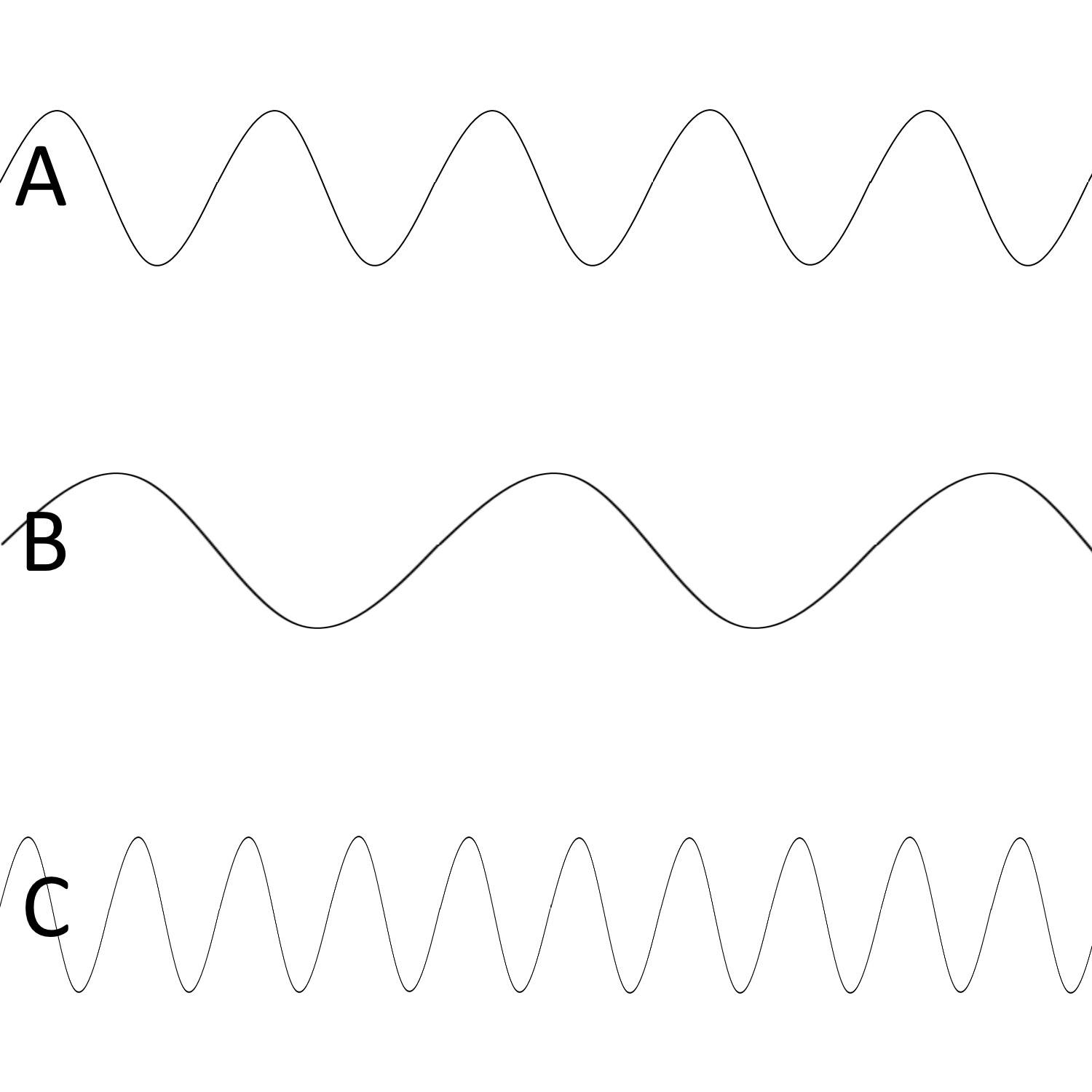
Which wave has the largest wavelength?
a)
A
b)
B
c)
C
d)
None (same wavelength)
81.
Which type of light has the highest energy of this group?
a)
red
b)
yellow
c)
green
d)
blue
82.
Visible light can be separated into various colors to form a (an) __________. 
a)
Spectrum
b)
Thermogram
c)
MRI
d)
X-Ray Picture 
83.
What property of the wave is represented by the letter "B"?
a)
amplitude
b)
crest
c)
trough
d)
wavelength
84.

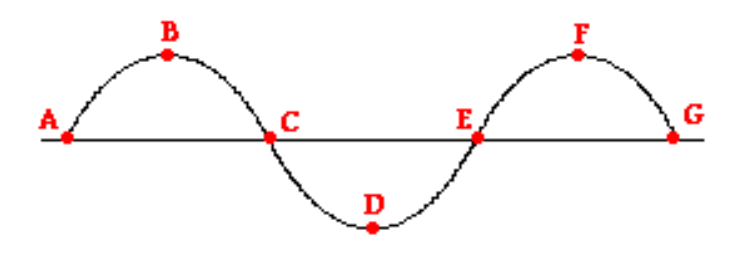
A wavelength is the distance between which 2 points?

a)

B and G

b)

A and C

c)

C and F

d)

A and H

85.

The following diagram shows a wave that begins with a ________frequency and transitions to a ________frequency.

a)

low, high

b)

high, low

c)

high, high

d)

None of these

86.
The shortest wavelength in visible light is______.
a)
violet
b)
red
c)
blue
d)
yellow
87.
This color in the visible part of the spectrum has the lowest energy. 
a)
Blue
b)
Green
c)
Red
d)
Violet
88.
This color in the visible part of the spectrum has the smallest wavelength.
a)
Blue
b)
Red
c)
Violet
d)
Yellow
89.

How are Electromagnetic waves different from Mechanical waves?

a)

EM waves have very short wavelengths

b)

EM waves transmit energy instead of matter

c)

EM waves can travel through the vacuum of space (without particles)

d)

EM waves can change direction by reflection