wayground logo

Free Printable Worksheets

Font size

S
M
L
XL
Worksheets

Structure and Function of DNA

Total questions: 87

Worksheet time: 2hrs 41mins

Name
Class
Date
1.
In DNA, Adenine bonds with ______________.
a)
Guanine
b)
Thymine
c)
Cytosine
d)
Adenine
2.
Guanine bonds with ______________.
a)
Adenine
b)
Guanine
c)
Cytosine
d)
Thymine
3.
What does DNA stand for?
a)
Deoxyribonucleic acid
b)
Denitrogenous acid
c)
Deribonucleic acid
d)
Diribonucleic acid
4.
Which organelle is DNA usually found in?
a)
cell membrane
b)
vacuole
c)
ribosome
d)
nucleus
5.

DNA is an acronym for _____

a)

Diphosphorus Nucleic Acid

b)

Ribose Nucleic Acid

c)

Deoxyribonucleic Acid

d)

Deoxyribonucleic Acetate

6.
Which of the following best describes a DNA molecule?
a)
double helix
b)
contains ribose
c)
made of amino acids
d)
contains Uracil
7.
What are the 4 nitrogen bases?
a)
adenine, thymine, cytoplasm, and guanine
b)
adenine, thymine cytosine, and guanine
c)
adenine, thymine, cytosine, and gylcerol
d)
adenine, thymine, cytosine, and glucose
8.
Which 2 molecules forms the sides (backbone) of the DNA ladder?
a)
deoxyribose and adenine
b)
deoxyribose and a hydrogen bond
c)
sugar and the nucleus
d)
deoxyribose (sugar) and phosphate
9.

Which of the following is not found in DNA?

a)

Thymine

b)

Guanine

c)

Uracil

d)

Cytosine

10.
adenine, guanine, cytosine, and thymine are known as
a)
sugars
b)
phosphates
c)
lipids
d)
nitrogen bases
11.
How many different varieties of nitrogen bases are used to build DNA
a)
1
b)
4
c)
8
d)
12
12.

A nucleotide is composed of

a)

A phosphate, sugar and nitrogenous base

b)

A protein, protein and Guanine

c)

A phosphate, Adenine, and nitrogenous base

d)

A protein, Adenine and nitrogenous base

13.

Which of the following is a base pair?

a)

Adenine - Cytosine

b)

Cytosine - Thymine

c)

Deoxyribose - Cytosine

d)

Cytosine - Guanine

14.

The weak bonds between base pairs is a ___

a)

Covalent Bond

b)

Polar Bond

c)

Non Polar Bond

d)

Hydrogen

15.
Which sequence of DNA bases would pair with this partial strand
ATG TGA CAG
a)
ATG TGA CAG
b)
TAC ACT GTC
c)
GTA AGT GAC
d)
CAT TCA CTG
16.
Which of the following units are repeatedly joined together to form a strand of DNA?
a)
amino acids
b)
nucleotides
c)
fatty acids
d)
polysaccharides
17.
In a molecule of double-stranded DNA, the amount of Adenine present is always equal to the amount of
a)
cytosine
b)
guanine
c)
thymine
d)
uracil
18.
Guanine bonds with ______________.
a)
Adenine
b)
Guanine
c)
Cytosine
d)
Thymine
19.
Why is DNA important?
a)
it is very small and very complicated
b)
it's in everything
c)
it serves as the blueprint for traits of all living things
d)
because we eat it every day for energy
20.
Which 2 molecules form the sides (backbone) of the DNA ladder?
a)
deoxyribose sugar and adenine
b)
deoxyribose sugar and a hydrogen bond
c)
deoxyribose sugar and the nucleus
d)
deoxyribose sugar and phosphate
21.
Which organelle is DNA usually found in?
a)
cell membrane
b)
vacuole
c)
chloroplast
d)
nucleus
22.
Name this structure
a)
double helix
b)
nucelotide
c)
twisted ladder
d)
hydrogen bond
23.
Nitrogenous bases are joined by which type of bond?
a)
polar bonds
b)
ionic bonds
c)
covalent bonds
d)
hydrogen bonds
24.
Nucleotides are made up of a sugar, phosphate, and..?
a)
nitrogenous base
b)
nucleic acid
c)
cholesterol
d)
fatty acid
25.
Which of the following units are repeatedly joined together to form a strand of DNA? (This is the MONOMER of DNA.) 
a)
amino acids
b)
nucleotides
c)
fatty acids
d)
polysaccharides
26.
Adenine bonds with ______________.
a)
Guanine
b)
Thymine
c)
Cytosine
d)
Adenine
27.
What are the 4 nitrogen bases?
a)
adenine, thymine, cytoplasm, and guanine
b)
adenine, thymine cytosine, and guanine
c)
adenine, thymine, cytosine, and gylcerol
d)
adenine, thymine, cytosine, and glucose
28.
Replicate the following strand of DNA: 
AATCATGGA
a)
AATCATGGA
b)
TTAGTACCT
c)
UUAGUACCU
d)
GGATAUCUA
29.
The sugar in DNA is ?
a)
sucrose
b)
glucose
c)
deoxyribose
d)
fructose
30.

DNA is called the "blueprint of life" because

a)

it is like a fingerprint

b)

it has a blue color

c)

it contains the plans for building an organism

d)

it can relay messages to other molecules

31.
Which sequence of DNA bases would pair with this partial strand
CAT TCA CTG
a)
ATG TGA CAG
b)
TAC ACT GTC
c)
GTA AGT GAC
d)
CAT TCA CTG
32.
order of replication
a)
3, 4, 2, 1
b)
3, 1, 4, 2
c)
2, 1, 4, 3
d)
3, 4, 1, 2
33.
A process in which DNA has the unique ability to make an exact copy of itself.
a)
Replication
b)
Translation
c)
Transcription
34.
Why does DNA replicate?
a)
To create another copy for the new cell
b)
To create a duplicate copy in case the original gets damaged
c)
To create a new copy to replace the damaged original
35.

DNA replication results in

a)

2 completely new DNA molecules

b)

2 DNA molecules that each contain a strand of the original

c)

1 new DNA molecule and 1 old

d)

1 new molecule of DNA

36.

Enzyme that breaks hydrogen bonds (unzips)

a)

Ligase

b)

Polymerase

c)

Primase

d)

Helicase

37.

The new DNA strand formed after DNA replication is an exact copy of its parent strand

a)

True

b)

False

38.
A DNA nucleotide contains all of the following, except...
a)
Deoxyribose
b)
Phosphate group
c)
Nitrogenous base
d)
Cholesterol
39.
Which of the following units are repeatedly joined together to form a strand of DNA?
a)
amino acids
b)
nucleotides
c)
fatty acids
d)
polysaccharides
40.

The picture below shows the steps of DNA replication beginning with step one and ending with step three.


​Because you are reusing the old, or parent, DNA strand DNA replication is said to be

a)

Semi- Conservative

b)

Semi-discontinuous

c)

Continuous

d)

Fully-Conserveative

41.

Which enzyme is responsible for adding the free nucleotides to the replicating DNA? ​

a)

DNA Helicase

b)

DNA Ligase

c)

DNA polyermase

d)

RNA Polymerase

42.

Which enzyme uncoils the twisted DNA?

a)

Topoisomerase

b)

DNA polymerase

c)

Helicase

d)

Primase

43.

What enzyme is represented by the letter D?

a)

Topoisomerase

b)

DNA Polymerase

c)

Primase

d)

Helicase

44.

What enzyme is represented by the letter A?

a)

Topoisomerase

b)

DNA Polymerase

c)

Primase

d)

Helicase

45.

What enzyme is represented by the letter B?

a)

Topoisomerase

b)

DNA Polymerase

c)

Primase

d)

Helicase

46.

What enzyme is represented by the letter C?

a)

Topoisomerase

b)

DNA Polymerase

c)

Primase

d)

Helicase

47.

What do you called the strand of DNA represented by the letter F?

a)

Parent Strand

b)

Daughter Strand

c)

Leading Strand

d)

Lagging Strand

48.

What do you called the strands of DNA represented by the letter E?

a)

Parent Strand

b)

Daughter Strand

c)

Leading Strand

d)

Lagging Strand

49.
In RNA, Uracil pairs with ______. 
a)
cytosine
b)
adenine
c)
guanine
d)
thymine
50.
The process to go from DNA to mRNA is _______
a)
translation
b)
transcription
c)
replication
51.
The process to go from mRNA to a protein is called ____
a)
transcription
b)
rRNA
c)
replication
d)
translation
52.
What process is going on in this photo? 
a)
Transcription 
b)
Translation 
c)
Replication 
d)
All the above 
53.
How many amino acids are coded for by this sequence of nucleotides:
ATG GGA ACT CCA
a)
4
b)
2
c)
6
d)
12
54.
What is the three base sequence of mRNA that codes for a single amino acid?
a)
Anticodon
b)
Codon
c)
Protein
55.
The mRNA leaves the ________ to find the ribosome to make proteins.
a)
cell
b)
nucleotide
c)
nucleus
56.

A small organelle in the cell on which proteins are assembled, It is a type of protein.

a)

Mitochondria

b)

Ribosome

c)

Nucleus

d)

Lysosome

57.
Which statement is describing the process of protein synthesis?
a)
DNA is copied into mRNA which is translated into protein
b)
DNA is copied into DNA
c)
DNA is copied into lysosome
58.
DNA sequence ACCTG produces which mRNA strand? 
a)
UGGAC
b)
TGGAC
c)
GTCCA
59.
Contains the bases adenine, uracil, cytosine and guanine
a)
DNA
b)
RNA
c)
Both
60.

Transcribe the following DNA strand: CTG AAT

a)

GAC TTA

b)

CTG AAT

c)

GAC UUA

d)

CUG AAU

61.
In DNA, Adenine pairs with ___________. 
a)
Guanine
b)
Cytosine
c)
Thymine
d)
Uracil
62.

DNA holds the code for making

a)

lipids

b)

carbohydrates

c)

proteins

d)

sugars

63.

Choose the sequence of the mRNA strand that would be match up with to the following strand:

GTAGTCA

a)

UATUAGA

b)

ACGACTG

c)

CAUCAGU

d)

CATCAGT

64.
The main function of tRNA is to...
a)
carry a message that, when translated, forms proteins
b)
form a portion of ribosomes
c)
string together complementary RNA and DNA strands
d)
bring amino acids from the cytoplasm to the ribosomes
65.
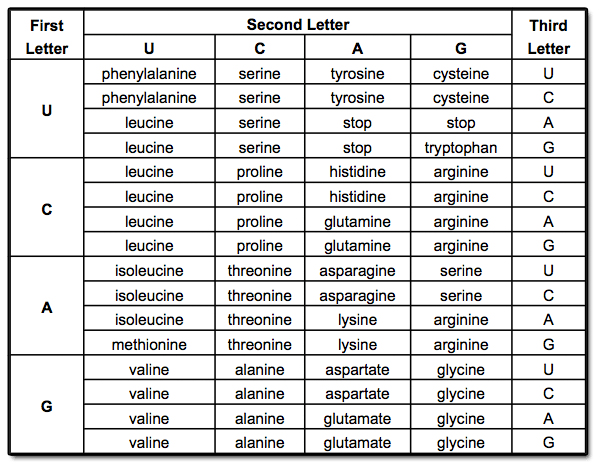
What amino acid is represented by the codon UUA?
a)
Phenylalanine
b)
Tyrosine
c)
Leucine
d)
Stop codon
66.

Which is the mRNA molecule that would be created from this DNA template:

TGGCAAGTACGT

a)

ACCGTTCATGCA

b)

UGGCAAGUACGU

c)

UCCGUUCUUGCU

d)

ACCGUUCAUGCA

67.
DNA travels outside of the nucleus.
a)
true
b)
false
68.
Messenger RNA carries a copy of the DNA code.
a)
true
b)
false
69.
Where do cells get the information to make proteins?
a)
RNA
b)
DNA
c)
phosphate group
70.

What process is steps 1-3 referring to?

a)

DNA Replication

b)

Transcription

c)

Translation

d)

Nucleus

71.

What is 11. pointing to?

a)

Cytoplasm

b)

Ribosome

c)

mRNA

d)

Nucleus

72.

What process is step 12 referring to?

a)

DNA Replication

b)

Transcription

c)

Translation

d)

Nucleus

73.

What does tRNA carry to the ribosome?

a)

Nucleus

b)

Codons

c)

Amino Acids

d)

None of the Above

74.

How many codons equals 1 amino acid?

a)

1

b)

2

c)

3

d)

4

75.

How do you know when to begin translating a strand of mRNA?

a)

look for AUG

b)

start at the beginning

c)

look for ATG

d)

when the teacher says so!!!

76.
Does the order of amino acids in a protein matter?
a)
YES!
b)
NO!
77.

What mutation has occurred here?

T-G-A-C-C-A

T-G-A-G-C-A

a)

Substitution

b)

Deletion

c)

Insertion

d)

Frameshift

78.

DNA molecule segment is : TTACGCAAG

The mutated DNA segment is TTACGCAAC. This is an example of ___ mutation.

a)

Substitution

b)

Insertion

c)

Inversion

d)

Translocation

79.
Any change in the sequence of DNA is...
a)
transgenic shift
b)
Single Genotype
c)
Monohybrid Trait
d)
Mutation
80.

ATT-TGA-GCC- Original

ATT-GAG-CC - Mutated

The example above is an example of a

a)

Insertion- Frameshift

b)

Deletion- Substitution

c)

Deletion -Frameshift

d)

All of the above

81.

DNA molecule segment is : TTA-CGC-AAG

The mutated DNA segment is TTC-GCA-AG. This is an example of ___ mutation.

a)

Substitution

b)

Deletion

c)

Insertion

d)

Inversion

82.

Original DNA: CAT GAT CCA

New DNA: CAT TGA TCC A

What mutation occurred?

a)

deletion

b)

substitution

c)

tranverse

d)

insertion

83.
Original: ATC CAT
Mutation: ATC GCAT
What mutation occurred?
a)
deletion
b)
insertion
c)
silent
d)
transverse
84.
Which of the following would result in a frameshift mutation?
a)
Insertions only
b)
Substitution only
c)
Deletion only
d)
Insertions and Deletions
85.

What type of gene mutation has occurred here? Normal-

AGA-TTC-ATA-GCG

Mutant-

AGA-TTC-AAT-AGC-G

a)

deletion frameshift

b)

insertion frameshift

c)

substitution

d)

nonsense

86.

Why are insertion and deletion mutations so harmful?

a)

They change all of the codons from the mutation on down the line, which changes the amino acid sequence

b)

They insert things that an organism doesn't need.

c)

They often delete things that organisms need.

d)

Insertion and deletions are not any more harmful than substitution mutations.

87.

What do gene mutations change?

a)

DNA

b)

RNA

c)

Proteins

d)

Lipids