
 Worksheets
After STAAR - Day 2
Total questions: 84
Worksheet time: 1hrs 8mins
Name
Class
Date
1.

What is the elevation of point B?
a)
800 ft
b)
850 ft
c)
900 ft
d)
1000 ft
2.

What is the elevation of the peak of the small island on the left side?
a)
About 20 meters
b)
About 40 meters
c)
About 60 meters
d)
About 200 meters
3.

What is the elevation of A?
a)
10 meters
b)
20 meters
c)
40 meters
d)
120 meters
4.

What feature is formed at B?
a)
river
b)
rift valley
c)
sink hole
d)
mountain
5.

If we were in a plane, Path B --> C is about the same distance as path E --> N. But, which path is the easier walk?
a)
B --> C is the easier walk
b)
E --> N is the easier walk
c)
B --> C and E --> N are the same walking distance
6.
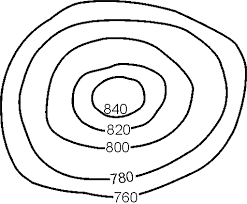
Determine the contour interval:
a)
5 m
b)
10 m
c)
15 m
d)
20 m
7.
What do contour lines that are farther apart represent?
a)
waterfall
b)
steep area
c)
gentle slope
d)
river
8.

How many mountain tops does this map have?
a)
one
b)
two
c)
three
d)
four
9.

What would be the most likely way this coastline would change over time?
a)
A fire could destroy the vegetation
b)
The waves could erode the beach
c)
The beach would grow due to deposition
d)
The beach will disappear due to plate tectonics
10.

A part of a river that curves is called a "meander". Meanders can change over time by becoming more pronounced. What has been an effect of this process over time that you can see in the image?
a)
The river is beginning to disappear due to erosion
b)
The river is getting longer over time due to deposition
c)
The river is slowing down in speed because of the meanders
d)
Sediment builds up on one side of the river bed as the water moves around the curve
11.

Based on the satellite image, how will this area most likely change?
a)
Much of the vegetation will be destroyed by a fire
b)
Much of the land is being melted due to hot spots in the crust
c)
A tornado is likely to destroy the region
d)
The river will flood, causing widespread damage
12.
Deltas forming at the mouths of rivers would be an example of...
a)
Weathering
b)
Erosion
c)
Deposition
d)
Preposition
13.
Wind blowing sand from one location to another is an example of...
a)
Weathering
b)
Erosion
c)
Deposition
d)
Sand dunes
14.
Glaciers scraping rocks across the earth’s surface is an example of...
a)
Weathering
b)
Erosion
c)
Deposition
d)
Sea Floor Spreading
15.

Which land form on the the right does topographic map 4 represent?
a)
C
b)
D
c)
E
d)
F
16.
Which of the following occurs because of convection currents?
a)
Tectonic plates on the crust move.
b)
The mantle increases in size.
c)
Pressure in the crust increases.
d)
Pressure in the crust decreases.
17.
Mountains form from ...
a)
plates sliding past one another
b)
collision of plates
c)
plates moving away from each other
18.
The area around the pacific plate where boundaries form is called...
a)
death ring
b)
fire zone
c)
ring of fire
d)
zone of fire
19.
Associated with transform boundaries.
a)
Volcanoes
b)
mountains
c)
trenches
d)
earthquakes
20.
What happens to temperature as you go deeper in the Earth?
a)
decreases
b)
increases
c)
fluctuates
d)
remains the same
21.
Which is true about hotter material in the mantle?
a)
more dense, sinks
b)
less dense, sinks
c)
less dense, rises
d)
more dense, rises
22.
This land formation occurs at a divergent continental/ continental boundary.
a)
mid ocean ridge
b)
deep ocean trench
c)
pacific hot spot
d)
rift valley
23.
Which of the following is where one plate slides under another plate?
a)
submarine zone
b)
divergence zone
c)
subduction zone
d)
lower zone
24.
Created by a divergent boundary.
a)
Rocky Mountains
b)
Mariana Trench
c)
Mid Atlantic ridge
25.
Which of the following did not support continental drift?
a)
magnetic striping on the ocean floor
b)
identical fossils on continents
c)
mountain ranges
d)
coastlines fit like a puzzle
26.

Which season is taking place in the Northern Hemisphere in Position 3?
a)
Winter
b)
Spring
c)
Summer
d)
Fall
27.

Which season is taking place in the Northern Hemisphere in Position 4?
a)
Winter
b)
Spring
c)
Summer
d)
Fall
28.

At position A, which hemisphere would have summer?
a)
Northern hemisphere
b)
Southern hemisphere
29.

What happens when the area in which you live tilts away from the sun?
a)
It is summer.
b)
It is spring.
c)
It is winter.
d)
It is fall.
30.
The term equinox means....
a)
equal amount of day light and equal amount of night
b)
Equal amount of winter and summer
c)
Equal amounts of hot dogs for everyone
d)
The longest day of the year
31.
Why do we experience the changing of the season on the earth?
a)
distance from the sun
b)
rotation of the earth
c)
change in solar output
d)
tilt of the earth's axix
32.

Why is the Equator warmest?
a)
Because it is closest to the sun.
b)
Because it receives the most direct sunlight
c)
Because no clouds form here.
d)
Because it is far from the sun
33.
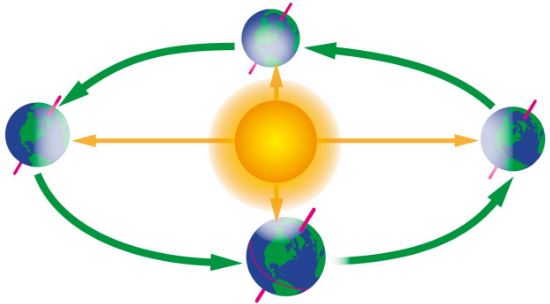
In spring/summer, the axis of the earth is pointed away or toward the sun?
a)
towards
b)
Neither away or toward
c)
away
34.
The spinning of an object on its axis is called______
a)
orbit
b)
rotation
c)
revolution
d)
tide
35.
Day and night is caused by the _____________ of earth on its axis.
a)
revolution
b)
orbit
c)
rotation
36.
The earth orbits around...
a)
the sun.
b)
the moon
c)
other planets
d)
the Milky Way
37.
What are the reasons for the seasons?
a)
Earth's tilt and rotation.
b)
Earth's rotation and revolution.
c)
Earth's tilt and revolution.
d)
Earth's tilt and resolution
38.
What is a gibbous moon?
a)
Shows more than half of the bright side of the moon
b)
Shows less than half of the bright side of the moon
c)
Shows a quarter of the bright side of the moon
d)
Shows a full bright moon
39.
What is the crescent moon?
a)
Shows more than half of the bright side of the moon.
b)
Shows less than half of the bright side of the moon.
c)
Shows a full moon
40.
What direction does the moon orbit the earth?
a)
Clockwise
b)
Counterclockwise
c)
Depends on the season
d)
I have no idea!
41.
full of light
a)
new moon
b)
1st Quarter
c)
full moon
d)
3rd Quarter
42.

a)
New moon
b)
Full moon
c)
1st Quarter
d)
3rd Quarter
43.

a)
New moon
b)
Full moon
c)
1st Quarter
d)
3rd Quarter
44.

a)
Waxing Crescent
b)
Waning Crescent
c)
Waxing Gibbous
d)
Waning Gibbous
45.

a)
Waxing Crescent
b)
Waning Crescent
c)
Waxing Gibbous
d)
Waning Gibbous
46.

a)
Waxing Crescent
b)
Waning Crescent
c)
Waxing Gibbous
d)
Waning Gibbous
47.

Waning means to be...
a)
Going away
b)
Growing
c)
Gaining light
d)
Moving
48.

Waxing means...
a)
Growing
b)
Dying
c)
Losing light
d)
Moving
49.

What is the next phase?
a)
New Moon
b)
Last Quarter
c)
Waxing Gibbous
d)
Waning Crescent
50.

The Earth rotates every...
a)
12 hours
b)
365 days
c)
24 hours
d)
366 days
51.
A[n] ______________ tide occurs when the sun is at right angles to the line between Earth and the moon.
a)
high
b)
neap
c)
low
d)
spring
52.
Differences in the moon's and sun's pull on different sides of the Earth cause _________.
a)
gravity
b)
lunar phases
c)
tides
d)
dabbing
53.
A[n] ___________ tide occurs when the sun, Earth, and the moon are nearly in a line.
a)
spring
b)
high
c)
low
d)
neap
54.
The bulge of water on the side of the Earth closest to the moon produces ___________.
a)
high tide
b)
low tide
c)
neap tide
d)
spring tide
55.
What force causes tides to happen on the earth?
a)
The pull of the gravity from the moon on the earth
b)
People jumping up and down on the surface of the earth
c)
The sun orbiting around the earth
d)
The animals in the ocean
56.

What type of tides would this arrangement of earth-moon-sun create?
a)
neap tide
b)
spring tide
c)
new moon tide
d)
full moon tide
57.

What type of tide would this arrangement of earth-moon-sun create?
a)
full moon tide
b)
new moon tide
c)
neap tide
d)
spring tide
58.

What type of galaxy is this?
a)
Spiral
b)
Elliptical
c)
Irregular
d)
Irrational
59.

What type of galaxy is this?
a)
Spiral
b)
Elliptical
c)
Irregular
d)
Irrational
60.

What type of galaxy is this?
a)
Spiral
b)
Elliptical
c)
Irregular
d)
Irrational
61.
All stars begin as a __________?
a)
giant
b)
black hole
c)
white dwarf
d)
nebula
62.
Our Galaxy is called the
a)
M38
b)
Milky Way Galaxy
c)
Andromeda Galaxy
d)
Pinwheel Galaxy
63.
A large celestial body that is composed of gas and that emits light.
a)
star
b)
black hole
c)
element
d)
big bang
64.
The distance that light travels in one year; about 9.46 trillion kilometers.
a)
Light Year
b)
Light Kilometer
c)
Light Second
d)
Warp Speed
65.
Which of the following is the largest?
a)
star
b)
universe
c)
cluster
d)
galaxy
66.
Light Years are a measure of -
a)
time
b)
speed
c)
distance
d)
light
67.
________ holds all of the planets in orbit around the sun.
a)
Gravity
b)
String
c)
Bill Nye
d)
Duct tape
68.

As a whole, Giants are considered hotter than White Dwarfs.
a)
True
b)
False
69.

Which star is the coldest?
a)
Yellow Star
b)
Red Star
c)
Orange Star
d)
Blue Star
70.
Compared to the rest of the stars, our sun is considered...
a)
Extremely Large and Cold
b)
Small with a medium temperature
c)
Medium size with medium temperature
71.
Which category is our Sun located in?
a)
White Dwarfs
b)
Supergiants
c)
Main Sequence
d)
Giants
72.
_______ are consumers that eat only meat.
a)
Herbivore
b)
Omnivore
c)
Carnivore
73.
Which group do fungi, bacteria, and termites belong to?
a)
decomposers
b)
producers
c)
herbivores
d)
omnivores
74.
Which organism make their own food through the process of photosynthesis?
a)
decomposer
b)
consumer
c)
herbivore
d)
producer
75.
Field mice eat corn. Which would most likely happen if the field mouse population grew?
a)
There would be more corn to feed the field mice.
b)
There would be less corn due to the mice eating it.
c)
The habitat would get overpopulated because the mice woudl eat too much.
76.
If the population of prey increases, the population of predators will ________because of the availability of food.
a)
decrease
b)
stay the same
c)
increase
77.
What would most likely happen if an ecosystem no longer received sunlight?
a)
The number of herbivores would increase
b)
The number of plants would increase
c)
all organisms would adapt
d)
All living organisms would eventually die
78.
Examples of how humans negatively affect local ecosystems are
a)
Building dams, deforestation (cutting down trees), adding point sources to nearby streams to allow for run-off, building roads and structures, and salting roads.
b)
Creating laws to prohibit fishing from local streams.
c)
Planting trees and other plants to attract native species.
d)
Removing non-native species from the environment.
79.
All food chains_____________________
a)
have more consumers than producers
b)
produce and use same amount of energy
c)
begin with a producer
d)
are unhealthy
80.
How does energy enter an ecosystem?
a)
sunlight
b)
soil
c)
animals
d)
invasive species
81.
A lion, captures and eats other animals. What is he considered?
a)
prey
b)
predator
c)
producer
d)
healthy
82.
How do consumers get their energy?
a)
laying in the sun
b)
eating other organisms
c)
providing food for other organisms
d)
surviving in an ecosystem
83.
What happens when humans cut down forests to build shopping malls?
a)
Plants and animals thrive in the new environment and pollution decreases.
b)
New animals species form and plants produce more oxygen.
c)
The shopping mall reduces the amount of pollution in the area.
d)
Habitat is altered, plants and animals destroyed, and pollution increases.
84.
In a population increase in any species, what would also have to increase in order for the species to thrive?
a)
Number of males, availability of food, availability of water
b)
Ability to see at night, number of males, number of predators
c)
Space for shelter, availability of food, availability of water
d)
Number of predators, space for shelter, number of males
100 %

