
 Worksheets
Fall Semester Exam
Total questions: 80
Worksheet time: 1hrs 6mins
Name
Class
Date
1.
Which of the following is NOT a part of the atom?
a)
proton
b)
neutron
c)
alpha particle
d)
electron
2.
What charge does a proton have?
a)
positive
b)
negative
c)
no charge
d)
neutral
3.
What charge does an electron have?
a)
positive
b)
negative
c)
neutral
d)
no charge
4.
Where are protons located in the atom?
a)
orbitals
b)
nucleus
c)
rings
d)
positive
5.
Where are electrons located in the atom?
a)
Nucleus
b)
Shells/orbitals
c)
circles
d)
center
6.
How does the size of an electron compare to the size of a proton?
a)
larger
b)
smaller
c)
equal
7.
How does the size of a proton compare to the size of a neutron?
a)
larger
b)
smaller
c)
equal
8.
All matter is made of what?
a)
energy
b)
atoms
c)
electrons
d)
compounds
9.
The atomic number of an elements is the total number of which particles in the nucleus?
a)
neutrons
b)
protons
c)
electrons
d)
protons and electrons
10.

Who came up with this model of an atom?
a)
J.J. Thompson
b)
Ernest Rutherford
c)
Neils Bohr
d)
James Chadwick
11.

What does the nucleus of an atom contain?
a)
Electrons and neutrons
b)
Protons and neutrons
c)
Neutrinos and positrons
d)
DNA and RN
12.

How is the number of neutrons calculated from the periodic table?
a)
atomic number
b)
atomic mass
c)
atomic mass - atomic number
d)
chemical symbol
13.

How is the number of protons calculated from the periodic table?
a)
Atomic number
b)
Atomic mass
c)
Atomic mass - Atomic number
d)
Atomic Symbol
14.
How many electrons can fit in the 2nd energy level?
a)
2
b)
4
c)
8
d)
18
15.
What does the mass number tell you?
a)
The mass of the nucleus (protons and neutrons)
b)
The mass of the nucleus (protons and electrons)
c)
The mass of the nucleus (neutrons and electrons)
d)
The mass of the atom
16.
What does the atomic number (the smaller number) tell you about an atom?
a)
The number of electrons
b)
The number of protons
c)
The number of protons and electrons
d)
The number of atoms
17.
What is the name of the element S?
a)
Silicon
b)
Sulfur
c)
Strontium
d)
Steve
18.
Which particles are responsible for the electric charge in the nucleus of an atom?
a)
protons and neutrons
b)
protons and electrons
c)
neutrons and electrons
d)
neutrons and neutrinos
19.
Which part of the atom is included in chemical reactions?
a)
positively charged particles
b)
negatively charged particles
c)
neutral particles
d)
particles in the nucleus
20.
If the atomic number is 3. What element is it?
a)
Sodium
b)
Hydrogen
c)
Beryllium
d)
Lithium
21.
Which statement best describes an atom?
a)
Atoms can be divided
b)
Atoms are made of elements
c)
Atoms are the smallest particles of matter that are still elements
d)
Atoms are not the smallest particles
22.
In the modern periodic table elements are arranged by:
a)
atomic mass
b)
atomic number
c)
valence electrons
d)
number of isotopes
23.
Each column in the periodic table is called a
a)
period
b)
group
c)
cluster
d)
unit
24.
Which group of the periodic table is composed of inert (not reactive) gases?
a)
alkali metals
b)
alkaline earth metals
c)
halogens
d)
noble gases
25.
Elements which are shiny, conduct electricity and heat are called
a)
metal
b)
nonmetal
c)
metalloid
d)
nonexistent
26.

The atoms along the staircase are called
a)
metals
b)
nonmetals
c)
metalloids
d)
noble gases
27.
Which is a halogen?
a)
Helium
b)
Chlorine
c)
Oxygen
d)
Neptune
28.
Calcium is most like which of the following?
a)
Barium
b)
Potassium
c)
Cesium
d)
Nitrogen
29.
The alkali metals have how many valence electrons?
a)
1
b)
2
c)
7
d)
8
30.
The noble gases have how many valence electrons?
a)
1
b)
2
c)
7
d)
8
31.

What does the 1.00794 stand for?
a)
Hydrogen
b)
atomic number
c)
atomic mass
d)
atomic explosion
32.

The blue atoms are called
a)
metals
b)
nonmetals
c)
metalloids
d)
noble gases
33.
All the elements on the right side of the periodic table are called..
a)
Metals
b)
Metalloid
c)
Nonmetals
34.
How many Valance electrons does Iodine Have?
a)
6
b)
16
c)
7
d)
17
35.

The period for Bromine is ___________.
a)
3
b)
2
c)
4
36.
What is the name of the group that never reacts--ever ever they are stable with a full outermost ring!!!
a)
noble gases
b)
transition
c)
halogens
d)
borons
37.
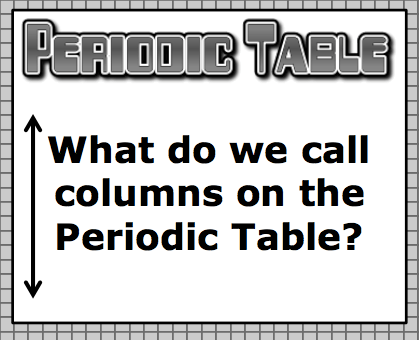
a)
Periods
b)
Groups
38.
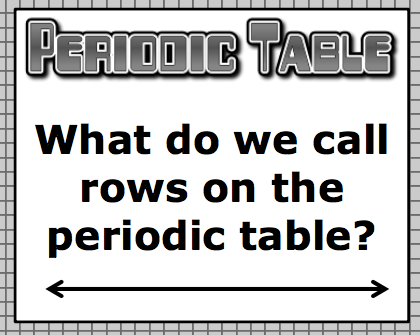
a)
Periods
b)
Groups
39.

a)
energy levels
b)
valence electrons
c)
protons
d)
neutrons
40.
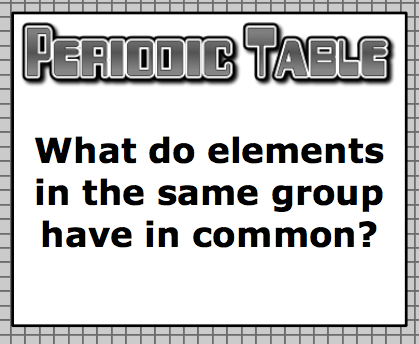
a)
energy levels
b)
valence electrons
c)
protons
d)
neutrons
41.
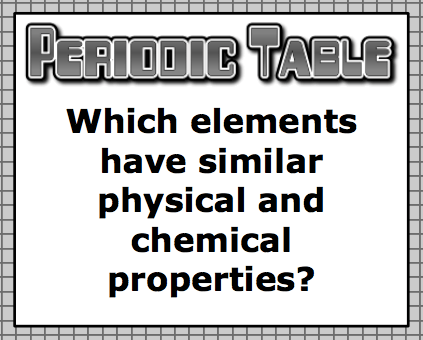
a)
Same group
b)
Same period
42.
a)
Group 1
b)
Group 17
c)
Group 2
d)
Group 18
43.

a)
Metals
b)
Nonmetals
44.
What is a PUSH or PULL of an object?
a)
Motion
b)
Force
c)
Friction
d)
Gravity
45.
Which force produces a change in motion?
a)
unbalanced force
b)
balanced force
c)
gravitational force
d)
frictional force
46.
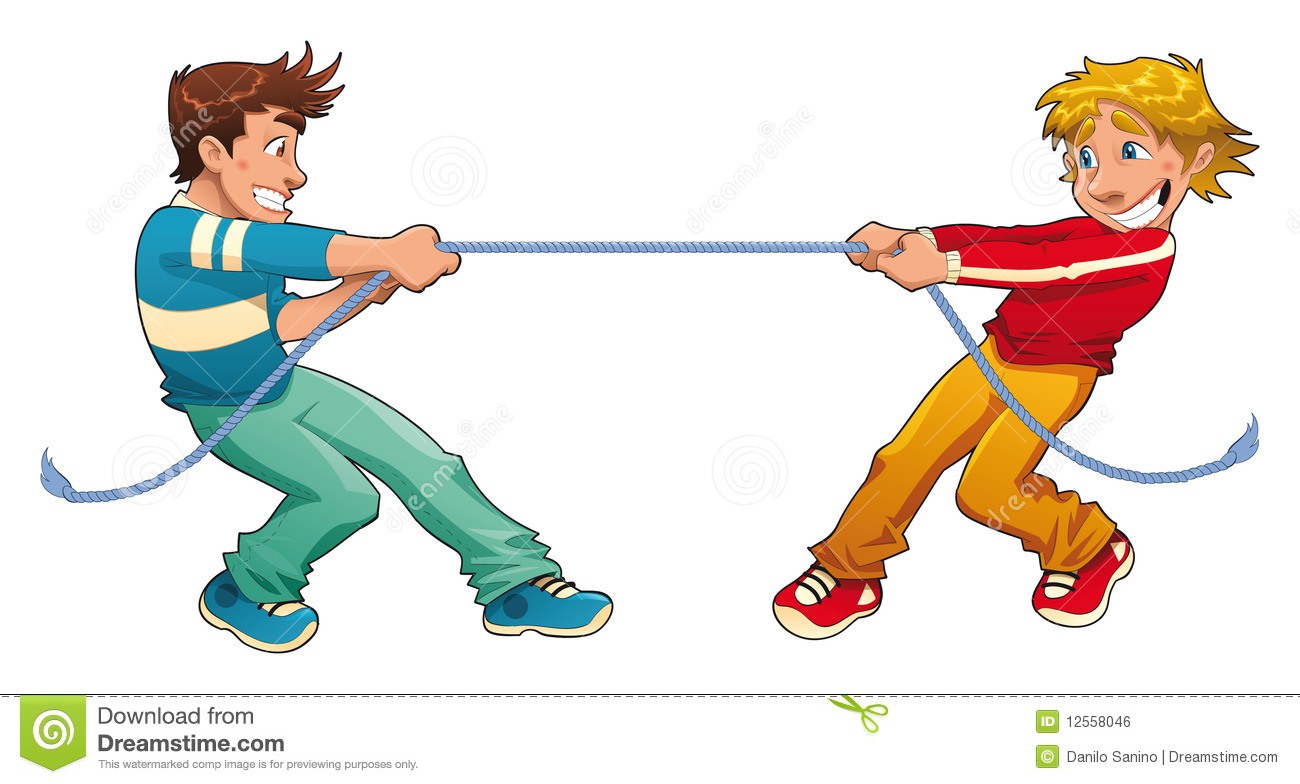
If these boys are pulling with the same amount of force. What will happen?
a)
The boy in blue will win.
b)
They will not move at all.
c)
The boy in red will win.
d)
Both will fall down.
47.
_______________ is how fast an object changes over time.
a)
speed
b)
velocity
c)
momentum
d)
acceleration
48.
What is the formula for force?
a)
F=M/A
b)
F=A/M
c)
F=M*A
d)
F=M*F
49.
What happens when two forces act in the same direction?
a)
They cancel each other out.
b)
The stronger one prevails.
c)
Their strengths are added.
d)
Their sum divided by the two is the total force.
50.
Any time the forces are unbalanced, an object will remain at rest. True or false?
a)
true
b)
false
51.
When you tell the direction and speed of an object, you give its
a)
motion
b)
velocity
c)
acceleration
d)
mass
52.
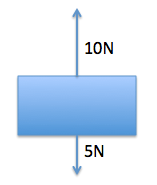
What is the net force on the block? (click on the words to view the picture)
a)
5 Newtons up
b)
5 Newtons down
c)
15 Newtons up
d)
15 Newtons down
53.
If a 10 kilogram object accelerates suddenly at 15 m/s2, how much force was applied to the object?
a)
150 Newtons
b)
15 Newtons
c)
150 kilograms
d)
100 kilograms
54.
A baseball is thrown a distance of 50 meters. What is the speed if it takes 2 seconds to cover that distance?
a)
100 m/s2
b)
25 m/s2
c)
52 m/s2
d)
100 seconds
55.
Which of the following objects has the least acceleration?
a)
a. an empty shopping cart pushed with a hard force
b)
b. a full shopping cart pushed with a hard force
c)
c. an empty shopping cart pushed with a light force
d)
d. a full shopping cart pushed with a light
force
56.
Speed is equal to
a)
Distance/Time
b)
Time/Distance
c)
Time x Distance
d)
Acceleration
57.
8 N to the left , and 4 N to the right. Find the net force. Is this balanced
a)
12 N Right No
b)
4 N Left No
c)
12 N Right Yes
d)
4 N Left Yes
58.
Number of H in 3(NH₄)₂CrO₄
a)
4
b)
2
c)
8
d)
24
59.
How many O's are in Al₂(SO₄)₃
a)
4
b)
12
c)
7
d)
24
60.
How many atoms of aluminum are on each side of the following equation: 4Al + 3O2 --> 2Al2 O3
a)
2
b)
6
c)
1
d)
4
61.
Element or compound?
H2O
H2O
a)
Element
b)
Compound
62.
Element or compound?
O2
O2
a)
Element
b)
Compound
63.
What is the number before a chemical formula called?
Ex: 2H2 + O2 --> 2H2O
Ex: 2H2 + O2 --> 2H2O
a)
Coefficient
b)
Subscript
c)
Atom
d)
Equation
64.
At the end of chemical reactions, what is the total mass of the reactants compared to the total mass of the products?
a)
the product is doubled
b)
the product is half the mass of the reactants
c)
the mass is the same
d)
the mass changes depending on the reaction
65.
In a ___________change, a substance changes into a different substance.
a)
Physical
b)
Chemical
66.

a copper penny turning greenish after a few years.
a)
Chemical Change
b)
Physical Change
67.
How many elements are in C6H12O6?
a)
1
b)
2
c)
3
d)
4
68.
The substances listed on the right side of a chemical equation are the
a)
Yields
b)
Reactants
c)
Products
d)
Precipitates
69.
Which is the Law of Conservation of Matter?
a)
matter cannot be created or destroyed, it only changes form
b)
matter can be created but it cannot be destroyed, it never changes form
c)
matter can be destroyed but it cannot be created, it usually just changes form
d)
matter is an unproven theory created by Hans Geiger
70.
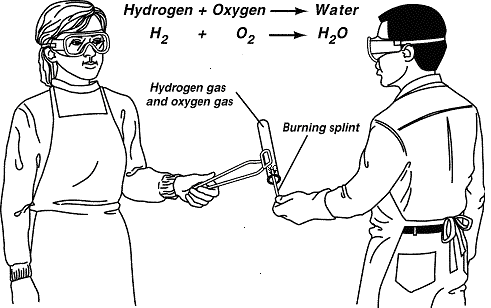
Identify the reactant(s) and product(s) of the reaction.
a)
All three are reactants and none are products.
b)
Hydrogen and water are the reactants, and oxygen is the product.
c)
Water and oxygen are the reactants, and hydrogen is the product.
d)
Hydrogen and oxygen are the reactants, and water is the product.
71.
What is the left part of a chemical equation called...
H2 + O --> H2O
H2 + O --> H2O
a)
Reactants
b)
Products
c)
Yields
d)
Chemical Equation
72.
What is the arrow in a chemical equation...
H2 + O --> H2O
H2 + O --> H2O
a)
Reactants
b)
Products
c)
Yields
d)
Chemical Equation
73.
What law is best described by inertia?
a)
1st
b)
2nd
c)
3rd
74.

a)
1st
b)
2nd
c)
3rd
75.

a)
1st
b)
2nd
c)
3rd
76.

a)
1st
b)
2nd
c)
3rd
77.
Object at rest stays at rest.
a)
1st
b)
2nd
c)
3rd
78.
Acceleration is due to a force put on an objects mass.
a)
1st
b)
2nd
c)
3rd
79.
Action/Reaction
a)
1st
b)
2nd
c)
3rd
80.
Equal and Opposite
a)
1st
b)
2nd
c)
3rd
100 %

